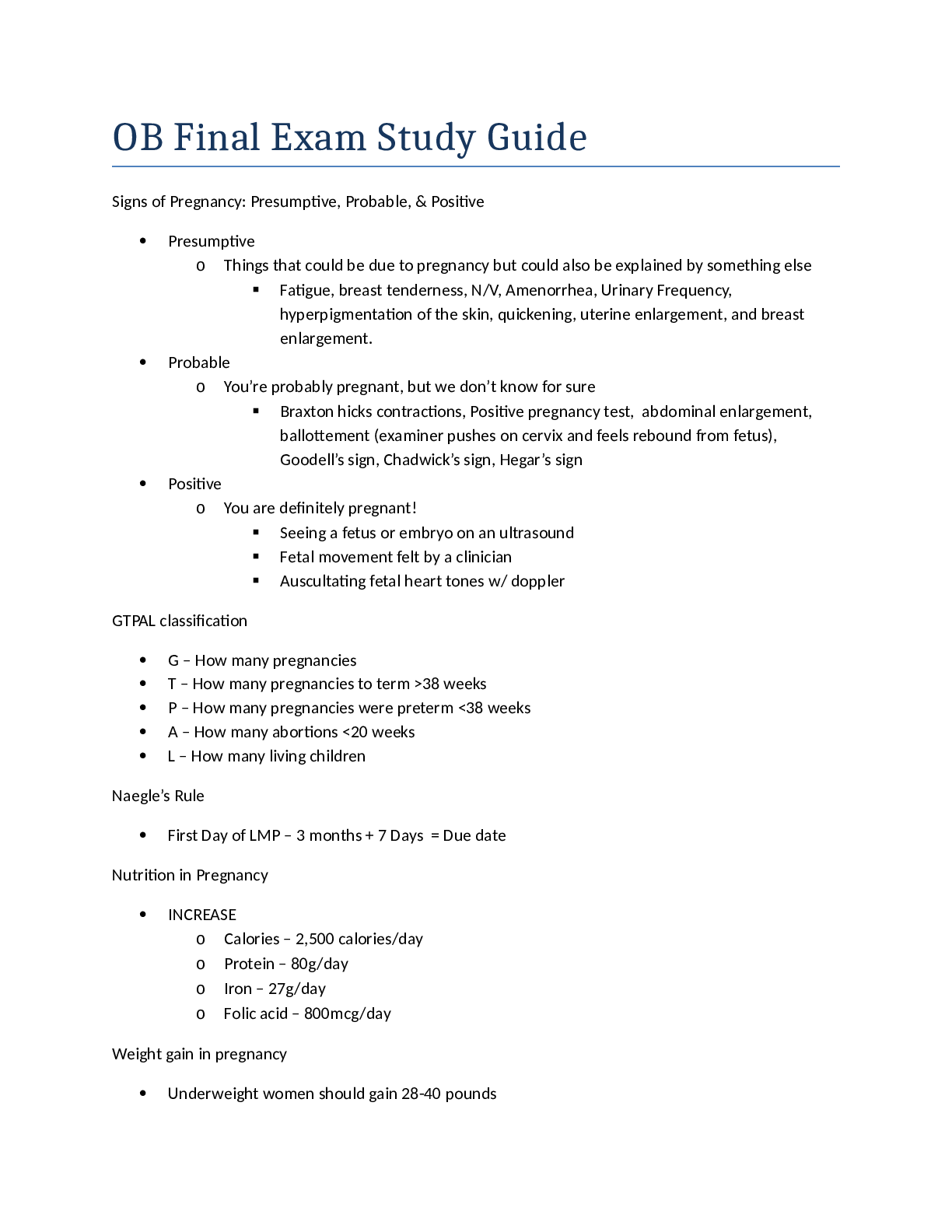
OB Final Exam Study Guide
Signs of Pregnancy: Presumptive, Probable, & Positive
Presumptive
o Things that could be due to pregnancy but could also be explained by something else
Fatigue, breast tenderness, N/V, A
...
OB Final Exam Study Guide
Signs of Pregnancy: Presumptive, Probable, & Positive
Presumptive
o Things that could be due to pregnancy but could also be explained by something else
Fatigue, breast tenderness, N/V, Amenorrhea, Urinary Frequency,
hyperpigmentation of the skin, quickening, uterine enlargement, and breast
enlargement.
Probable
o You’re probably pregnant, but we don’t know for sure
Braxton hicks contractions, Positive pregnancy test, abdominal enlargement,
ballottement (examiner pushes on cervix and feels rebound from fetus),
Goodell’s sign, Chadwick’s sign, Hegar’s sign
Positive
o You are definitely pregnant!
Seeing a fetus or embryo on an ultrasound
Fetal movement felt by a clinician
Auscultating fetal heart tones w/ doppler
GTPAL classification
G – How many pregnancies
T – How many pregnancies to term >38 weeks
P – How many pregnancies were preterm <38 weeks
A – How many abortions <20 weeks
L – How many living children
Naegle’s Rule
First Day of LMP – 3 months + 7 Days = Due date
Nutrition in Pregnancy
INCREASE
o Calories – 2,500 calories/day
o Protein – 80g/day
o Iron – 27g/day
o Folic acid – 800mcg/day
Weight gain in pregnancy
Underweight women should gain 28-40 pounds
o 5 lbs in the 1st trimester
o Then 1.2 lbs per week
Normal weight women should gain 25-35 pounds
o 3.5-5 lbs in the first trimester
o Then ~1lb per week
Overweight women should gain 15-25 pounds
o 2 lbs in first trimester
o Then 2/3 lb per week
Obese women should gain no more than 15 pounds
Exercise in pregnancy
Exercise during pregnancy is encouraged but the intensity and duration should be modified
Contraindicated in preterm labor, poor weight gain, anemia, face and hand edema, pain,
hypertension, threatened abortion, dizziness, SOB, multiple gestation, decreased fetal activity,
cardiac disease and palpitations
150 minutes of moderate intensity exercise per week
Helps return the woman’s body to normal after pregnancy
Low-impact aerobic exercises with stretching before and after
Never exercise to the point of exhaustion
Danger/warning signs of pregnancy
First trimester
o Spotting or bleeding, painful urination, severe persistent vomiting, lower abdominal pain
with dizziness and shoulder pain.
Second Trimester
o Regular uterine contractions, pain in calf, often increased with foot flexion, sudden gush
or leakage of fluid from the vagina, and absence of fetal movement for more than 12
hours
Third Trimester
o Sudden weight gain, periorbital or facial edema, severe abdominal pain, headache w/
visual changes, decrease in fetal daily movement for more than 24 hours.
Common discomforts of pregnancy
First Trimester
o Urinary frequency or incontinence
Decrease fluids 2-3 hrs before bed, limit intake of caffeine, Kegel exercises,
empty bladder with first full sensation
o Fatigue
Get a full night’s sleep, healthy well-balanced diet, nap in the early afternoon,
rest when you feel tired.
o N/V
Avoid an empty stomach, eat dry crackers before getting out of bed, eat several
small meals throughout the day, avoid brushing teeth immediately after eating,
Acupressure wristbands, drink fluids between meals, avoid greasy, fried foods,
or foods with a strong odor.
o Breast tenderness
Wear a larger bra with good support even while she’s sleeping
o Constipation
Eat fresh or dried fruit with the skins on, whole grain cereal and breads, increase
physical activity, pelvic floor exercises, stretching exercises, and yoga daily, meals
at regular intervals, defecate at a certain time each day, use a Squatty Potty,
increase water intake, decrease refined carbs, warm fluids in the morning, avoid
large amounts of cheese.
o Nasal stuffiness, bleeding gums, and epistaxis
Increase fluids, use a humidifier in room at night, advise her to blow her nose
gently, one nostril at a time, avoid nasal decongestants and sprays. If her
nosebleed advise her to loosen clothing around her neck, tilt her head forward,
pinch nostrils for 10-15 minutes, and apply an ice pack to her nose. Advise her to
practice good oral hygiene, soft toothbrush and flossing daily, warm saline
mouth washes.
o Cravings
Watch out for Pica
o Leukorrhea
Keep perineal area clean and dry, wash with mild soap during shower, avoid
pantyhose or tight nylon clothes, encourage cotton underwear and the use of a
nightgown, avoid douching and tampon use.
Second Trimester
o Backache
Avoid standing or sitting for long periods, apply heating pad, put pillows behind
back when sitting, use proper body mechanics when lifting, avoid excessive
bending, lifting or walking without rest, wear supportive shoes, avoid heels,
maintain good posture.
o Leg Cramps
Elevate the legs above heart level, straighten both legs and flex feet toward your
body, taking additional calcium supplements
o Varicosities of the leg and vulva
Walking daily, elevate legs, avoid standing in one positions too long, avoid
constrictive knee-high stocking and socks, don’t cross legs when sitting, wear
support stockings for better circulation.
o Hemorrhoids
Establish a regular time to have a BM, avoid constipation and straining during
pooping, drink plenty of fluids and eat fiber rich foods, exercise, warm sitz bath
and cool witch hazel compresses.
o Flatulence with bloating
Avoid gas forming foods (beans, cabbage, and onions) and foods with high
amounts of white sugar, add more fiber, fluids, and exercise, avoid chewing gum,
get into the knee-chest position, reduce carbonated beverages and cheese,
eating mints.
Third Trimester
o SOB and Dyspnea
Adjust body position to allow maximum expansion of the chest, avoid large
meals, raise the HOB, lying on her left side, periodically stand up and reach her
arms over her head and take a deep breath, avoid overheating, rest after
exercise.
o Heartburn and Indigestion
Avoid spicy foods, eat small frequent meals, elevate head to 30 degrees while
sleeping, stop smoking, avoid caffeinated drinks, don’t lay down for 3 hours after
meals, drink sips of water, avoid foods that trigger symptoms, take antacids if
severe.
o Dependent Edema
Elevate feet and legs, wear support hose, change positions frequently, walk a
sensible pace, stop every 2 hours during long car rides to walk around, rock from
ball of foot to toes while standing, lie on left side, avoid foods high in sodium,
avoid knee-high support hose, adequate fluid intake, avoid sugar and fats
o Braxton Hicks contractions
Change position, engage in mild exercise, and drink more fluids.
Smoking in pregnancy
Preterm birth, fetal addiction to nicotine, and low birth weight is caused by smoking. Encourage
smoking cessation before or in early pregnancy.
Timing of Doctors appointments
For a normal pregnancy
o Every 4 weeks up to 28 weeks
o Every 2 weeks from 29-36 weeks
o Every week from 37 weeks to birth
Changes or things that happen in each trimester of pregnancy
Reproductive: uterus increase in size/ shape and position change
Cardiovascular: CO/BV increase, HR increase @5 weeks peaks (10-15min pre-pregnancy) @32
weeks
Respiratory: Oxygen need increase/ lung capacity decrease
Musculoskeletal: weight increase/ pelvic joints relax
GI: N/V may occur/ constipation ( increase water intake
Renal: urine production same/ increase urinary frequency
Endo: Placenta become endocrine organ produces hormones
Ambivalence: unsure/ conflicting feelings
Acceptance: readiness
Emotional liability: frequent changes in motional state
Body image changes:
o First semester: waiting on baby bump
o Second semester: rapid physical changes (belly/ breast ) skin changes, mobility decrease,
tired
Relationship with fetus: daydream
Vital Signs:
o BP: normal first trimester/ 24-32 weeks diastolic decreases
Complication: Maternal hypotension
o Pulse: increase 10-15/ min @ 32 weeks
o RR: some SOB/ rate does not change for the most part
Expected Findings:
o FHR 110-160 with accelerations notes
o Heart sounds change/murmurs possibility – change after delivery
o Uterine size 50-1000 (0.1 to 2.2 lbs) @ 36 weeks fundus reach xiphoid process
o Cervical changes (purplish-blue color into the vaginal)
o Breast changes
o Skin changes
Chloasma: face
Linea nigra: dark line on belly
Striae gravidarum: stretch mark
Lightening
Fetal descent into the pelvis
Happens typically by 40 weeks
For first time mothers it occurs 2 weeks prior to the onset of labor
For multipara mothers it occurs at the onset of labor
Quickening
feelings of the baby moving
occurs in 16 - 20 weeks
Engagement and station
Station is the centimeters of the presenting art in relation to the ischial spines
-2, -1, 0, 1, 2
0 Station = Engagement
o Typically happens in primigravida’s 2 weeks before term
o Multiparas may experience several weeks before onset of labor or not until labor begins
Diagnostic tests such as: NST, BPP, CST
Nonstress Test: NST
o Provides an indirect measurement of uteroplacental function
o NST is recommended twice weekly after 28 weeks for clients with diabetes, IUGR,
preeclampsia, post-term pregnancy, renal disease, and multifetal pregnancies.
o Prior to the procedure the client eats a meal to stimulate fetal movement
o Women should empty her bladder and sit in a semi fowler’s position.
o For the test to be reactive there must be at least two fetal heart rate accelerations
15bpm above baseline for 15 minutes within a 20-minute period
o If no accelerations are detected the test is extended for another 20 minutes
o If still not accelerations, then the mother is sent for a BPP
Biophysical Profile (BPP)
o Assessment of various parameters of fetal well-being
o The biophysical profile looks at fetal body movements, fetal tone, fetal breathing,
amniotic fluid, NST
o Each worth 2 points
o 10 points possible, a score of 8 or higher is considered normal
Contraction Stress Test (CST)
o Women lightly brushing her palm across her nipple for 2 mins causing pituitary gland to
release oxytocin, then stopping nipple stimulation when contraction begins
Repeat after 5 min rest period
See how fetal responds to contraction to determine tolerate stress labor
Pattern with at least 3 contraction within 10 minutes duration of 40-60
seconds
Contraction longer 90 seconds/5+ contraction avoid nipple stimulation
True vs false labor
True labor is indicated by cervical change. The contraction are regulars and get progressively
stronger. The pain is felt in the back and radiates to the front of the abdomen. They continue
regardless of position change and are worsened by physical activity such as walking.
False labor is indicated by irregular uterine contractions that do not progressively get stronger
and are felt in the abdomen. They do not produce cervical change. These contractions may be
weakened by walking or changing positions.
[Show More]







.png)
.png)

