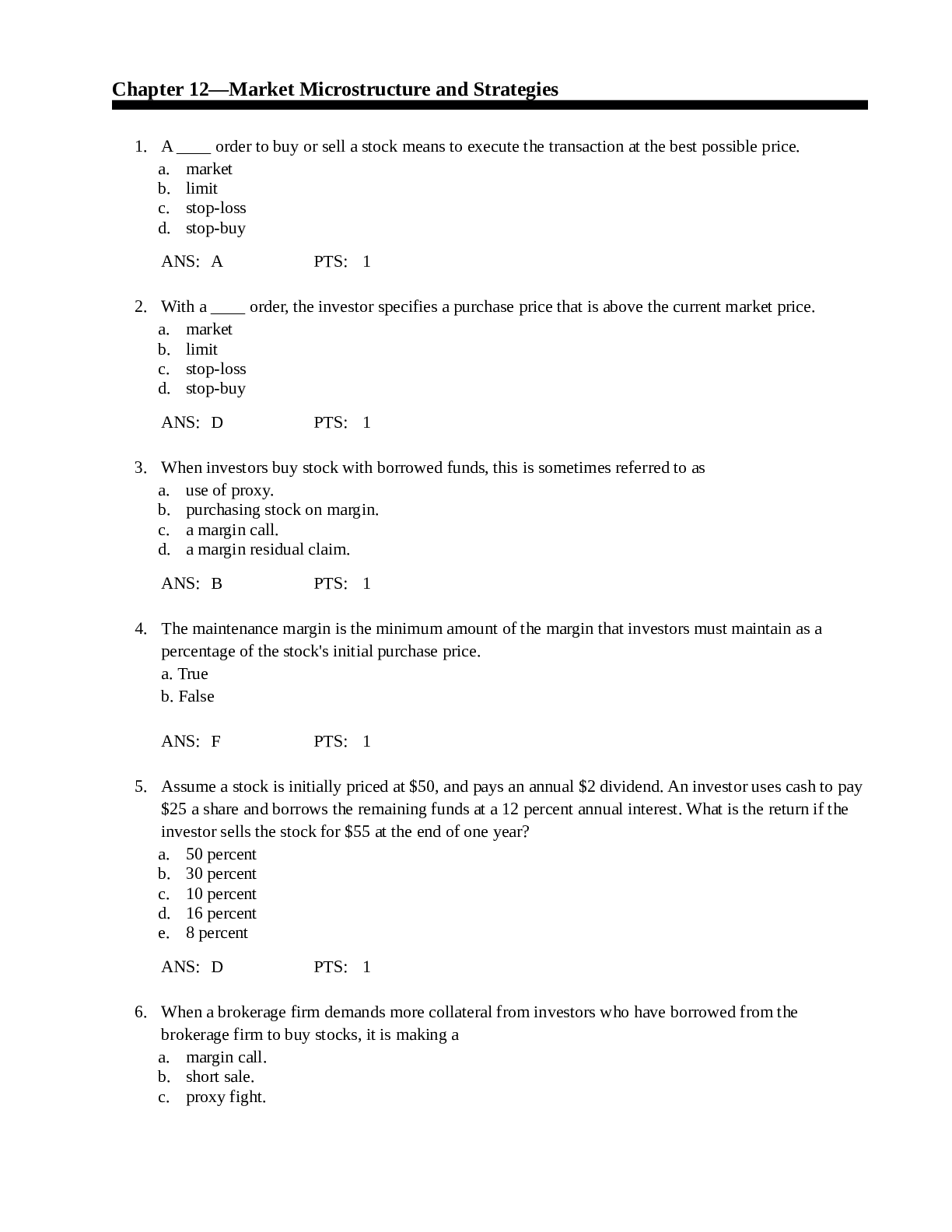
1. A ____ order to buy or sell a stock means to execute the transaction at the best possible price.
a. market
b. limit
c. stop-loss
d. stop-buy
ANS: A PTS: 1
2. With a ____ order, the investor specifies a purchase
...
1. A ____ order to buy or sell a stock means to execute the transaction at the best possible price.
a. market
b. limit
c. stop-loss
d. stop-buy
ANS: A PTS: 1
2. With a ____ order, the investor specifies a purchase price that is above the current market price.
a. market
b. limit
c. stop-loss
d. stop-buy
ANS: D PTS: 1
3. When investors buy stock with borrowed funds, this is sometimes referred to as
a. use of proxy.
b. purchasing stock on margin.
c. a margin call.
d. a margin residual claim.
ANS: B PTS: 1
4. The maintenance margin is the minimum amount of the margin that investors must maintain as a
percentage of the stock's initial purchase price.
a. True
b. False
ANS: F PTS: 1
5. Assume a stock is initially priced at $50, and pays an annual $2 dividend. An investor uses cash to pay
$25 a share and borrows the remaining funds at a 12 percent annual interest. What is the return if the
investor sells the stock for $55 at the end of one year?
a. 50 percent
b. 30 percent
c. 10 percent
d. 16 percent
e. 8 percent
ANS: D PTS: 1
6. When a brokerage firm demands more collateral from investors who have borrowed from the
brokerage firm to buy stocks, it is making a
a. margin call.
b. short sale.
c. proxy fight.d. hedge.
ANS: A PTS: 1
7. Which of the following statements is incorrect?
a. In a short sale, investors place an order to sell a stock that they do not own.
b. Investors sell a stock short when they anticipate that its price will rise.
c. When investors sell short, they will ultimately have to provide the stock back to the
investor from whom they borrowed it.
d. Short-sellers must make payments to the investor from whom the stock was borrowed to
cover the dividend payments that the investor would have received of the stock had not
been borrowed.
ANS: B PTS: 1
8. Program trading
a. is commonly used to reduce the susceptibility of a stock portfolio to stock market
movements.
b. may involve the purchase of stocks that become "underpriced."
c. may involve the sale of stocks that become "overpriced."
d. can be combined with the trading of individual bonds to create portfolio insurance.
e. none of the above
ANS: A PTS: 1
9. You purchase a stock with cash, and you earn a negative return on the stock. If you had purchased the
stock with 60 percent cash and 40 percent borrowed funds, your return on your investment would have
been
a. positive.
b. more negative than if you had covered the entire investment with cash.
c. negative, but more favorable than if you had covered the entire investment with cash.
d. zero.
ANS: B PTS: 1
10. Mark would like to purchase a stock priced at $70. Mark thinks he can sell the stock for $100 after one
year. If Mark does not borrow any money from his brokerage firm, what is the estimated return on the
stock?
a. 30.00 percent
b. 42.86 percent
c. 30.00 percent
d. 42.86 percent
e. none of the above
ANS: D PTS: 111. Mark would like to purchase a stock priced at $70. The stock is not expected to pay any dividends in
the coming year. Mark can either put up the entire amount and purchase the stock, or borrow half of
the investment amount from his brokerage firm at an annual interest rate of 12 percent and put up the
remainder. Mark thinks he can sell the stock for $100 after one year. If Mark borrows from his
brokerage firm, his estimated return on the stock would be ____ percent.
a. 42.86
b. 85.71
c. 73.71
d. 30.00
ANS: C PTS: 1
12. Karen just purchased a stock costing $33 on margin, paying $23 and borrowing the remainder from a
brokerage firm at 15 percent annual interest. The stock pays an annual dividend of $2. If Karen sells
the stock after one year at a price of $50, what is the return on the stock?
a. 27.60 percent
b. 82.61 percent
c. 76.09 percent
d. 58.70 percent
e. none of the above
ANS: C PTS: 1
13. The present margin requirement is that at least ____ percent of an investor's invested funds must be
paid in cash.
a. 20
b. 30
c. 40
d. 50
e. none of the above
ANS: D PTS: 1
14. An investor sold a stock short a year ago for $50 per share. The stock's price is currently $52 per share.
If the investor is unwilling to accept a loss on the short sale of more than $5 per share on the
transaction, she could place a
a. stop-loss order with a specified selling price of $55 per share.
b. stop-buy order with a specified purchase price of $55 per share.
c. stop-loss order with a specified selling price of $45 per share.
d. stop-buy order with a specified purchase price of $45 per share.
ANS: B PTS: 1
15. The short interest ratio is commonly measured as the number of shares shorted divided by the number
of shares that the firm has repurchased in the last quarter.
a. True
b. False
ANS: F PTS: 116. Investors can reduce their risk by purchasing a stock on margin instead of using all cash to buy the
stock.
a. True
b. False
ANS: F PTS: 1
17. A short seller
a. anticipates that the price of the stock sold short will increase.
b. earns the difference between what they initially paid for the stock versus what they later
sell the stock for.
c. makes a profit equal to the difference between the original sell price and the price paid for
the stock, after subtracting any dividend payments made.
d. is essentially lending the stock to another investor and will ultimately receive that stock
back from that investor.
e. none of the above
ANS: C PTS: 1
18. ____ are enforced to restrict the amount of credit extended to customers by stockbrokers.
a. Limit orders
b. Margin requirements
c. Maintenance margins
d. Initial margins
ANS: B PTS: 1
[Show More]