Question:
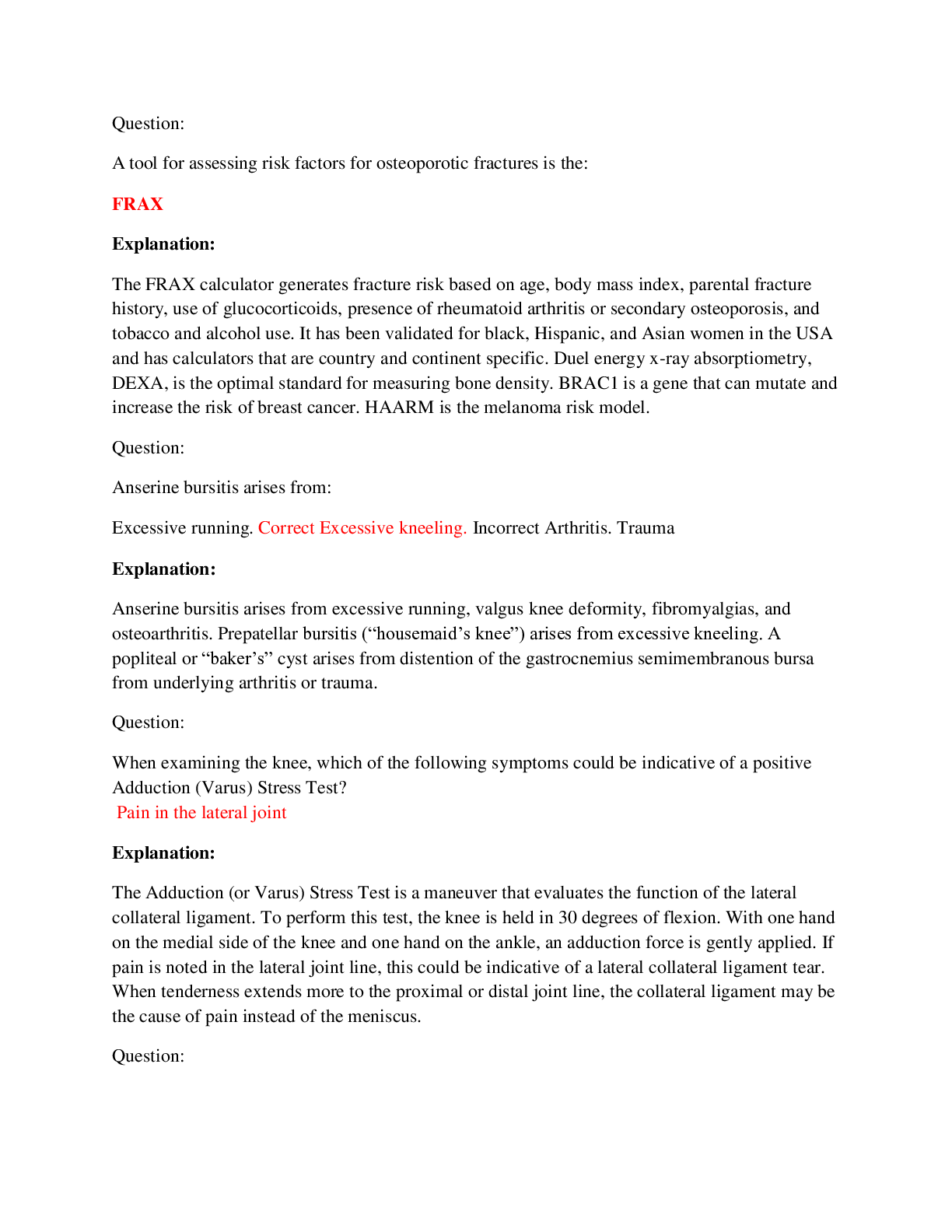
Anserine bursitis arises from:
excessive running. Correctexcessive kneeling. Incorrectarthritis.trauma Explanation:
Anserine bursitis arises from excessive running, valgus knee deformity, fibromyalgias,
...
Question:
Anserine bursitis arises from:
excessive running. Correctexcessive kneeling. Incorrectarthritis.trauma Explanation:
Anserine bursitis arises from excessive running, valgus knee deformity, fibromyalgias, and osteoarthritis. Prepatellar bursitis (“housemaid’s knee”) arises from excessive kneeling. A popliteal or “baker’s” cyst arises from distention of the gastrocnemius semimembranous bursa from underlying arthritis or trauma.
Question:
When examining the knee, which of the following symptoms could be indicative of a positive Adduction (Varus) Stress Test?
Pain in the lateral joint Explanation:
The Adduction (or Varus) Stress Test is a maneuver that evaluates the function of the lateral collateral ligament. To perform this test, the knee is held in 30 degrees of flexion. With one hand on the medial side of the knee and one hand on the ankle, an adduction force is gently applied. If pain is noted in the lateral joint line, this could be indicative of a lateral collateral ligament tear. When tenderness extends more to the proximal or distal joint line, the collateral ligament may be the cause of pain instead of the meniscus.
Question:
When assessing the knee, the examiner instructs the patient to straighten his knee. This motion would assess knee:
Extension Explanation:
Having the patient straighten his leg assesses extension of the knee. The examiner instructs the patient to bend his knee. This maneuver assesses knee flexion. Internal rotation of the knee could be elicited by having the patient swing his lower leg toward the midline while sitting. Instructing the patient to swing his leg away from his midline while sitting assesses external rotation of the knee.
Question:
When performing an examination of a tender left finger on an adult, the surrounding tissue reveals warmth, edema, and redness. This finding could be suggestive of:
gouty arthritis Explanation:
Redness, warmth, and edema over a tender joint suggest septic or gouty arthritis infection, or possibly rheumatoid arthritis.
Question:
An example of a fibrous joint would be the:
Skull Explanation:
The skull is an example of the fibrous joint. Examples of synovial joints include the shoulder, knee, hip, wrist, distal radioulnar, elbow, and carpals. Vertebral bodies of the spine and the pubic symphysis of the pelvis are examples of cartilaginous joints.
Question:
To palpate the medial meniscus, slightly internally rotate the tibia and palpate the medial soft tissue along the:
upper edge of the tibial plateau Explanation:
To palpate the medial meniscus, slightly internally rotate the tibia and palpate the medial soft tissue along the upper edge of the tibial plateau. The lateral meniscus is palpated on the lateral joint line by placing the patient's knee in slight flexion. To palpate the tibiofemoral joint, face the patient's knee and place the thumbs in the soft-tissue depressions on either side of the patellar tendon.
[Show More]