1.
In which of the following ways can the nurse promote the sense of taste foran
older adult?
a. Mix foods together on the dinner tray
b. Avoid cologne, air fresheners, or room deodorizers
c. Encourage the client to
...
1.
In which of the following ways can the nurse promote the sense of taste foran
older adult?
a. Mix foods together on the dinner tray
b. Avoid cologne, air fresheners, or room deodorizers
c. Encourage the client to chew food thoroughly
d. Discourage the use of salt or seasonings with prepared food
ANSWER C: As clients age, their sense of taste may diminish, reducing the
Stuvia.com - The Marketplace to Buy and Sell your Study Material
joy that comes with eating. A nurse can promote the sense of taste for a client
by encouraging him to chew his food thoroughly while eating. This results in
longer contact of food with the taste buds and a greater chance of tasting the
food.
2.
Which of the following is classified as a prerenal condition that affectsurinary
elimination?
a. Nephrotoxic medications
b. Pericardial tamponade
c. Neurogenic bladder
d. Polycystic kidney disease
Stuvia.com - The Marketplace to Buy and Sell your Study Material
ANSWER B: A prerenal condition is that which causes reduced urinary
elimination due to a diminished blood flow to the kidneys. A condition such
as cardiac tamponade affects the heart's ability to pump adequate amounts of
blood, thereby reducing blood flow to vital organs throughout the body,
including the kidneys.
3.
A nurse is assessing an African American client for risks of a pressure ulcer. Which
of the following best describes what the nurse might find with an earlypressure
ulcer in this client?
a. Skin has a purple/bluish color
b. Capillary refill is 1 second
c. Skin appears blanched at the pressure site
d. Tenting appears when checking skin turgor
ANSWER A: When assessing for signs of developing pressure ulcers in a
client with dark skin, decreased circulation may not always be readily
apparent. For instance, blanching, the red undertones seen in light-skinned
clients, will not always be present. Instead, the skin of an early pressure ulcer
may develop a purple or bluish color.
4.
A term used to refer to generalized wasting of body tissues and malnutrition
is called:
a. Entropion
b. Confabulation
c. Induration
d. Cachexia
Stuvia.com - The Marketplace to Buy and Sell your Study Material
ANSWER D: Cachexia is a term used to describe the generalized wasting of
body tissues, ill health, and malnutrition that is associated with some chronic
diseases. Cachexia involves a loss of fat tissue to protect the bones and joints.
Clients with cachexia are at risk of pressure ulcers in addition to complications
associated with malnutrition and poor health.
5.
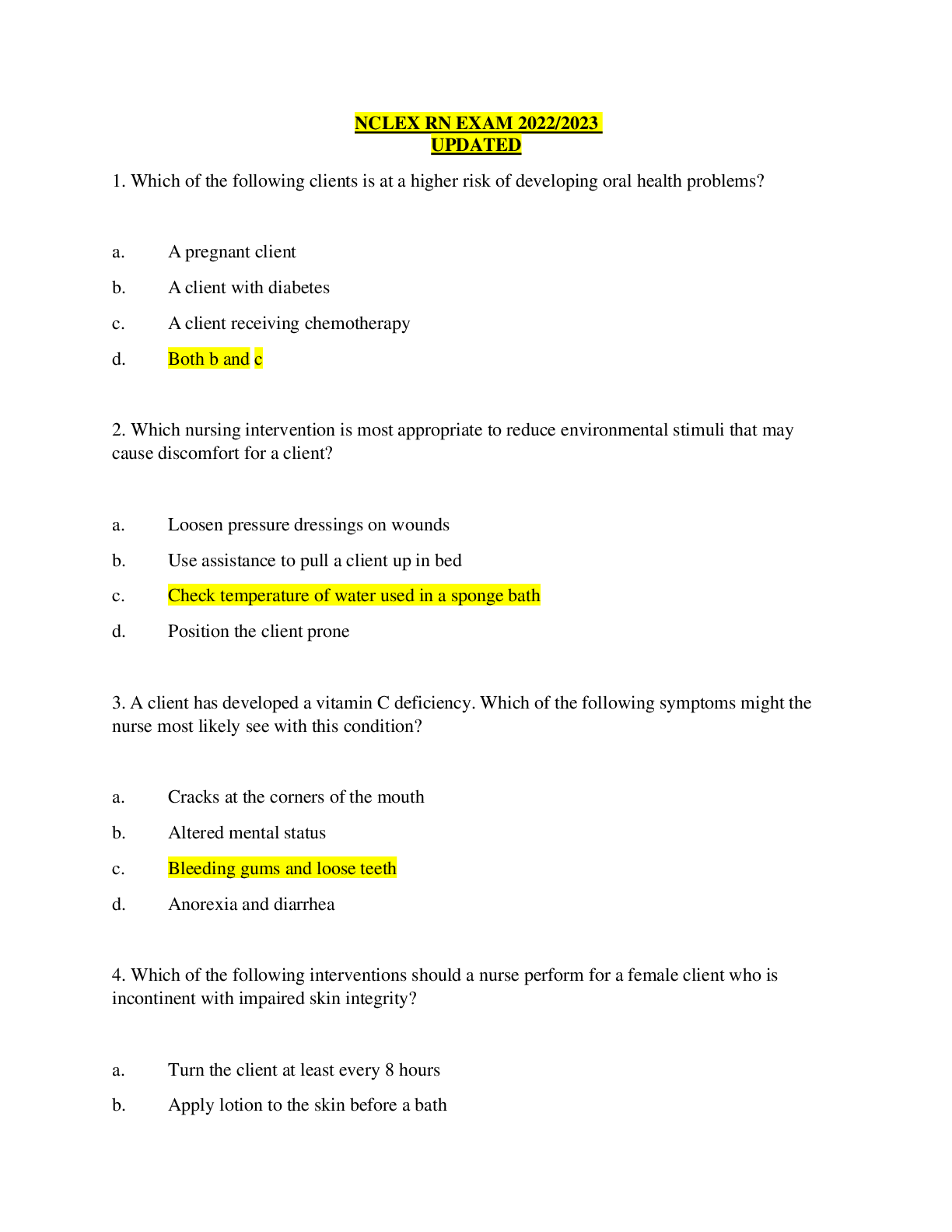
Which of the following clients is at a higher risk of developing oral health
problems?
a. A pregnant client
b. A client with diabetes
c. A client receiving chemotherapy
d. Both b and c
ANSWER D: Some clients are at higher risk of developing oral health
problems due to changes in the mouth associated with certain diseases, or an
inability to provide proper self care and oral hygiene. Diabetic clients may be
more likely to develop periodontal disease, gingivitis, or mouth dryness.
Clients receiving chemotherapy may have mouth ulcers or gingivitis, leading
to further pain and infection.
6.
Which nursing intervention is most appropriate to reduce environmental
stimuli that may cause discomfort for a client?
a. Loosen pressure dressings on wounds
b. Use assistance to pull a client up in bed
c. Check temperature of water used in a sponge bath
Stuvia.com - The Marketplace to Buy and Sell your Study Material
d. Position the client prone
ANSWER C: A nurse can reduce environmental stimuli that can cause
discomfort for a client through several interventions. When giving a sponge
bath, the nurse can check the temperature of the bath water to ensure it is not
too hot to avoid burns, nor too cold, to avoid causing discomfort. Other
measures the nurse can perform include lifting clients rather than pulling them
up in bed, changing wet dressings, and providing proper positioning while in
bed.
7.
A client has developed a vitamin C deficiency. Which of the following
symptoms might the nurse most likely see with this condition?
a. Cracks at the corners of the mouth
b. Altered mental status
c. Bleeding gums and loose teeth
d. Anorexia and diarrhea
ANSWER C: A client with a severe vitamin C deficiency has a condition
called scurvy. Clients with scurvy are most likely to develop bleeding gums,
loose teeth, poor wound healing, and easy bruising.
8.
Which of the following interventionsshould a nurse perform for a femaleclient
who is incontinent with impaired skin integrity?
a. Turn the client at least every 8 hours
b. Apply lotion to the skin before a bath
Stuvia.com - The Marketplace to Buy and Sell your Study Material
c. Provide perineal care after the client uses the bathroom
d. Bathe the client every 3 days
ANSWER C: A nurse can help protect the skin integrity of some clients,
especially female clients who are incontinent, by performing cares that keep
the skin clean and dry. Providing perineal care after the client uses the
bathroom promotes good skin integrity by removing excess secretions that
could cause odor and infection.
9.
A client has fallen asleep in his bed in the hospital. His heart rate is 65 bpm,
his muscles are relaxed, and he is difficult to arouse. Which stage of the sleep
cycle is this client experiencing?
a. Stage 1
b. Stage 2
c. Stage 3
d. Stage 4
ANSWER C: A client in stage 3 of the sleep cycle has moved into deeper
stages of sleep and is more difficult to arouse. The client may have relaxed
muscles, a decrease in vital signs, and may lie very still. Stage 3 of sleep is a
type of non-REM sleep in which the client progresses toward REM sleep and
vivid dreams.
10.
A nurse is assisting a client who uses an intraaural hearing aid. Once the aid
has been placed in the ear, it begins to whistle. What is the next action of the
nurse?
Stuvia.com - The Marketplace to Buy and Sell your Study Material
a. Try to reposition the hearing aid
b. Change the batteries
c. Remove the device and have it cleaned
d. Notify the physician that the hearing aid is not working
ANSWER A: An intraaural hearing aid, sometimes called an in-the-ear
hearing aid, is one that is placed in the ear canal. When positioning the hearing
aid, a whistling sound indicates it may be positioned improperly. If whistling
sounds begin after placement, the nurse should try to reposition thehearing aid.
11.
A nurse is preparing to irrigate a client's indwelling catheter through a closed,
intermittent system. Which of the following steps must the nurse take as part
of this process?
a. Use sterile solution from the refrigerator
b. Position the client in the prone position
c. Clamp the catheter at the level above the injection port
d. Inject sterile solution through the injection port into the catheter
ANSWER D: When performing a closed intermittent system of catheter irrigation,
the nurse should draw up sterile solution that has been at room temperature using
sterile technique. The client should be positioned for easyaccess to the catheter site
and to assess the abdomen during the procedure.
After clamping the tubing below the level of the injection port and cleansing
the site, the nurse injects fluid into the port, which travels up the catheter to
irrigate the tubing and the bladder.
[Show More]