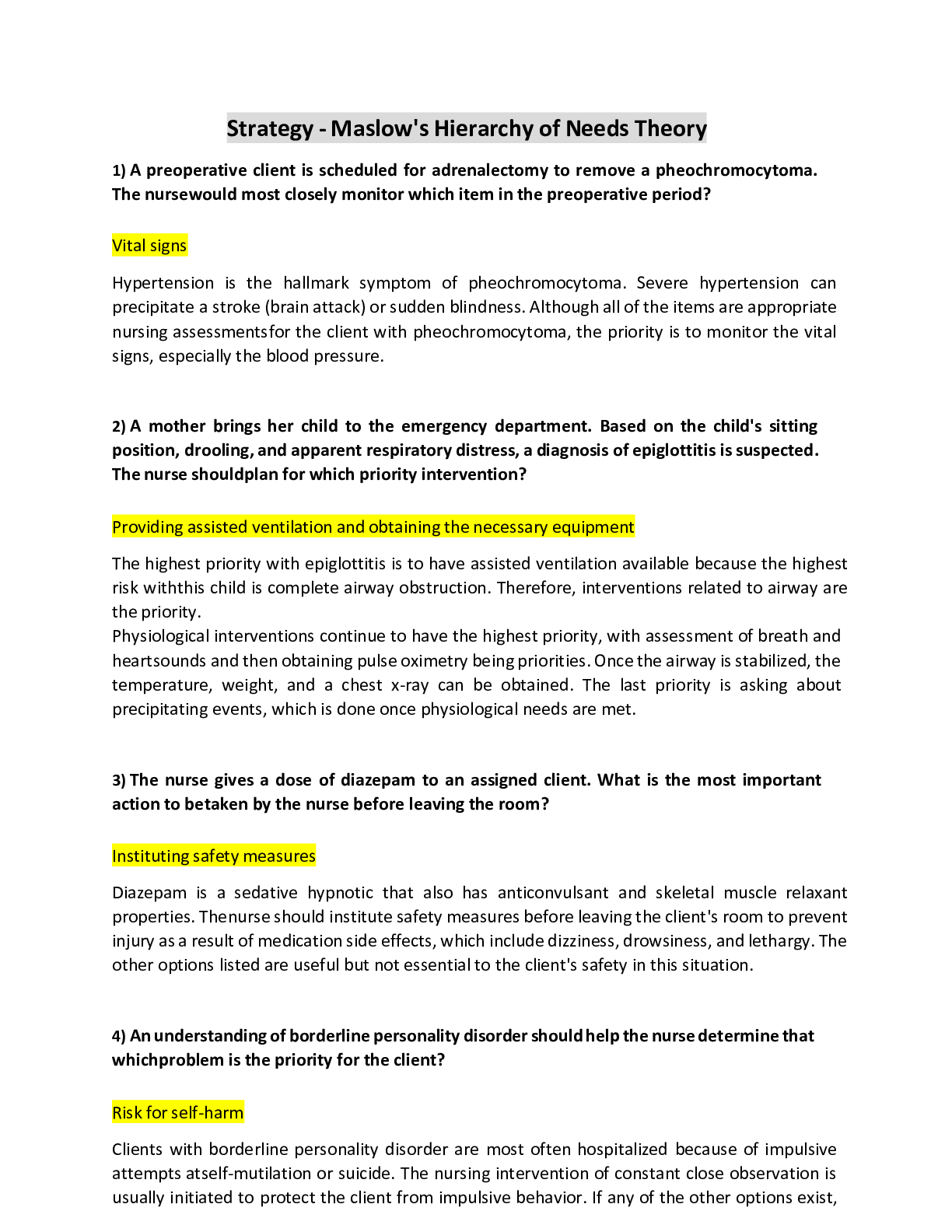
Strategy - Maslow's Hierarchy of Needs Theory
1) A preoperative client is scheduled for adrenalectomy to remove a pheochromocytoma.
The nursewould most closely monitor which item in the preoperative period?
Vitalsigns
...
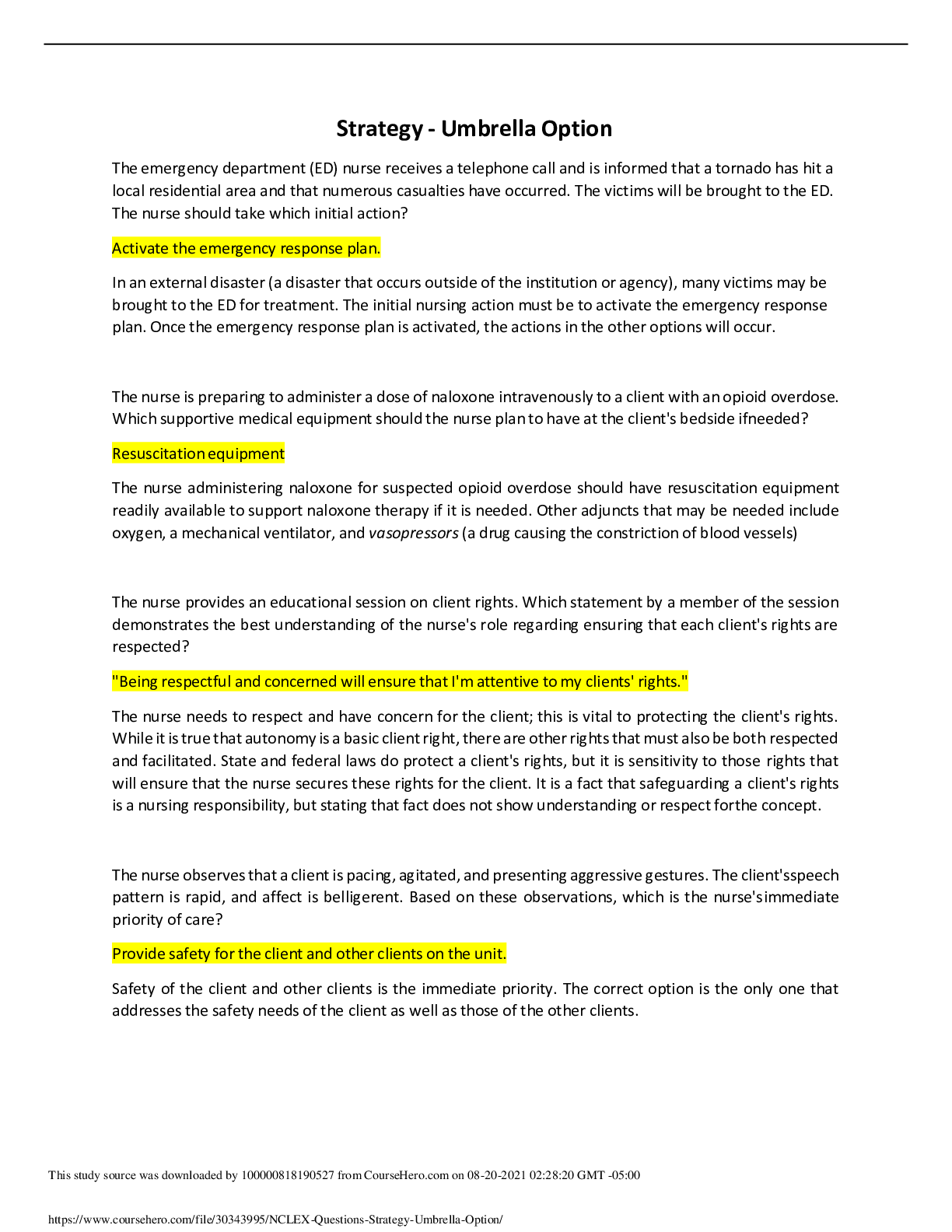
Strategy - Maslow's Hierarchy of Needs Theory
1) A preoperative client is scheduled for adrenalectomy to remove a pheochromocytoma.
The nursewould most closely monitor which item in the preoperative period?
Vitalsigns
Hypertension is the hallmark symptom of pheochromocytoma. Severe hypertension can
precipitate a stroke (brain attack) or sudden blindness. Although all of the items are appropriate
nursing assessmentsfor the client with pheochromocytoma, the priority is to monitor the vital
signs, especially the blood pressure.
2) A mother brings her child to the emergency department. Based on the child's sitting
position, drooling, and apparent respiratory distress, a diagnosis of epiglottitis is suspected.
The nurse shouldplan for which priority intervention?
Providing assisted ventilation and obtaining the necessary equipment
The highest priority with epiglottitis is to have assisted ventilation available because the highest
risk withthis child is complete airway obstruction. Therefore, interventions related to airway are
the priority.
Physiological interventions continue to have the highest priority, with assessment of breath and
heartsounds and then obtaining pulse oximetry being priorities. Once the airway is stabilized, the
temperature, weight, and a chest x-ray can be obtained. The last priority is asking about
precipitating events, which is done once physiological needs are met.
3) The nurse gives a dose of diazepam to an assigned client. What is the most important
action to betaken by the nurse before leaving the room?
Instituting safety measures
Diazepam is a sedative hypnotic that also has anticonvulsant and skeletal muscle relaxant
properties. Thenurse should institute safety measures before leaving the client's room to prevent
injury as a result of medication side effects, which include dizziness, drowsiness, and lethargy. The
other options listed are useful but not essential to the client's safety in this situation.
4) An understanding of borderline personality disordershould help the nurse determine that
whichproblem is the priority for the client?
Risk forself-harm
Clients with borderline personality disorder are most often hospitalized because of impulsive
attempts atself-mutilation or suicide. The nursing intervention of constant close observation is
usually initiated to protect the client from impulsive behavior. If any of the other options exist,
they are of lesser priority.
5) The nurse is planning care for a postpartum client who had a vaginal delivery 2 hours ago.
The clientrequired an episiotomy and has several hemorrhoids. What is the priority nursing
consideration for this client?
Client pain level
The priority nursing consideration for a client who delivered 2 hours ago and who has an
episiotomy andhemorrhoids is client pain level. Most clients have some degree of discomfort
during the immediate postpartum period. There are no data in the question that indicate
inadequate urinary output, the presence of client perception of body changes, and potential for
imbalanced body fluid volume.
6) A clinic nurse is performing an admission assessment on an African American client
scheduled for cataractremoval with intraocular lensimplantation. Which question should the
nurse avoid asking onthe initial assessment?
"Do you have any family problems?"
In the African American culture, it is considered to be intrusive to ask personal questions on the
initial contact or meeting. African Americans are highly verbal and express feelings openly to
family or friends,but what transpires within the family is viewed as private. The psychosocial
assessment would be of lowest priority during the initial admission assessment. Additionally,
because cardiovascular, renal, andgastrointestinal assessments are physiological, they are the
priority assessments.
7) The nurse is preparing to care for a client with immunodeficiency. The nurse should plan to
addresswhich problem as the priority?
Risk for infection
The client with immunodeficiency hasinadequate or no immune bodies and is atrisk forinfection.
Thepriority concern would be risk for infection. The question presents no data indicating that
the client is experiencing anxiety. Fatigue may be a problem and the client may need to be placed
on protective isolation, but these are not the priority problems for this client. Infection can be
life-threatening and is the priority.
8) A client recently admitted to the hospital in the manic phase of bipolar disorder is unkempt,
taking antipsychotic medications, and complaining of abdominal fullness and discomfort.
Which interventionaddresses the priority sign/symptom?
Encourage frequent fluid intake and a high-fiber diet.
Constipation is a common elimination problem with clients in a manic phase of bipolar disorder.
Constipation may occur as the result of a combination of factors, including taking antipsychotic
medications, suppressing the urge to defecate, and a decreased fluid intake as a result of the
manic activity level. The symptoms listed in the question in combination with antipsychotic
medications are indicators of constipation. A high-fiber diet and increased fluids can reduce
constipation.
9) A client arrives in the emergency department in a crisis state demonstrating signs of
profoundanxiety. What should the initial nursing assessment focus on?
The client's physical condition
The initial nursing assessment of a client in a crisis state isto evaluate the physical condition of the
client,the potential for self-harm, and the potential for harm to others. Once this has been
determined and appropriate interventions have been initiated, the nurse would then proceed
with the mental health interview that involves the remaining options.
10) The nurse is collecting data from an African American client scheduled for surgery. Which
questions would be most appropriate forthe nurse to ask on initial assessment? Select all that
apply.
"Do you ever experience chest pain?"
"Do you have any difficulty breathing?"
"Do you frequently have episodes of headache?"
In the African American culture, it is considered to be intrusive to ask personal questions on the
initial contact ormeeting. African Americans are highly verbal and expressfeelings openly to family
orfriends,but what transpires within the family is viewed as private. Psychosocial data are the least
priority duringthe initial data collection. Additionally, cardiovascular, neurological, and respiratory
data include physiological assessments that would be the priority.
11) The nurse has created a plan of care for a client experiencing dystocia and includes several
nursingactions in the plan of care. What is the priority nursing action?
Monitoring the fetal heart rate
Dystocia is difficult labor that is prolonged or more painful than expected. The priority is to
monitor the fetal heart rate. Although providing comfort measures, changing the client's
position frequently, and keeping the significant other informed of the progress of the labor are
components of the plan of care,the fetal status would be the priority.
12) During the assessment, whatisthe nurse's primary goalfor a confused and disoriented
clientdiagnosed with posttraumatic stress disorder?
Making the client feel safe
It is important to make a confused client feel safe. Explaining the unit rules and orienting the
client tothe unit are part of any admission process. Stabilizing psychiatric needs is a long-term
goal.
13) The nurse caring for a client with a diagnosis of acute schizophrenia should use which
approachwhen planning care?
Provide assistance with grooming and nutrition until the client's thinking has cleared.
In the acute phase, the nurse must assume responsibility for planning for the client's basic human
needs,such as nutrition, hygiene, sleep, and activities of daily living. As the nurse plans care for
the schizophrenic client, it is important to understand the client's developmental stage and ability
to accept the disease. The client lacks insight and may not be aware of the illness because of the
severe decompensation in thinking. Including the client in decision making at this point is
incorrect because these actions do not provide a structured routine. Repeatedly pointing out
inconsistencies is a nontherapeutic communication technique.
14) The nurse is preparing a plan of care for a client with diabetes mellitus who has
hyperglycemia.The nurse places priority on which client problem?
Inadequate fluid volume
An increased blood glucose level will cause the kidneys to excrete the glucose in the urine. This
glucose is accompanied by fluids and electrolytes, causing an osmotic diuresis leading to
dehydration. This fluid loss must be replaced when it becomes severe. Options 1, 3, and 4 are
not related specifically to the information in the question.
15) The nurse is conducting an admission assessment on an African American client
scheduled for ahernia repair. Which assessment data are of least importance during the
initial assessment?
Psychosocial assessment data
The psychosocial assessment is the least priority during the initial admission assessment. In the
AfricanAmerican culture, it is considered intrusive to ask personal questions on the initial contact
or meeting. Additionally, cardiovascular, neurological, and respiratory assessments include
physiological assessments, which would be the priority assessments.
16) A client with a history of panic disorder comesto the emergency department and states
to thenurse, "Please help me. Ithink I'm having a heart attack." What isthe priority nursing
action?
Assess the client's vitalsigns.
Clients with panic disorders experience acute physical symptoms, such as chest pain and
palpitations.The priority is to assess the client's physical condition to rule out a physiological
disorder. Therefore,options 2, 3, and 4 are not the priority.
17) The charge nurse is planning the assignment for the day. Which factors should the nurse
remainmindful of when planning the assignment? Select all that apply.
The acuity level of the clients
Client needs and workers' needs and abilities
There are guidelinesthat the nurse should use when delegating and planning assignments. These
includethe following: ensure client safety; be aware of individual variations in work abilities;
determine which tasks can be delegated and to whom; match the task to the delegatee on the
basis of the nurse practice act and appropriate position descriptions; provide directions that are
clear, concise, accurate, and complete; validate the delegatee's understanding of the directions;
communicate a feeling of confidence to the delegatee and provide feedback promptly after the
task is performed; and maintain continuity of care as much as possible when assigning client care.
Staff requests, convenience as in clustering client rooms, and anticipated changes in unit census
are not specific guidelines to use when delegating and planning assignments.
[Show More]