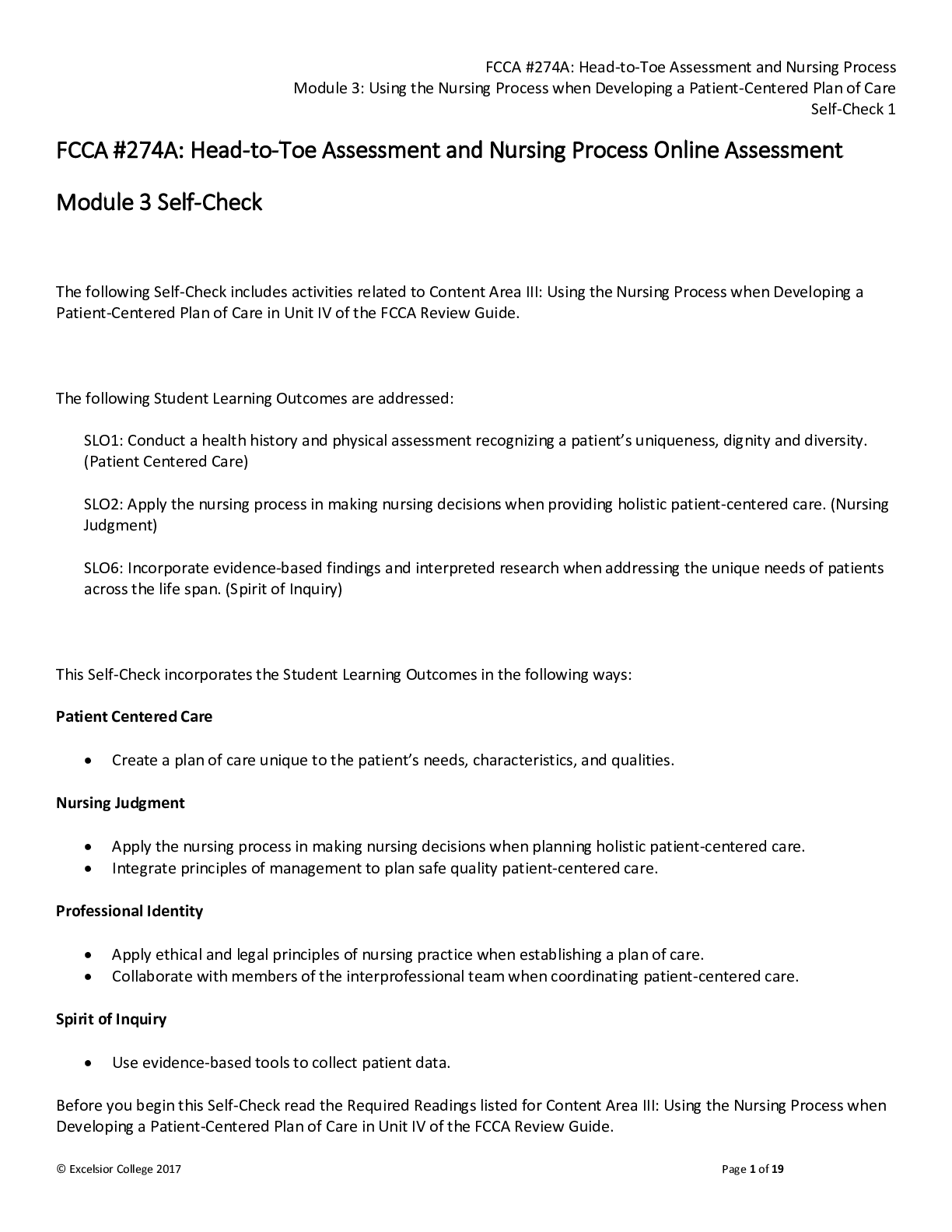
FCCA #274A: Head-to-Toe Assessment and Nursing Process Online Assessment
Module 3 Self-Check
The following Self-Check includes activities related to Content Area III: Using the Nursing Process when Developing a
Patien
...
FCCA #274A: Head-to-Toe Assessment and Nursing Process Online Assessment
Module 3 Self-Check
The following Self-Check includes activities related to Content Area III: Using the Nursing Process when Developing a
Patient-Centered Plan of Care in Unit IV of the FCCA Review Guide.
The following Student Learning Outcomes are addressed:
SLO1: Conduct a health history and physical assessment recognizing a patient’s uniqueness, dignity and diversity.
(Patient Centered Care)
SLO2: Apply the nursing process in making nursing decisions when providing holistic patient-centered care. (Nursing
Judgment)
SLO6: Incorporate evidence-based findings and interpreted research when addressing the unique needs of patients
across the life span. (Spirit of Inquiry)
This Self-Check incorporates the Student Learning Outcomes in the following ways:
Patient Centered Care
• Create a plan of care unique to the patient’s needs, characteristics, and qualities.
Nursing Judgment
• Apply the nursing process in making nursing decisions when planning holistic patient-centered care.
• Integrate principles of management to plan safe quality patient-centered care.
Professional Identity
• Apply ethical and legal principles of nursing practice when establishing a plan of care.
• Collaborate with members of the interprofessional team when coordinating patient-centered care.
Spirit of Inquiry
• Use evidence-based tools to collect patient data.
Before you begin this Self-Check read the Required Readings listed for Content Area III: Using the Nursing Process when
Developing a Patient-Centered Plan of Care in Unit IV of the FCCA Review Guide.
FCCA #274A: Head-to-Toe Assessment and Nursing Process
Module 3: Using the Nursing Process when Developing a Patient-Centered Plan of Care
Self-Check 1
© Excelsior College 2017 Page 2 of 19
This Self-Check contains 26 questions.
Please recognize that this Self-Check contains only a sampling of the content for this module.
The questions in this Self-Check will require you to refer to the Health History and Physical Assessment of your patient
Anna Mae Feinstein.
You may need to refer to the Morse Fall Scale.
Question 1
After conducting a health history, what cluster of data does the RN recognize as significant to Ms. Feinstein’s current
health problem? Select all that apply.
Refer to Mrs. Feinstein’s completed Health History.
Refer to Mrs. Feinstein’s completed Physical Assessment.
• Fell at home 2 weeks ago.
• Drinks a glass of wine weekly.
• Uses a seat walker to rest when walking.
• Feels lightheaded when quickly changing position.
• Has a health care agent.
The correct answers are:
Fell at home 2 weeks ago.
Uses a seat walker to rest when walking.
Feels lightheaded when quickly changing position.
Health history includes the patient’s reason for seeking health care and exploring the history of present concern.
A history of falling; using a seat walker to rest when walking and feeling lightheaded when changing positions are
significant cues that forms a cluster of data that predispose to the current reason for seeking medical attention.
Question 2
Analyze the findings of Ms. Feinstein health history and how they relate to the general risk factors associated with falls.
Refer to Mrs. Feinstein’s completed Health History.
Refer to Mrs. Feinstein’s completed Physical Assessment.
Risk Factors:
• Lack of regular exercise.
• Prescribed antihypertensive medication.
FCCA #274A: Head-to-Toe Assessment and Nursing Process
Module 3: Using the Nursing Process when Developing a Patient-Centered Plan of Care
Self-Check 1
© Excelsior College 2017 Page 3 of 19
• Verbal report of being unsteady.
• Use of scatter rugs in the home.
• Inadequate nutrition.
The correct answers are:
Risk Factor: Lack of regular exercise.
Health History Findings: Mrs. Feinstein reports regular exercise doing Tai Chi exercises. This is not a personal risk factor
for falls for Mrs. Feinstein.
Risk Factor: Prescribed antihypertensive medication
Health History Findings: Mrs. Feinstein takes lisinopril (Zestril) daily. This is a risk factor that pertains to Mrs. Feinstein.
Risk Factor: Verbal report of being unsteady
Health History Findings: Mrs. Feinstein reports feeling unsteady at times at home. This is a risk factor that pertains to
Mrs. Feinstein.
Risk Factor: Use of scatter rugs in the home
Health History Findings: Mrs. Feinstein reports that scatter rugs were removed from her home by her daughter. This is
not a personal risk factor for falls for Mrs. Feinstein.
Risk Factor: Inadequate nutrition
Health History Findings: Mrs. Feinstein reports no recent unexpected weight loss. She appears well nourished. This is not
a personal risk factor for falls for Mrs. Feinstein.
Question 3
Using the Morse Fall Scale, analyze the findings of Ms. Feinstein health history and how they relate to the general risk
factors associated with falls.
Refer to Mrs. Feinstein’s completed Health History.
Refer to Mrs. Feinstein’s completed Physical Assessment.
Refer to the Morse Fall Scale.
The correct answers are:
Item: History of falling: immediate or within three months
Correct Score: 25 Mrs. Feistein’s reason for admission was related to a fall at home.
Item: Secondary diagnosis
Correct Score: 15 Mrs. Feinstein has a history of hypertension.
Item: Ambulatory Aid
Correct Score: 15 Mrs. Feinstein uses a seat walker.
Item: IV/Heparin Lock
Correct Score: 20 Mrs. Feinstein has an intravenous for fluids and pain.
FCCA #274A: Head-to-Toe Assessment and Nursing Process
Module 3: Using the Nursing Process when Developing a Patient-Centered Plan of Care
Self-Check 1
© Excelsior College 2017 Page 4 of 19
Item: Gait/Transferring
Correct Score: 20 Mrs. Feinstein’s gait is impaired.
Item: Mental Status
Correct Score: 0 Mrs. Feinstein’s mental status “knows need to be careful”.
Total Score: 95
Risk Level: High Risk
Question 4
Which of Mrs. Feinstein’s patient data supports the need to collaborate with the dietitian?
Refer to Mrs. Feinstein’s completed Health History.
Refer to Mrs. Feinstein’s completed Physical Assessment.
[Show More]










.png)
.png)

