PATHOPHYS Module Exams
Module 1 Exam
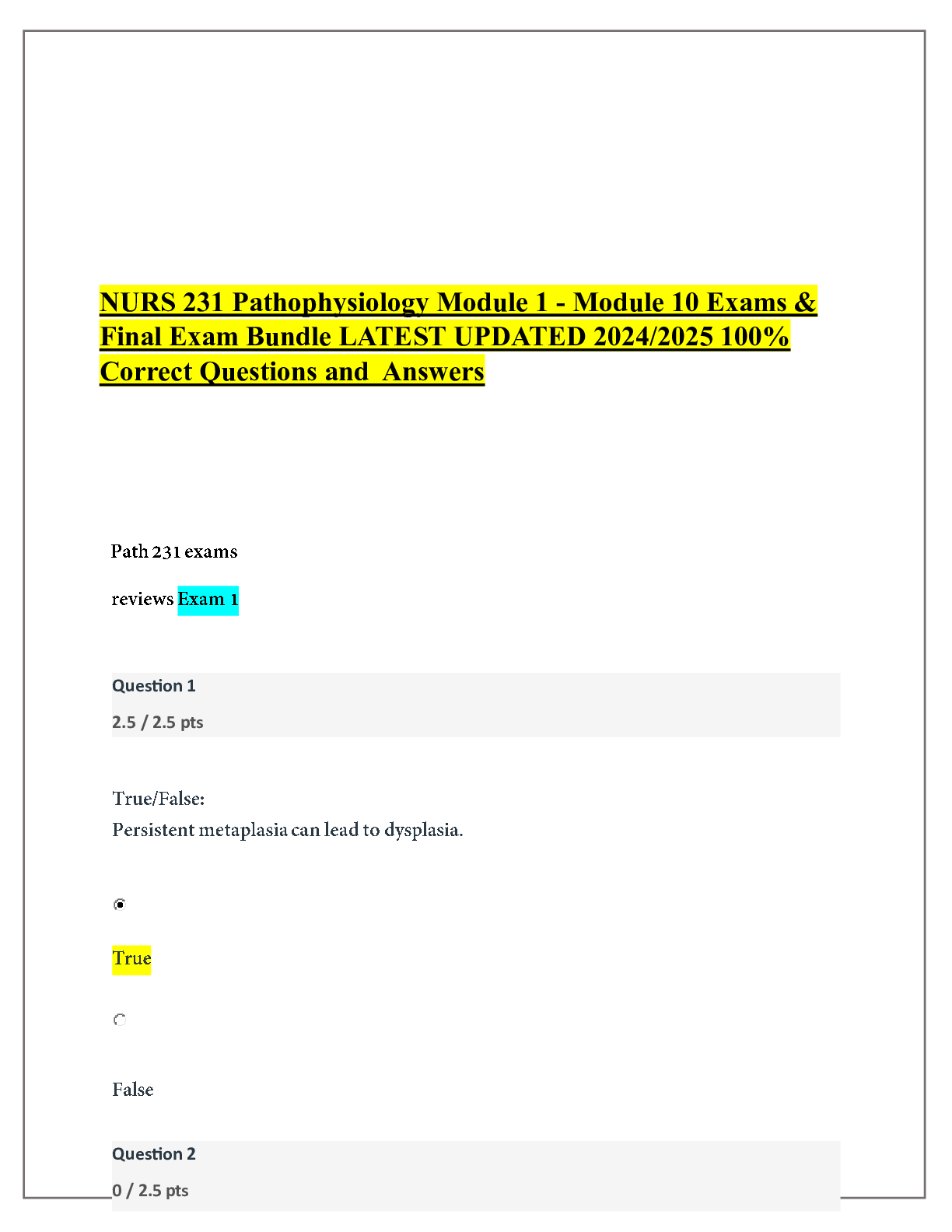
Question 1
2.5 / 2.5 pts
True/False:
A bodybuilder’s muscles will display hyperplasia.
True
Correct!
False
It will display hypertrophy.
Question 2
2.5 / 2.5 pts
True/False
...
PATHOPHYS Module Exams
Module 1 Exam
Question 1
2.5 / 2.5 pts
True/False:
A bodybuilder’s muscles will display hyperplasia.
True
Correct!
False
It will display hypertrophy.
Question 2
2.5 / 2.5 pts
True/False:
Barrett esophagus is an example of dysplasia.
True
Correct!
False
It’s metaplasia.
Question 3
0 / 2.5 pts
True/False:
Hypertrophy is an increase in the size of an organ or tissue caused by an increase in the number of cells
You Answered
True
Correct Answer
False
Question 4
2.5 / 2.5 pts
True/False:
Hypertrophy can occur under normal and pathological conditions.
Correct!
True
False
Question 5
10 / 10 pts
Match the following:
Deals with the cause of death in a population a.
Incidence
Number of new cases in a population at risk during a specified time b.
Prevalence
Number of people with the disease in a population in a given time c.
Morbidity
The effect of an illness on one’s life
d. Mortality
Question 6
2.5 / 2.5 pts
Multiple Choice
Which is NOT true of the cytoskeleton?
It controls shape and movement
Cilia and flagella are microtubule-filled cellular extensions
Correct!
It includes peroxisomes and proteasomes
Peroxisomes and proteasomes are not part of the cytoskeleton.
Question 7
1.67 / 2.5 pts
Which of the following move across the cell membrane via diffusion? Select all that apply.Correct!
Oxygen
Glucose
Correct Answer
Water
Correct!
Carbon dioxide
Question 8
2.5 / 2.5 pts
Multiple Choice
Which of the following are false regarding cell communication?
Endocrine signaling depends on hormones
Neurotransmitters act through synapses
G-protein linked receptors act through an on-off switch
Correct!
Paracrine signaling releases a chemical into the extracellular fluid that affects its own activity
Question 9
2.5 / 2.5 pts
Which is true of the cytoskeleton? Select all that apply.
Correct!
It controls shape and movement
Correct!
Cilia and flagella are microtubule-filled cellular extensions
It includes peroxisomes and proteasomes
Question 10
0 / 2.5 pts
Multiple Choice
High blood pressure is an example of which of the following?
Pathology
Correct Answer
Pathophysiology
Physiology
You Answered
No answer text provided.
Question 11
2.5 / 2.5 pts
Multiple Choice
A patient has a fever and rash. What are these examples of?
Correct!
Signs
Symptoms
Both A & B
Question 12
2.5 / 2.5 pts
Multiple Choice
Which of the following is true of a test’s sensitivity?
It is how likely the same result will occur if repeated
Correct!
If negative, it can safely be assumed that the person does not have a disease
It is considered a true-negative result
It can only be calculated from people without the disease
Question 13
2.5 / 2.5 pts
Multiple Choice
Which of the following is the effect of an illness on one’s life?
Incidence
Correct!
Morbidity
Prevalence
Mortality
Question 14
10 / 10 pts
Define secondary prevention and give an example:
Your Answer:
It is one of three categories in disease prevention. It aims to detect and treat disease early, while thedisease
is asymptomatic and curable. An example is an annual Pap smear.
Secondary prevention aims to detect and treat disease early, usually while the disease is
asymptomatic and curable. Some examples include annual Pap smears to detect early cervical
cancer, encouraging smoking cessation, checking blood pressure and cholesterol, and colonoscopy
screening.
Question 15
10 / 10 pts
Compare and contrast the two types of gangrenous necrosis.
Your Answer:
2 types are dry and moist. In dry gangrenous, the affected tissue is dehydrated, shrinks back and becomes
dark brown or black in color. THe spread of dry is slow. In wet, the affected area is cold, swollen, with no
pulse. The skin is moist, black, and distended. Small blisters form and as liquefaction occurs, foul ordor
emerges. The spread of wet gangrenous is rapid.
In dry gangrene the affected tissue becomes dry and shrinks, the skin wrinkles, and its color changes
to dark brown or black. The spread of dry gangrene is slow. It results from a cut off in arterial blood
supply and is a form of coagulation necrosis. In wet gangrene, the affected area is cold, swollen, and
pulseless. The skin is moist, black, and under tension. Blebs form on the surface,liquefaction occurs,
and a foul odor is caused by bacterial action. The spread of tissue damage is rapid
[Show More]















.png)


