1. The following is a December 31, 2021, post-closing trial balance for
Culver City Lighting, Inc.
Account Title Debits Credits
Cash $ 68,000
Accounts receivable 52,000
Inventory 58,000
Prepaid insurance 28,000
Eq
...
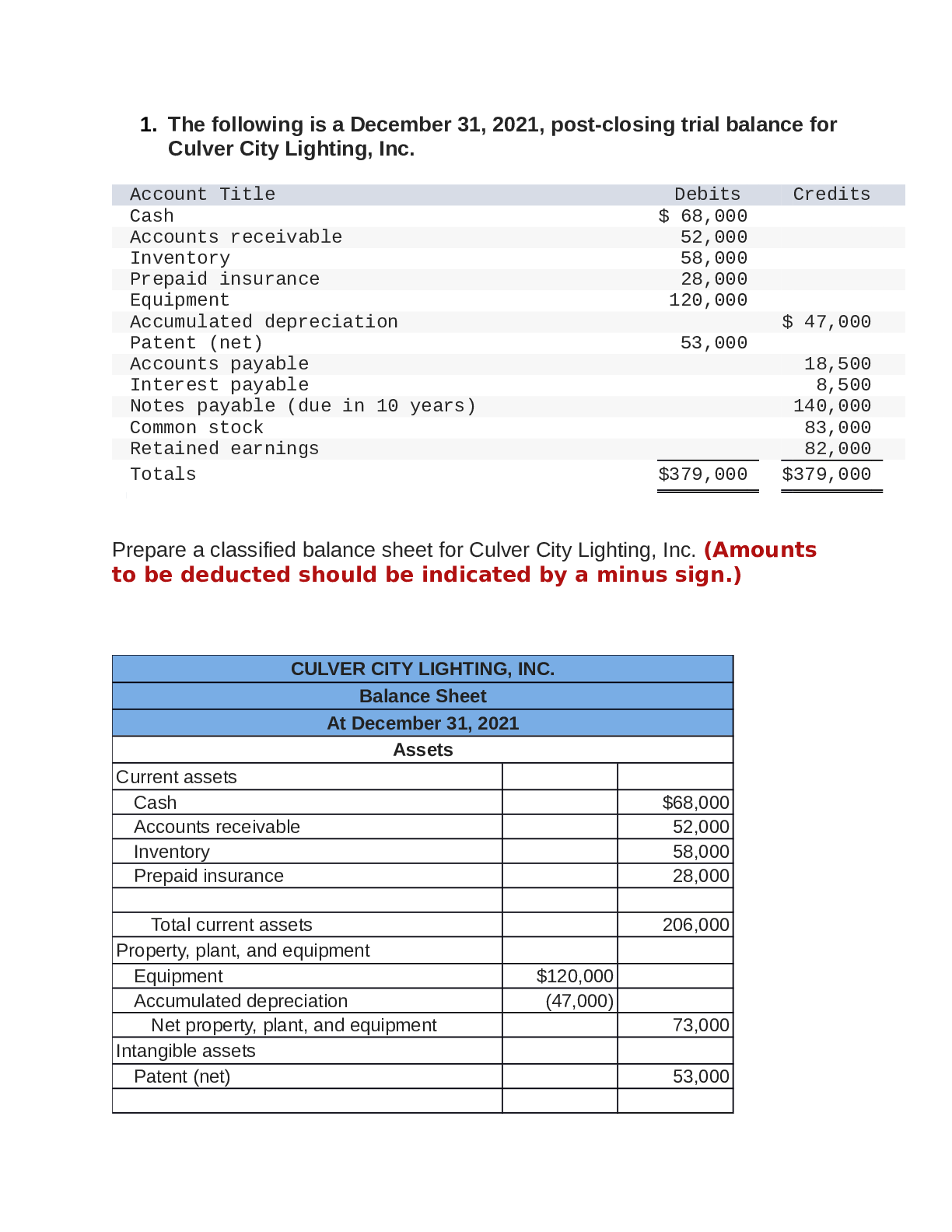
1. The following is a December 31, 2021, post-closing trial balance for
Culver City Lighting, Inc.
Account Title Debits Credits
Cash $ 68,000
Accounts receivable 52,000
Inventory 58,000
Prepaid insurance 28,000
Equipment 120,000
Accumulated depreciation $ 47,000
Patent (net) 53,000
Accounts payable 18,500
Interest payable 8,500
Notes payable (due in 10 years) 140,000
Common stock 83,000
Retained earnings 82,000
Totals $379,000 $379,000
Prepare a classified balance sheet for Culver City Lighting, Inc. (Amounts
to be deducted should be indicated by a minus sign.)
CULVER CITY LIGHTING, INC.
Balance Sheet
At December 31, 2021
Assets
Current assets
Cash $68,000
Accounts receivable 52,000
Inventory 58,000
Prepaid insurance 28,000
Total current assets 206,000
Property, plant, and equipment
Equipment $120,000
Accumulated depreciation (47,000)
Net property, plant, and equipment 73,000
Intangible assets
Patent (net) 53,000
Total assets $332,000
Liabilities and Shareholders' Equity
Current liabilities
Accounts payable $18,500
Interest payable 8,500
Total current liabilities 27,000
Long-term liabilities
Notes payable 140,000
Total liabilities 167,000
Shareholders' equity
Common stock $83,000
Retained earnings 82,000
Total shareholders' equity 165,000
Total liabilities and shareholders' equity $332,000
2. You have been asked to review the December 31, 2021, balance
sheet for Champion Cleaning. After completing your review, you
list the following three items for discussion with your superior:
1. An investment of $49,000 is included in current assets.
Management has indicated that it has no intention of liquidating
the investment in 2022.
2. A $290,000 note payable is listed as a long-term liability, but you
have determined that the note is due in 10, equal annual
installments with the first installment due on March 31, 2022.
3. Deferred revenue of $117,000 is included as a current liability even
though only two-thirds will be recognized as revenue in 2022, and
the other one-third in 2023.
Determine the appropriate classification of each of these items. (If no
entry is required for classification, choose "No entry".)
Current Long-term
Items Amount Classification Amount
1. Investment No entry $49,000 Investments
2. Installment note $29,000 Current liabilities $261,000 Long-term liabilities
3. Deferred revenue $78,000 Current liabilities $39,000 Long-term liabilities
Explanation
1. The $49,000 should be classified as a long-term asset, under the investments
classification.
2. $29,000, next year’s installment, should be classified as a current liability, current
maturities of long-term debt. The remaining $261,000 is included in long-term liabilities.
3. Two-thirds of the deferred revenue, $78,000, should be classified as a current liability, the
remaining $39,000 as a long-term liability.
3 For each of the following note disclosures, indicate whether
the disclosure would likely appear in (A) the summary of
significant accounts policies or (B) a separate note.
Note disclosures A/B
(1) Depreciation method A
(2) Contingency information B
(3) Significant issuance of common stock after the fiscal year-end B
(4) Cash equivalent designation A
(5) Long-term debt information B
(6) Inventory costing method A
4 The following are the typical classifications used in a balance sheet
[Show More]