Chapter 49: Care of Patients with Eye and Vision Problems Test Bank
Document Content and Description Below
1. A client is using an ophthalmic beta-blocking agent for the treatment of glaucoma. Which
instruction does the nurse give to the client to prevent orthostatic hypotension?
a. “Change positions quickly after administe
...
[Show More]
Last updated: 3 years ago
Preview 1 out of 10 pages
Instant download

Buy this Document to get the Full Access Instantly
Provided by Students Who Aced it
We Verify Document Content to Gurantee Accuracy
Reviews( 0 )
Document information
Connected school, study & course
About the document
Uploaded On
Aug 23, 2021
Number of pages
10
Written in
All

Additional information
This document has been written for:
Uploaded
Aug 23, 2021
Downloads
0
Views
152
Topic Tags
Recommended For You
Get more on EXAM »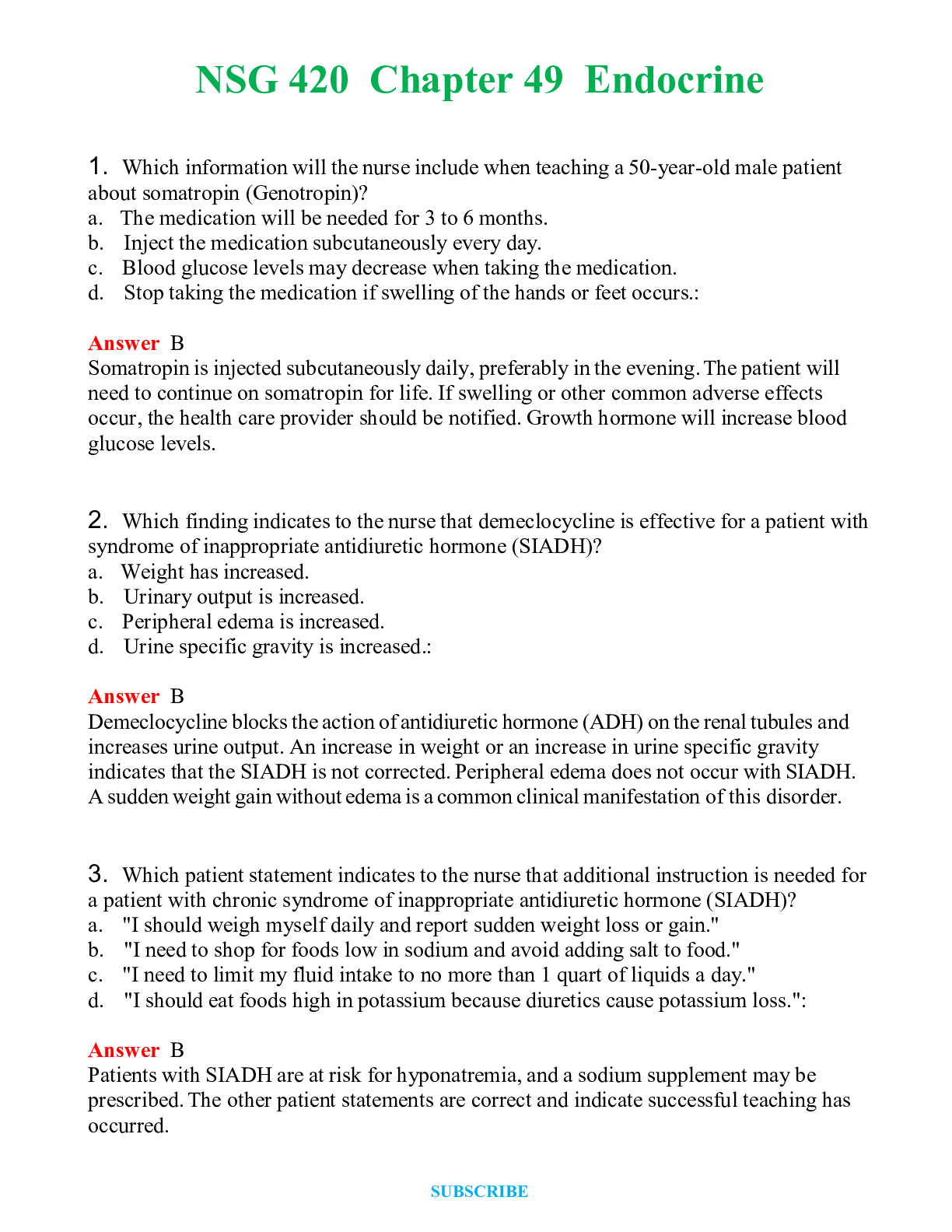
$8.5
14 Pages
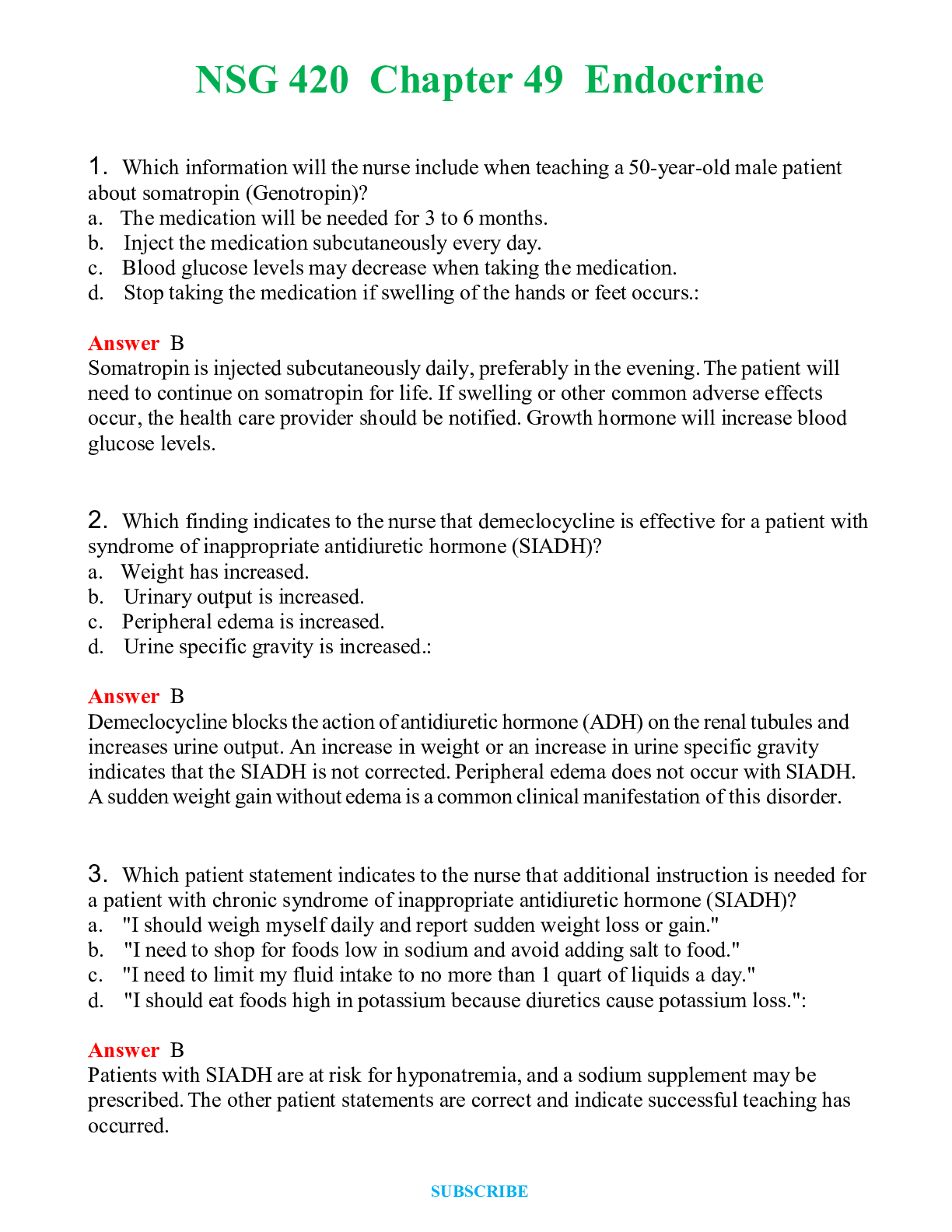
NSG 420 Chapter 49 Endocrine | Questions & Answers with rati...
$10.5
14 Pages
NSG 420 Chapter 49 Endocrine Actual Exam Q & A (Graded A+...
.png)
$9
17 Pages
Sophia Milestone Adult Nursing (NUR 105) Med Surg test Latest...
.png)
$12
24 Pages
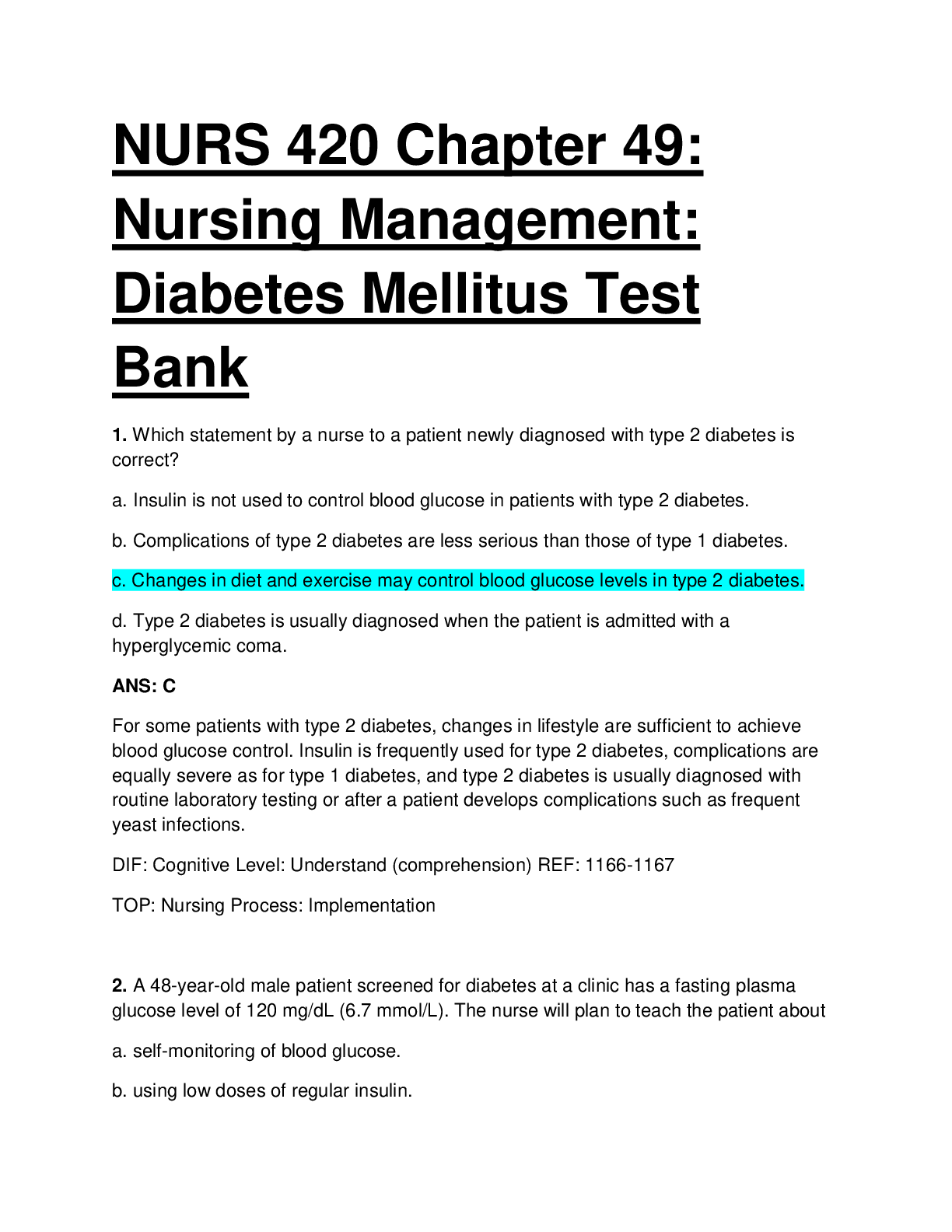
Lewis's Chapter 49- Endocrine Problems Test Bank, Chapter 47-...
$11
26 Pages
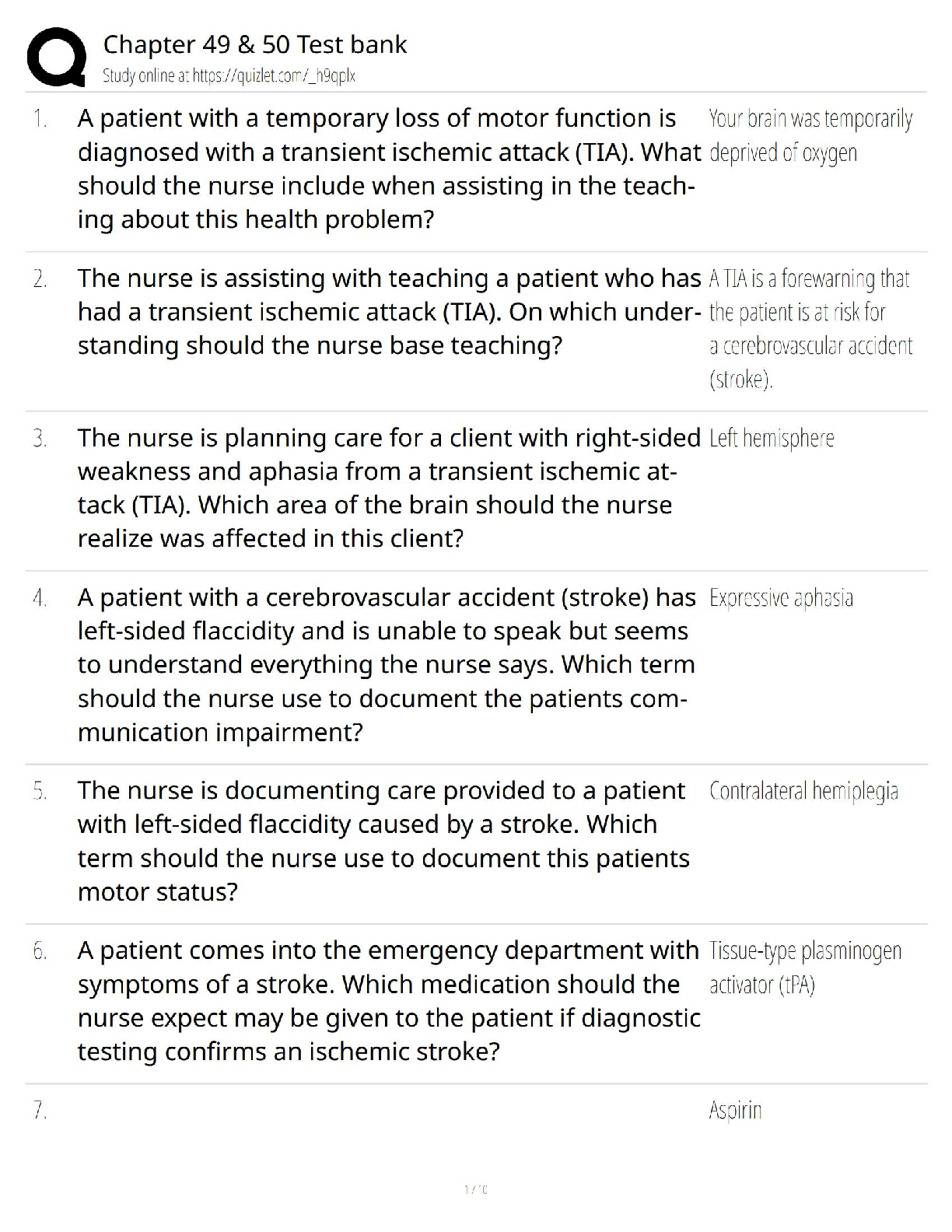
NURS 420 Chapter 49: Nursing Management: Diabetes Mellitus Tes...
$7
14 Pages
Chapter 49 Pasco-Hernando Community College - NUR1021 1211c HI...

$13
25 Pages
VN1105-Chapter 49: Care of the Patient with a Urinary Disorder...
$12
10 Pages
NURS 3320 Chapter 49- Disorders of Endocrine Control of Growth...
$12
10 Pages
NURS 3320 Chapter 49- Disorders of Endocrine Control of Growth...

$10.5
19 Pages
PEDS- Chapter 41- The Child with an Infectious Disease, Chapt...
$7.5
8 Pages
LEHNE 9TH EDITION CHAPTER 49: ANTIDYSRHYTHMIC DRUGS QUESTIONS...
$13
17 Pages
NURS 4403 Chapter 49: Neuromuscular or Muscular Dysfunction,10...

$12
9 Pages
NR 443 CHAPTER 49: FEMALE REPRODUCTIVE DISORDERS | VERIFIED GU...
$12
9 Pages
NR 443 CHAPTER 49: FEMALE REPRODUCTIVE DISORDERS | VERIFIED GU...
.png)
$7
8 Pages
Milestone Chapter 49 Assessment of the Musculoskeletal System...
$7
21 Pages
ATI Management: Endocrine Problems: Medical-Surgical Nursing:...
 Correct Study Guide, Download to Score A.png)
$14
30 Pages
ATI Chapter 49 Endocrine Problems, Lewis Medical-Surgical Nurs...

$10
39 Pages
Study Guide for Exam #2 - Fundamentals of Nursing - Ch. 43, 44...
More related documents below