Chapter 1: Introduction: Marketing for Hospitality and Tourism
Chapter Outline
I. Introduction: Marketing in the Hospitality Industry
A. Customer orientation. The purpose of a business is to create and maintain
profi
...
Chapter 1: Introduction: Marketing for Hospitality and Tourism
Chapter Outline
I. Introduction: Marketing in the Hospitality Industry
A. Customer orientation. The purpose of a business is to create and maintain
profitable customers. Customer satisfaction leading to profit is the central
goal of hospitality marketing.
II. What Is Hospitality Marketing? Marketing is the art and science of finding,
retaining, and growing profitable customers.
Importance of Marketing
A. The entrance of corporate giants into the hospitality market and the
marketing skills these companies have brought to the industry have
increased the importance of marketing within the industry.
B. Analysts predict that the hotel industry will consolidate in much the same
way as the airline industry has, with five or six major chains dominating the
market. Such consolidation will create a market that is highly competitive.
The firms that survive this consolidation will be the ones that understand
their customers.
C. In response to growing competitive pressures, hotel chains are relying on
the expertise of the marketing director.
IV. Travel Industry Marketing
A. Successful hospitality marketing is highly dependent on the entire travel
industry.
B. Government or quasi-government agencies play an important role in
travel industry marketing through legislation aimed at enhancing the
industry and through promotion of regions, states, and nations.
C. Few industries are as interdependent as the travel and hospitality
industries.
V. Marketing Process. The marketing process is a five-step model of the
marketing process. In the first four steps, companies work to understand
consumers, create customer value, and build strong customer relationships.
In the final step, companies reap the rewards of creating superior customer
value. By creating value for customers, they in turn capture value from
customers in the form of sales, profits, and long-term customer equity.
A. Understand customers
1. Needs. Human beings have many complex needs. These include basic
physical needs for food, clothing, warmth, and safety; social needs for
belonging, affection, fun, and relaxation; esteem needs for prestige,
recognition, and fame; and individual needs for knowledge and selfexpression.
2. Wants. Wants are how people communicate their needs.
3. Demands. People have almost unlimited wants but limited resources.
They choose products that produce the most satisfaction for their money.
When backed by buying power, wants become demand.
4. Market offerings. Some combination of tangible products, services,
information, or experiences that are offered to the market.
5. Value, expectations, and satisfaction
a. Customer value is the difference between the benefits that the customer
gains from owning and/or using a product and the costs of obtaining the
product.
b. Customer expectations are based on past buying experiences, the
opinions of friends, and market information.
c. Satisfaction. Satisfaction with a product is determined by how well the
product meets the customer’s expectations for that product.
6. Exchange and relationships
a. Exchange. Exchange is the act of obtaining a desired object from someone by
offering something in return.
b. Relationship marketing. Relationship marketing focuses on building a
relationship with a company’s profitable customers. Most companies are
finding that they earn a higher return from resources invested in getting
repeat sales from current customers than from money spent to attract new
customers.
c. Designing customer-driven marketing strategy. Marketing management is the
art and science of choosing target markets and building profitable
relationships with them.
i. Selecting customers to serve. The company must select those market
segments it wishes to serve.
ii. Choosing a value proposition. The company must also decide how it will serve
targeted customers—how it will differentiate and position itself in the
marketplace. A company’s value proposition is the set of benefits or values it
promises to deliver to consumers to satisfy their needs.
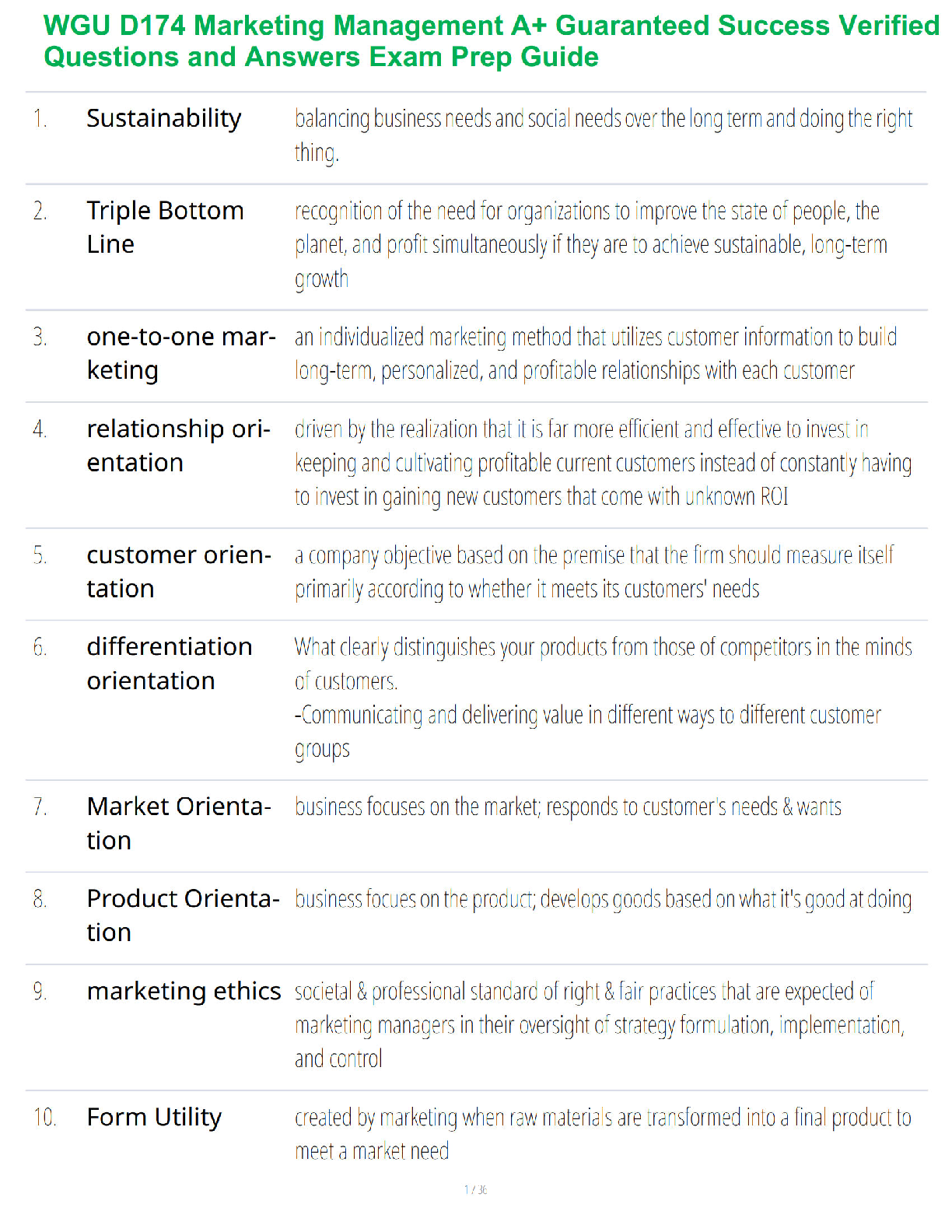
VI. Five Marketing Management Philosophies
A. Production concept. The production concept holds that customers will
favor products that are available and highly affordable, and therefore
management should focus on production and distribution efficiency.
B. Product concept. The product concept holds that customers prefer existing
products and product forms, and the job of management is to develop good
versions of these products.
C. Selling concept. The selling concept holds that consumers will not buy
enough of the organization’s products unless the organization undertakes a
large selling and promotion effort.
D. Marketing concept. The marketing concept holds that achieving
organizational goals depends on determining the needs and wants of target
[Show More]
.png)

x.png)



.png)
 hesi.png)
.png)