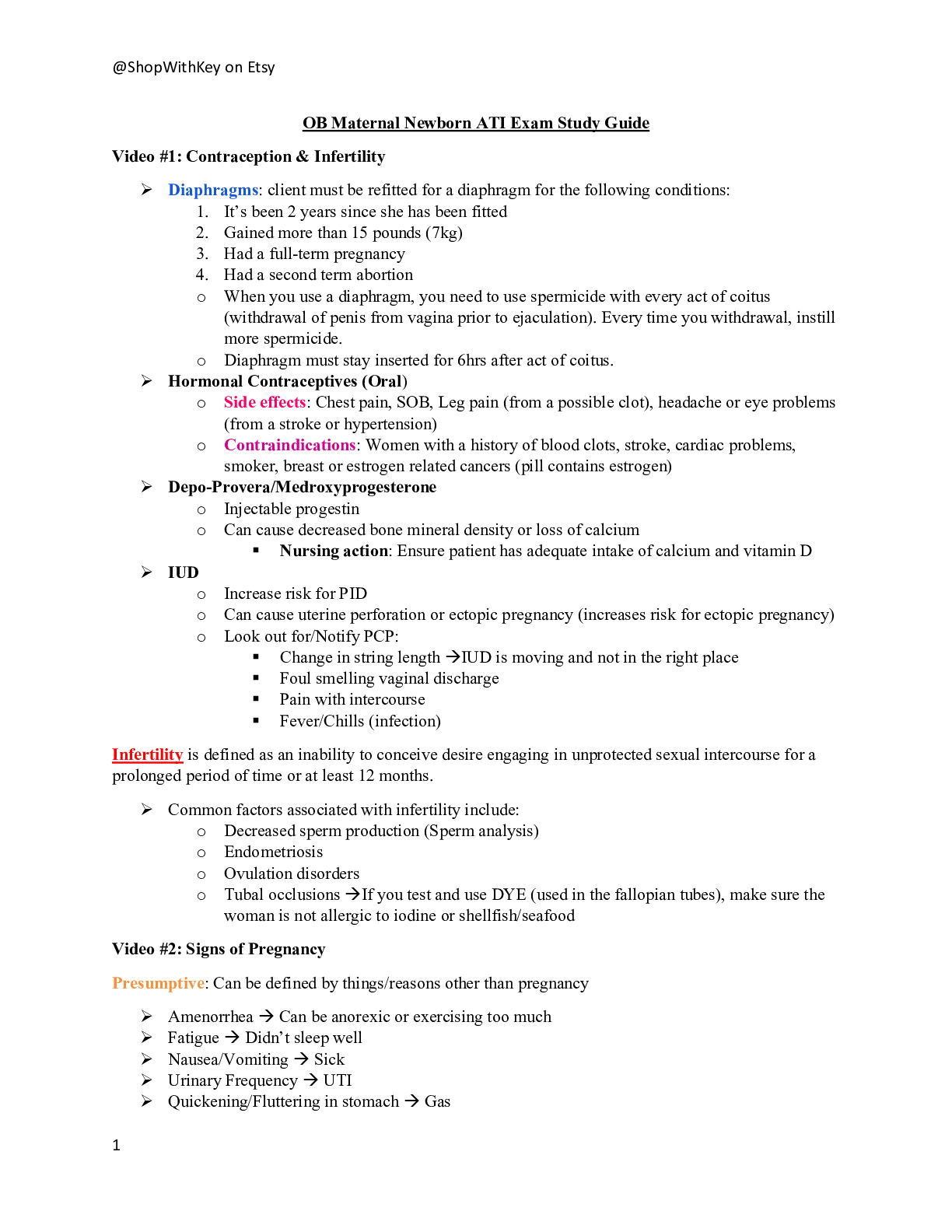
OB Maternal Newborn ATI Exam Study Guide
Video #1: Contraception & Infertility
Diaphragms: client must be refitted for a diaphragm for the following conditions:
1. It’s been 2 years since she has been fitted
2. Gai
...
OB Maternal Newborn ATI Exam Study Guide
Video #1: Contraception & Infertility
Diaphragms: client must be refitted for a diaphragm for the following conditions:
1. It’s been 2 years since she has been fitted
2. Gained more than 15 pounds (7kg)
3. Had a full-term pregnancy
4. Had a second term abortion
o When you use a diaphragm, you need to use spermicide with every act of coitus
(withdrawal of penis from vagina prior to ejaculation). Every time you withdrawal, instill
more spermicide.
o Diaphragm must stay inserted for 6hrs after act of coitus.
Hormonal Contraceptives (Oral)
o Side effects: Chest pain, SOB, Leg pain (from a possible clot), headache or eye problems
(from a stroke or hypertension)
o Contraindications: Women with a history of blood clots, stroke, cardiac problems,
smoker, breast or estrogen related cancers (pill contains estrogen)
Depo-Provera/Medroxyprogesterone
o Injectable progestin
o Can cause decreased bone mineral density or loss of calcium
Nursing action: Ensure patient has adequate intake of calcium and vitamin D
IUD
o Increase risk for PID
o Can cause uterine perforation or ectopic pregnancy (increases risk for ectopic pregnancy)
o Look out for/Notify PCP:
Change in string length IUD is moving and not in the right place
Foul smelling vaginal discharge
Pain with intercourse
Fever/Chills (infection)
Infertility is defined as an inability to conceive desire engaging in unprotected sexual intercourse for a
prolonged period of time or at least 12 months.
Common factors associated with infertility include:
o Decreased sperm production (Sperm analysis)
o Endometriosis
o Ovulation disorders
o Tubal occlusions If you test and use DYE (used in the fallopian tubes), make sure the
woman is not allergic to iodine or shellfish/seafood
Video #2: Signs of Pregnancy
Presumptive: Can be defined by things/reasons other than pregnancy
Amenorrhea Can be anorexic or exercising too much
Fatigue Didn’t sleep well
Nausea/Vomiting Sick
Urinary Frequency UTI
Quickening/Fluttering in stomach Gas
@ShopWithKey on Etsy
2
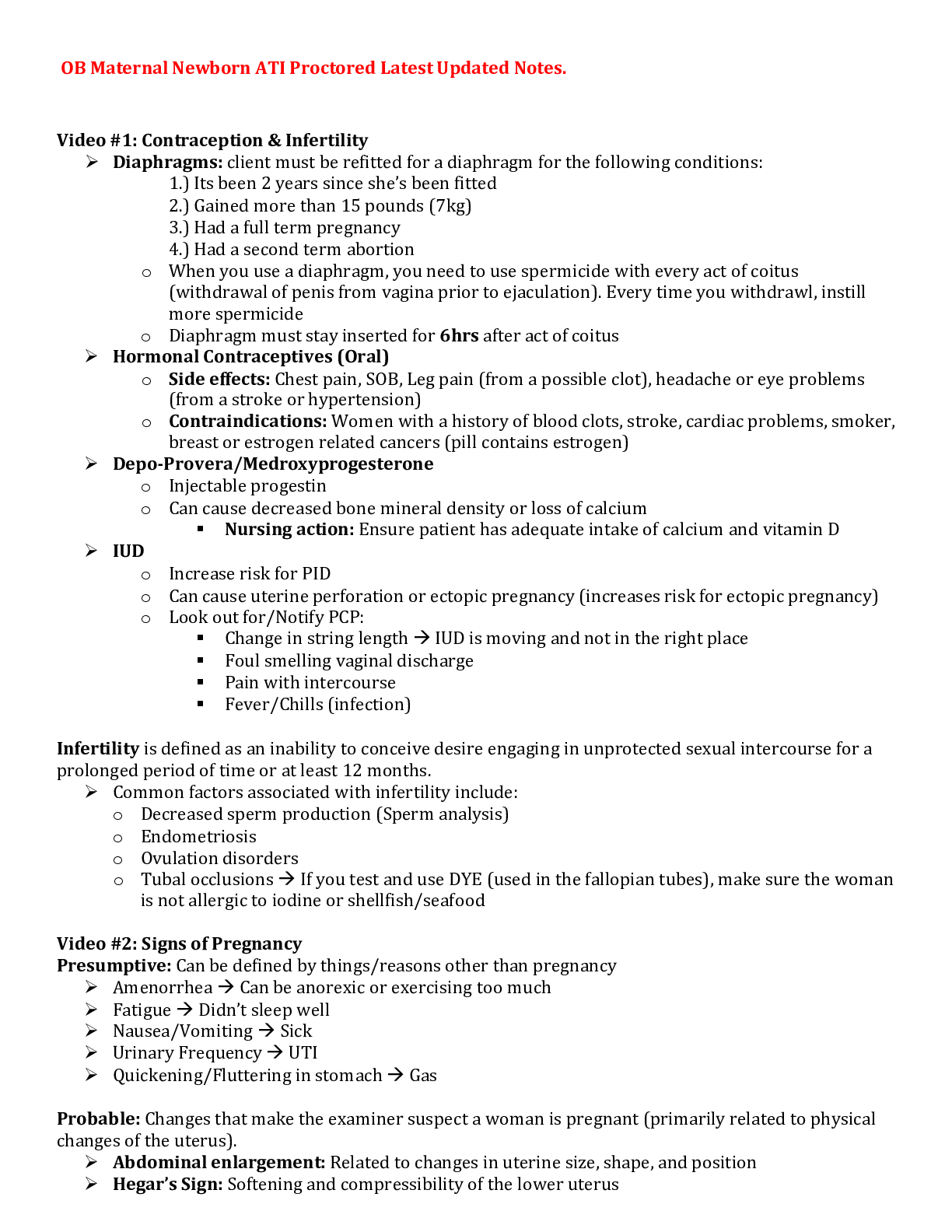
Probable: Changes that make the examiner suspect a woman is pregnant (primarily related to physical
changes of the uterus).
Abdominal enlargement: Related to changes in uterine size, shape, and position
Hegar’s Sign: Softening and compressibility of the lower uterus
Chadwick’s Sign: Deepend violet bluish color of cervix and vaginal mucosa
Goodell’s Sign: Softening of cervical tip
Ballottement: Rebound of unengaged uterus
Braxton Hicks Contractions: False contractions that are painless, irregular, and usually relieved
by walking
Positive Pregnancy Test: Woman’s hormonal level may not be normal
Fetal Outline:
Positive: Very distinct things.
Fetal Heart Sounds
Fetal Heartbeat can be heard
Can see the baby with ultrasound
Can feel movement in the uterus
Naegele’s Rule: Last menstrual period minus (– ) 3 months + 7 days + 1-year ;Cathy’s Rule: + 9
months + 1 week
Gravidity and Parity:
Gravida: a woman who is pregnant
Gravidity: number of pregnancies
o Nulligravida: a woman who has never been pregnant
o Primigravida: a woman who is pregnant for the first time
o Multigravida: a woman in at least her second pregnancy.
Parity: the number of births (not the number of fetuses [ex: twins]) carried pat 20 weeks
gestation, whether or not the fetus was born alive.
o Nullipara: a woman who has not had a birth at more than 20 weeks of gestation.
o Primipara: a woman who has had one birth that occurred after 20 weeks of gestation.
o Multipara: a woman who has had two or more pregnancies to the stage of fetal viability.
Know how to find out GTPAL numbers:
G= Gravidity (# of times a woman has been pregnant PLUS current pregnancy)
T= Term Births (How many babies were delivered at term 38 WEEKS OR MORE)
P= Preterm Births (Below 38 weeks)
A= Abortion (spontaneous or not) or miscarriages L= Living children
Fundal height:
Measured to evaluate the gestational age of the fetus.
During the second and third trimesters (weeks 18-30), the fundal height in centimeters
approximately equals the fetus’s age in weeks, plus or minus 2 cm.
At 16 weeks, the fundus can be found approximately halfway between the symphysis pubis and
the umbilicus.
@ShopWithKey on Etsy
3
At 20 to 22 weeks, the fundus is
approximately at the location of
the umbilicus.
At 36 weeks, the fundus is at the
xiphoid process.
* When assessing fundal
height, monitor the client
closely for supine
hypotension when place
in the supine position.
Measuring fundal height:
1. Place the client in a supine position
2. Place the end of the tape measure
at the level of symphysis pubis
3. Stretch the tape to the tope of the
uterine fundus
4. Note and record the measurement.
Physiological Maternal Changes:
Cardiovascular system:
Circulating blood volume increases by approximately 40 – 50%; physiological anemia may occur
as the plasma increase exceeds the increase in the production of red blood cells.
Heart size is increased, and the heart is elevated upward and to the left because of displacement of
the diaphragm as the uterus enlarges.
There is an increase in the body’s demand for iron.
Sodium and water retention may occur, which can lead to weight gain.
Respiratory system:
Oxygen consumption increases by approximately 15% to 20%
Diaphragm is elevated as a result of the enlarged uterus
Shortness of breath may be experienced.
* During pregnancy, a woman’s pulse rate may increase about 10 to 15 beats/minute, the
blood pressure slightly decreases in the second trimester, then increases in the third
trimester but not above the pregnancy level; and the respiratory rate remains unchanged
or slightly increases.
Gastrointestinal System:
Nausea and vomiting, which usually subsides by the 3rd month, may occur as a result of the
secretion of human chorionic gonadotropin (hCG); hCG stabilizes or decreases around week 12
Poor appetite may occur because of decreased gastric motility.
Alterations in taste and smell may occur.
Constipation may occur because of an increase in progesterone production or pressure of the
uterus, resulting in decreased GI motility.
@ShopWithKey on Etsy
4
Flatulence and heartburn may occur because of decreased GI motility and slowed emptying of the
stomach cause by an increase in progesterone production.
Gum tissue may become swollen and easily bleed because of increasing levels of estrogen.
Ptyalism (excessive secretion of saliva) may occur because of increasing levels of estrogen.
Renal System:
Frequency of urination increases in the 1st and 3rd trimesters because of increased bladder
sensitivity and pressure of the enlarging uterus on the bladder,
Decreased bladder tone may occur and is caused by an increase in progesterone and estrogen
levels; bladder capacity increases in response to increasing levels of progesterone.
The renal threshold fir glucose may be reduced.
Reproductive system:
1. Uterus
a) Uterus enlarges, increasing in mass from approximately 60 g to 1000 g as a result of
hyperplasia (influence of estrogen) and hypertrophy.
b) Size and number of blood vessels and lymphatics increase
c) Irregular contractions occur, typically beginning after 16 weeks gestation.
2. Cervix
a) Cervix becomes shorter, more elastic, and larger in diameter.
b) Endocervical glands secrete a thick mucus plug, which is expelled from the canal when
dilation begins.
c) Increased vascularization and an increase in estrogen causes a softening and a violet
discoloration (Chadwick’s sign), which occurs at about week 6.
3. Ovaries
a) Secrete progesterone for first 6 to 7 weeks of pregnancy
b) Block maturation of new follicles
c) Cease ovum production.
4. Vagina
a) Hypertrophy and thickening of the muscle occurs.
b) Increase in vaginal secretions is experienced: secretions are usually, thick, white, and
acidic.
5. Breasts
a) Breast changes occur because of the increasing effects of estrogen and progesterone
b) Breast size increases and breasts may be tender.
c) Nipples become more pronounced and the areolae become darker.
d) Superficial veins become prominent
e) Montgomery’s follicles become hypertrophied
f) Colostrum may leak from the breasts.
Skin:
Changes in skin occur because of increased levels of melanocyte-stimulating hormone, which
increase secondary ot increases in estrogen and progesterone; these changes include the
following:
a) Increased pigmentation
b) Dark streak down the midline of the abdomen may appear (linea nigra).
[Show More]




.png)








.png)
.png)

