HESI PHARMACOLOGY PROCTORED EXAM
1. A nurse is teaching staff about the conduction of the heart. In which order will the nurse present the conduction cycle, starting with the first structure?
1. Bundle of His
2. Purki
...
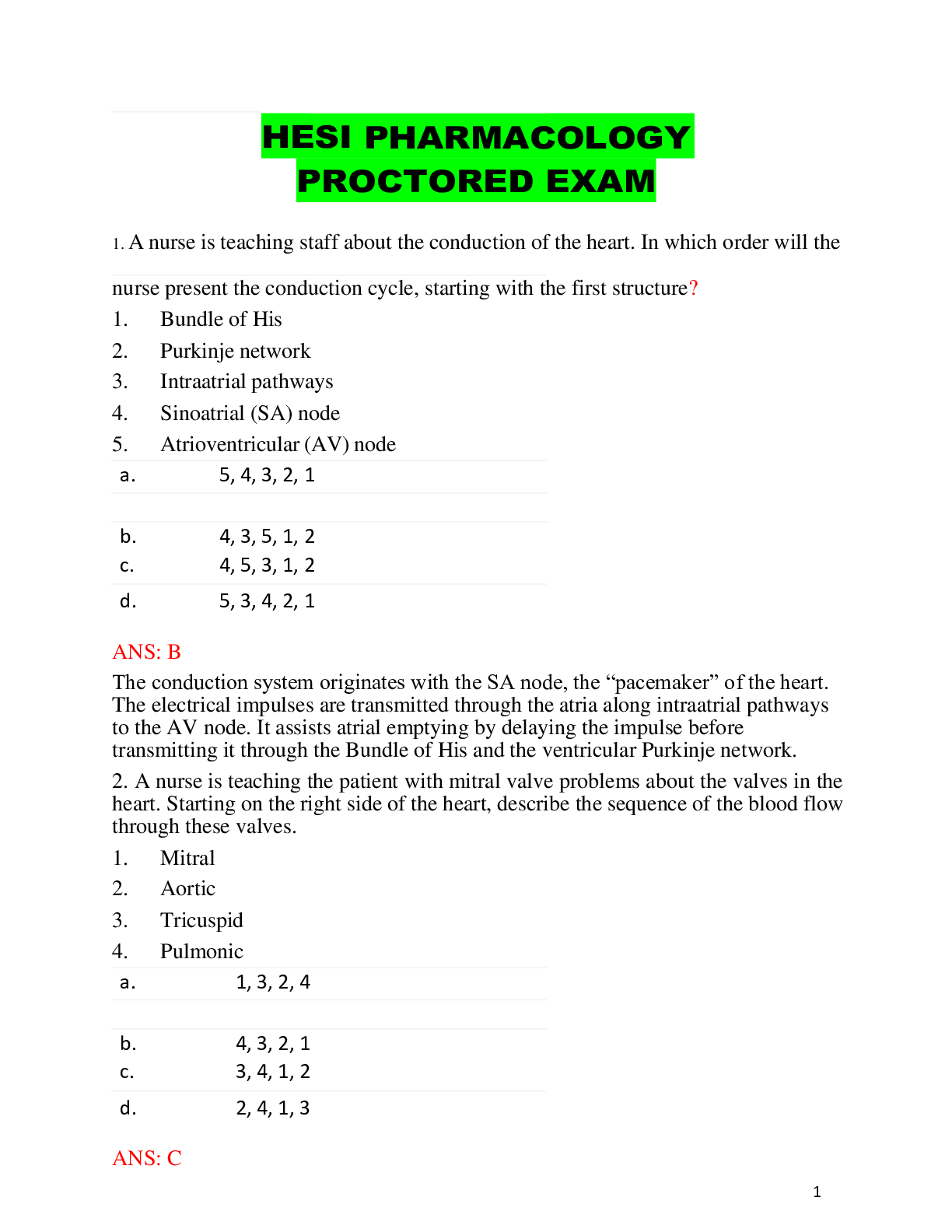
HESI PHARMACOLOGY PROCTORED EXAM
1. A nurse is teaching staff about the conduction of the heart. In which order will the nurse present the conduction cycle, starting with the first structure?
1. Bundle of His
2. Purkinje network
3. Intraatrial pathways
4. Sinoatrial (SA) node
5. Atrioventricular (AV) node
a. 5, 4, 3, 2, 1
b. 4, 3, 5, 1, 2
c. 4, 5, 3, 1, 2
d. 5, 3, 4, 2, 1
2. A nurse is teaching the patient with mitral valve problems about the valves in the heart. Starting on the right side of the heart, describe the sequence of the blood flow through these valves.
1. Mitral
2. Aortic
3. Tricuspid
4. Pulmonic
a. 1, 3, 2, 4
b. 4, 3, 2, 1
c. 3, 4, 1, 2
d. 2, 4, 1, 3
3. A nurse explains the function of the alveoli to a patient with respiratory
problems. Which information about the alveoli’s function will the nurse share with the patient?
a. Carries out gas exchange
b. Regulates tidal volume
c. Produces hemoglobin
d. Stores oxygen
4. A nurse auscultates heart sounds. When the nurse hears S2, which valves is the nurse hearing close?
a. Aortic and mitral
b. Mitral and tricuspid
c. Aortic and pulmonic
d. Mitral and pulmonic
5. The nurse is teaching about the process of exchanging gases
through the alveolar capillary membrane. Which term will the nurse use to describe this process?
a. Ventilation
b. Surfactant
c. Perfusion
d. Diffusion 2
6. A nurse is caring for a patient who was in a motor vehicle accident
that resulted in cervical trauma to C4. Which assessment is the priority?
a. Pulse
b. Respirations
c. Temperature
d. Blood pressure
7. The patient is breathing normally. Which process does the nurse
consider is working properly when the patient inspires?
a. Stimulation of chemical receptors in the aorta
b. Reduction of arterial oxygen saturation levels
c. Requirement of elastic recoil lung properties
d. Enhancement of accessory muscle usage
8. The home health nurse recommends that a patient with respiratory
3
problems install a carbon monoxide detector in the home. What is the
a. Crartiboonnalme ofonroxthideenduerstec’stoarcstiaorne?required by law in the home.
Carbon monoxide
tightly binds to hemoglobin, causing hypoxia.
b. Carbon monoxide signals the cerebral cortex to cease ventilations. Carbon monoxide combines with oxygen in the body and produces a
c. deadly toxin.
9. While performing an assessment, the nurse hears crackles in the patient’s lung fields. The nurse also learns that the patient is sleeping on
three pillows to help with the difficulty breathing during the night. Which condition will the nurse most likely observe written in the patient’s medical record?
a. Atrial fibrillation
b. Myocardial ischemia
c. Left-sided heart failure
d. Right-sided heart failure
10. A patient has a myocardial infarction. On which primary blood vessel
will the nurse focus care to reduce ischemia?
a. Superior vena cava
4
b. Pulmonary artery
c. Coronary artery
d. Carotid artery
1. A patient is receiving 35% O2 via a Venturi mask. To ensure the correct amount of O2 delivery, which action by the nurse is important?
a. Teach the patient to keep the mask on during meals.
b. Keep the air entrainment ports clean and unobstructed.
c. Give a high enough flow rate to keep the bag from collapsing.
d. Drain moisture condensation from the corrugated tubing
2. Postural drainage with percussion and vibration is ordered twice daily for a patient with chronic bronchitis. Which intervention should the nurse include in the plan of care?
a. Schedule the procedure 1 hour after the patient eats.
b. Maintain the patient in the lateral position for 20 minutes.
c. Give the prescribed albuterol (Ventolin HFA) before the therapy.
d. Perform percussion before assisting the patient to the drainage The nurse develops a teaching plan to help increase activity tolerance at home for an older adult with severe chronic obstructive pulmonary disease (COPD). Which instructions would be appropriate for the nurse to include in the plan of care?
a. Stop exercising when you feel short of breath.
b. Walk until pulse rate exceeds 130 beats/minute.
c. Limit exercise to activities of daily living (ADLs).
d. Walk 15 to 20 minutes a day at least 3 times/week. 5
3. A patient with severe chronic obstructive pulmonary disease (COPD) tells the nurse, “I wish I
were dead! I’m just a burden on everybody.” Based on this information, which nursing diagnosis is
most appropriate?
a. Complicated grieving related to expectation of death
b. Chronic low self-esteem related to physical dependence
c. Ineffective coping related to unknown outcome of illness
d. Deficient knowledge related to lack of education about
4. A patient with chronic obstructive pulmonary disease (COPD) has poor gas exchange. Which action by the nurse would support the patient’s ventilation?
a. Have the patient rest in bed with the head elevated to 15 to 20 degrees.
b. Encourage the patient to sit up at the bedside in a chair and lean forward.
c. Ask the patient to rest in bed in a high-Fowler’s position with the knees flexed.
d. Place the patient in the Trendelenburg position with pillows behind the head. A 55-yr-old patient with increasing dyspnea is being evaluated for a possible diagnosis of chronic obstructive pulmonary disease (COPD). When teaching a patient about pulmonary spirometry for this condition, what is the most important question the nurse should ask?
a. “Are you claustrophobic?”
b. “Are you allergic to shellfish?”
c. “Have you taken any bronchodilators today?”
d. “Do you have any metal implants or prostheses?”
.........................................................................................continued...............................................................................................................
[Show More]



 Test Bank.png)



 Correct Study Guide, Download to Score A.png)
 Correct Study Guide, Download to Score A.png)
 Correct Study Guide, Download to Score A.png)



 (1).png)

