Male GU
14-2 Benign prostatic hypertrophy is a common fi nding as men age. Classically, this condition may begin
with diffi culty initiating the urinary stream, hesitancy, urgency, postvoid dribbling, urinary frequency
...
Male GU
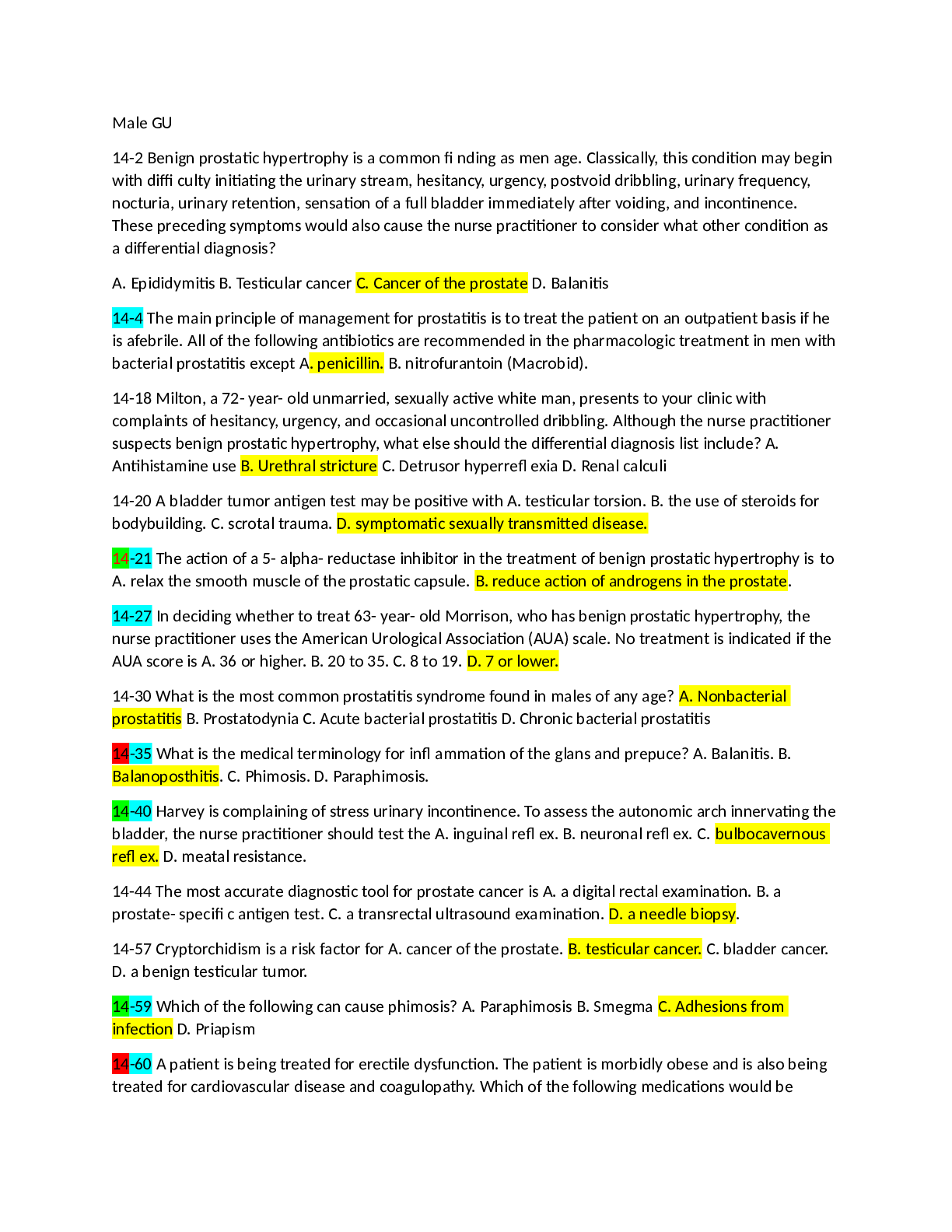
14-2 Benign prostatic hypertrophy is a common fi nding as men age. Classically, this condition may begin
with diffi culty initiating the urinary stream, hesitancy, urgency, postvoid dribbling, urinary frequency,
nocturia, urinary retention, sensation of a full bladder immediately after voiding, and incontinence.
These preceding symptoms would also cause the nurse practitioner to consider what other condition as
a differential diagnosis?
A. Epididymitis B. Testicular cancer C. Cancer of the prostate D. Balanitis
14-4 The main principle of management for prostatitis is to treat the patient on an outpatient basis if he
is afebrile. All of the following antibiotics are recommended in the pharmacologic treatment in men with
bacterial prostatitis except A. penicillin. B. nitrofurantoin (Macrobid).
14-18 Milton, a 72- year- old unmarried, sexually active white man, presents to your clinic with
complaints of hesitancy, urgency, and occasional uncontrolled dribbling. Although the nurse practitioner
suspects benign prostatic hypertrophy, what else should the differential diagnosis list include? A.
Antihistamine use B. Urethral stricture C. Detrusor hyperrefl exia D. Renal calculi
14-20 A bladder tumor antigen test may be positive with A. testicular torsion. B. the use of steroids for
bodybuilding. C. scrotal trauma. D. symptomatic sexually transmitted disease.
14-21 The action of a 5- alpha- reductase inhibitor in the treatment of benign prostatic hypertrophy is to
A. relax the smooth muscle of the prostatic capsule. B. reduce action of androgens in the prostate.
14-27 In deciding whether to treat 63- year- old Morrison, who has benign prostatic hypertrophy, the
nurse practitioner uses the American Urological Association (AUA) scale. No treatment is indicated if the
AUA score is A. 36 or higher. B. 20 to 35. C. 8 to 19. D. 7 or lower.
14-30 What is the most common prostatitis syndrome found in males of any age? A. Nonbacterial
prostatitis B. Prostatodynia C. Acute bacterial prostatitis D. Chronic bacterial prostatitis
14-35 What is the medical terminology for infl ammation of the glans and prepuce? A. Balanitis. B.
Balanoposthitis. C. Phimosis. D. Paraphimosis.
14-40 Harvey is complaining of stress urinary incontinence. To assess the autonomic arch innervating the
bladder, the nurse practitioner should test the A. inguinal refl ex. B. neuronal refl ex. C. bulbocavernous
refl ex. D. meatal resistance.
14-44 The most accurate diagnostic tool for prostate cancer is A. a digital rectal examination. B. a
prostate- specifi c antigen test. C. a transrectal ultrasound examination. D. a needle biopsy.
14-57 Cryptorchidism is a risk factor for A. cancer of the prostate. B. testicular cancer. C. bladder cancer.
D. a benign testicular tumor.
14-59 Which of the following can cause phimosis? A. Paraphimosis B. Smegma C. Adhesions from
infection D. Priapism
14-60 A patient is being treated for erectile dysfunction. The patient is morbidly obese and is also being
treated for cardiovascular disease and coagulopathy. Which of the following medications would becontraindicated? A. Topical testosterone (Androgel) B. Sildenafi l (Viagra) C. Alprostadil (Caverjet) D.
Subcutaneous pellet testost
14-61 A patient’s chief complaint is heaviness in the scrotum. The nurse practitioner assesses swelling of
the testes, along with warm scrotal skin. What differential diagnosis is most probable? A. Cryptorchidism
B. Orchitis C. Testicular torsion D. Epididymitis
14-65 Most lesions of the penis are nontender and painless. Which of the following conditions begins
with a tender, painful lesion? A. Syphilitic chancre B. Genital herpes
14-70 Which of the following medications is known to cause nocturia? A. Sympathomimetic agents B.
Phenothiazines C. Androgens D. Alpha- adrenergic agents
14-72 Harris, age 68, is complaining of crooked, painful erections. He has palpable, nontender, hard
plaques just beneath the skin of his penis. Based on the chief complaint and assessment, what is the
most likely differential diagnosis? A. Carcinoma of the penis B. Genital herpes C. Syphilitic chancre D.
Peyronie’s disease
14-74 Morris, age 52, is in a new relationship and is not sure whether his erectile dysfunction is caused
by stress about his performance or is organic. What simple test could you suggest to determine if he has
the ability to have an erection? A. Nocturnal penile tumescence and rigidity test
urethral opening is on the dorsal side of the glans. This is referred to as A. hypospadias. B. Peyronie’s
disease. C. priapism. D. epispadias.
14-80 A patient is being followed by the nurse practitioner for disease progression or remission after
treatment for testicular cancer. Which of the following biochemical markers would be ordered and
analyzed? A. Human chorionic gonadotropin (hCG) B. Alpha- fetoprotein (AFP) C. Lactate dehydrogenase
(LDH) D. All of the above
14-87 Which sexually transmitted diseases are cofactors for HIV transmission? A. Syphilis and chlamydia
B. Herpes and chlamydia C. Chancroid and genital herpes D. Chancroid and gonorrhea
14-89 A patient’s chief complaint is blood in the urine. The nurse practitioner knows that the most
common cause of gross hematuria in the male population is A. a bladder infection. B. benign prostatic
hypertrophy. C. bladder tumor. D. prostatitis.
14-90 Sidney, age 72, presents to the clinic with complaints of a weak urine stream, hesitancy, and
painful ejaculation. On digital rectal examination, you note that his prostate is boggy. The most common
cause of his symptoms is A. acute bacterial prostatitis. B. chronic bacterial prostatitis. C. chronic
nonbacterial prostatitis with chronic pelvic pain syndrome. D. noninfl ammatory prostatitis.
14-98 Lower urinary tract symptoms (LUTS) in males can present as a constellation of storage or voiding
symptoms. Storage symptoms include A. hesitancy and poor fl ow. B. intermittency and post- void
dribble. C. straining and dysuria. D. urgency and nocturia.
14-102 The most common type of hernia in the male population is a(n) A. indirect inguinal hernia. B.
direct inguinal hernia. C. femoral hernia. D. umbilical hernia.14-104 The nurse practitioner has just treated a patient’s condylomata acuminata with podophyllum in
benzoin. What instructions should be given to him as part of patient teaching? A. “Refrain from sexual
relations for 48 hours.” B. “Don’t take a shower until tomorrow morning.” C. “Wash the medication off
within 1 to 2 hours.” D. “Go into the bathroom now and wash the medication off.”
14-105 Transillumination of fl uid in the scrotum may be seen with A. a varicocele. B. a hydrocele. C. te
14-106 Low- grade, localized prostate cancer can be treated successfully with A. radical prostatectomy or
radiation. B. chemotherapy. C. cryosurgery (freezing) of a small part of the gland. D. watchful waiting.
sticular torsion. D. testicular cancer.
14-108 You are referring a 73- year- old client for management of his prostate cancer with hormonal
therapy. It is understood that goserelin acetate (Zoladex) acts as a method of androgen ablation by A.
blocking the release of follicle- stimulating hormone (FSH) and luteinizing hormone (LH). B. blocking 5-
alpha- reductase, which converts testosterone into dihydrotestosterone. C. inhibiting the binding of
testosterone to the cancer cells. D. inhibiting the progression of cancer cells through the cell cycle.
Chap 16
16-1 A 13- year- old obese (BMI greater than 95%) boy reports low- grade left knee pain for the past 2
months. He denies antecedent trauma but admits to frequent “horseplay” with his friends. The pain has
progressively worsened, and he is now unable to bear weight at all on his left leg. His current complaints
include left groin, thigh, and medial knee pain and tenderness. His examination demonstrates negative
Drawer, Lachman, and McMurray tests; left hip with decreased internal rotation and abduction; and
knee fl exion causing external hip rotation. Based on the above scenario, the nurse practitioner should
suspect A. a left meniscal tear. B. a left anterior cruciate ligament (ACL) tear. C. a slipped capital femoral
epiphysis (SCFE). D. Osgood-Schlatter disease.
16-4 Treatment of choice for polymyalgia rheumatica (PMR) is A. acetaminophen or NSAIDs. B. low- dose
steroids. C. tricyclic antidepressants. D. antibiotics.’
16-5 Dan, age 49, developed osteomyelitis of the femur after a motorcycle accident. Which of the
following statements about the clinical manifestations of osteomyelitis is correct? A. Integumentary
effects include swelling, erythema, and warmth at the involved site. B. There is a low- grade fever with
intermittent chills. C. Musculoskeletal effects include tenderness of the entire leg. D. Cardiovascular
effects include bradycardia.
16-12 If any limitation or any increase in range of motion occurs when assessing the musculoskeletal
system, the angles of the bones should be measured using A. Phalen’s test. B. skeletometry. C. the
Thomas test. D. a goniometer.
16-14 Mrs. Kelly, age 80, has a curvature of the spine. This is likely to indicate which age- related change?
A. Lordosis B. Dorsal kyphosis C. Scoliosis D. Kyphoscoliosis
16-23 Janine, age 69, has a class III case of rheumatoid arthritis. According to the American Rheumatism
Association, her function would be A. adequate for normal activities despite a handicap of discomfort or
limited motion of one or more joints. B. largely or wholly incapacitated, bedridden, or confi ned to a
wheelchair, permitting little or no self- care. C. completely able to carry on all usual duties without
handicaps. D. adequate to perform only few or none of16-24 To aid in the diagnosis of meniscus damage, which test should a nurse practitioner perform? A.
The bulge test B. The Lachman test C. The drawer test D. Apley’s compression test
16-25 Mickey, age 18, is on a chemotherapeutic antibiotic for a musculoskeletal neoplasm. Which drug
do you think he is taking? A. Cyclophosphamide (Cytoxan) B. Doxorubicin (Adriamycin) C. Methotrexate
(Rheumatrex) D. Cisplatin (Platinol)
16-26 Stan, age 34, fractured his femur when his horse tripped over a jump. With this type of injury, you
know that Stan is at risk for fat emboli. Early assessment fi ndings for this complication include A. fever,
tachycardia, rapid respirations, and neurological manifestations. B. neurological manifestations,
temperature elevation, bradycardia, and pallor. C. hostility; combativeness; substernal pain; and a weak,
thready pulse. D. lethargy, hypothermia, paresthesia, and absent peripheral pulses.
16-27 Upon assessment, the nurse practitioner notes unilateral back pain that had an acute onset and
increases when standing and bending. A straight- leg test is negative. The most likely differential
diagnosis is A. herniated nucleus pulposus. B. muscle strain. C. osteoarthritis. D. spondylolisthesis
16-33 The nurse practitioner has just completed a work- up on Michael, age 13, and confi rmed OsgoodSchlatter disease. The initial management would be to A. refer to orthopedics for early surgical
correction. B. recommend physical therapy for quadricepstrengthening exercises. C. advise him to
temporarily discontinue all sports activities until his growth plates have completely fused. D. tell Michael
that he can resume his usual activities immediately without concern and should begin aggressive
exercises to increase muscle bulk and strength.
16-35 You are assessing Jamal, age 16, after a football injury to his right knee. You elicit a positive
anterior/posterior drawer sign. This test indicates an injury to the A. lateral meniscus. B. cruciate
ligament. C. medial meniscus. D. collateral ligament.
16-36 Carol, age 62, has swollen, bony proximal interphalangeal joints. The nurse practitioner describes
these as A. Heberden’s nodes. B. Bouchard’s nodes. C. Osler’s nodes. D. Murphy’s nodes..
16-37 Sean, a factory line worker, has osteoarthritis of the right hand. According to the American College
of Rheumatology (ACR), the guidelines for pharmacological treatment include A. acetaminophen,
tramadol, and intra- articular corticosteroid injections. B. oral NSAIDs, Tramadol, and articular
corticosteroid injections. C. acetaminophen, topical capsaicin, and topical NSAIDs. D. topical capsaicin,
topical NSAIDs, and oral NSAIDs.
16-40 Black men have a relatively low incidence of osteoporosis because they have A. increased bone
resorption. B. a higher bone mass. C. wide and thick long bones. D. decreased bone deposition.
16-45 Joan, age 76, has been given a diagnosis of osteoporosis confi rmed with a dual- energy x- ray
absorptiometry (DEXA) scan. The nurse practitioner has educated her about the importance of
increasing calcium and vitamin D in her diet and starting a low- impact, weight- bearing exercise
program. The nurse practitioner is also going to start the patient on medial management. Joan asks
about a drug called a “SERM” that she has heard has been shown in studies to prevent vertebral
fractures. Which of the following pharmacological therapies for osteoporosis is classifi ed as a selective
estrogen receptor modulator (SERM)? A. Alendronate (Fosamax) B. Risedronate (Actonel) C. Salmon
calcitonin D. Raloxifene (Evista)16-52 Which of the following statements is true regarding vertebrae? A. All people have only 24
vertebrae (cervical, thoracic, and lumbar). B. Due to differences in race or gender, select groups may
have 23 or 25 vertebrae (cervical, thoracic, and lumbar). C. It is common to have fewer than 23 vertebrae
(cervical, thoracic, and lumbar). D. It is common to have more than 2
tests are ordered, the nurse practitioner completes a physical examination and makes a differential
diagnosis of osteoarthritis rather than rheumatoid arthritis. Which clinical manifestation ruled out
rheumatoid arthritis? A. Fatigue B. Affected joints are swollen, cool, and bony hard on palpation C.
Decreased range of motion D. Stiffness
16-55 Mrs. Matthews, age 71, has rheumatoid arthritis. On reviewing an x- ray of her hip, you notice that
there is a marked absence of articular cartilage. What mechanism is responsible for this? A. Antigenantibody formation B. Lymphocyte response C. Immune complex formation D. Lysosomal degradation
16-56 Heidi, age 29, is a nurse who has an acute episode of back pain. You have determined that it is a
simple “mechanical” backache and order A. bedrest for 2 days. B. muscle relaxants. C. her to continue
activities as the pain permits. D. back- strengthening exercises.
16-58 Which of the following is true regarding scoliosis? A. Functional scoliosis is fl exible; it is apparent
with standing and disappears with forward bending. B. Functional scoliosis is fi xed; the curvature shows
both on standing and bending forward. C. Structural scoliosis is fi xed; the curvature shows both on
standing and bending forward. D. Functional scoliosis is permanent, whereas structural scoliosis can
result from outside infl uences such as leg length discrepancy or muscle spasms..
16-65 In analyzing synovial fl uid, a yellow- green color may indicate which of the following? A. Trauma B.
Gout C. A bacterial infection D. Rheumatoid arthritis
16-66 When teaching Alice, age 77, to use a cane because of osteoarthritis of her left knee, an important
point to stress is to tell her to A. carry the cane in the ipsilateral hand. B. advance the cane with the
ipsilateral leg. C. make sure that the cane length equals the height of the iliac crest. D. use the cane to
aid in joint protection and safety.
16-67 June, age 67, presents with back pain with no precipitating event. The pain is located over her
lower back and muscles without sciatica, and it is aggravated by sitting, standing, and certain
movements. It is alleviated with rest. Palpation localizes the pain, and muscle spasms are felt. There was
an insidious onset with progressive improvement. What is the most likely differential diagnosis? A.
Ankylosing spondylitis B. Musculoskeletal strain C. Spondylolisthesis D. Herniated disk
16-69 Ankylosis is defi ned as A. muscle shortening. B. joint stiffness. C. malposition of a joint. D.
dislocation of a joint.
16-71 Anne, age 67, sustained a fall on an outstretched hand. She presents holding her arm against her
chest with her elbow fl exed. Based on the specifi c location of her pain, you suspect a radial head
fracture. The best initial strategy to assess for radial head fracture would be A. to palpate for tenderness,
swelling, and crepitus just distal to the lateral epicondyle.
16-75 Jim, age 64, has rheumatoid arthritis (RA). Which of the following drugs would be of the least
benefi t? A. Disease- modifying antirheumatic drugs (DMARDs) B. Acetaminophen (Tylenol) C. NSAIDs D.
Glucocorticoids16-76 To diagnose fi bromyalgia, there must be tenderness on digital palpation in at least 11 of 18 (nine
pairs) tender point sites, which would include the A. occiput, low cervical, trapezius, and supraspinatus.
16-77 The nurse practitioner is trying to distinguish between an articular and nonarticular
musculoskeletal complaint of a 26- year- old patient complaining of pain in the elbow area. Which of the
following would characterize nonarticular bursitis? A. Deep or diffuse pain B. Limited ROM on active and
passive movement C. Point or focal tenderness D. Swelling and instability
16-83 Ethan, age 10, jumps off a 2- foot wall, twisting his foot and ankle upon landing. His ankle x- ray
demonstrates a fracture of the distal tibia over the articular surface into the epiphysis and physis. Based
on the Salter-Harris classifi cation for growth plate injuries, you know this is a A. Salter-Harris II. B. SalterHarris III.
16-90 What disorder affects older individuals, particularly women, and is characterized by pain and
stiffness in the cervical spine and shoulder and hip girdles, along with signs of systemic infection such as
malaise, weight loss, sweats, and low- grade fever? A. Fibromyalgia syndrome B. Myofascial somatic
dysfunction C. Polymyalgia rheumatic.
16-91 Which test is used to diagnose an Achilles’ tendon rupture? A. The Boutonniere test B. The
Lachman test C. The Thompson test
16-92 How can you differentiate between a ganglion cyst and a neoplasm? A. A neoplasm is more
painful. B. Ganglia transilluminate..
16-96 What is the name of the test used to assess for nerve- root compression? A. The Apley scratch test
B. The drop arm test C. Finkelstein’s test D. Spurling’s maneuver
16-97 A 55- year- old patient is able to complete ROM against gravity with some resistance. The nurse
practitioner would assign which of the following numerical grades to this manual muscle testing
description? A. 5 B. 4
16-100 What is the type of joint that is freely movable, such as the shoulder joint, called? A. The
synarthrosis joint B. The amphiarthrosis joint C. The diarthrosis joint
16-101 Daniel, age 45, is of northern European ancestry and has a dysfunctional and disfi guring
condition affecting the palmar tissue between the skin of the distal palm and fourth and fi fth fi ngers.
What do you suspect? A. Hallux valgus B. de Quervain’s tenosynovitis C. Dupuytren’s contracture
16-111 Martin, age 58, presents with urethritis, conjunctivitis, and asymmetric joint stiffness, primarily in
the knees, ankles, and feet. Which condition do you suspect? A. Syphilis B. Gonorrhea C. HIV D. Reactive
arthritis
16-114 Which of the following tests assesses the patency of the radial and ulnar arteries? A. Allen test
16-119 Which test assesses for thoracic outlet syndrome by having the client abduct his or her arms 90
degrees externally rotated with the elbows fl exed 90 degrees and then having the client open and close
his or her hands for 3 minutes? A. The Neer test B. Speed’s test C. Hawkins test D. The Roos test
[Show More]





![Preview of eBook [PDF] Barash, Cullen, and Stoelting's Clinical Anesthesia 9th Edition By Bruce F. Cu](https://browseimages.nyc3.digitaloceanspaces.com/paper-images/2024/Aug/29/8DF2QRTq2024-08-29-10-3966d0259b7c4b5.png)
![Preview of eBook [PDF] Fundamentals of Nursing 3rd Edition By Joanne Tollefson, Sue C. DeLaune, Patri](https://browseimages.nyc3.digitaloceanspaces.com/paper-images/2024/Aug/26/U6SQ8mmq2024-08-26-01-4766cc5d40d7385.png)
![Preview of eBook [PDF] Burns' Pediatric Primary Care 7th Edition BY Dawn Lee Garzon Maaks,, Nancy Bar](https://browseimages.nyc3.digitaloceanspaces.com/paper-images/2024/Aug/26/WR2rowXX2024-08-26-02-0966cc625bea839.png)


.png)


.png)
.png)

