Lab Exercise: Minerals
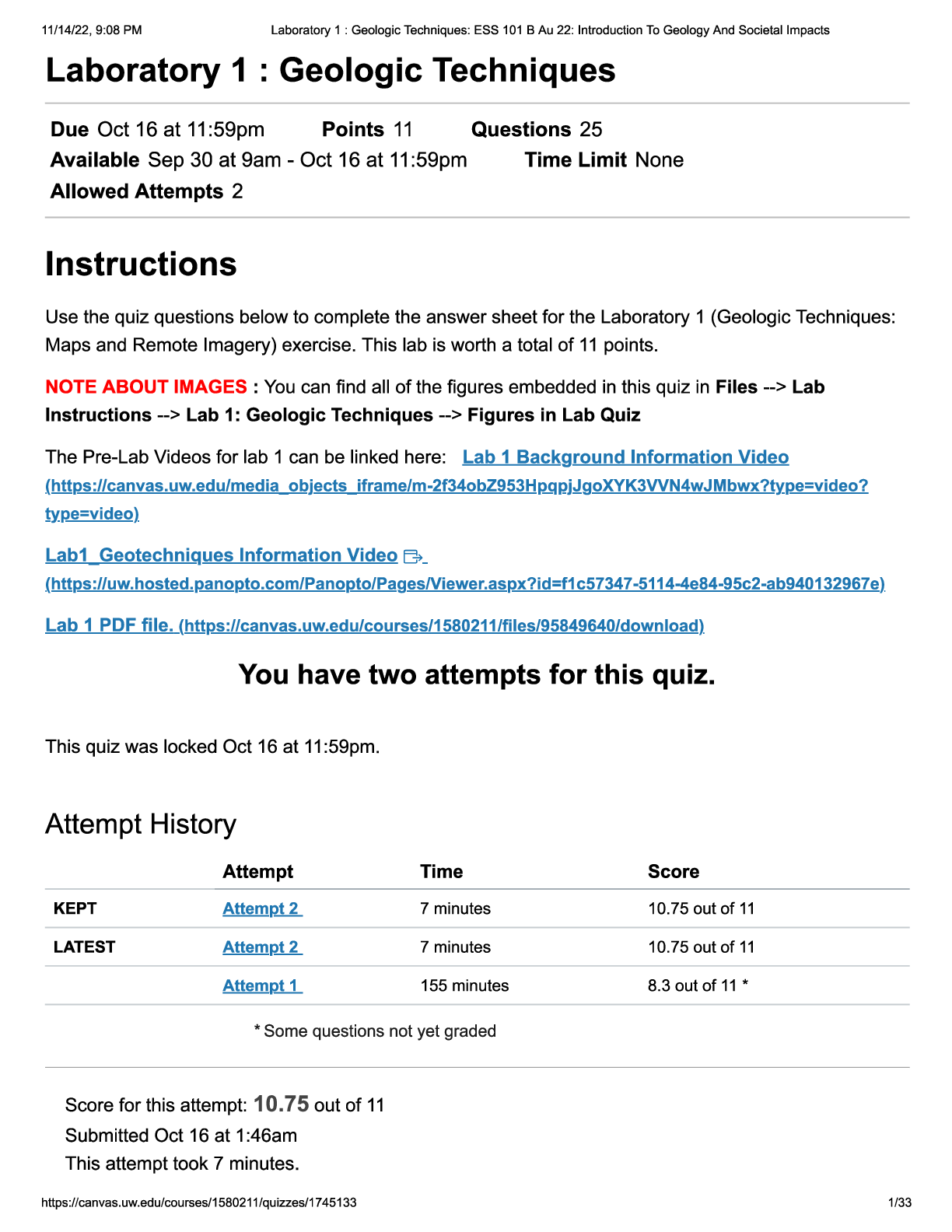
Due Feb 1 at 11:59pm Points 26 Questions 17 Time Limit None
Allowed Attempts 2
Instructions
Attempt History
Attempt Time Score
LATEST Attempt 1 102 minutes 20.78 out of 26
! Correct answers
...
Lab Exercise: Minerals
Due Feb 1 at 11:59pm Points 26 Questions 17 Time Limit None
Allowed Attempts 2
Instructions
Attempt History
Attempt Time Score
LATEST Attempt 1 102 minutes 20.78 out of 26
! Correct answers are hidden.
Score for this attempt: 20.78 out of 26
Submitted Feb 1 at 2:34pm
This attempt took 102 minutes.
This exercise covers minerals and mineral properties. You will need to use the information
contained in chapters 1 and 2 of the laboratory manual to complete this laboratory exercise.
This exercise does not have a time limit. You may only submit this exercise 2 times. Your highest
grade will be recorded.
Take the Quiz Again
Question 1 1 / 1 pts
Definition of a mineral.
Geologists define a mineral as any naturally occurring, inorganic solid,
with an orderly crystalline structure and a definite chemical composition.
1. Naturally occurring. Minerals form through natural geologic
processes. A mineral cannot be a manmade substance. A synthetic
diamond or emerald is not considered a true mineral because it is not
Lab Exercise: Minerals: GEOL-1403.295: Lab: Physical Geology https://collin.instructure.com/courses/869627/quizzes/1914005
1 of 23 2/1/21, 2:36 PMnaturally occurring.
2. Inorganic. An organic substance is a compound composed mostly of
oxygen, carbon and hydrogen where carbon atoms bond directly with
hydrogen atoms. Simple sugar, carbohydrate and fat (Figure 1) are
examples of organic substances. To be classified as a mineral, a
substance must be inorganic.
3. Solid. Minerals are solid substances, not liquid or gas.
4. Crystalline. The atoms that make up a mineral are arranged in an
orderly, repetitive manner. This orderly structure of atoms is reflected in
the regularly shaped objects called crystals.
5. Definite chemical composition. The composition of a mineral can
be expressed as a chemical formula that allows for some variation. A
chemical formula provides definite proportions of certain atoms. For
example, The chemical formula of quartz is expresses as SiO2 which
indicates that quartz consists of silicon (Si) and oxygen (O) atoms, in a
proportion of one-to-two.
Select all the characteristics below that make up the definition of a
mineral.
possess a definite crystalline form
inorganic material
possess a definite chemical composition
must be natural (not created by humans)
must be a solid material
Lab Exercise: Minerals: GEOL-1403.295: Lab: Physical Geology https://collin.instructure.com/courses/869627/quizzes/1914005
2 of 23 2/1/21, 2:36 PMQuestion 2 1 / 1 pts
____________ may become trapped within the crystalline structure of a
mineral, causing slight changes to mineral properties (such as color).
Impurities
Question 3 1 / 1 pts
Is petroleum (pictured below) a mineral? Select the properties of
petroleum that match the properties of minerals. A mineral must meet
all the criteria.
You may need to look up the material online if you are not familiar with
its properties.
Lab Exercise: Minerals: GEOL-1403.295: Lab: Physical Geology https://collin.instructure.com/courses/869627/quizzes/1914005
3 of 23 2/1/21, 2:36 PMNaturally occurring
Partial Partial Question 4 0.5 / 1 pts
Are glass bottles (pictured below) a mineral? Select the properties of
glass bottles that match the properties of minerals. A mineral must meet
all the criteria.
You may need to look up the material online if you are not familiar with
its properties
[Show More]