CHAPTER 9
Capital Budgeting Criteria
True/False
1. Errors resulting from a capital budgeting decision are not considered major since the consequences of
such errors average out over the life of the investment.
ANSWE
...
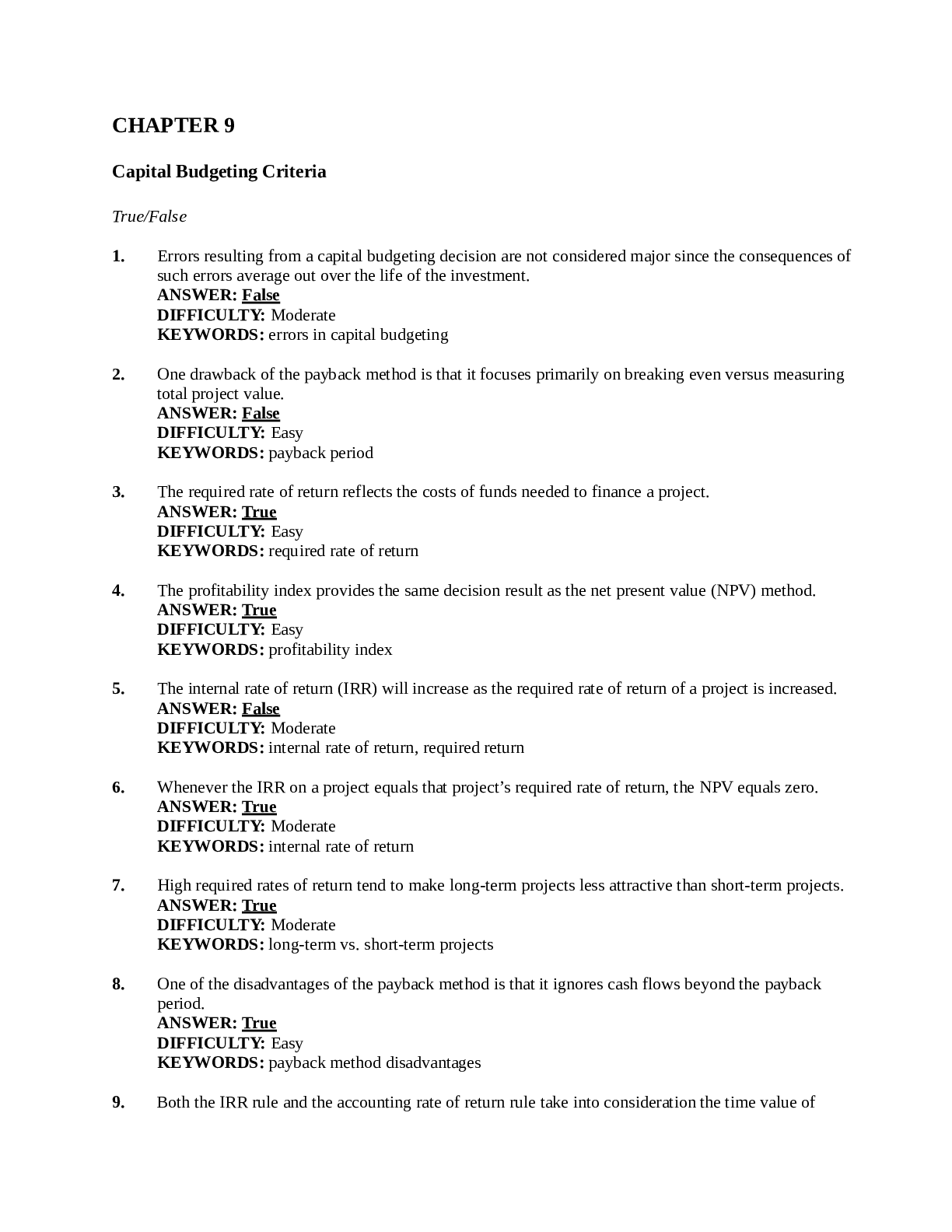
CHAPTER 9
Capital Budgeting Criteria
True/False
1. Errors resulting from a capital budgeting decision are not considered major since the consequences of
such errors average out over the life of the investment.
ANSWER: False
DIFFICULTY: Moderate
KEYWORDS: errors in capital budgeting
2. One drawback of the payback method is that it focuses primarily on breaking even versus measuring
total project value.
ANSWER: False
DIFFICULTY: Easy
KEYWORDS: payback period
3. The required rate of return reflects the costs of funds needed to finance a project.
ANSWER: True
DIFFICULTY: Easy
KEYWORDS: required rate of return
4. The profitability index provides the same decision result as the net present value (NPV) method.
ANSWER: True
DIFFICULTY: Easy
KEYWORDS: profitability index
5. The internal rate of return (IRR) will increase as the required rate of return of a project is increased.
ANSWER: False
DIFFICULTY: Moderate
KEYWORDS: internal rate of return, required return
6. Whenever the IRR on a project equals that project’s required rate of return, the NPV equals zero.
ANSWER: True
DIFFICULTY: Moderate
KEYWORDS: internal rate of return
7. High required rates of return tend to make long-term projects less attractive than short-term projects.
ANSWER: True
DIFFICULTY: Moderate
KEYWORDS: long-term vs. short-term projects
8. One of the disadvantages of the payback method is that it ignores cash flows beyond the payback
period.
ANSWER: True
DIFFICULTY: Easy
KEYWORDS: payback method disadvantages
9. Both the IRR rule and the accounting rate of return rule take into consideration the time value of
money.
ANSWER: False
DIFFICULTY: Moderate
KEYWORDS: internal rate of return, accounting rate of return
10. In general, all discounted cash flow criteria are consistent and will give similar accept-reject decisions.
ANSWER: True
DIFFICULTY: Moderate
KEYWORDS: discounted cash flow criteria, accept-reject decisions
11. When several sign reversals in the cash flow stream occur, the IRR equation can have more than one
positive IRR.
ANSWER: True
DIFFICULTY: Moderate
KEYWORDS: multiple internal rates of return
12. Many firms today continue to use the payback method but employ the NPV or IRR methods as
secondary decision methods of control for risk.
ANSWER: False
DIFFICULTY: Moderate
KEYWORDS: payback, net present value, internal rate of return
13. The required rate of return represents the cost of capital for a project.
ANSWER: True
DIFFICULTY: Easy
KEYWORDS: required rate of return, cost of capital
14. The IRR assumes that cash flows are reinvested at the cost of capital.
ANSWER: False
DIFFICULTY: Easy
KEYWORDS: internal rate of return, reinvestment assumption
15. According to the modified internal rate of return (MIRR) technique, when a project’s MIRR is greater
than its cost of capital, the project should be accepted.
ANSWER: True
DIFFICULTY: Moderate
KEYWORDS: MIRR acceptance criteria
16. If the NPV of a project is zero, then the profitability index should equal one.
ANSWER: True
DIFFICULTY: Moderate
KEYWORDS: net present value, profitability index
17. The net present value profile is a graph showing how a project’s NPV changes as the IRR changes.
ANSWER: False
DIFFICULTY: Moderate
KEYWORDS: net present value profile
18. If the NPV of a project is positive, the profitability index must be greater than one.
ANSWER: True
DIFFICULTY: Moderate
KEYWORDS: net present value, profitability index
19. It is possible for a project to have more than one IRR if there is more than one sign change in the aftertax cash flows due to the project.
ANSWER: True
DIFFICULTY: Moderate
KEYWORDS: multiple IRRs
20. The higher the discount rate, the more valued is the proposal with the early cash flows.
ANSWER: True
DIFFICULTY: Moderate
KEYWORDS: discount rate and value
21. If the project’s payback period is greater than or equal to zero, the project should be accepted.
ANSWER: False
DIFFICULTY: Moderate
KEYWORDS: payback period
22. The NPV of a project will equal zero whenever the payback period of a project equals the required rate
of return.
ANSWER: False
DIFFICULTY: Moderate
KEYWORDS: net present value, payback period
23. The NPV of a project will equal zero whenever the average rate of return equals the required rate of
return.
ANSWER: False
DIFFICULTY: Moderate
KEYWORDS: net present value, required rate of return
24. The IRR is the discount rate that equates the present value of the project’s future net cash flows with
the project’s initial outlay.
ANSWER: True
DIFFICULTY: Moderate
KEYWORDS: internal rate of return
25. If a project’s profitability index is less than 0.0, then the project should be rejected.
ANSWER: False
DIFFICULTY: Moderate
KEYWORDS: profitability index
26. A single project can only have one NPV, PI, and IRR.
ANSWER: False
DIFFICULTY: Moderate
KEYWORDS: multiple IRRs
27. Competitive market forces make it imperative for a firm to have a systematic strategy for generating
capital-budgeting projects.
ANSWER: True
DIFFICULTY
[Show More]












.png)
.png)










.png)

.png)


