Question 2 2 / 2 points
The first step in planning and scheduling a project is to develop the .
PERT/CPM network diagram work breakdown structure
variance calculations for each activity employee scheduling
...
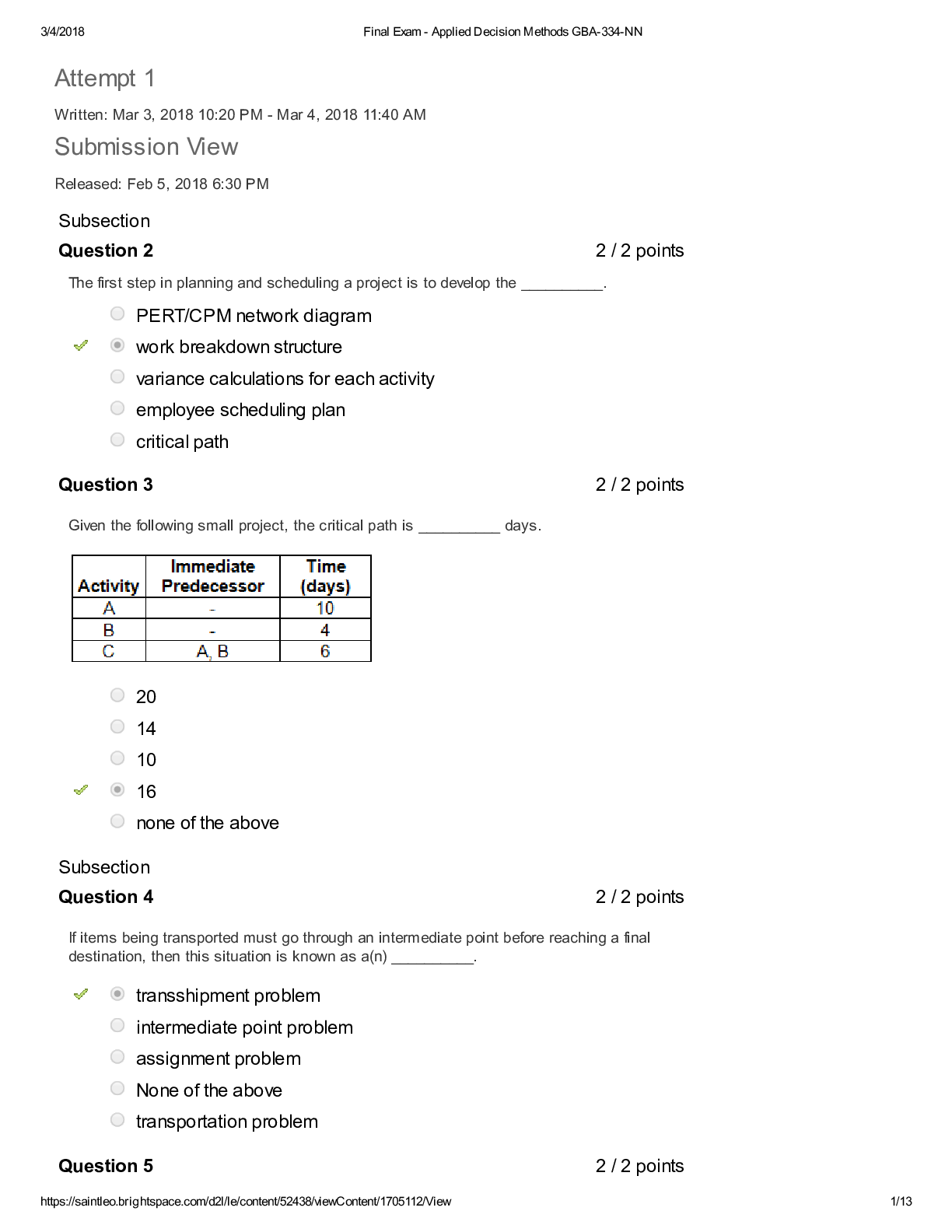
Question 2 2 / 2 points
The first step in planning and scheduling a project is to develop the .
PERT/CPM network diagram work breakdown structure
variance calculations for each activity employee scheduling plan
critical path
Question 3 2 / 2 points
Given the following small project, the critical path is days.
20
14
10
16
none of the above
Subsection
Question 4 2 / 2 points
If items being transported must go through an intermediate point before reaching a final destination, then this situation is known as a(n) .
transshipment problem intermediate point problem assignment problem
None of the above transportation problem
Question 5 2 / 2 points
Bank Boston has a branch at Bryant College. The branch is busiest at the beginning of the college year when freshmen and transfer students open accounts. This year, freshmen arrived at the office at a rate of 40 per day (assume 8-hour days). On average, it takes the Bank Boston staff person about ten minutes to process each account application. The bank is considering having one or two tellers. Each teller is paid $12 per hour and the cost of waiting in line is assumed to be $8 per hour.
What is the average number of people waiting to open accounts?
3.27
5.83
4.16
5.27
Question 6 2 / 2 points
A widely used mathematical programming technique designed to help managers and decision making relative to resource allocation is called .
None of the above constraint programming goal programming
linear programming computer programming
Question 7 2 / 2 points
A company can decide how many additional labor hours to acquire for a given week. Subcontractor workers will only work a maximum of 20 hours a week. The company must produce at least 200 units of product A, 300 units of product B, and 400 units of product C. In 1 hour of work, worker 1 can produce 15 units of product A, 10 units of product B, and 30 units of product C. Worker 2 can produce 5 units of product A, 20 units of product B, and 35 units of product C. Worker 3 can produce 20 units of product A, 15 units of product B, and 25 units of product C. Worker 1 demands a salary of $50/hr, worker 2 demands a salary of
$40/hr, and worker 3 demands a salary of $45/hr. The company must choose how many hours they should contract with each worker to meet their production requirements and minimize labor cost.
Assuming this is a linear programming problem, which of the following is the objective function?
Minimize 40X1 + 45X2 + 50X3 Maximize 40X1 + 45X2 + 50X3 Maximize 50X1 + 40X2 + 45X3
Minimize 50X1 + 40X2 + 45X3
Question 8 2 / 2 points
The following table represents a project with four activities. All times are in weeks.
Using the data in the table, what is the minimal expected completion tiime (in weeks) for the project?
19
37
18
11
None of the above
Question 9 2 / 2 points
The following table represents a project with four activities. All times are in weeks.
Using the data in the table, what is the critical path?
A-B-C-D B-D
A-B
None of the above A-C
Question 10 2 / 2 points
The following table represents a project with four activities. All times are in weeks.
According to the data in the table, there are four activities in the project. Assume the normal distribution is appropriate to use to determine the probability of finishing by a particular time. If you wished to find the probability of finishing the project in 20 weeks or fewer, it would be
necessary to find the variance and then the standard deviation to be used with the normal distribution. What variance would be used?
None of the above 12
2
4
8
[Show More]