1.
An 8-year-old child is receiving
digoxin (Lanoxin) for congestive heart
failure (CHF). In assessing the child,
the nurse finds that her apical heart
rate is 80 beats/min, she complains of
being slightly nauseate
...
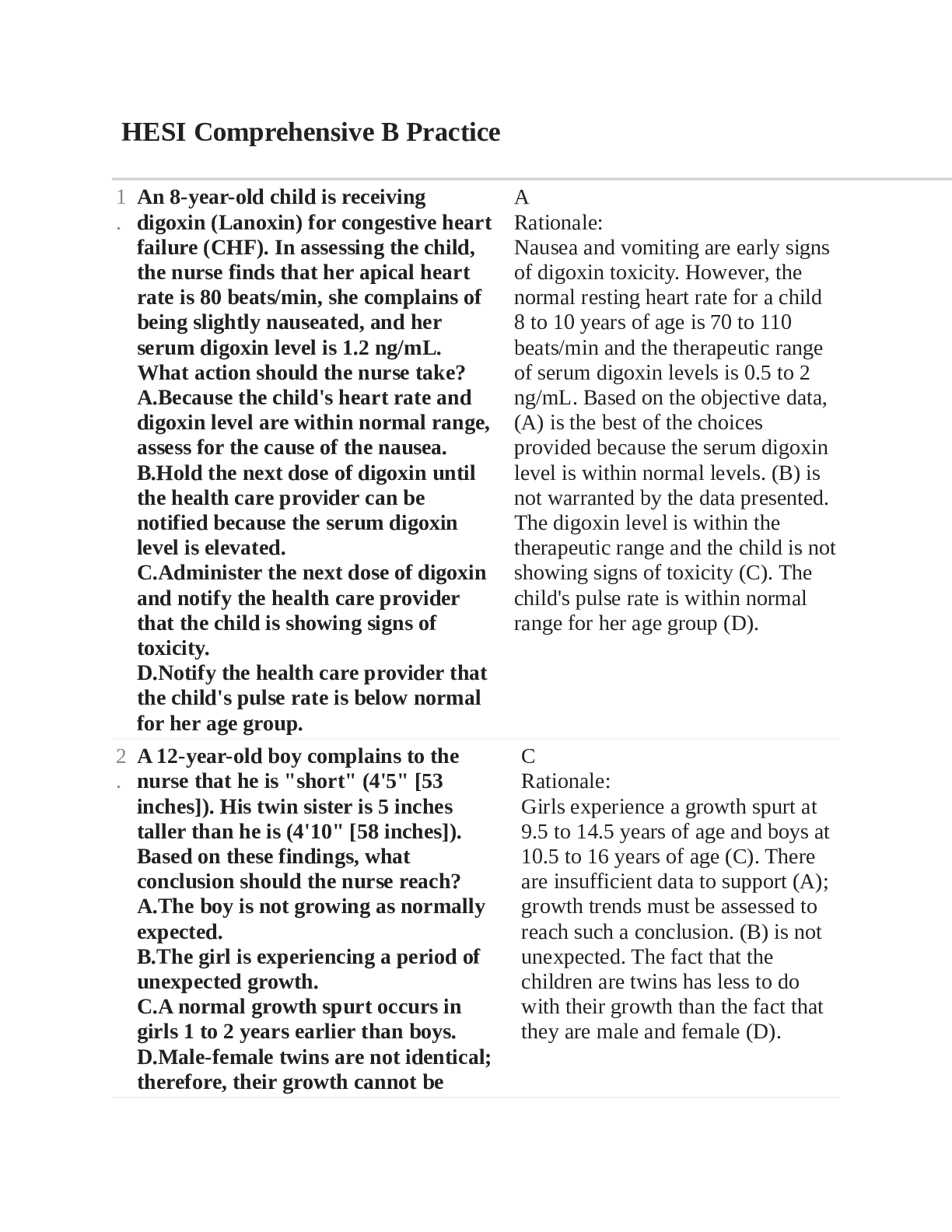
1.
An 8-year-old child is receiving
digoxin (Lanoxin) for congestive heart
failure (CHF). In assessing the child,
the nurse finds that her apical heart
rate is 80 beats/min, she complains of
being slightly nauseated, and her
serum digoxin level is 1.2 ng/mL.
What action should the nurse take?
A.Because the child's heart rate and
digoxin level are within normal range,
assess for the cause of the nausea.
B.Hold the next dose of digoxin until
the health care provider can be
notified because the serum digoxin
level is elevated.
C.Administer the next dose of digoxin
and notify the health care provider
that the child is showing signs of
toxicity.
D.Notify the health care provider that
the child's pulse rate is below normal
for her age group.
A
Rationale:
Nausea and vomiting are early signs
of digoxin toxicity. However, the
normal resting heart rate for a child
8 to 10 years of age is 70 to 110
beats/min and the therapeutic range
of serum digoxin levels is 0.5 to 2
ng/mL. Based on the objective data,
(A) is the best of the choices
provided because the serum digoxin
level is within normal levels. (B) is
not warranted by the data presented.
The digoxin level is within the
therapeutic range and the child is not
showing signs of toxicity (C). The
child's pulse rate is within normal
range for her age group (D).
2.
A 12-year-old boy complains to the
nurse that he is "short" (4'5" [53
inches]). His twin sister is 5 inches
taller than he is (4'10" [58 inches]).
Based on these findings, what
conclusion should the nurse reach?
A.The boy is not growing as normally
expected.
B.The girl is experiencing a period of
unexpected growth.
C.A normal growth spurt occurs in
girls 1 to 2 years earlier than boys.
D.Male-female twins are not identical;
therefore, their growth cannot be
C
Rationale:
Girls experience a growth spurt at
9.5 to 14.5 years of age and boys at
10.5 to 16 years of age (C). There
are insufficient data to support (A);
growth trends must be assessed to
reach such a conclusion. (B) is not
unexpected. The fact that the
children are twins has less to do
with their growth than the fact that
they are male and female (D).compared.
3.
A 45-year-old female client is admitted
to the psychiatric unit for evaluation.
Her husband states that she has been
reluctant to leave home for the last 6
months. The client has not gone to
work for a month, has been terminated
from her job, and has not left the
house since that time. This client is
displaying symptoms of which
disorder?
A.Claustrophobia
B.Acrophobia
C.Agoraphobia
D.Necrophobia
C
Rationale:
Agoraphobia (C) is the fear of
crowds or of being in an open
place. (A) is the fear of being in
closed places. (B) is the fear of high
places. (D) is an abnormal fear of
death or bodies after death. A
phobia is an unrealistic fear
associated with severe anxiety.
4.
An adult client with a medical
diagnosis of substance abuse and
schizophrenia was recently switched
from oral fluphenazine HCl (Prolixin)
to IM fluphenazine decanoate (Prolixin
Decanoate) because of medication
noncompliance. What should the nurse
teach the client and family about this
change in medication regimen?
A.Long-acting medication is more
effective than daily medication.
B.A client with substance abuse must
not take any oral medications.
C.There will continue to be a risk of
alcohol and drug interaction.
D.Support groups are only helpful for
substance abuse treatment.
C
Rationale:
Alcohol enhances the side effects of
Prolixin. The half-life of Prolixin
PO is 8 hours, whereas the half-life
of the Prolixin Decanoate IM is 2 to
4 weeks. Therefore, the side effects
of drinking alcohol are far more
severe when the client drinks
alcohol after taking the long-acting
Prolixin Decanoate IM (C). (A, B,
and D) provide incorrect
information.
5.
An adult female who presents at the
mental clinic trembling and crying
becomes distressed when the nurse
attempts to conduct an assessment.
She complains about the number of
questions that are being asked, which
D
Rationale:
The client is exhibiting signs of
moderate anxiety, which include
voice tremors, shakiness, somatic
complaints, and selective inattention.she is convinced are going to cause
her to have a heart attack. What
action should the nurse take?
A.Take the client's blood pressure
and reassure her that questioning
will not cause a heart attack.
B.Explain that treatment is based on
information obtained in the
assessment.
C.Encourage the client to relax so
that she can provide the information
requested.
D.Empower the client to share her
story of why she is here at the mental
health clinic.
[Show More]