Physics  >  QUESTIONS & ANSWERS  >  M2 - Data Sheets and Conceptual Questions. Physics. All Calculations and Working Indicated and Expla (All)

M2 - Data Sheets and Conceptual Questions. Physics. All Calculations and Working Indicated and Explained.

Document Content and Description Below

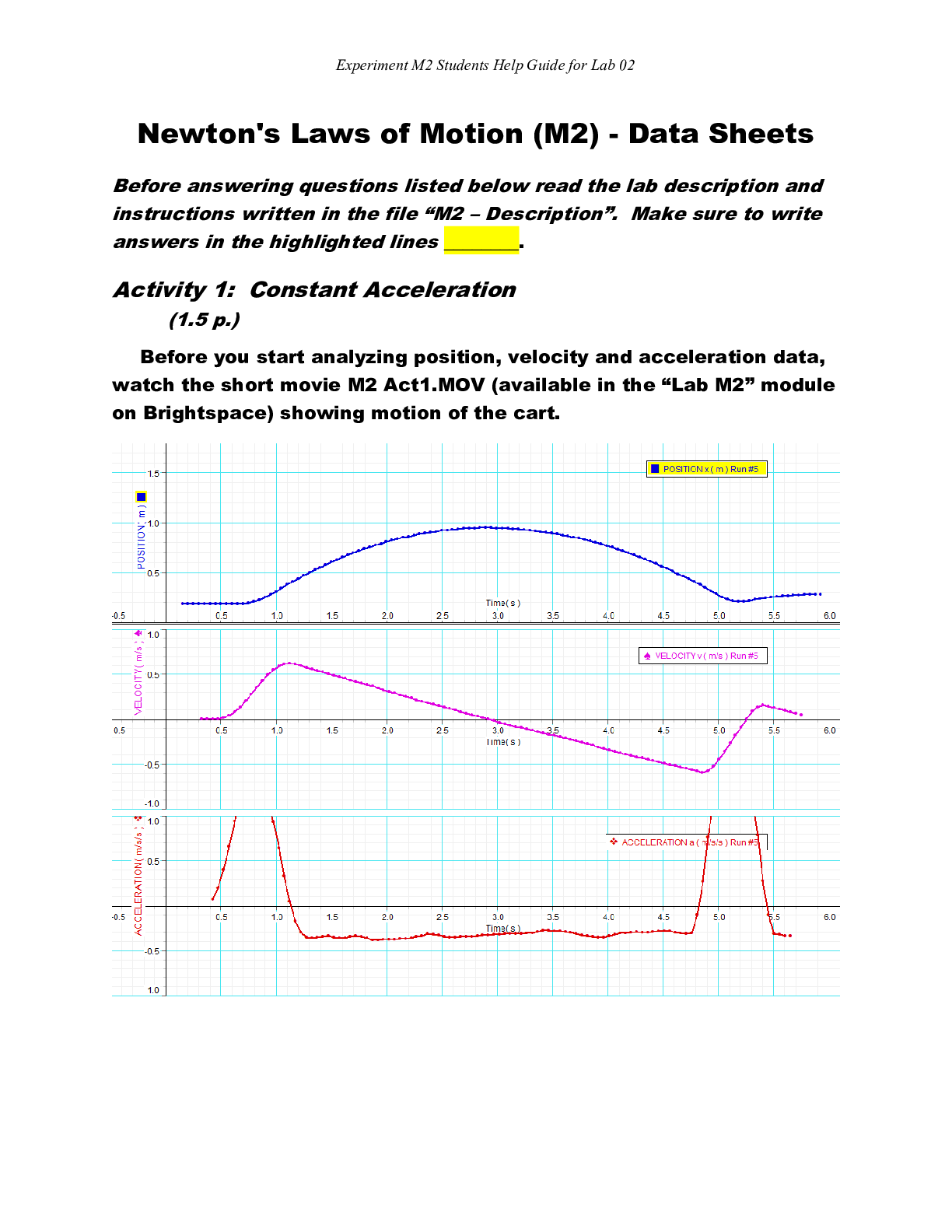
Newton's Laws of Motion (M2) - Data Sheets Before answering questions listed below read the lab description and instructions written in the file “M2 – Description”. Make sure to write answers ... in the highlighted lines ________. Activity 1: Constant Acceleration (1.5 p.) Before you start analyzing position, velocity and acceleration data, watch the short movie M2 Act1.MOV (available in the “Lab M2” module on Brightspace) showing motion of the cart. Acceleration values ( m/s2 ) Deviations from the average acceleration: Squared deviations from the average acceleration: 1 -0.347 -0.006 0.000036 2 -0.344 -0.003 0.000009 3 -0.342 -0.001 0.000001 4 -0.338 0.003 0.000009 5 -0.332 0.009 0.000081 Average = -0.341 Sum = 0.000136 Find the selected data points on the printout and clearly mark these points with a pen (for example, circle them). Average value of the acceleration: = -0.341 ( m/s2 ) (as average of five instantaneous accelerations). Calculate the standard deviation of acceleration sa using the formula given in the Error Analysis section of the lab manual. The final result of the acceleration measurements (1-6) should be written as: a = aAV ± sa {e.g., a = 0.43 ± 0.12 m/sec2} Show your work below: Therefore, the result for average acceleration is: Calculate the theoretical value of acceleration (c.f., Figure 3). Show your work! Measure the distance between the two outside legs supporting the track (use the ruler on the track to measure this value). l = ___1.435___ ( m ) The height of the aluminum block under one of the legs: h = 5.08 cm = 0.0508 m Calculate the absolute difference between experimental value and the theoretical value of acceleration: Calculate the percent difference between experimental value and the theoretical value of acceleration: Show your work. (use only two significant figures)   Activity 2: Newton's Second Law (1.5 p.) Before you start analyzing position, velocity and acceleration data, watch the short movie M2 Act2.MOV (available in the “Lab M2” module on Brightspace) showing motion of the cart. Find the selected data points on the printout and clearly mark these points with a pen (for example, circle them). Therefore, the result for average acceleration is: Calculate the theoretical value of acceleration. Calculate the absolute difference between experimental value and the theoretical value of acceleration. Show your work. Activity 3: Force Probe as Electronic Balance (0.5 p.) Activity 4: Newton's Third Law (0.5 p.) A. Attach the hooks of the two force probes together as shown in Figure 6. Pull on the two probes in opposite directions for a Keep the probes hooked together. Try to pull only one probe and do not pull the other one. Can you get a zero-force recorded by one probe and significantly non-zero force measured by the other probe? Can you really pull only one probe without pulling the other? (Yes or No) No Which physics law describes this situation? Newton’s Third Law of motion B. Attach probe “B” to the lab bench using the clamp and hold probe “A” in your hand. Complete all calculations and write results using this file. Write the answers to the Conceptual Questions on the next pages. Save the edited file under a new name showing your name, e.g. “M2 – John Smith”. This will be your lab report. Next, submit the file “M2 – John Smith” on Brightspace for grading.   Conceptual Questions (must be typed) 1. Weight of a book was measured using an electronic scale. The scale showed 8.0 N. Next, the book and the scale were placed in an elevator that does not show the floor number. When elevator started moving the reading of the scale has changed, but later was reading 8.0 N again. Can you tell if the elevator is moving upward or downward just by looking at the scale when it starts moving? Could you tell the direction of motion when the elevator is moving with a constant speed? Please, explain. 2. Consider two masses connected with a thin string as illustrated in Figure 8 - "Motion of two masses with friction". Assume that there is a significant friction between mass m1 and the supporting, horizontal surface. What must be the value of the coefficient of kinetic friction k for the two masses to move at a constant velocity? The constant velocity means that the acceleration a = 0. Derive the formula for k relative to masses m1 and m2. Remember that the condition for constant velocity is that the sum of forces acting on mass m1 must be equal to zero. Figure 8. Motion of two masses with friction. Write the answers to the Conceptual Questions below this line. - Yes, you can tell the direction when the elevator starts moving [Show More]

Last updated: 3 years ago

Preview 1 out of 10 pages

Buy Now

Instant download

We Accept:

Payment methods accepted on Scholarfriends (We Accept)
Preview image of M2 - Data Sheets and Conceptual Questions. Physics. All Calculations and Working Indicated and Explained. document

Buy this document to get the full access instantly

Instant Download Access after purchase

Buy Now

Instant download

We Accept:

Payment methods accepted on Scholarfriends (We Accept)

Reviews( 0 )

$9.00

Buy Now

We Accept:

Payment methods accepted on Scholarfriends (We Accept)

Instant download

Can't find what you want? Try our AI powered Search

66
0

Document information


Connected school, study & course


About the document


Uploaded On

Sep 10, 2020

Number of pages

10

Written in

All

Seller


Profile illustration for QuizMaster
QuizMaster

Member since 6 years

1196 Documents Sold

Reviews Received
185
56
29
11
17
Additional information

This document has been written for:

Uploaded

Sep 10, 2020

Downloads

 0

Views

 66

Document Keyword Tags


$9.00
What is Scholarfriends

Scholarfriends.com Online Platform by Browsegrades Inc. 651N South Broad St, Middletown DE. United States.

We are here to help

We're available through e-mail, Twitter, Facebook, and live chat.
 FAQ
 Questions? Leave a message!

Follow us on
 Twitter

Copyright © Scholarfriends · High quality services·