Chapter 3 – Systems Analysis and Design – testbank – Dennis/Wixom/Roth – page 1
Multiple Choice
1. The outcome of the analysis phase is the:
a) Feasibility Analysis document
b) System proposal document
c) System spe
...
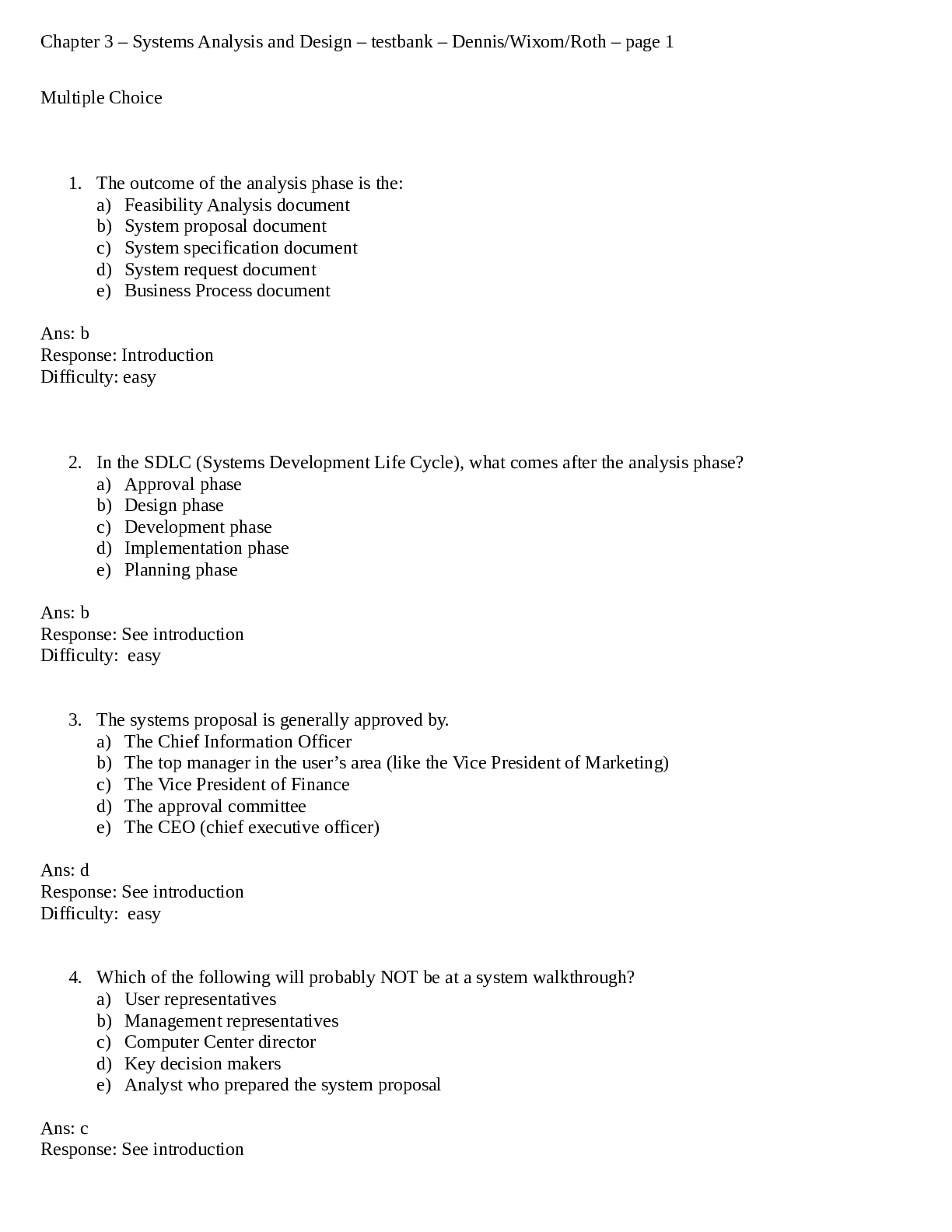
Chapter 3 – Systems Analysis and Design – testbank – Dennis/Wixom/Roth – page 1
Multiple Choice
1. The outcome of the analysis phase is the:
a) Feasibility Analysis document
b) System proposal document
c) System specification document
d) System request document
e) Business Process document
Ans: b
Response: Introduction
Difficulty: easy
2. In the SDLC (Systems Development Life Cycle), what comes after the analysis phase?
a) Approval phase
b) Design phase
c) Development phase
d) Implementation phase
e) Planning phase
Ans: b
Response: See introduction
Difficulty: easy
3. The systems proposal is generally approved by.
a) The Chief Information Officer
b) The top manager in the user’s area (like the Vice President of Marketing)
c) The Vice President of Finance
d) The approval committee
e) The CEO (chief executive officer)
Ans: d
Response: See introduction
Difficulty: easy
4. Which of the following will probably NOT be at a system walkthrough?
a) User representatives
b) Management representatives
c) Computer Center director
d) Key decision makers
e) Analyst who prepared the system proposal
Ans: c
Response: See introduction
Chapter 3 – Systems Analysis and Design – testbank – Dennis/Wixom/Roth – page 2
Difficulty: medium
5. The line between analysis and design is sometimes very blurry. One reason is that _____:
a) Object-oriented methods are generally fuzzier as compared to waterfall methods
b) there is inadequate funding for the analysis phase to do a complete analysis
c) analysts are generally rushed to complete the system proposal
d) scope creep has occurred
e) the deliverables are really the first step in the design of the new system
Ans: e
Response: See introduction
Difficulty: medium
6. Which is NOT a purpose of the requirements definition?
a) To give a very high-level explanation of the business requirements
b) A more precise list of requirements that can be used as inputs to the rest of analysis
c) Create functional requirements
d) Create cost/benefit analysis
e) Create non-functional requirements
Ans: d
Response: See requirements definition
Difficulty: medium
7. When determining requirements it is good to have all BUT ____ involved.
a) Managers in the business area
b) Analysts
c) Project Sponsors
d) Staff in the business area
e) Information technology staff
Ans: e
Response: See Determining Requirements
Difficulty : easy
8. An example of a functional requirement is _________
a) Access to the customer order system
b) System should be available in English and Spanish
c) System can be accessed through a Blackberry device
d) Output can be displayed in Internet Explorer, in Firefox, or in Google Chrome browsers
e) System is automatically updated every 5 seconds
Chapter 3 – Systems Analysis and Design – testbank – Dennis/Wixom/Roth – page 3
Ans: a
Response: See Requirements Determination
Difficulty: medium
9. An example of a nonfunctional requirement is ____________
a) Supplier table is available
b) The system must contain customer order history for three years
c) System can be used in any of 100 offices worldwide
d) SQL queries from customer table and order table are available
e) Customer zipcode is formatted as character data
Ans: c
Response: See Requirements Determination
Difficulty: medium
10. Which is generally NOT true of non-functional requirements?
a) Cultural differences can be considered
b) Color interpretations on screens and forms may be different in different geographical places
c) Multi-lingual interfaces many be needed
d) Systems may need to adapt from global solutions to local realities
e) Systems may need to have actual expenses from global operations
Ans: e
Response: See Requirements Determination
Difficulty: medium
Chapter 3 – Systems Analysis and Design – testbank – Dennis/Wixom/Roth – page 4
11. Which is NOT an expectation of the Requirements Definition?
a) Listing of functional requirements
b) Listing of project costs and benefits in both dollars and Euros
c) Listing of non-functional requirements
d) Defining scope of project
e) To be the document that is used for clarification when problems arise.
a. Ans: b
Response: See Requirements definition
Difficulty: medium
[Show More]