NR 509 Shadow Health Comprehensive Assessment SOAP NOTE
Economics > EXAM > FRL 306MT2-Sp19-Practice-Key. PRACTICE MIDTERM EXAM II - KEY. All Questions Answered. (All)
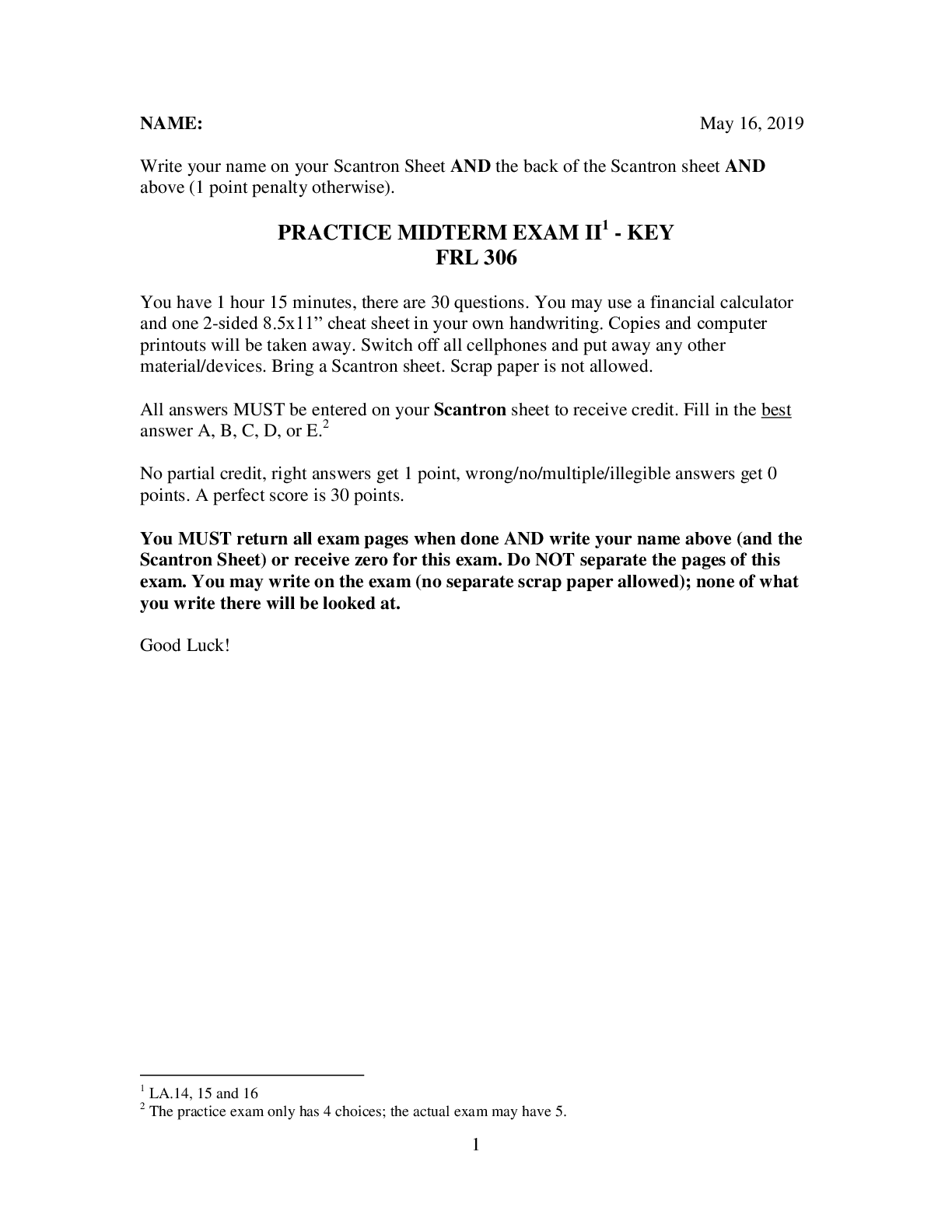
PRACTICE MIDTERM EXAM II - KEY FRL 306 You have 1 hour 15 minutes, there are 30 questions. You may use a financial calculator and one 2-sided 8.5x11” cheat sheet in your own handwriting. Copies ... and computer printouts will be taken away. Switch off all cellphones and put away any other material/devices. Bring a Scantron sheet. Scrap paper is not allowed. All answers MUST be entered on your Scantron sheet to receive credit. Fill in the best answer A, B, C, D, or E. No partial credit, right answers get 1 point, wrong/no/multiple/illegible answers get 0 points. A perfect score is 30 points. You MUST return all exam pages when done AND write your name above (and the Scantron Sheet) or receive zero for this exam. Do NOT separate the pages of this exam. You may write on the exam (no separate scrap paper allowed); none of what you write there will be looked at. 1. Required by the Truth-in-Lending Act, the annual percentage rate (APR) is reported by the lender to the borrower on virtually all U.S. home mortgage loans. The APR accounts for all of the following EXCEPT: 2. 2. For the purposes of estimating the effective borrowing cost (EBC), only those up-front expenses associated with obtaining the mortgage should be included. With this in mind, which of the following costs should not be included in one's calculation of EBC? 3. Partially amortizing mortgage loans require periodic payments of principal, but are not paid off completely over the loan's term to maturity. Instead, the balance of the principal amount is paid at maturity in what is commonly referred to as a: 4. With the recent popularity of adjustable-rate mortgages (ARM), lenders have begun to offer ARMs with different adjustment periods. Which of the following ARM choices will most likely have the highest initial rate? 5. To encourage borrowers to accept adjustable rate mortgages (ARMs) rather than level-payment mortgages, mortgage originators generally offer an initial short-term introductory rate that is less than the prevailing market mortgage rate. This rate is referred to as a(n): 6. Given the following information on a fixed-rate loan, determine the maximum amount that the lender will be willing to provide to the borrower. Loan Term: 30 years, Monthly Payment: $800, Interest Rate: 6%. 7. Given the following information on a 30-year fixed-payment loan, determine the remaining balance that the borrower has at the end of seven years. Interest Rate: 7%, Monthly Payment: $1,200. 8. Given the following information, calculate the balloon payment for a partially amortized mortgage. Loan amount: $84,000, Term to maturity: 7 years, Amortization Term: 30 years, Interest rate: 4.5%, Monthly Payment: $425.62. 9. Given the following information, calculate the lender's yield. Loan amount: $166,950, Term: 30 years, Interest rate: 8 %, Payment: $1,225.00, Discount points: 2. 10. Given the following information, calculate the effective borrowing cost (EBC). Loan amount: $166,950, Term: 30 years, Interest rate: 8 %, Payment: $1,225.00, Discount points: 2, Other Closing Expenses: $3,611. 11. Considering the following information, what is the NPV if the borrower refinances the loan? Expected holding period: 15 years, Current loan balance: $100,000, Current loan interest: 9 %, Current loan remaining term 15 years; New loan interest: 7.5 %, Cost of refinancing: $4,250; New loan term: 15 years 12. Jane Doe took out a 15 year, 6% fixed rate LPM mortgage loan for $300,000 exactly 5 years ago. The terms were set so that she would owe a balloon payment of $100,000 at maturity. If she only made scheduled payments, what is her outstanding loan balance? 13. Refer to problem 14. Current mortgage rates have risen to 8%. What is the maximum price the lender could sell Jane Doe’s (five year-old) mortgage for in the secondary market? 14. Refer to problem 14. Jane Doe is considering a refi into a 30-year fully amortizing 5% LPM. Fees for the new mortgage are 2 discount points, plus $2,000 in other fees, and there is no prepayment penalty on the old mortgage. What is her effective borrowing cost, expressed as an MEY, if she intends to keep the new mortgage for 5 years? 15. John Doe just took out a 2/6 fully amortizing 30-year ARM for $500,000, with a teaser rate of 4%. The mortgage has an annual reset to a 250bps spread above the 1-year CMT rate. Currently, this rate is 3%, and on the 1 year anniversary of origination it will be 4%. What are his monthly mortgage payments in first year? 16. Refer to the previous problem. What are his payments in the second year? 17. Risk is the possibility that actual outcomes will vary from what was expected when the asset was purchased. If investors require a higher rate of return for undertaking more risk, the underlying assumption is that investors are: 18. The internal rate of return (IRR) and the net present value (NPV) are tools that are widely used in real estate investment and finance decision making. An investor would most likely pursue an investment if which of the following circumstances was true? 19. Suppose an investor deposits $2,500 in an interest-bearing account at her local bank. The account pays 2.5% interest compounded annually. If the investor plans on withdrawing the original principal plus accumulated interested at the end of 7 years, what is the total amount that she should expect to receive assuming interest rates do not change? 20. Suppose that a tenant is interested in renting out a two-bedroom apartment for $1000 a month for the next year. While the landlord requires rent to be paid at the beginning of the month, he will not be depositing the rental check into a local savings account until the end of each month. If the annual interest that the landlord can earn on this account is 5% and interest is compounded monthly, how much will he have in his savings account at the end of the year? 21. A buyer has a $20,000 down-payment for a $200,000 home purchase. She can obtain a 90% LTV (standard, i.e., 30yr, fully amortizing, fixed rate, level payment) mortgage at 5%, or an 80% (standard) mortgage at 4.5% MEY. At a note rate for a second mortgage exceeding which of the following does it make financial sense to take the 90% option rather than the 80% + piggyback? Assume all mortgages will be held for 30 years without curtailment. 22. Assume that an individual puts $10,000 into a savings account that pays 3% interest compounded monthly with the intent to withdraw the balance in 5 years to buy a car. If he does not make any further deposits over this period, how much will the individual be able to put towards his purchase? 23. Suppose an investor is interested in purchasing the following income producing property at a current market price of $450,000. The prospective buyer has estimated the expected cash flows over the next four years to be as follows: Year 1 = $40,000, Year 2 = $45,000, Year 3 = $50,000, Year 4 = $55,000. Assuming that the required rate of return is 12% and the estimated proceeds from selling the property at the end of year four is $500,000, what is the NPV of the project? 24. An investor just purchased an office building for $100,000. He knows for certain that he can sell the building for $110,000 in 5 years. Approximately how much does he need to charge in annual rent in order to achieve a 15% annual return on the deal? 25. One of the main differences between residential mortgage loans and permanent financing of commercial real estate lies in the allocation of liability in the case of default. In commercial real estate, a “bankruptcy remote” special-purpose entity is created that shields the actual borrower from personal liability. When a lender cannot lay claim to the personal assets of the defaulted borrower, this type of loan is commonly referred to as a: 26. While balloon mortgage loan payments are typically based on a 30-year amortization schedule, the loan actually matures in either 3, 5, 7, or 10 years. Of the following, which is the primary risk that a lender reduces their exposure to through the relatively short loan term on a balloon mortgage? 27. While floating rate mortgage loans may offer lower interest rates to borrowers than comparable fixed-payment mortgages, floating-rate loans may increase a lender’s exposure to which of the following risks since borrowers may not be able to continue to service the debt if payments on the loan increase significantly? 28. There are a number of alternatives when it comes to the capital structure for acquisitions of commercial real estate. Through which of the following lending relationships does the lender have the right to foreclose on the equity of the borrower’s company in the case of default? 29. The use of financial leverage by real estate investors can be a double-edged sword. All of the following statements regarding the use of financial leverage by real estate investors are true EXCEPT: 30. Relative to residential loans, the underwriting process for commercial loans is more complicated. The commercial loan underwriting process focuses first on which of the following? [Show More]
Last updated: 3 years ago
Preview 1 out of 7 pages
Buy this document to get the full access instantly
Instant Download Access after purchase
Buy NowInstant download
We Accept:

Can't find what you want? Try our AI powered Search
Connected school, study & course
About the document
Uploaded On
Sep 10, 2020
Number of pages
7
Written in
All
This document has been written for:
Uploaded
Sep 10, 2020
Downloads
0
Views
114
Scholarfriends.com Online Platform by Browsegrades Inc. 651N South Broad St, Middletown DE. United States.
We're available through e-mail, Twitter, Facebook, and live chat.
FAQ
Questions? Leave a message!
Copyright © Scholarfriends · High quality services·