NURSING6650 final exam • • Question 1 1 out of 1 points In a group therapy session for adolescents, a 15-year-old patient says he has trouble making conversation with people he does not know well. Based on the principle
...
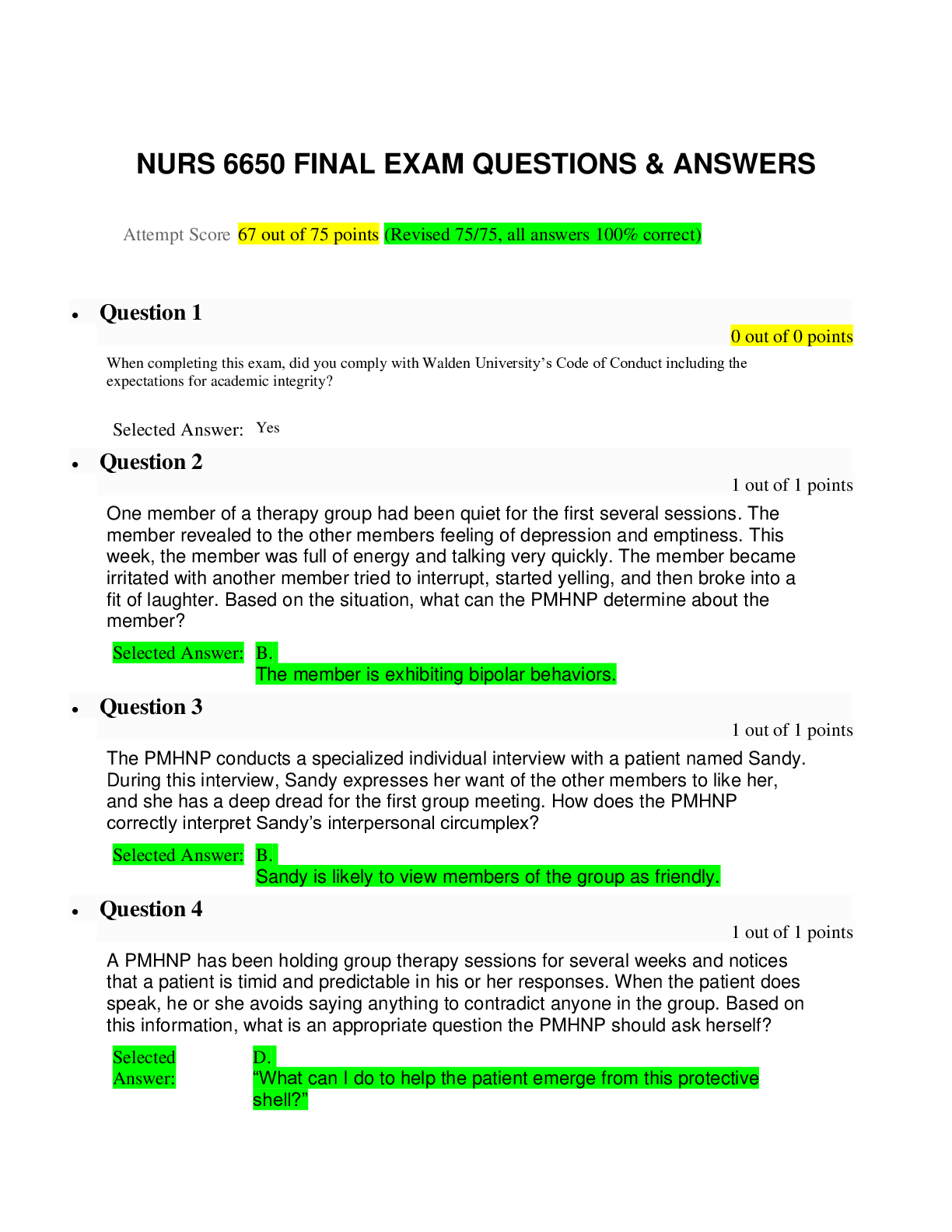
NURSING6650 final exam • • Question 1 1 out of 1 points In a group therapy session for adolescents, a 15-year-old patient says he has trouble making conversation with people he does not know well. Based on the principle of development of socializing techniques, what explicit approach might the PMHNP take? • Question 2 1 out of 1 points One group member is identified by the PMHNP as the monopolist of the group. Which behavior does the PMHNP believe this member is most likely to display? • Question 3 1 out of 1 points During a first group therapy session, a member is outgoing and participates actively. Based on this information, what is an appropriate prediction about this group member by the PMHNP? • Question 4 1 out of 1 points A 21-year-old client with narcissistic traits is noted to continuously disrupt the group by speaking while others are speaking. It becomes evident that the client is purposely disrupting the group and decreasing the group’s productivity. What does the PMHNP identify as a cause of the client’s behavior? • Question 5 1 out of 1 points Harold Wyman is a 74-year-old man who is trying to mend a relationship with his adult daughter. Based on his intake assessment, the PMHNP believes that the father has depression. The daughter and Harold meet with the PMNHP, and the daughter explains that her father always appears mopey and withdrawn and refuses to do anything about it. When asked, the father reports feeling sad all the time. Which action will the PMNHP employ with Harold using the interpersonal psychotherapy approach throughout the various sessions? • Question 6 1 out of 1 points A PMHNP is leading a group therapy session for patients with substance abuse problems. After a productive session in which all members participated, the following week was not as productive. In order to help the group members assume responsibility for evaluating the meeting, what is an appropriate comment for the PMHNP to make? • Question 7 1 out of 1 points During the “mid-group debrief” the clinical supervisor focused on the following areas with the two counselors except: • Question 8 1 out of 1 points The social microcosm theory is a theory that relates to group composition. In accordance with this theory, the PMHNP is aware that the group must consist of which of the following? • Question 9 0 out of 1 points Peter, a successful businessman, is introduced to the group during the twelfth week. Following Peter’s introduction, Joseph, a long-term member in the group, begins to lead the group and discuss all of the things that he has personally accomplished. In what way does the PMHNP correctly interpret Joseph’s behavior? • Question 10 0 out of 1 points The PMHNP conducts a specialized individual interview with a patient named Sandy. During this interview, Sandy expresses her want of the other members to like her, and she has a deep dread for the first group meeting. How does the PMHNP correctly interpret Sandy’s interpersonal circumplex? • Question 11 1 out of 1 points When discussing the role of the consultant in the parenting group session, Dr. Carlson explains that the consultant should use several skills in order to help keep the group going and should enable group members to become very engaged with one another. The consultant should use all of the following skills to achieve this, except: • Question 12 1 out of 1 points A PMHNP is meeting with parents and their 10-year-old child. The child is having trouble paying attention at school and has been getting easily frustrated at home when doing homework, which often results in everyone arguing. What step might the PMHNP take as part of a family-centered, solution-oriented approach? • Question 13 0 out of 1 points The PMHNP is meeting with an adult woman and her father, who is 85 years old. The father stays quiet most of the session. The daughter explains he is mad at her for “bringing him to a see a shrink.” The daughter reports that things have been tense in the house since her father moved in. The father has a history of depression, though he does not take any medication for it. In addition, lately the father seems to never sleep. “I hear him rummaging around in the kitchen, the garage, the living room, at all hours of the night. Sometimes he’ll nap during the day, but not much. This is putting a strain on my marriage, because my husband can’t sleep with all of this going on.” Which therapeutic approach does the PMHNP identify as most appropriate for the 85-year-old father? • Question 14 1 out of 1 points During an initial meeting, a PMHNP spends time speaking with a patient who suffers from social anxiety. The therapist finds the patient extremely loud and overbearing. The PMHNP’s negative feelings continue no matter how hard he or she tries to feel differently toward the patient. What is the most appropriate next step by the PMHNP? • Question 15 1 out of 1 points A patient has had a problem with substance use and has been receiving treatment for addiction. Which additional step might the PMHMP suggest to help the patient maintain abstinence from drugs during and after treatment? • Question 16 0 out of 1 points The leader begins a group meeting by doing the “names activity.” At the completion of the activity, the leader explains that the activity is useful for all of the following reasons, except: • Question 17 1 out of 1 points A 36-year-old client attends group therapy regularly but is consistently tardy. The client explains that job and family obligations interfere with attendance to the group. What is the most appropriate intervention by the PMHNP? • Question 18 0 out of 1 points Group participation is an important aspect of how successful group therapy will be. The PMHNP recognizes that the gender of group participants can play a role in the likelihood of group participation. Which statement about gender and group composition does the PMHNP take into account? • Question 19 0 out of 1 points When the counselor discussed assertiveness with the group members, she began the session by providing definitions and asking group members to line up consistent with where they feel they are currently in terms of assertiveness. Why did she do this? • Question 20 1 out of 1 points A patient in group therapy named Ted shares personal information for the first time. He seems nervous but continues to talk. How might the PMHNP use nonverbal positive reinforcement to support Ted’s feeling more comfortable? • Question 21 1 out of 1 points Members of a therapy group have been meeting for several months. During group therapy, a patient is bossy and controlling. During this week’s session, she is confronted by another group member about her behavior and replies, “This is not how I normally act. You are not my family and friends. I don’t act the same way around them.” What can the PMHNP deduce from her behavior? • Question 22 1 out of 1 points A PNHNP is holding a group therapy session for a father and his 10-year-old son, whom the father explains has been acting out lately. The son says, “He is always telling me what to do and never listens when I have an idea.” Which solution would the PMHNP most likely suggest as an approach to the problem? • Question 23 0 out of 1 points A PMHNP is treating a patient in individual therapy and thinks the patient may be a good candidate for group therapy. The patient is motivated to start group therapy, which meets twice a month. Then the patient adds, “I can come to the first two meetings, but then will be away on business for at least a month, maybe longer. But then I can come to the at least one meeting before my next trip.” Based on this information, what is the most likely recommendation by the PMHNP? • Question 24 1 out of 1 points Members of a therapy group have been meeting for several weeks. While a member named Margaret is talking about how her spouse ignores her when she tries to tell him what to do, another member named Nicole interrupts and says, “Maybe he thinks you are being bossy.” Margaret replies by saying, “At least I’m not an alcoholic like you are!” What is an appropriate response by the PMHNP? • Question 25 1 out of 1 points A 9-year-old child who witnessed a fatal car accident has come to therapy with her parents to get treatment. The child has been irritable since the event and has not wanted to talk about it. Utilizing a trauma-focused cognitive behavior therapy (TF-CBT) approach, the PMHNP has reviewed skills that the parents may use to help their child at home. Based on the PMHNP’s suggestion, which is a statement the parents might make after the child has a temper tantrum? • Question 26 0 out of 1 points During the first group meeting, a client states, “I am here because I am very shy. I don’t mesh well with others and I rarely get invitations to go anywhere.” Which statement about the client’s reason for seeking help and treatment best applies? • Question 27 1 out of 1 points A client is observed discussing many problems and complaints during group therapy. However, when other group members attempt to offer advice, the client does not accept it. Based on this observation, what can the PMHNP determine about the client? • Question 28 1 out of 1 points During a group therapy session, a member comments that another member named Ted had no compassion. Ted replies, “Why does it matter if I care one way or another. I can’t solve their problems.” The other member starts crying and blames Ted for this. He shrugs and answers, “I don’t understand why you are crying.” Based on this information, what is the most likely determination the PMHNP can make about Ted? • Question 29 1 out of 1 points Jane has been attending group therapy for the past year; she and the therapist have determined that she has met her goals. Jane has been arriving to group late or not coming to group at all. How does the PMHNP correctly interpret Jane’s behavior? • Question 30 1 out of 1 points A PMHNP is treating an 8-year-old child who was at a cousin’s house during a domestic violence situation. Using a common factors model, the PMHNP wants to pay attention to cultivating the relationship with the parents and child. After the child talks about how nervous he or she has been since witnessing the trauma, what is an appropriate response by the PMHNP? • Question 31 1 out of 1 points The PMHNP is meeting with a married couple. The husband is 81 years old, and the wife is 78 years old. They tell the PMHNP that many of their friends have passed away over the last couple of years, and it’s making them feel sentimental about their lives and the fact that they are getting older. Hearing this, the PMHNP uses a life review approach with the couple. What action will the PMHNP employ? • Question 32 0 out of 1 points A
[Show More]