AF 302testbank.pdf
Chapter 1: Doing Business in Digital Times
Test Bank
Multiple Choice
1. Food manufacturers must be able to trace all ingredients ________ in case of contamination
or recall.
a. Along their suppl
...
AF 302testbank.pdf
Chapter 1: Doing Business in Digital Times
Test Bank
Multiple Choice
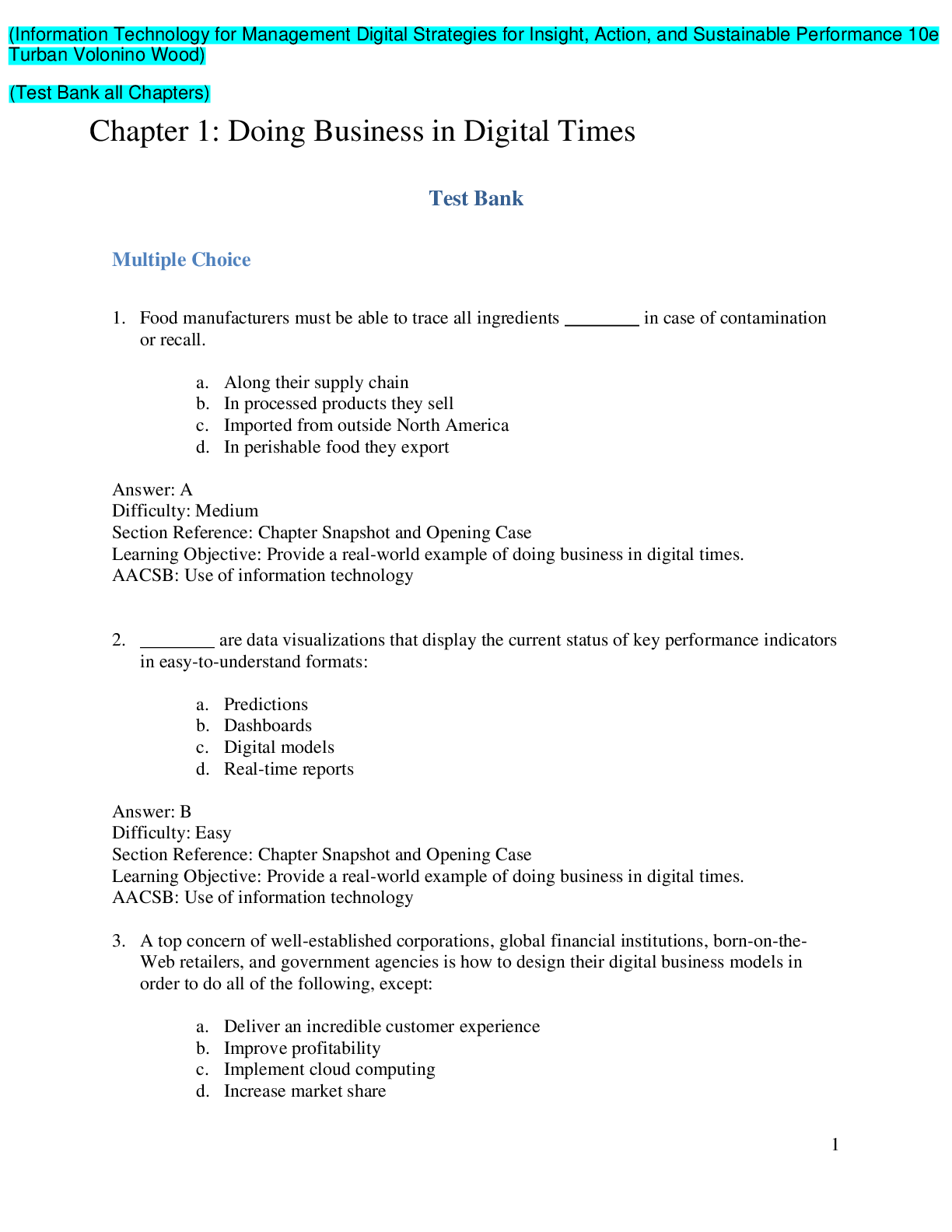
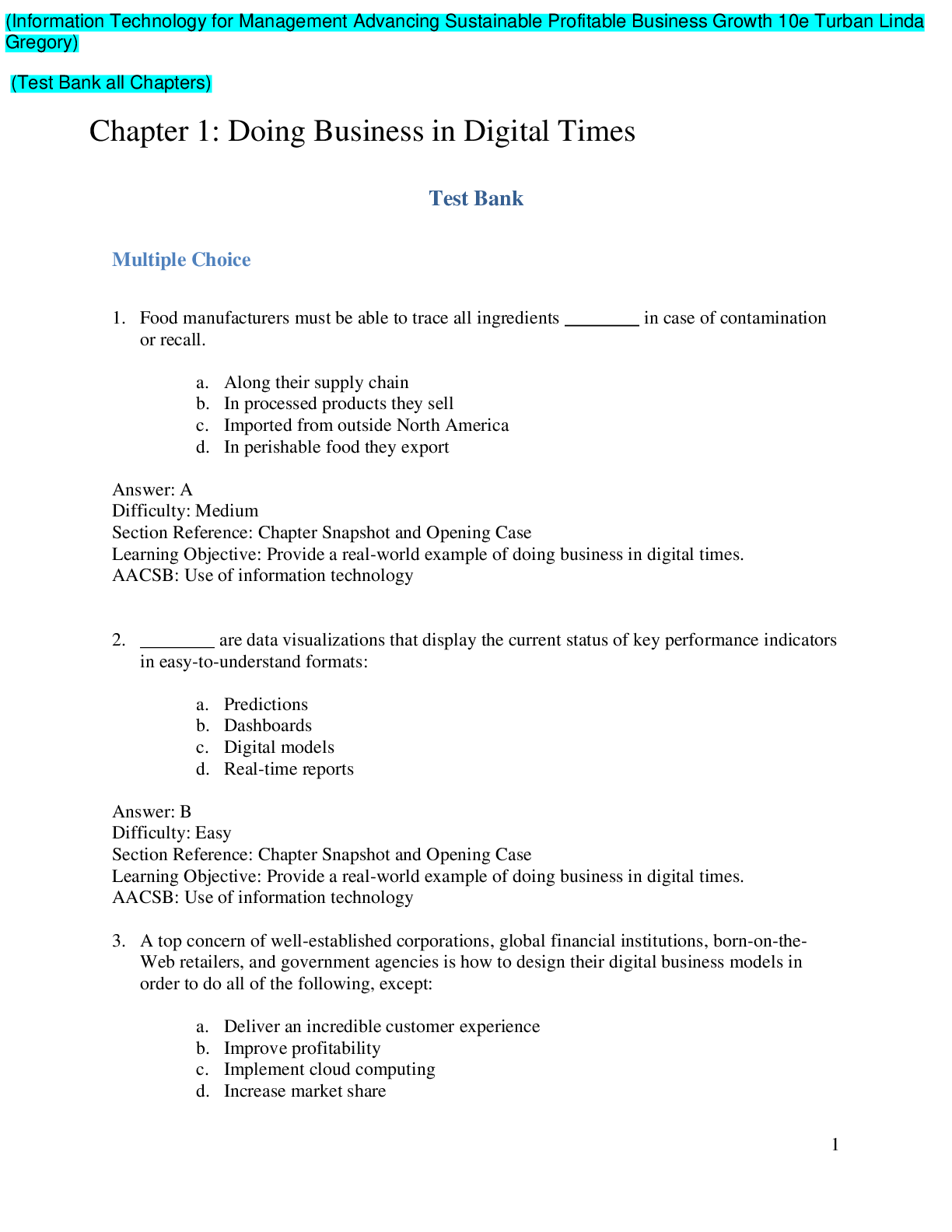
1. Food manufacturers must be able to trace all ingredients ________ in case of contamination
or recall.
a. Along their supply chain
b. In processed products they sell
c. Imported from outside North America
d. In perishable food they export
Answer: A
Difficulty: Medium
Section Reference: Chapter Snapshot and Opening Case
Learning Objective: Provide a real-world example of doing business in digital times.
AACSB: Use of information technology
2. ________ are data visualizations that display the current status of key performance indicators
in easy-to-understand formats:
a. Predictions
b. Dashboards
c. Digital models
d. Real-time reports
Answer: B
Difficulty: Easy
Section Reference: Chapter Snapshot and Opening Case
Learning Objective: Provide a real-world example of doing business in digital times.
AACSB: Use of information technology
3. A top concern of well-established corporations, global financial institutions, born-on-the-
Web retailers, and government agencies is how to design their digital business models in
order to do all of the following, except:
a. Deliver an incredible customer experience
b. Improve profitability
c. Implement cloud computing
d. Increase market share
Answer: C
Difficulty: Medium
Section Reference: Every Business is a Digital Business
Learning Objective: Describe the use of digital technology in every facet of business and how
digital channels are being leveraged.
AACSB: Analytic skills
4. Forrester research repeatedly confirms there is a strong relationship between the quality of a
firm's ________, which in turn increases revenue.
a. Mobile apps and business transactions
b. IoT capabilities and KPIs
c. Business model and marketing efforts
d. Customer experience and loyalty
Answer: D
Difficulty: Hard
Section Reference: Every Business is a Digital Business
Learning Objective: Describe the use of digital technology in every facet of business and how
digital channels are being leveraged.
AACSB: Use of information technology
5. Enterprises can acquire the latest business apps and digital services as they are needed and
without large upfront investments by switching from owning IT resources to ________.
a. cloud computing
b. private data centers
c. data synchronization
d. machine-to-machine technology
Answer: A
Difficulty: Medium
Section Reference: Every Business is a Digital Business
Learning Objective: Describe the use of digital technology in every facet of business and how
digital channels are being leveraged.
AACSB: Use of information technology
6. Amazon Elastic Compute Cloud, known as EC2, eliminates the need to invest in hardware up
front, so companies can develop and deploy applications faster. EC2 reduces the time it takes
to acquire server space from ________.
a. weeks to minutes
b. weeks to days
c. months to weeks
d. months to days
Answer: A
Difficulty: Medium
Section Reference: Every Business is a Digital Business
Learning Objective: Describe the use of digital technology in every facet of business and how
digital channels are being leveraged.
AACSB: Use of information technology
7. Machine-to-machine (M2M) technology enables sensor-embedded products to share reliable
real-time data ________.
a. over short distances
b. via radio signals
c. using cloud services
d. via databases
Answer: B
Difficulty: Hard
Section Reference: Every Business is a Digital Business
Learning Objective: Describe the use of digital technology in every facet of business and how
digital channels are being leveraged.
AACSB: Reflective thinking skills
8. An estimated ________ % of big data are unstructured.
a. 25
b. 33
c. 50
d. 80
Answer: D
Difficulty: Medium
Section Reference: Every Business is a Digital Business
Learning Objective: Describe the use of digital technology in every facet of business and how
digital channels are being leveraged.
AACSB: Reflective thinking skills
9. The field of ________ involves managing and analyzing massive sets of data for purposes
such as target marketing, trend analysis, and the creation of individually tailored products
and services.
a. Data science
b. Cloud computing
c. Machine-to-machine technology
d. Business models
Answer: A
Difficulty: Medium
Section Reference: Every Business is a Digital Business
Learning Objective: Describe the use of digital technology in every facet of business and how
digital channels are being leveraged.
AACSB: Reflective thinking skills
10. All of the following are examples of the influence of social, mobile, and cloud technologies
except ________.
a. Connections and feedback via social networks have changed the balance of
influence.
b. Customers expect to use location-aware services, apps, alerts, social networks,
and the latest digital capabilities at work and outside work.
c. Customer loyalty and revenue growth depend on a business’ ability to offer
unique customer experiences that wow customers more than competitors can.
d. Consumers are less likely to trust tweets from ordinary people than
recommendations made by celebrity endorsements.
Answer: D
Difficulty: Hard
Section Reference: Every Business is a Digital Business
Learning Objective: Describe the use of digital technology in every facet of business and how
digital channels are being leveraged.
AACSB: Reflective thinking skills
11. Zipcar has pioneered the car rental by the hour business model. What technology enables
Zipcar to lease cars for short time spans to registered members?
a. Social networks
b. Mobiles
c. Sensors
d. Wearables
Answer: C
Difficulty: Hard
Section Reference: Every Business is a Digital Business
Learning Objective: Describe the use of digital technology in every facet of business and how
digital channels are being leveraged.
AACSB: Reflective thinking skills
12. Which if the following is not an example of the Internet of Things is being used by
businesses?
a. A network of ground sensors that allow agricultural operations to adjust the
amount of fertilizer and water applied to specific field locations.
b. Sensors in shoppers club cards that make it possible for retailers to offer discounts
or promotions to consumers at the point of sale.
c. Sensors in rental cars that allow companies to base rates on the driving behavior
of their customers
d. Sensors on packages of cereal, pasta, soup or other food products made for
children that allow companies to determine young consumer’s satisfaction with
the nutritional value of the product.
Answer: D
Difficulty: Medium
Section Reference: Every Business is a Digital Business
Learning Objective: Describe the use of digital technology in every facet of business and how
digital channels are being leveraged.
AACSB: Use of information technology
13. Examples of _____________ that can be facilitated by digital technologies are credit
approval, opening a new account, order fulfillment, and shipping a product.
a. Strategic activities
b. Business processes
c. Planning activities
d. Competitive advantages
Answer: B
Difficulty: Hard
Section Reference: Business Process Management and Improvement
Learning Objective: Explain the types, sources, characteristics, and control of enterprise data,
and what can be accomplished with near-real-time data.
AACSB: Use of information technology
14. The goal of _________ is to eliminate unnecessary non–value added processes, then to
simplify and automate the remaining processes to reduce cycle time, labor, and costs
a. Strategic planning
b. Business process reengineering
c. Real-time information systems
d. Business Intelligence
Answer: B
Difficulty: Easy
Section Reference: Business Process Management and Improvement
Learning Objective: Explain the types, sources, characteristics, and control of enterprise data,
and what can be accomplished with near-real-time data.
AACSB: Use of information technology
15. All functions and departments in the enterprise have tasks that they need to complete to
produce outputs or ________ in order to meet their ________.
a. deliverables; objectives
b. business processes; budgets
c. milestones; deliverables
d. processes; business model
Answer: A
Difficulty: Medium
Section Reference: Business Process Management and Improvement
Learning Objective: Explain the types, sources, characteristics, and control of enterprise data,
and what can be accomplished with near-real-time data.
AACSB: Use of information technology
16. AutoTrader redesigned its legacy order fulfillment process in order ________
a. To process hundreds of orders and contracts each month
b. To document how tasks were performed
c. To reduce cycle time
d. To move processing to the cloud
Answer: C
Difficulty: Medium
Section Reference: Business Process Management and Improvement
Learning Objective: Explain the types, sources, characteristics, and control of enterprise data,
and what can be accomplished with near-real-time data.
AACSB: Use of information technology
17. What are the basic components of business processes?
a. Inputs and outputs
b. Data, knowledge, and activities
c. People, technology, and outputs
d. Inputs, activities, and deliverables
Answer: D
Difficulty: Hard
Section Reference: Business Process Management and Improvement
Learning Objective: Explain the types, sources, characteristics, and control of enterprise data,
and what can be accomplished with near-real-time data.
AACSB: Use of information technology
18. Routine formal processes are referred to as ________.
a. cross-functional processes
b. standard operating procedures
c. business tasks
d. standardized transactions
Answer: B
Difficulty: Medium
Section Reference: Business Process Management and Improvement
Learning Objective: Explain the types, sources, characteristics, and control of enterprise data,
and what can be accomplished with near-real-time data.
AACSB: Use of information technology
19. Applying IT to a manual or outdated process will _________:
a. Minimize cycle time
b. Not optimize the process
c. Eliminate wasted steps
d. Improve the outputs
Answer: B
Difficulty: Hard
Section Reference: Business Process Management and Improvement
Learning Objective: Explain the types, sources, characteristics, and control of enterprise data,
and what can be accomplished with near-real-time data.
AACSB: Use of information technology
20. Which of the following is not a goal of business process reengineering?
a. eliminate unnecessary or non-value-added processes
b. simplify and automate remaining processes
[Show More]


.png)
.png)
.png)
.png)


.png)
.png)