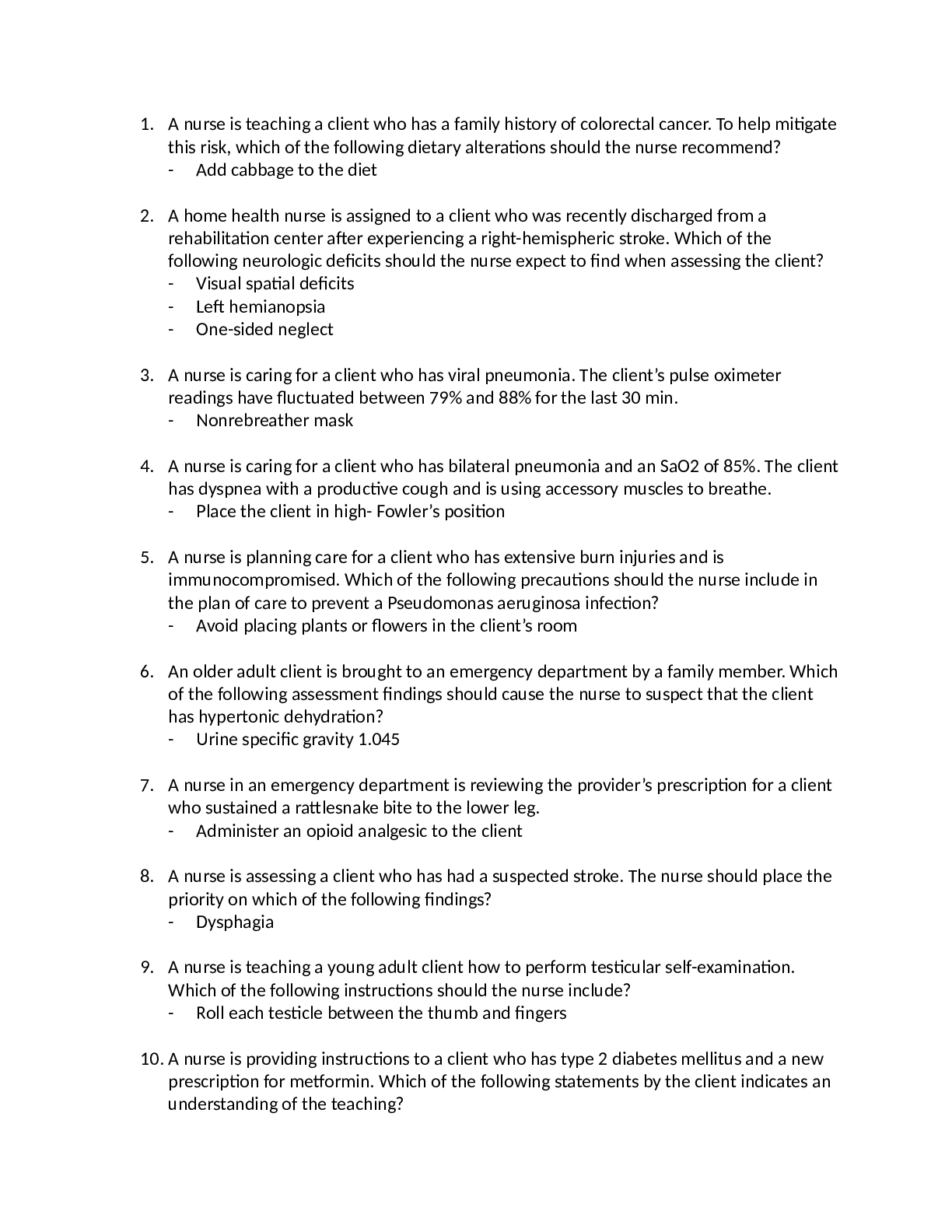
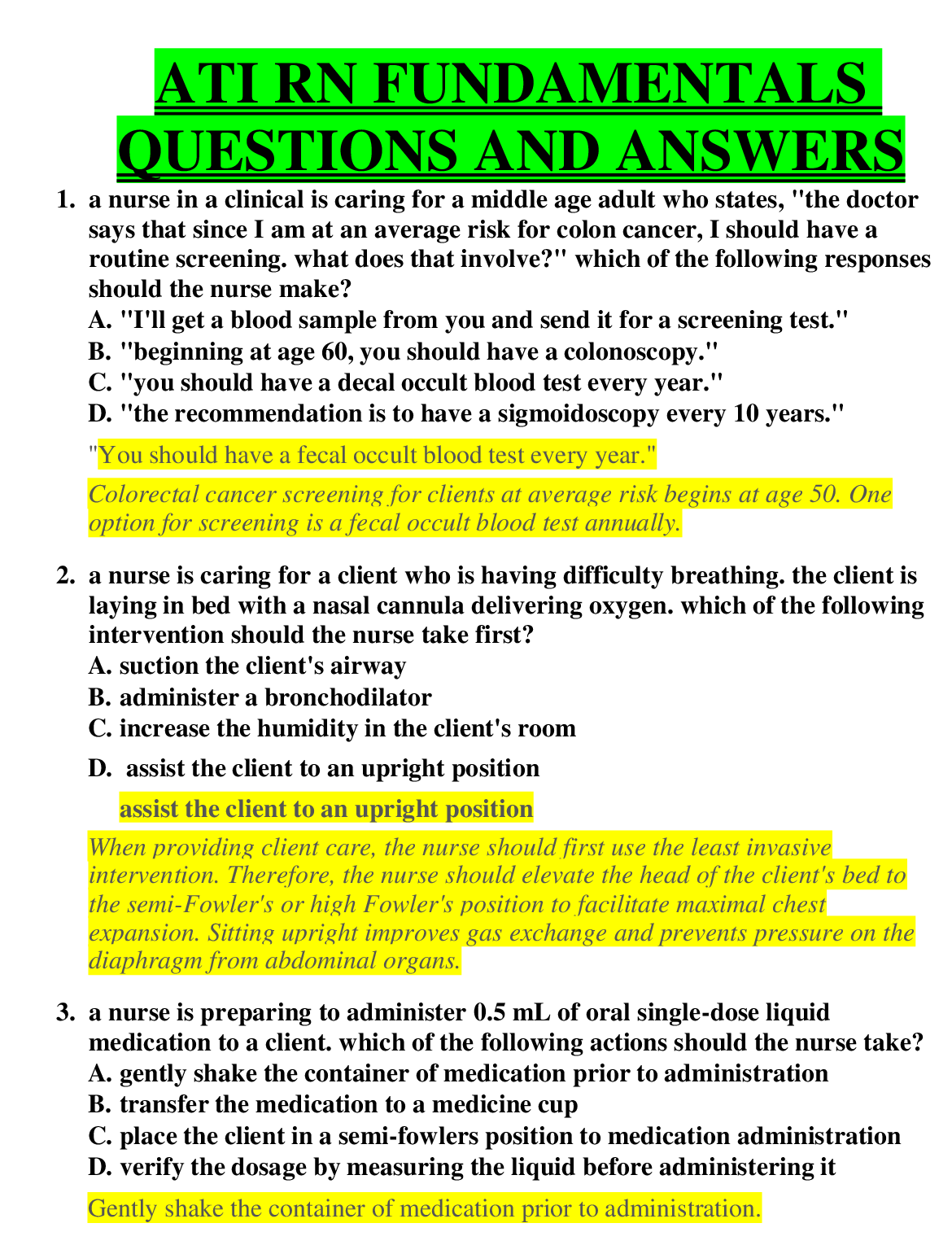
A nurse is teaching a client who has a family history of colorectal cancer. To help mitigate
this risk, which of the following dietary alterations should the nurse recommend?
-
2. A home health nurse is assigned to a
...
A nurse is teaching a client who has a family history of colorectal cancer. To help mitigate
this risk, which of the following dietary alterations should the nurse recommend?
-
2. A home health nurse is assigned to a client who was recently discharged from a
rehabilitation center after experiencing a right-hemispheric stroke. Which of the
following neurologic deficits should the nurse expect to find when assessing the client?
3. A nurse is caring for a client who has viral pneumonia. The client’s pulse oximeter
readings have fluctuated between 79% and 88% for the last 30 min.
-
4. A nurse is caring for a client who has bilateral pneumonia and an SaO2 of 85%. The client
has dyspnea with a productive cough and is using accessory muscles to breathe.
5. A nurse is planning care for a client who has extensive burn injuries and is
immunocompromised. Which of the following precautions should the nurse include in
the plan of care to prevent a Pseudomonas aeruginosa infection?
6. An older adult client is brought to an emergency department by a family member. Which
of the following assessment findings should cause the nurse to suspect that the client
has hypertonic dehydration?
7. A nurse in an emergency department is reviewing the provider’s prescription for a client
who sustained a rattlesnake bite to the lower leg.
-
8. A nurse is assessing a client who has had a suspected stroke. The nurse should place the
priority on which of the following findings?
9. A nurse is teaching a young adult client how to perform testicular self-examination.
Which of the following instructions should the nurse include?
10. A nurse is providing instructions to a client who has type 2 diabetes mellitus and a new
prescription for metformin. Which of the following statements by the client indicates an
understanding of the teaching?
11. A nurse is teaching a client who has venous insufficiency about self-care. Which of the
following statements should the nurse identify as an indication that the client
understands the teaching?
12. A nurse is assessing a client who has acute cholecystitis. Which of the following findings
is the nurse’s priority?
13. A nurse is reviewing the health record of a client who is scheduled for allergy skin
testing. The nurse should postpone the testing and report to the provider which of the
following findings?
14. A nurse is caring for a group of clients. The nurse should plan to make a referral to
physical therapy for which of the following clients?
15. A nurse is caring for a client who has diabetic ketoacidosis (DKA). Which for the following
laboratory findings should the nurse expect?
16. A nurse is planning teaching for a client who has bladder cancer and is to undergo a
cutaneous diversion procedure to establish a ureterostomy. Which of the following
statements should the nurse include in the teaching?
17. A nurse is providing teaching for a female client who has recurrent urinary tract
infections. Which of the following information should the nurse include in the teaching?
18. A nurse and an assistive personnel (AP) are caring for a client who has bacterial
meningitis. The nurse should give the AP which of the following instructions?
-
19. A nurse is caring for a client who is 12 hr postoperative following a total hip arthroplasty.
Which of the following actions should the nurse take?
-
20. A nurse in a provider’s office is assessing a client who has migraine headaches and is
taking feverfew to prevent headaches. The nurse should identify that which of the
following client medications interacts with feverfew?
21. A nurse is caring for a client who has pancreatitis. The nurse should expect which of the
following laboratory results to be below the expected reference range?
22. A nurse is providing discharge instructions to a client following an upper gastrointestinal
series with barium contrast. Which of the following information should the nurse
provide?
23. A nurse is assessing a client who had extracorporeal shock wave lithotripsy (ESWL) 6 hr
ago. Which of the following findings should the nurse expect?
- Stone fragments in the urine
24. A nurse is assessing a group of clients for indications of role changes. The nurse should
identify that which of the following clients is at risk for experiencing a role change?
25. A nurse is caring for a client who has a new diagnosis of hyperthyroidism. Which of the
following is the priority assessment finding that the nurse should report to the provider?
-
26. A nurse is providing discharge instructions to a client who has a partial-thickness burn on
the hand. Which of the following instructions should the nurse include?
27. A nurse is providing teaching to a client who is receiving chemotherapy and has a new
prescription for epoetin alfa. Which of the following client statements indicates an
understanding of the teaching?
-
28. A nurse is providing discharge teaching to a client who has heart failure and a new
prescription for a potassium-sparing diuretic. Which of the following information should
the nurse include in the teaching?
-
29. A nurse is caring for a client who has HIV. Which of the following findings indicates a
positive response to the prescribed HIV treatment?
30. A nurse is caring for a client who is postoperative following a total hip arthroplasty.
Which of the following laboratory values should the nurse report to the provider?
31. A nurse is assessing a client who has had a plaster cast applied to their left leg 2 hr ago.
32. A nurse is providing teaching to a client who has chronic kidney disease and a new
prescription for erythropoietin.
33. A nurse is caring for a client who is undergoing hemodialysis to treat end-stage kidney
disease (ESKD). The client reports muscle cramps and a tingling sensation in their hands.
-
34. A nurse in a community clinic is caring for a client who reports an increase in the
frequency of migraine headaches. To help reduce the risk for migraine headaches, which
of the following foods should the nurse recommend the client avoid?
35. A nurse is providing teaching to a female client who has a history of urinary tract
infections (UTIs).
36. A nurse is performing a dressing change for a client who is recovering from a
hemicolectomy. When removing the dressing, the nurse notes that a large part of the
bowel is protruding through the abdomen.
37. A nurse is preparing to administer a unit of packed RBCs to a client.
38. A nurse is evaluating a client who has a new diagnosis of type 1 diabetes mellitus. Which
of the following client statements indicates the client is successfully coping with the
change?
39. A nurse is caring for a client who has a closed head injury and has an intraventricular
catheter placed. Which of the following findings indicates that the client is experiencing
increased intracranial pressure (ICP)? (Select all that apply)
40. A nurse is planning to provide discharge teaching for the family of an older adult client
who has hemianopsia and is at risk for falls.
41. A nurse in an emergency department is caring for a client who reports vomiting and
diarrhea for the past 3 days. Which of the following findings should indicate to the nurse
that the client is experiencing fluid volume deficit?
42. A nurse is caring for a client who is on bed rest and has a new prescription for
enoxaparin subcutaneous. Which of the following actions should the nurse take?
43. A nurse in a provider’s office is caring for a client who requests sildenafil to treat erectile
dysfunction. Which of the following statements should the nurse make?
44. A nurse in an emergency department is assessing a client who has a detached retina.
Which of the following should the nurse expect the client to report?
45. A nurse is providing teaching to an older adult client who has cancer and a new
prescription for an opioid analgesic for pain management. Which of the following
information should the nurse include in the teaching?
-
46. A nurse is assessing a client following the administration of magnesium sulfate 1 g IV
bolus. For which of the following adverse effects should the nurse monitor?
47. A nurse is assessing a male client for an inguinal hernia. Which of the following areas
should the nurse palpate to verify that the client has an inguinal hernia?
48. A nurse is caring for a client who has type 1 diabetes mellitus and has had acute
bronchitis for the past 3 days. Which of the following statements should the nurse
include when instructing the client?
49. A nurse has received change-of-shift report for a group of clients. Which of the following
clients should the nurse assess first?
50. A nurse is caring for a client who has amyotrophic lateral sclerosis (ALS) and is being
admitted to the hospital with pneumonia. Which of the following assessment findings is
the nurse’s priority?
-
51. A nurse is creating a plan of care for a client who has neutropenia as a result of
chemotherapy. Which of the following interventions should the nurse include in the
plan?
- .
52. A nurse is providing teaching to a client who has hypothyroidism and is receiving
levothyroxine. The nurse should instruct the client that which of the following
supplements can interfere with the effectiveness of the medication?
-
53. A nurse is caring for a client who has anorexia, low-grade fever, night sweats, and a
productive cough. Which of the following actions should the nurse take first?
54. A nurse in an acute care facility is caring for a client who is at risk for seizures. Which of
the following precautions should the nurse implement?
55. A nurse is caring for a client who is receiving total parenteral nutrition (TPN). A new bag
is not available when the current infusion is nearly completed. Which of the following
actions should the nurse take?
56. A nurse is providing dietary teaching to a client who is postoperative following a
thyroidectomy with removal of the parathyroid glands. The nurse should instruct the
client to include which of the following foods that has the greatest amount of calcium in
her diet?
57. A nurse is caring for a client who is experiencing a tonic-clonic seizure. Which of the
following actions should the nurse take?
58. A nurse is performing a cardiac assessment for a client who had a myocardial infarction 3
days ago. Which of the following actions should the nurse take first after hearing the
following sound? (Click on the audio button to listen to the clip)
59. A nurse is providing teaching to a client who has a gastric ulcer and a new prescription
for omeprazole. The nurse should instruct the client that the medication provides relief
by which of the following actions?
60. A nurse is conducting an admission history for a client who is to undergo a CT scan with
an IV contrast agent. The nurse should identify that which of the following findings
requires further assessment?
-
61. A nurse is caring for a client who has portal hypertension. The client is vomiting blood
mixed with food after a meal. Which of the following actions should the nurse take first?
-
62. A nurse is planning care for a client who is undergoing brachytherapy via a sealed vaginal
implant to treat endometrial cancer. Which of the following actions should the nurse
include in the client’s plan of care?
-
63. A nurse is caring for a client who has a potassium level of 3 mEq/L. Which of the
following assessment findings should the nurse expect?
64. A nurse in an ICU is assessing a client who has a traumatic brain injury. Which of the
following findings should the nurse identify as a component of Cushing’s triad?
-
65. A nurse is providing preoperative teaching for a client who is scheduled for an open
cholecystectomy. Which of the following actions should the nurse take?
66. A nurse is caring for a client who has a leg cast and is returning demonstration on the
proper use of crutches while climbing stairs. Identify the sequence the client should
follow when demonstrating crutch use.
67. A nurse in an emergency department is caring for a client who is experiencing a thyroid
storm. Which of the following manifestations should the nurse expect? (Select all that
apply)
68. A nurse is caring for a client who has a prescription for enalapril. The nurse should
identify which of the following findings as an adverse effect of the medication?
69. A nurse is providing teaching to a client who has irritable bowel syndrome (IBS). Which
of the following instructions should the nurse include in the teaching?
70. A nurse is caring for a client who has a stage III pressure injury. Which of the following
findings contributes to delayed wound healing?
71. A nurse is caring for a client who is experiencing supraventricular tachycardia. Upon
assessing the client, the nurse observes the following findings: heart rate 200/min, blood
pressure 78/40 mm Hg, and respiratory rate 30/min. Which of the following actions
should the nurse take?
72. A nurse is caring for a client who presents to a clinic for a 1-week follow-up visit after
hospitalization for heart failure. Based on the information in the client’s chart, which of
the following findings should the nurse report to the provider? (Click on the Exhibit
button for additional information about the client. There are three tabs that contain
separate categories of data.)
73. A nurse is planning to irrigate and dress a clean, granulating wound for a client who has
a pressure injury. Which of the following actions should the nurse take?
74. A nurse is caring for a client who has a new prescription for total parenteral nutrition
(TPN) The client is to receive 2,000 kcal per day. The TPN solution has 5000 kcal/L. The IV
pump should be set at how many mL/hr?
-
75. A nurse is caring for a client who is receiving morphine for daily dressing changes. The
client tells the nurse, “I don’t want any more morphine because I don’t want to get
addicted.” Which of the following actions should the nurse take?
76. A nurse is planning care to decrease psychosocial health issues for a client who is
starting dialysis treatments for chronic kidney disease. Which of the following
interventions should the nurse include in the plan?
77. A nurse in a provider’s office is assessing a client who has hypertension and takes
propranolol. Which of the following findings should indicate to the nurse that the client
is experiencing an adverse reaction to this medication?
-
78. A nurse is reviewing the laboratory results of a client who has cirrhosis. Which of the
following laboratory values should the nurse expect?
79. A nurse is preparing a client who has supraventricular tachycardia for elective
cardioversion. Which of the following prescribed medications should the nurse instruct
the client to withhold for 48 hrs prior to cardioversion?
80. A nurse is providing teaching to an older adult female client who has stress incontinence
and a BMI of 32. Which of the following statements by the client indicates an
understanding of the teaching?
-
81. A nurse is assessing a client who has Grave’s disease. Which of the following images
should indicate to the nurse that the client has exophthalmos?
82. A nurse is caring for a client has who has chronic glomerulonephritis with oliguria. Which
of the following findings should the nurse identify as a manifestation of chronic
glomerulonephritis?
-
83. A nurse in an emergency department is caring for a client who has full-thickness burns
over 20% of their total body surface area. After ensuring a patent airway and
administering oxygen, which of the following items should the nurse prepare to
administer first?
84. A nurse is caring for a client who is having a seizure. Which of the following interventions
is the nurse’s priority?
85. A nurse is caring for a client 1 hr following a cardiac catheterization. The nurse notes the
formation of a hematoma at the insertion site and a decreased pulse rate in the affected
extremity. Which of the following interventions is the nurse’s priority?
86. A nurse is providing teaching to a client who has esophageal cancer and is to undergo
radiation therapy. Which of the following statement should the nurse identify as an
indication that the client understands the teaching?
-
87. A nurse is preparing to admit a client who has dysphagia. The nurse should plan to place
which of the following items at the client’s bedside?
-
88. A nurse is teaching a class about client rights. Which of the following instructions should
the nurse include?
[Show More]