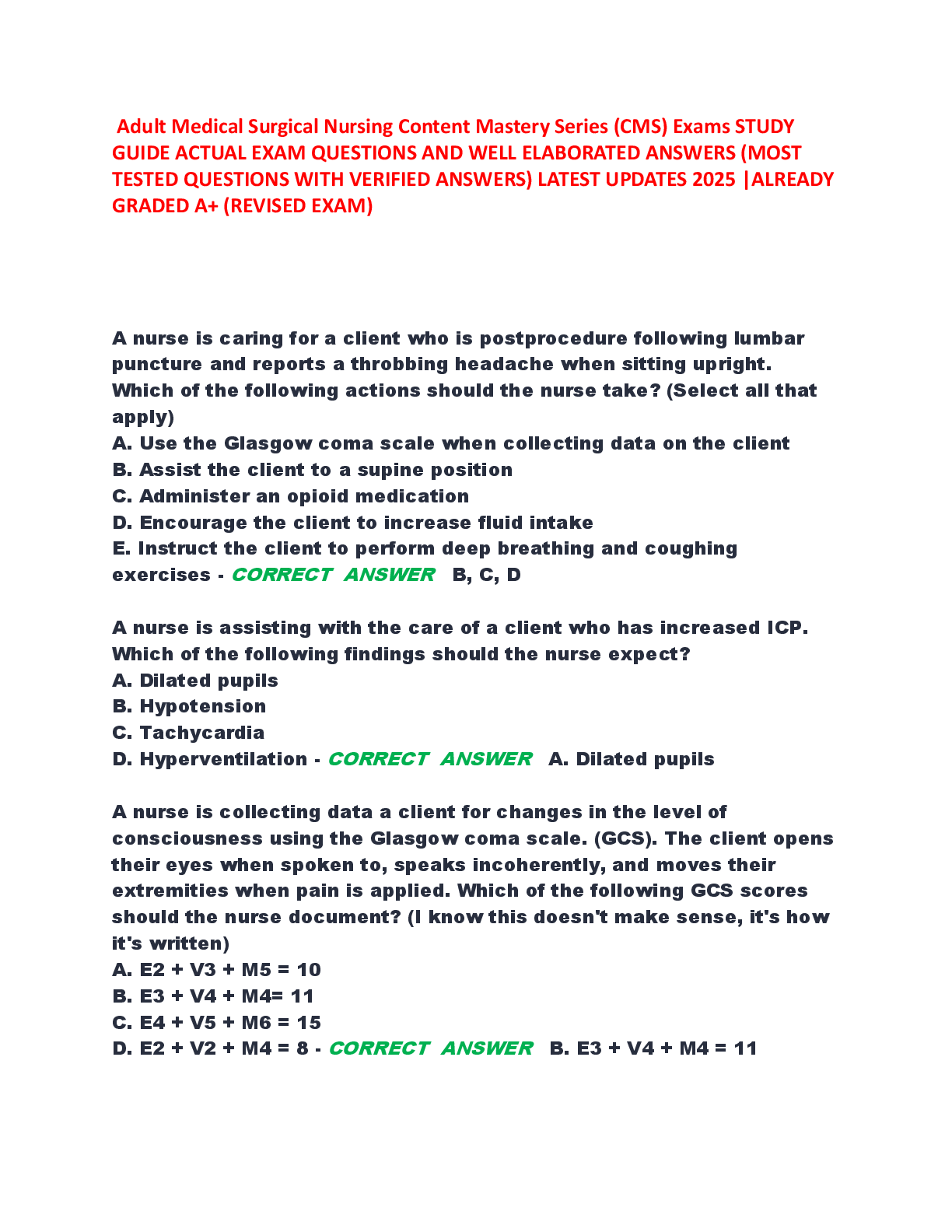
A nurse is reviewing the laboratory results of a client who is scheduled for a CT scan with an IV
contrast agent. Which of the following laboratory findings should the nurse report to the
provider prior to the procedur
...
A nurse is reviewing the laboratory results of a client who is scheduled for a CT scan with an IV
contrast agent. Which of the following laboratory findings should the nurse report to the
provider prior to the procedure?
2. A nurse is monitoring a client who is take acarbose. Which of the following findings should the
nurse identify as an adverse effect of the medication?
3. A nurse is assisting with the care of a client who had a cardiac catheterization via the right
femoral artery. Which of the following actions should the nurse take to prevent post-procedure
complications?
4. A nurse is contributing to the plan of care for a client wo has chronic obstructive pulmonary
disease (COPD) and is dyspneic. Which of the following interventions should the nurse include in
the plan?
5. A nurse is preparing to administer phytonadione 7 mg subcutaneously to a client who has an INR
of 4. Available is phytonadione 10 mg/mL. How many mL should the nurse administer? (Round
the answer to the nearest tenth. Use a leading zero if it applies. Do not use a trailing zero.)
6. A nurse is examining a client’s IV and notes a red line up his arm. The client reports a throbbing,
burning pain at the IV site. The nurse should identify that the client’s manifestations indicate
which of the following complications of IV therapy?
7. A nurse is reinforcing teaching about management of constipation with a client who has
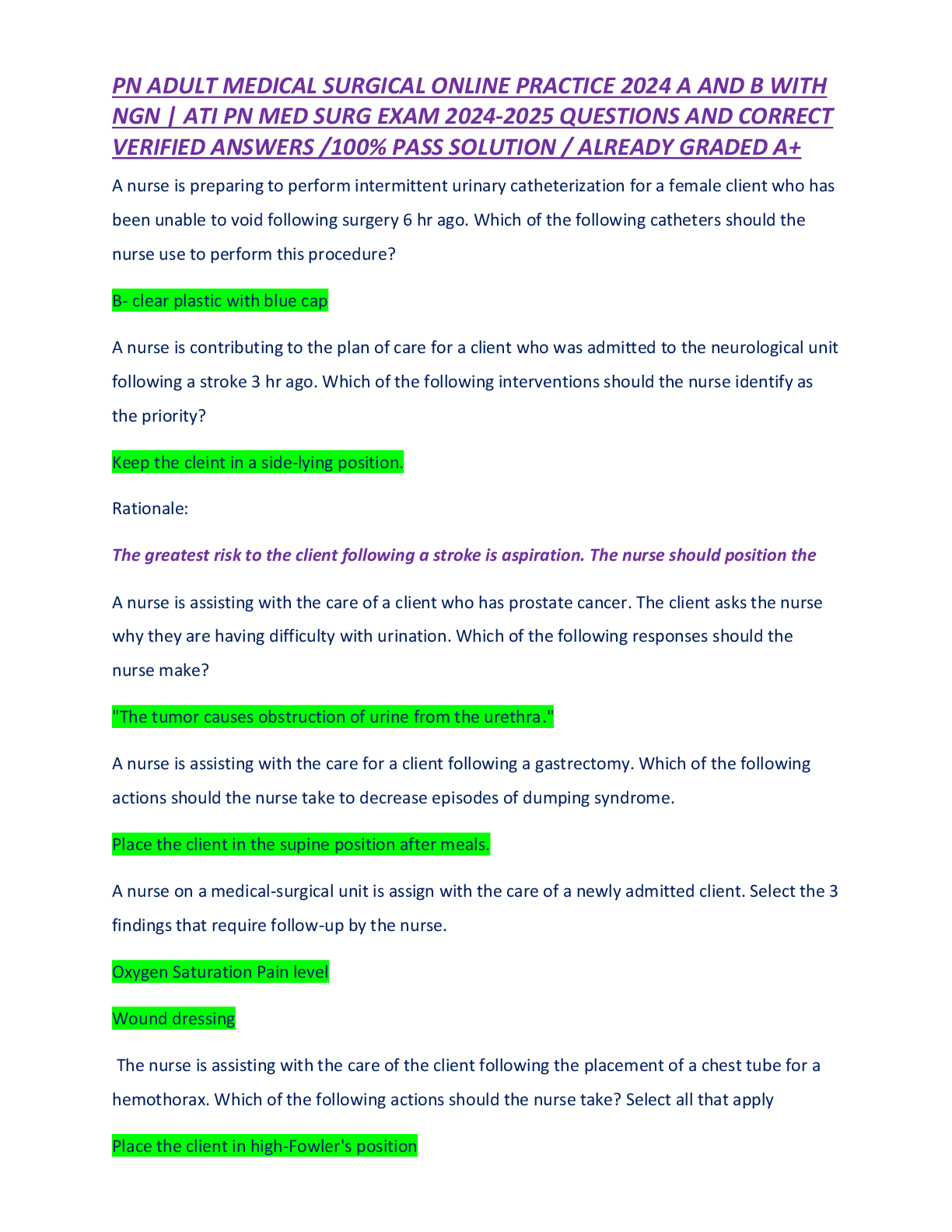
hypothyroidism. Which od the following should the nurse include in the teaching?
8. A nurse is caring for a client who has a compound fracture of the femur and was placed in
balanced suspension skeletal traction 4 days ago. Which of the following actions should the
nurse take?
9. A nurse observes a client who is lying in bed experiencing a tonic-clonic seizure. Which of the
following actions should the nurse take?
10. A nurse is contributing to the plan of care for a client who has multiple sclerosis and is taking
dantrolene to manage muscle spasms. Which of the following interventions should the nurse
include?
11. A nurse is reinforcing discharge teaching to prevent dumping syndrome for a client following a
partial gastrectomy for ulcers. Which of the following information should the nurse include in
the teaching?
12. A nurse is collecting data from a client who has heart failure and is taking digoxin. Which of the
following outcomes from the medication should the nurse expect?
13. A nurse is reinforcing discharge teaching with a client who has hearing loss. Which of the
following actions should the nurse take when communicating with the client?
14. A nurse is preparing to remove a client's NG tube. Which of the following interventions should
the nurse take to decrease the risk of aspiration?
15. A nurse is contributing to the plan of care for an older adult client who is at risk for osteoporosis.
Which of the following interventions should the nurse include to prevent bone loss?
16. A home health nurse is reinforcing teaching with a client about preventing complications of
peripheral vascular disease. Which of the following statements indicates that the client is
adhering to the nurse's instructions?
17. A nurse is reinforcing teaching about glycosylated hemoglobin (HbA1c) testing with a client who
has diabetes mellitus. Which of the following statements indicates that the client understands
the teaching?
18. A nurse is assisting the charge nurse with developing an in-service about caring for clients who
have internal sealed radiation implants. Which of the following information should the nurse
include?
19. A nurse is caring for a client who had an acute ischemic stroke 1 day ago. Which of the following
actions should the nurse take to reduce the risk for aspiration?
.
20. A nurse is caring for a client who is 1 day postoperative following a hip arthroplasty. The client is
exhibiting hypotension, tachycardia, and tachypnea. The nurse should recognize that these
findings indicate which of the following complications?
21. A nurse is reinforcing teaching with a client who has gonorrhea. Which of the following
information should the nurse include?
22. A nurse is contributing to the plan of care for a client who was admitted to the neurological unit
following a stroke 3 hr ago. Which of the following interventions should the nurse identify as the
priority?
23. A nurse is assisting in the care of a client who has manifestations of sepsis. Which of the
following provider prescriptions should the nurse implement first?
24. A nurse is reinforcing teaching with a client who is taking insulin glargine. Which of the following
information should the nurse include in the teaching?
25. A nurse is collecting data from a client who has hypothyroidism. Which of the following
manifestations should the nurse anticipate?
26. A nurse is collecting data from a client who has chronic kidney disease with hyperkalemia. Which
of the following findings should the nurse expect related to hyperkalemia?
27. A nurse enters the room of a client whose transfusion of packed RBCs was initiated 15 min ago
by the RN. The client reports dyspnea and urticaria. Which of the following actions should the
nurse perform first?
28. A nurse is collecting data from a 55-year-old female client who reports vaginal dryness and hot
flashes. The client is interested in trying hormone replacement therapy (HRT). Which of the
following should the nurse recognize as a contraindication to HRT?
29. A nurse is reinforcing teaching with the family of a client who has a cervical injury and has a halo
vest in place. Which of the following safety precautions should the nurse include in the
teaching?
30. A nurse is collecting data from a client who has hypokalemia. Which of the following findings
should the nurse identify as the priority?
31. A nurse in a long-term care facility is collecting data from a client who reports fullness in the
rectum and abdominal cramping. Which of the following findings should indicate to the nurse
that the client might have a fecal impaction?
32. A nurse is caring for a client who is preoperative and is receiving an IV infusion of cefazolin. Ten
minutes after beginning the infusion, the client reports intense itching. Which of the following
actions should the nurse take first?
33. A nurse is planning to implement droplet precautions for a client who has manifestations of
pertussis. Which of the following interventions should the nurse include when contributing to
the plan of care?
34. A nurse is reinforcing discharge instructions with a client who is postoperative following a right
hip arthroplasty. Which of the following statements should the nurse make?
35. A nurse is reinforcing teaching with an adolescent client regarding testicular self-examination.
Which of the following statements by the client demonstrates an understanding of the teaching?
36. A nurse is caring for a client who has acute pancreatitis. While providing care, the nurse observes
ecchymosis around the umbilicus. The nurse should identify that this is a manifestation of which
of the following?
37. A nurse is contributing to the plan of care for a client who is postoperative following a total knee
arthroplasty. The client is using a continuous passive motion (CPM) machine. Which of the
following interventions should the nurse recommend for the plan of care?
38. A nurse is monitoring a client who recently had a cast placed on the right lower extremity for a
bone fracture. Which of the following findings should the nurse recognize as abnormal?
39. A nurse is reinforcing teaching with a client who has mitral valve disease. Which of the following
statements by the client indicates an understanding of the disease process?
40. A nurse is providing discharge teaching for the family of a client who has Parkinson's disease.
Which of the following information should the nurse include in the teaching?
41. A nurse is caring for a client who has bacterial meningitis. Upon monitoring the client, which of
the following findings should the nurse expect?
42. A nurse is reinforcing teaching with a client who has systemic lupus erythematosus (SLE) and is
to begin taking methylprednisolone orally. Which of the following statements should the nurse
include in the teaching?
43. A nurse is reinforcing discharge teaching with a client who has cirrhosis. Which of the following
instructions should the nurse include?
44. A nurse is reviewing the medical record of a client who has a prescription for morphine. Which
of the following findings should the nurse report to the provider?
45. A nurse is caring for a client who is at risk for developing pressure ulcers. Which of the following
actions should the nurse take?
46. A nurse is discussing health screening guidelines with an older adult client. Which of the
following statements should the nurse include?
"."
47. A nurse is reinforcing teaching about joint protection with a client who has an acute
exacerbation of rheumatoid arthritis. Which of the following information should the nurse
include in the teaching?
48. A nurse is preparing to auscultate the bowel sounds of a client who has a mechanical bowel
obstruction in the descending colon. When listening in the left upper quadrant, the nurse should
identify this sound as which of the following? (Click on the audio button to listen to the clip.)
49. A nurse is reinforcing teaching with a client who is on a low-sodium diet and asks about how to
improve the taste of bland food. Which of the following should the nurse recommend?
Lemon juice
50. A nurse is caring for a client who is postoperative and has an epidural infusion. Which of the
following findings should the nurse recognize as the priority?
Dyspnea
51. A nurse is caring for a client who is 3 days postoperative following a total right hip arthroplasty.
Which of the following actions should the nurse take?
Maintain abduction of the client's right leg while in bed.
52. A nurse is caring for a client who is 24 hr postoperative following abdominal surgery and has an
NG tube. Which of the following actions should the nurse plan to take to decrease the risk of
postoperative complications?
53. A nurse is contributing to the plan of care for a client who is having difficulty eating following a
stroke. Which of the following interventions should the nurse plan to implement first?
R
54. A nurse is caring for a client who is in Buck's traction. Which of the following interventions
should the nurse perform to reduce skin breakdown?
55. A nurse is reviewing the laboratory results of a client who has chronic kidney failure and is
receiving epoetin alfa. The nurse should identify that which of the following laboratory values
indicates the treatment is effective?
56. A nurse is reinforcing teaching with a client who has multiple sclerosis and a new prescription for
baclofen. Which of the following instructions should the nurse include in the teaching?
57. A nurse is performing an ECG on a client who is scheduled for surgery the following morning. In
which of the following locations should the nurse place the V1 electrode? (You will find hot spots
to select in the artwork below. Select only the hot spot that corresponds to your answer.)
58. A nurse in an oncology clinic is reinforcing teaching about Mohs surgery with a client who has
skin cancer. Which of the following information should the nurse include in the teaching?
Mohs surgery is a horizontal shaving of thin layers of the tumor.
59. A nurse is caring for a client who has a methicillin-resistant Staphylococcus aureus (MRSA)
infection in a surgical wound. Which of the following information should the nurse plan to share
with visitors?
60. A nurse is reinforcing teaching about dietary changes with a client who has cardiovascular
disease. Which of the following images indicates the type of cooking fat the nurse should
recommend the client use when preparing meals?
61. A nurse is contributing to the plan of care for a client who has a methicillin-resistant
Staphylococcus aureus (MRSA) infection and is on contact isolation precautions. Which of the
following actions should the nurse take?
62. A nurse is caring for an older adult client who has a reddened area over the sacrum. Which of
the following actions should the nurse take?
63. A nurse is collecting data on a client who is scheduled for a cardiac catheterization. Which of the
following laboratory levels should the nurse review prior to the procedure?
64. A nurse is reviewing the laboratory results of a client who has type 2 diabetes mellitus. The
nurse should identify that which of the following laboratory values indicates the client is at risk
for delayed wound healing?
65. A nurse is contributing to the plan of care for a client who has a new prescription for nystatin
suspension for oral candidiasis. Which of the following interventions should the nurse include in
the plan?
66. A nurse is caring for a client and administers penicillin IM. The client begins exhibiting hives and
has severe difficulty breathing. After establishing a patent airway, which of the following actions
should the nurse take next?
67. A nurse is caring for a client who has terminal pancreatic cancer. The client states, "I don't think I
can go on any longer." Which of the following responses should the nurse make?
68. A nurse is contributing to the plan of care for a client who has peripheral arterial disease (PAD)
of the lower extremities. Which of the following interventions should the nurse include?
69. A nurse is reinforcing teaching about gastroesophageal reflux disease (GERD) with a client.
Which of the following statements by the client indicates an understanding of the teaching?
70. A nurse is reinforcing discharge teaching about wound care with a family member of a client who
is postoperative. Which of the following should the nurse include in the teaching?
71. Following a blood draw procedure for a fasting blood sugar (FBS) test, a client tells the nurse,
"I'm glad they took my blood because I'm really hungry. All I've had since midnight is water and
some juice." Which of the following actions should the nurse take?
72. A nurse is caring for a client who is scheduled for surgery and is experiencing anxiety. Which of
the following interventions should the nurse identify as the priority?
73. A nurse is collecting data from a client and notices several skin lesions. Which of the following
findings should the nurse report as possible melanoma?
74. A nurse is preparing to administer furosemide to a client who has heart failure. Which of the
following findings should the nurse report before administering the medication?
75. A nurse is preparing to suction a client who has a tracheostomy. Which of the following actions
should the nurse take first?
76. A nurse is participating in a health fair for older adult clients. Which of the following
immunizations should the nurse recommend for this age group?
77. A nurse is assisting with the discharge planning for a client who is postoperative following a total
hip arthroplasty. Which of the following instructions should the nurse include in the discharge
plan?
78. A nurse is reinforcing teaching with a client who has heart failure and a new prescription for
hydrochlorothiazide. Which of the following findings should the nurse instruct the client to
report to the provider?
79. A nurse is caring for a client who has a history of breast cancer. The client asks the nurse about
birth control. Which of the following methods of birth control is contraindicated for this client?
80. A nurse is caring for a client who is receiving chemotherapy. The client mentions that she has a
loss of appetite because she has sores in her mouth and that food no longer tastes good. Which
of the following suggestions to the client should the nurse make?
81. A nurse is assisting in the plan of care regarding bowel retraining for a client who has a cervical
spinal cord injury. Which of the following interventions should the nurse plan to implement first?
82. A nurse is caring for a client who has difficulty swallowing. Which of the following actions should
the nurse implement to prevent aspiration?
83. A nurse is preparing to administer scheduled medications to a client. Which of the following
prescriptions should the nurse verify with the provider? (Click on the "Exhibit" button for
additional information about the client. There are three tabs that contain separate categories of
data.)
84. A nurse is assisting a client who reports difficulty falling asleep. Which of the following activities
should the nurse recommend promoting sleep?
85. A nurse is reinforcing teaching with a client who has asthma. Which of the following client
statements indicates an understanding of the use of budesonide and albuterol inhalers? (Select
all that apply.)
86. A nurse is caring for a client who has meningococcal pneumonia. Which of the following
personal protective equipment should the nurse use?
87. A nurse is reinforcing teaching about home care with a client who had a knee arthroplasty.
Which of the following factors should the nurse identify as an indication that a barrier to
learning might be present?
88. A nurse is monitoring an older adult client who has a history of an enlarged prostate and is
experiencing suprapubic discomfort. Which of the following actions should the nurse take first?
89. A nurse is caring for a client who has a prescription for phenazopyridine. Which of the following
findings should the nurse identify as a therapeutic effect of the medication?
[Show More]


.png)