SCI 228 Week 1 Variety answer to Quiz
Grade Details - All Questions
Question 1.Question :
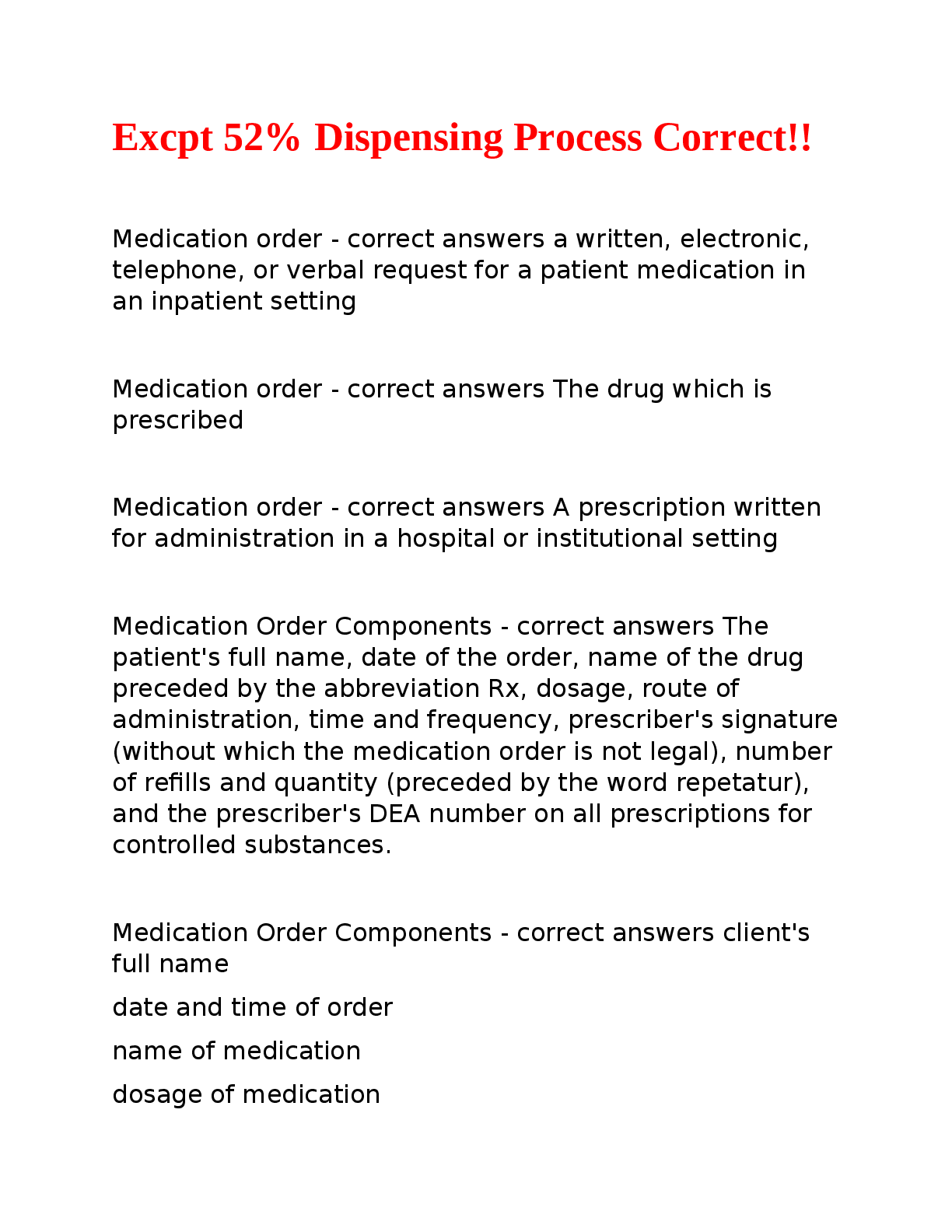
(TCO 1) Which statement is FALSE concerning the field of nutrition?
Student Answer: Nutrition is the study
...
SCI 228 Week 1 Variety answer to Quiz
Grade Details - All Questions
Question 1.Question :
(TCO 1) Which statement is FALSE concerning the field of nutrition?
Student Answer: Nutrition is the study of how food nourishes the
body.
Nutrition encompasses how we consume, digest,
metabolize, and store food.
Nutrition is an ancient science that dates back to the
fourteenth century.
Nutrition involves studying the factors that influence
Instructor Explanation:
eating patterns.
Chapter 1
Points Received: 2 of 2
Comments:
Question 2.Question :
(TCO 1) refers to eating the right proportion of foods.
Student Answer: Restriction
Balance Moderation Variety
Instructor
Explanation:
Chapter 2
Points Received: 0 of 2
Comments:
Question 3.Question :
(TCO 1) What is at the base of the Healthy Eating
Pyramid?
Student Answer: Bread, cereal, rice, and pasta
Low-fat dairy foods
Fruits and vegetables
Daily exercise and weight control
Instructor
Explanation:
Chapter 2
Points Received: 2 of 2
Comments:
Question 4.Question :
(TCO 1) Which of the following is exempt from
standard food labeling regulations?
Student Answer: Coffee
Spices
Meat
All of these
Instructor
Explanation:
Chapter 2
Points Received: 0 of 2
Comments:
Question 5.Question :
(TCO 3) Responding to the presence of protein and fat in our meal, cholecystokinin (CCK) signals the gallbladder to release a substance called:
Student Answer: lipase. pepsin. chyme. bile.
Instructor
Explanation:
Chapter 3
Points Received: 2 of 2
Comments:
Question 6.Question :
(TCO 3) The acidity of the stomach allows for all of the
following EXCEPT:
Student Answer: preparing dietary carbohydrates for absorption in the
small intestine.
protecting the human body from bacteria in food.
denaturing protein to allow its breakdown and
absorption.
activating pepsin.
Instructor
Explanation:
Chapter 3
Points Received: 2 of 2
Comments:
Question 7.Question :
(TCO 3) Why do fungi rarely cause food infection?
Student Answer: Few species of fungi cause serious illness.
Fungal growth makes food look unappealing. Fungal growth makes food taste unappealing.
All of these are reasons why fungi rarely cause food
Instructor Explanation:
infection.
Chapter 18
Points Received: 2 of 2
Comments:
Question 8.Question :
(TCO 3) Which of the following is responsible for food spoilage?
Student Answer: Oxygen Heat Light
All of these are responsible for food spoilage.
Instructor Explanation:
Chapter 18
Points Received: 2 of 2
Comments:
Question 9.Question :
(TCO 3) In the United States, the most common food- borne illnesses result from which of the following bacteria?
Student Answer: Giardia lamblia Salmonella Campylobacter jejuni
Clostridium botulinum
Instructor Explanation:
Chapter 18
Points Received: 0 of 2
Comments:
Question 10.Question :
(TCO 3) Which government agency regulates the labeling, sale, distribution, use, and disposal of all pesticides in the United States?
Student Answer: Food and Drug Administration
United States Department of Agriculture Environmental Protection Agency Centers for Disease Control
Instructor
Explanation:
Chapter 18
Points Received: 2 of 2
Comments:
* Times are displayed in (GMT-07:00) Mountain Time (US & Canada)
Name: Test #1
Status : Needs Grading
Score: 13 out of 20 points
Time Elapsed: 0 hours, 42 minutes, and 36 seconds out of 0 hours and 40 minutes allowed.
Instructions: You will have 40 minutes to take the test. There are 40 questions. Each
question is worth 1/2 point for a total of 20 points. You will need a calculator
for this test. Once you start, you will not be able to take it again if you stop. So
make sure you have a time when you will be uninterrupted. Please print out
your score page incase of any problems. Always check your score to see if it
has registered in Gradebook. If you experience any problems, contact me
immediately!
Question
1
Multiple Choice 0.5 of 0.5 points
The smallest units of matter that normally cannot be broken down are:
Question 2
Question 3
Question 4
Question 5
Question 6
Question 7
Selected Answer: atoms Correct Answer: atoms
Multiple Choice 0 of 0.5 points
Which of the following is NOT a function of dietary protein?
Selected Answer: building new cells and tissues
Correct Answer: serving as a primary energy source for the body
Multiple Choice 0.5 of 0.5 points
Hunger is best described as:
Selected Answer: a physiological desire to consume food.
Correct Answer: a physiological desire to consume food.
Multiple Choice 0.5 of 0.5 points
The building blocks of proteins are called:
Selected Answer:
amino acids
Correct Answer: amino acids
Multiple Choice 0 of 0.5 points
The is most responsible for prompting individuals to seek food.
Selected Answer:
stomach
Correct Answer: hypothalmus
Multiple Choice 0.5 of 0.5 points
Which of the following is required on all food labels?
Selected Answer:
all of the above
Correct Answer: all of the above
Multiple Choice 0.5 of 0.5 points
In which organ does most water absorption occur?
Question 8
Question 9
Question 10
Question 11
Question 12
Selected Answer: large intestine Correct Answer: large intestine
Multiple Choice 0.5 of 0.5 points
Proteins that act to speed up body processes, but are not changed in the process, are called:
Selected Answer: enzymes Correct Answer: enzymes
Multiple Choice 0 of 0.5 points
There are many types of diet plans available today. The best diet plan overall is the one that:
Selected Answer: provides enough calories
Correct Answer: fits the lifestyle and needs of the individual
Multiple Choice 0 of 0.5 points
Bob eats his breakfast and his GI tract will now begin the process of digesting and absorbing the nutrients from his meal. What is the order in which each of the organs of the GI tract will work to achieve this process?
Selected Answer: mouth: stomach: espohagus: small intestine: large intestine Correct Answer: mouth; espohagus: stomach: small intestine: large intestine
Multiple Choice 0.5 of 0.5 points
Vitamin C and B are termed:
Selected Answer: water-soluble vitamins Correct Answer: water-soluble vitamins
Multiple Choice 0.5 of 0.5 points
The type of study that observes a large population to determine factors that may influence nutritional habits and disease trends is called a(n):
Selected Answer: epidemiological study
Question 13
Question 14
Question 15
Question 16
Question 17
Question 18
Correct Answer: epidemiological study
Multiple Choice 0 of 0.5 points
In which group are cheeses listed in the Exchange System?
Selected Answer: milk Correct Answer: meat
Multiple Choice 0 of 0.5 points
Jack is a college athlete who requires 2800 kilocalories a day to support his total energy needs. Even though Jack likes many different foods and makes it a point to try new things, he only consumes approximately 1600 kilocalories a day. Which one of the characteristics of a healthy diet is Jack missing?
Selected Answer: balance
Correct Answer: adequacy
Multiple Choice 0.5 of 0.5 points
refers to eating the right amount of foods.
Selected Answer:
moderation
Correct Answer: moderation
Multiple Choice 0.5 of 0.5 points
Which of the following nutrients is organic?
Selected Answer:
Protein
Correct Answer: Protein
Multiple Choice 0.5 of 0.5 points
Which of the following is an example of carbohydrate-rich foods?
Selected Answer:
wheat and lentils
Correct Answer: wheat and lentils
Multiple Choice 0 of 0.5 points
Assuming each has the same number of calories, which has the greatest nutrient density?
Question 19
Question 20
Question 21
Question 22
Question 23
Selected Answer: 2 Thin Mint Girl Scout cookies Correct Answer: 1 medium fresh orange
Multiple Choice 0 of 0.5 points
What is the name of the sphincter that separates the stomach from the small intestines?
The 5-A-Day The Color Way Program was developed by the: Selected Answer: National Dairy Council
Correct Answer: National Cancer Institute
Multiple Choice 0.5 of 0.5 points
What is chyme?
Selected Answer: mixture of partially digested food, water, and gastric juices Correct Answer: mixture of partially digested food, water, and gastric juices
Multiple Choice 0.5 of 0.5 points
The Dietary Guidelines for Americans recommends consuming less than
mg of sodium each day. Selected Answer: 2300
Question 24
Question 25
Question 26
Question 27
Question 28
Question 29
Correct Answer: 2300
Multiple Choice 0.5 of 0.5 points
are examples of inorganic nutrients.
Selected Answer: Minerals Correct Answer: Minerals
Multiple Choice 0.5 of 0.5 points
Cell membranes are PRIMARILY composed of:
Selected Answer: phospholipids Correct Answer: phospholipids
Multiple Choice 0.5 of 0.5 points
The information provided on the food label that identifies intake of nutrients based on 2000 calories a day is called the:
Selected Answer: Percent Daily Value
Correct Answer: Percent Daily Value
Multiple Choice 0.5 of 0.5 points
The Dietary Guidelines for Americans recommends a minimum of:
Selected Answer:
30 minutes of moderate activity most days
Correct Answer: 30 minutes of moderate activity most days
Multiple Choice 0 of 0.5 points
Jack's lunch contains 121 grams of carbohydrate, 40 grams of protein, and 25 grams of fat. What percent of kilocalories in this meal come from fat?
Selected Answer: 19%
Correct Answer: 26%
Multiple Choice 0.5 of 0.5 points
Which statement best describes nutrient density?
Question 30
Question 31
Question 32
Question 33
Question 34
Selected Answer: Consume foods that have the most nutrients for their calories.
Correct Answer: Consume foods that have the most nutrients for their calories.
Multiple Choice 0.5 of 0.5 points
The human body is organized into the following structural levels:
Selected Answer: atoms: molecues: cells: tissues: organs: systems Correct Answer: atoms: molecues: cells: tissues: organs: systems
Multiple Choice 0.5 of 0.5 points
What element makes protein different from carbohydrate and fat?
Selected Answer: Nitrogen Correct Answer: Nitrogen
Multiple Choice 0.5 of 0.5 points
Vitamins are classified into two groups; and .
Selected Answer: fat soluble; water soluble Correct Answer: fat soluble; water soluble
Multiple Choice 0.5 of 0.5 points
Which of the following describes the vitamins A, D, E, and K?
Selected Answer: can be stored in adipose and liver tissue Correct Answer: can be stored in adipose and liver tissue
Multiple Choice 0 of 0.5 points
The "powerhouse" of the cell that provides the most ATP is the:
Selected Answer: nucleus Correct Answer: mitochondria
Question Multiple Choice 0 of 0.5 points
35
Question 36
Question 37
Question 38
Question 39
Question 40
Bicarbonate is released into the duodenum during the process of digestion. Why? Selected Answer: to digest fats/oils
Correct Answer: to neutralize the acidic chyme
Multiple Choice 0.5 of 0.5 points
serve as an important source of energy for muscles during times of rest and low-intensity exercise.
Selected Answer: lipids
Correct Answer: lipids
Multiple Choice 0.5 of 0.5 points
Which of the following is NOT an essential nutrient?
Selected Answer:
Alcohol
Correct Answer: Alcohol
Multiple Choice 0.5 of 0.5 points
Which two pancreatic hormones are responsible for maintaining blood glucose levels?
Selected Answer: insulin and glucagon Correct Answer: insulin and glucagon
Multiple Choice 0.5 of 0.5 points
The government agency that regulates the food labels on fresh meat and poultry in the United States is the:
Selected Answer: USDA Correct Answer: USDA
Multiple Choice 0 of 0.5 points
Healthier fat sources include and vegetable oils. Selected Answer: margarine
Correct Answer: nuts
Nutrition for Life, 3e (Thompson)
Chapter 2 The Human Body: Are We Really What We Eat?
Multiple-Choice Questions
1) Which of the following are grouped together to perform an integrated function?
A) molecules
B) tissues
C) systems
D) organelles Answer: C Page Ref: 45
2) Which of the following is MOST responsible for prompting individuals to seek food?
A) stomach
B) small intestine
C) hypothalamus
D) mouth Answer: C Page Ref: 38
3) Which physiological trigger(s) will result in the sensation of hunger?
A) low glucose levels
B) high glucose levels
C) release of the chemical messengers leptin and serotonin
D) eating a meal with a high satiety value Answer: A
Page Ref: 38
4) Hunger is best described as
A) a physiological desire to find food and eat.
B) a psychological desire to find food and eat.
C) eating that is often driven by environmental cues.
D) eating that is often driven by emotional cues. Answer: A
Page Ref: 38
5) Which of the following is NOT a regulator of satiety in the body?
A) GI tract
B) hypothalamus
C) hormones
D) kidneys Answer: D
Page Ref: 39
6) Which of the following snacks will have the highest satiety value, assuming the calories and relative size are similar?
A) slice of whole-grain bread
B) piece of cheese
C) glass of whole milk
D) glass of skim milk Answer: B
Page Ref: 39
7) The smallest units of matter that cannot be broken down by natural means are
A) atoms.
B) molecules.
C) cells.
D) lipids. Answer: A Page Ref: 43
8) The human body is organized into the following structural levels (smallest to largest)
A) molecules: atoms: organs: systems: tissues: cells.
B) atoms: molecules: cells: tissues: organs: systems.
C) organs: tissues: molecules: systems: atoms: organs.
D) atoms: cells: systems: tissues: molecules: organs. Answer: B
Page Ref: 43-45
9) Cell membranes are
A) very rigid and resistant to all noncellular molecules.
B) semipermeable.
C) the organelles responsible for ATP production.
D) chemical messengers that are secreted into the bloodstream by a gland. Answer: B
Page Ref: 43
10) In which organelle is the cell's DNA located?
A) nucleus
B) mitochondria
C) cell membrane
D) cytoplasm Answer: A Page Ref: 45
11) The "powerhouses" of the cell that produce energy from food molecules are the
A) mitochondria.
B) ribosomes.
C) nuclei.
D) cytoplasm. Answer: A Page Ref: 45
12) What is the term that describes the process by which the foods we eat are broken down into smaller components by either mechanical or chemical means?
A) digestion
B) absorption
C) elimination
D) peristalsis Answer: A Page Ref: 45
13) Which of the following is NOT a role that the liver plays in digestion and absorption of nutrients?
A) Filters the blood, removing potential toxins such as alcohol and drugs.
B) Secretes insulin and glucagon to assist in the regulation of blood glucose concentrations.
C) Receives the products of digestion from the small intestine and releases nutrients depending on body needs.
D) Synthesizes bile to assist in the digestion and absorption of fat. Answer: B
Page Ref: 52-53
14) Most digestion and absorption occurs in the
A) stomach.
B) esophagus.
C) small intestine.
D) mouth. Answer: C Page Ref: 50
15) Juanita eats her breakfast, and her GI tract then begins the process of digesting and absorbing the nutrients from this meal. What is the order in which each of the organs of the GI tract will work to achieve this process?
A) mouth: esophagus: small intestine: stomach: large intestine
B) mouth: esophagus: stomach: small intestine: large intestine
C) mouth: stomach: esophagus: small intestine: large intestine
D) mouth: stomach: esophagus: large intestine: small intestine Answer: B
Page Ref: 45
16) The mechanical and chemical digestion of food is initiated in the
A) mouth.
B) small intestine.
C) stomach.
D) esophagus. Answer: A Page Ref: 46-47
17) Salivary amylase is a(n)
A) hormone.
B) antibody.
C) bicarbonate.
D) enzyme. Answer: D Page Ref: 47
18) Which best explains why carbohydrate digestion ceases when food reaches the stomach?
A) Carbohydrate is completely digested in the mouth.
B) Salivary amylase cannot function in the acid environment of the stomach.
C) Carbohydrate is completely absorbed in the esophagus.
D) Intestinal bacteria are needed for carbohydrate digestion. Answer: B
Page Ref: 47
19) Which of the following is NOT a component of the gastric juices?
A) hydrochloric acid
B) pepsin
C) insulin
D) gastric lipase Answer: C Page Ref: 49
20) What is chyme?
A) ulcerations of the esophageal lining
B) healthy bacteria of the small intestine
C) mixture of partially digested food, water, and gastric juices
D) substance that allows for the emulsification of dietary lipid Answer: C
Page Ref: 49
21) A primary function of the mucus in the stomach is to
A) neutralize stomach acid.
B) activate pepsinogen to form pepsin.
C) protect stomach cells from digestion.
D) emulsify fats. Answer: C Page Ref: 49
22) Which of the macronutrients is NOT broken down chemically in the stomach?
A) protein
B) carbohydrate
C) fat
D) vitamin C Answer: B Page Ref: 49
23) Proteins that induce chemical changes to speed up body processes are called
A) hormones.
B) peptides.
C) enzymes.
D) chymes. Answer: C Page Ref: 47
24) The brush border is located in the
A) esophagus.
B) stomach.
C) small intestine.
D) large intestine. Answer: C
Page Ref: 51
25) What is the name of the sphincter that separates the esophagus and the stomach?
A) pyloric
B) gastroesophageal
C) ileocecal
D) rectal Answer: B Page Ref: 48
26) The last section of the small intestine that connects to the ileocecal valve is called the
A) bile duct.
B) duodenum.
C) jejunum.
D) ileum. Answer: D Page Ref: 51
27) Responding to the presence of fat in our meal, the gallbladder releases a substance called
A) lipase.
B) pepsin.
C) chyme.
D) bile. Answer: D Page Ref: 51
28) What roles do the hormones insulin and glucagon play in signaling hunger?
A) They detect changes in pressure in the stomach.
B) They stimulate release of digestive juices.
C) The respond to changing glucose levels and signal the hypothalamus.
D) They initiate movements in the GI tract known as "hunger pangs." Answer: C
Page Ref: 38-39
29) The fingerlike projections of the small intestine that increase surface area and allow for the absorption of nutrients are called
A) villi.
B) lacteals.
C) sphincters.
D) diverticuli. Answer: A Page Ref: 51
30) Which circulatory system carries most of the fats and fat-soluble nutrients?
A) vascular
B) mesenteric
C) lymphatic
D) enterohepatic Answer: C Page Ref: 52
31) Which large vessel transports absorbed nutrients to the liver?
A) portal vein
B) pulmonary vein
C) aorta
D) subclavian vein Answer: A
Page Ref: 52
32) In which organ does the majority of water absorption occur?
A) mouth
B) stomach
C) small intestine
D) large intestine Answer: D
Page Ref: 51
33) Collectively, the nerves of the gastrointestinal tract are referred to as
A) peptic nerves.
B) hepatic nerves.
C) enteric nerves.
D) gastric nerves. Answer: C
Page Ref: 45
34) If a person has GERD, which of the following is probably malfunctioning?
A) gallbladder
B) pancreas
C) epiglottis
D) gastroesophageal sphincter Answer: D
Page Ref: 56
35) What is the primary cause of peptic ulcers?
A) stress
B) H. pylori bacteria
C) prolonged use of aspirin
D) eating too many spicy foods Answer: B
Page Ref: 57
36) Which of the following would be an appropriate treatment approach for someone who has GERD?
A) surgical removal of the gallbladder
B) omission of all lactose foods
C) antibiotic therapy
D) lose weight and quit smoking Answer: D
Page Ref: 57
37) Which of the following statements best describes irritable bowel syndrome (IBS)?
A) an erosion of the gastrointestinal tract caused by the overproduction of hydrochloric acid
B) an immune response resulting from the ingestion of an allergen
C) a hypersensitivity to wheat resulting in diarrhea and bloating
D) a bowel disorder that interferes with the colon; no definite cause is known Answer: D
Page Ref: 64
38) Mary experiences anaphylactic shock after eating a peanut butter sandwich. What is the most appropriate treatment for Mary?
A) IV glucose
B) Tylenol or another pain medication
C) antibiotics
D) epinephrine Answer: D Page Ref: 60
39) The liquid within an animal cell is known as
A) gastric juice.
B) glucagon.
C) cytoplasm.
D) mitochondria. Answer: C
Page Ref: 44
40) The psychological desire that encourages us to seek out a particular food is
A) hunger.
B) appetite.
C) satiety.
D) anorexia. Answer: B Page Ref: 38
41) The the region of the forebrain where physiological signals are translated into thirst and hunger messages is the
A) pituitary gland.
B) adrenal gland.
C) thalamus.
D) hypothalamus. Answer: D
Page Ref: 38
42) Secreted from many glands of the body, hormones acts as
A) "powerhouses" of cells.
B) chemical messengers that trigger a physiological response.
C) absorptive features that increase the surface area of the small intestine.
D) fat emulsifiers. Answer: B
Page Ref: 38
43) In contrast to hunger, appetite is triggered by
A) signals from nerve cells in the stomach lining.
B) insulin and glucagon.
C) satiety.
D) the sensory appeal of foods and their learned social and cultural associations. Answer: D
Page Ref: 40
44) The state in which a person has a physiologic need for food but no appetite is known as
A) anorexia.
B) peristalsis.
C) satiety.
D) hunger. Answer: A Page Ref: 38
45) A functional grouping of similar cells is known as a(n)
A) atom.
B) molecule.
C) tissue.
D) organ. Answer: C Page Ref: 45
46) Tight rings of muscles that control the movement of food through the organs of the gastrointestinal tract are known as
A) villi.
B) microvilli.
C) mitochondria.
D) sphincters. Answer: D Page Ref: 45
47) Approximately how long is the human GI tract?
A) 30 inches
B) 30 feet
C) 50 inches
D) 50 feet Answer: B Page Ref: 45
48) Elimination is the bodily process in which
A) undigested portions of food and waste are removed from the body.
B) the products of digestion are taken through the wall of the intestine.
C) food is chemically and physically broken down into component molecules.
D) probiotics are produced. Answer: A
Page Ref: 45
49) Carbohydrate digestion begins in the
A) mouth.
B) stomach.
C) small intestine.
D) large intestine. Answer: A
Page Ref: 47
50) Protein digestion begins in the
A) mouth.
B) stomach.
C) small intestine.
D) large intestine. Answer: B
Page Ref: 49
51) Which structure keeps food from entering the trachea during swallowing?
A) upper esophageal sphincter
B) lower esophageal sphincter
C) soft palate
D) epiglottis Answer: D Page Ref: 48
52) The wavelike contractions that move food along the GI tract are known as
A) proteases.
B) pepsin.
C) peristalsis.
D) pituitary glands. Answer: C
Page Ref: 48 True/False Questions
1) Atoms are the smallest units of matter. Answer: TRUE
Page Ref: 43
2) The cell's nucleus is the organelle responsible for producing energy from food molecules. Answer: FALSE
Page Ref: 45
3) Hunger is the physical sensation that drives humans to eat. Answer: TRUE
Page Ref: 38
4) The primary organ producing the sensation of hunger is the stomach. Answer: FALSE
Page Ref: 38
5) Foods containing carbohydrate have the highest satiety value. Answer: FALSE
Page Ref: 39
6) Overall, very little digestion occurs in the human mouth. Answer: TRUE
Page Ref: 47
7) Typically, ingested food remains in the stomach for 2 hours prior to traveling to the small intestine.
Answer: TRUE Page Ref: 50
8) The pancreas is the largest digestive organ. Answer: FALSE
Page Ref: 52
9) The small intestine is the longest portion of the human GI tract. Answer: TRUE
Page Ref: 50
10) The majority of nutrient absorption takes place in the stomach. Answer: FALSE
Page Ref: 50
11) Since they do not require further digestion, dietary vitamins and minerals are small enough to be absorbed by the gastrointestinal tract.
Answer: TRUE Page Ref: 50-51
12) The presence of any bacteria in the large intestine indicates a potentially serious systemic allergic reaction that can be fatal if left untreated.
Answer: FALSE Page Ref: 54
13) The most common symptom of GERD is chronic diarrhea. Answer: FALSE
Page Ref: 56
14) Irritable bowel syndrome is more common among women than men. Answer: TRUE
Page Ref: 64
15) The sigmoid colon is the first segment of the large intestine. Answer: FALSE
Page Ref: 54
16) Food allergies cause an immune response by the body. Answer: TRUE
Page Ref: 59
17) Most instances of constipation are caused by intestinal bacteria. Answer: FALSE
Page Ref: 64
18) Diarrhea and dehydration are the most serious potential reactions when consuming an allergenic food product.
Answer: FALSE Page Ref: 59-60
19) Untreated diarrhea can be fatal in young children. Answer: TRUE
Page Ref: 62
20) Currently, the only treatment for celiac disease is a diet free of wheat, barley, and rye. Answer: TRUE
Page Ref: 61
21) Adults cannot learn to enjoy a food unless it was introduced to them in childhood. Answer: FALSE
Page Ref: 41
22) Produced by the liver, bile is stored in the gallbladder and emulsifies fats in the small intestine.
Answer: TRUE Page Ref: 51
23) The brush border is a term that describes the microvilli of the large intestine's lining. Answer: FALSE
Page Ref: 51
24) The gallbladder secretes bicarbonate into the small intestine to neutralize the acidity of chyme.
Answer: FALSE Page Ref: 51
25) Celiac disease can only be diagnosed with a blood test. Answer: FALSE
Page Ref: 61 Essay Questions
1) Starting at the mouth and ending at the rectum, describe the process of human digestion and absorption.
Page Ref: 46-54
2) Describe the symptoms and treatment of irritable bowel syndrome (IBS). Page Ref: 64
3) Describe the lining of the small intestine. How does its unique structure contribute to the process of nutrient absorption?
Page Ref: 51
4) What is the difference between a food intolerance and a food allergy? Page Ref: 59-61
Questions from Chapter Boxes
1) Bile reacts with fats in a similar way as soap does. Answer: TRUE
Page Ref: 51
2) Probiotics have been shown to be effective in treating
A) traveler's diarrhea.
B) food allergies.
C) gastroesophageal reflux disease (GERD).
D) diabetes mellitus. Answer: A
Page Ref: 55
3) Traveler's diarrhea is caused by
A) food allergies.
B) stress.
C) antibiotic overuse.
D) viral or bacterial infections. Answer: D
Page Ref: 63
4) One appetizing and safe alternative to barley for people with celiac disease is
A) wheat.
B) gluten.
C) Job's tears.
D) rye. Answer: C Page Ref: 62
5) Because the activity of probiotics in the GI tract is short-lived, they need to be consumed on a daily basis to be effective.
Answer: TRUE Page Ref: 55
6) Which of the following food sources is a rich source of probiotics?
A) whole-wheat bread
B) yogurt
C) orange juice
D) calcium supplements Answer: B
Page Ref: 55
7) The emerging field of nutrigenomics studies how nutrition and environment can affect gene function.
Answer: TRUE Page Ref: 44
8) What are probiotics and how are they involved in keeping us healthy? Page Ref: 55
9) List the eight major allergenic foods. Explain how and why the U.S. Food and Drug Administration (FDA) regulates these ingredients in packaged foods.
Page Ref: 59
Chapter 14
1.
All preservatives must be listed on the food label.
True
2.
One limitation of using aseptic packaging is that it is an environmentally unfriendly process.
False
3.
The majority of food allergies cause an immediate reaction.
False
4.
Nitrates have been shown to cause cancer in humans.
False
5.
Thoroughly cooking beef, pork, or fish will destroy helminth larvae and prevent infection.
True
6.
In the United States, the most common food-borne illnesses result from which of the following bacteria?
a Campylobacter jejuni
.
b. Salmonella
c. Clostridium botulinum
d. Giardia lamblia
7.
An estimated of all chicken eggs in the U.S. are contaminated with Salmonella.
a. one-half
b. one-fifth
c one-third
.
d. one-fourth
8.
Pesticides are:
a. chemicals added to food that help prevent microbial spoilage and enzymatic deterioration.
b. chemicals produced by microorganisms that harm tissue and elicit an immune response.
c. chemicals added to food to enhance them in some way.
d chemicals used in the field and in storage areas to decrease destruction caused
. by insects and fungus.
9.
The food-borne illness caused by Campylobacter jejuni is associated with consuming:
a water that has been contaminated with fecal material.
.
b. grains that have been stored in a moist environment.
c. contaminated beef or pork.
d. tapeworms.
10.
Hepatitis A is a food-borne virus that can result in damage.
a liver
.
b. muscle
c. nerve
d. intestinal
11.
Foods of animal origin are the most common sources of food-borne illnesses.
True
12.
Refrigerating or freezing foods will kill any bacteria present in the food.
False
13.
The majority of food infections are caused by bacteria.
True
14.
Yellow dye #6, corn syrup, and calcium added to orange juice are all examples of:
a. genetically modified organisms.
b additives.
.
c. preservatives.
d. pesticides.
15.
The easiest and most effective way to prevent food-borne illnesses is to:
a. separate foods to avoid cross-contamination.
b. chill foods to prevent microbes from growing.
c. cook foods to their proper temperature. d wash hands before handling food.
.
16.
Which of the following is TRUE concerning the safe storage of leftovers?
a. Leftovers should only be refrigerated for up to four days.
b. Leftovers should be refrigerated within two hours of serving.
c. Leftovers should be stored at a depth of no greater than two inches. d All of the above are true.
.
17.
All additives are synthetic.
False
18.
Children never outgrow food allergies.
False
19.
Consuming processed foods as opposed to whole foods decreases the risk of contracting a food-borne illness.
False
20.
Mad cow disease has never been reported in the United States.
False
21.
is added to table salt in the United States in order to reduce the risk of developing a goiter.
a. Magnesium
b. Sodium c Iodine
.
d. Iron
22.
Which agency monitors all confirmed cases of food-borne illness?
a. FDA
b CDC
.
c. EPA
d. USDA
23.
Which of the following preservatives is(are) commonly used to prevent rancidity in oils and fats?
a. BHT (butylated hydroxytoluene)
b. BHA (butylated hydroxyanisole)
c. propionic acids
d both A and B
.
24.
Which of the following is an example of food intoxication?
a. Salmonella
.
c. hepatitis A
d. Norwalk virus
25.
There are no labeling requirements for products containing recombinant bovine growth hormone (rBGH).
True
26.
Which of the following is NOT a recommended method for preventing cross-contamination?
a. washing utensils and cutting boards in the dishwasher
b. separating raw and cooked foods
c. washing dishtowels and aprons often d using a porous wood cutting board
.
27.
Which of the following is NOT an advantage of using biopesticides?
a. do not leave pesticide residues on crops
b. degrade rapidly and are easily washed away by water
c. are less toxic to humans and the environment
d can be produced synthetically and are therefore inexpensive
.
28.
Why do fungi rarely cause food infection?
a. Few species of fungi cause serious illness.
b. Fungal growth makes food taste unappealing.
c. Fungal growth makes food look unappealing.
d All of the above are reasons fungi rarely cause food infection.
.
29.
Products that are "100% organic" or "organic" must display the USDA seal.
True
30.
It is unsafe to use food past its "use by" date.
False
31.
To decrease the exposure to food allergens it is wise to eat less processed and more organically grown foods.
True
32.
Which of the following temperature ranges provides optimal growth for the majority of food- borne microbes?
a. 60-80°F
b 80-100°F
.
c. 40-60°F
d. 20-40°F
33.
Why is rBGH given to many U.S. dairy cows?
a. to strengthen the cows' immune systems
b. to improve the nutritional quality of the cows' milk c to increase milk production without increasing feed
.
d. to prevent the growth of microbes in the cows' milk
34.
Which of the following is responsible for food spoilage?
a. heat
b. light
c. oxygen
d All of the above are responsible for food spoilage.
.
35.
All of the following are protective responses to encountering food-borne microbes EXCEPT:
a. vomiting and diarrhea.
b. fever.
c decreased metabolic rate.
.
d. increased production of white blood cells.
36.
Which government agency regulates the labeling, sale, distribution, use, and disposal of all pesticides in the United States?
a. Centers for Disease Control
b. United States Department of Agriculture
c. Food and Drug Administration
d Environmental Protection Agency
.
37.
Clostridium botulinum thrives in an acidic environment.
False
38.
The toxins produced by microbes are destroyed by heat.
False
39. WRONG ANSWER
Which of the following are the most common form of pesticides?
a. herbacides
b fungicides
.
d. biopesticides
40.
Bovine spongiform encephalopathy is a food-borne illness also known as:
a. hepatitis A.
b. Norwalk virus.
c mad cow disease.
.
d. typhoid fever.
41.
Which of the following BEST describes the Delaney Clause?
a. list of food additives generally regarded as safe; established in 1958 by the
U.S. Congress
b. pending legislation to ban irradiation as a method of food preservation
c government action that prevents the intentional addition of compounds that
. have been shown to cause cancer in animals or humans
d. government recommendation that all predatory fish be tested for mercury before being sold to the consumer
42.
Organic farmers cannot use pesticides.
False
43.
Which of the following is an example of a persistent organic pollutant?
a. coal tar
b. GMO
c mercury
.
d. sulfite
44.
Which of the following food preservation methods limits spoilage by drawing water out of foods, making them inhospitable to bacterial growth?
a. smoking
b. sugaring
c. salting
d all of the above
.
45.
Which of the following additives gives ham, hot dogs, and bologna their pink color?
a. propionic acid
b. BHT/BHA
c nitrates/nitrites
.
d. sulfites
46.
Which government agency regulates organic farming standards in the United States?
a. Food and Drug Administration
b. Centers for Disease Control
c. Environmental Protection Agency
d United States Department of Agriculture
.
47.
Irradiation is a permitted preservation technique used by organic farmers.
False
48.
Which of the following is FALSE regarding the prion that causes mad cow disease?
a. It is found in tissue of the central nervous system of infected animals.
b. It can survive traditional cooking temperatures.
c It is concentrated in the milk and muscle meat of animals.
.
d. Ground meats are most often contaminated.
49.
Food infections result from consuming foods in which microbes have secreted poisonous toxins.
False
50.
A cyclic food allergy is one that:
Student Response
Student Response
a. occurs every time the offending food is eaten.
b. occurs during times of physiological stress, such as during illness or surgery.
c. develops on a fixed time frame, such as once a month. d develops slowly over time.
.
51.
The primary method used to preserve seafood is:
Student Response
a. drying.
b. smoking. c adding salt.
.
d. adding sugar.
52.
Each year it is estimated that over percent of the U.S. population has symptoms of food-borne illness without knowing or reporting it.
Student Response
a. 20
b. 75
c. 30 d 50
.
53.
It is unsafe to thaw frozen foods on the kitchen counter (at room temperature).
True
54.
Which human organ system is most affected by toxic levels of mercury?
a. renal
b. digestive c nervous
.
d. cardiovascular
55.
In which of the following environments does Clostridium botulinum flourish?
Student Response
a. > 140°F
b. < 40°F
c. acidic d alkaline
.
56.
Ninety (90) percent of all food allergies are due to the found in foods.
Student Response
a proteins
.
b. toxins
c. additives
d. bacteria
57.
Some researchers consider food allergies a form of food-borne illness.
True
58.
The safety of raw seafood cannot be guaranteed; it must be cooked.
True
59.
The two types of fungi are:
Student Response
a. yeasts and helminths.
b. molds and spongiforms. c molds and yeasts.
.
d. prions and dioxins.
60.
The proper steps developed for canning foods ensures that all endospores of are eliminated when followed carefully.
Student Response
a Clostridium botulinum
.
b. Salmonella
c. Campylobacter jejuni
d. Giardia intestinalis
61.
Which of the following describes the prevailing theory in the development of food allergies?
a. manipulation of plants and animals (GMOs) results in new proteins that cause an immune response.
b. Early weaning and introduction of solids foods to infants produces an allergy.
c. Frequent exposure to food allergens not listed on the food label can cause food allergies.
d All of the above are part of the prevailing theory on food allergies.
.
62. WRONG ANSWER
Which of the following foods is most likely to contain sulfites?
a peas (canned)
.
b. ground beef
c. grapes (fresh)
d. yogurt
[Show More]