*NURSING  >  EXAM  >  NR 503 Week 4 Midterm Exam (Epidemiology). SOLVED (All)

NR 503 Week 4 Midterm Exam (Epidemiology). SOLVED

Document Content and Description Below

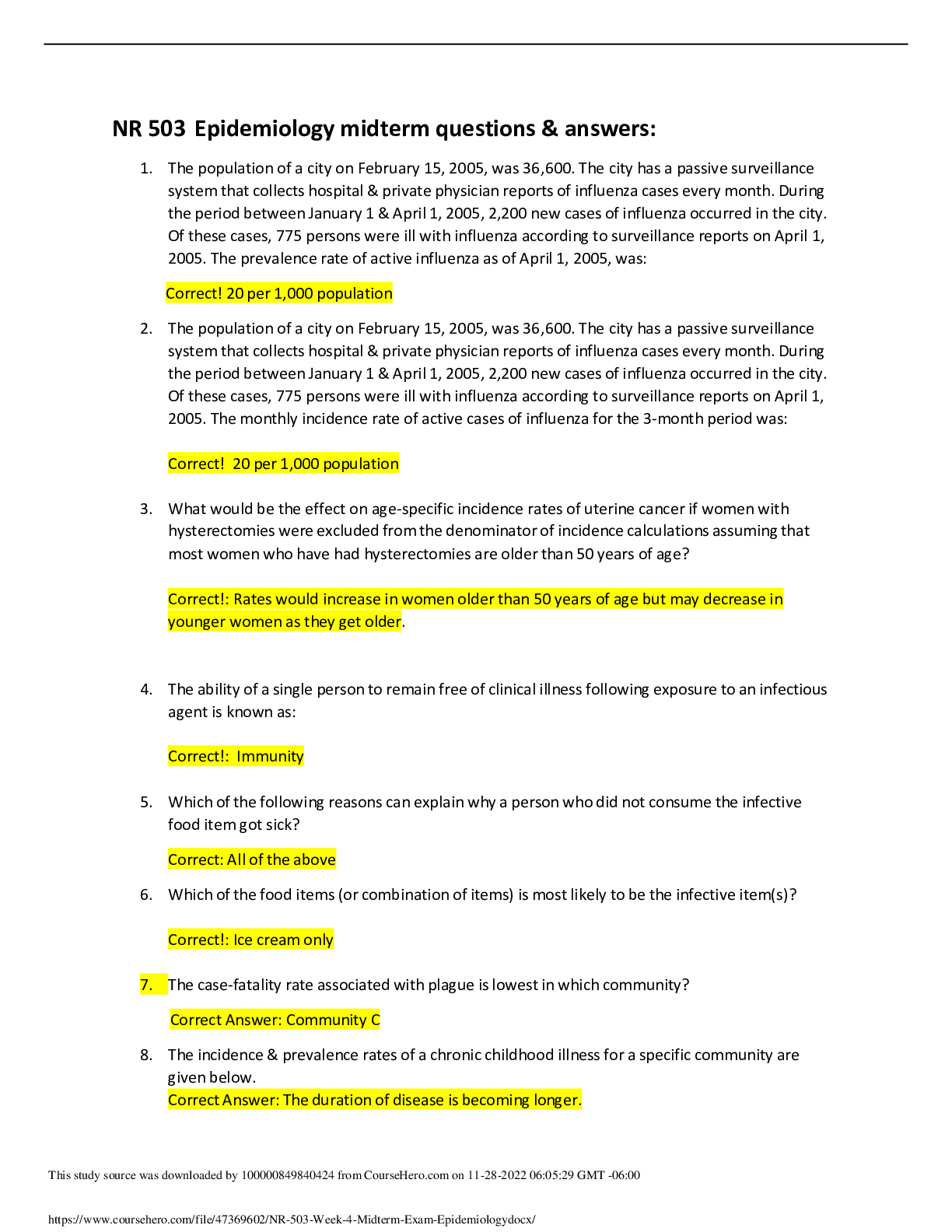
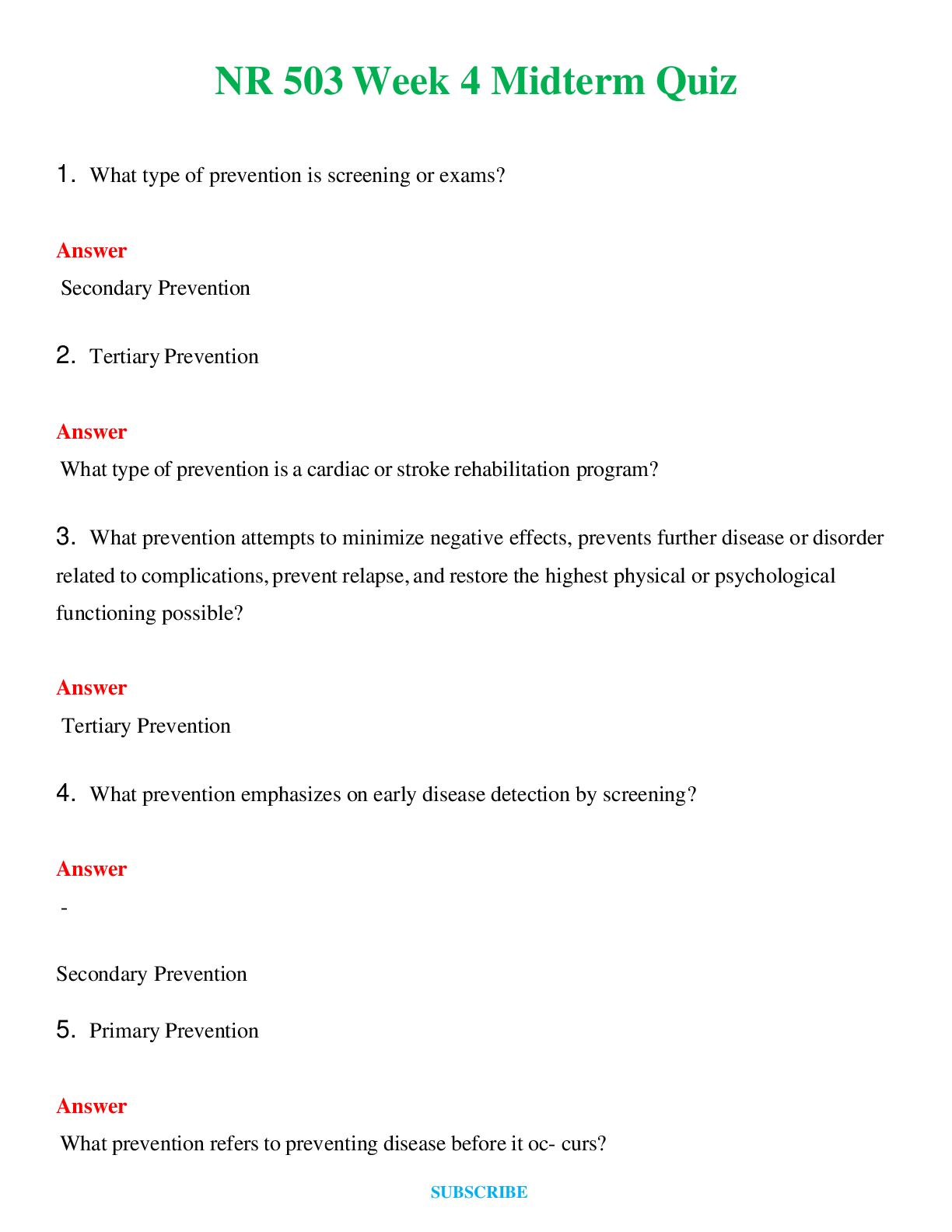
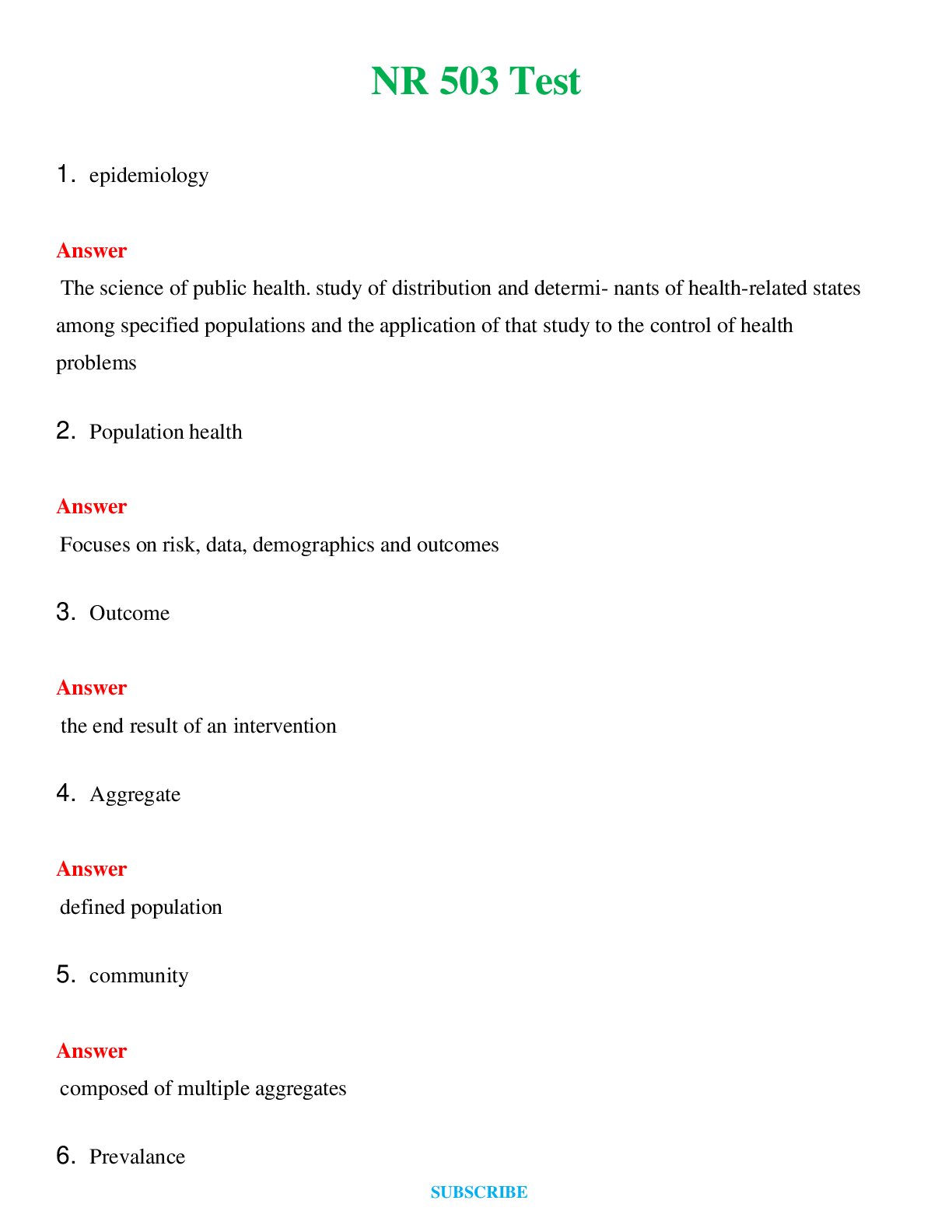
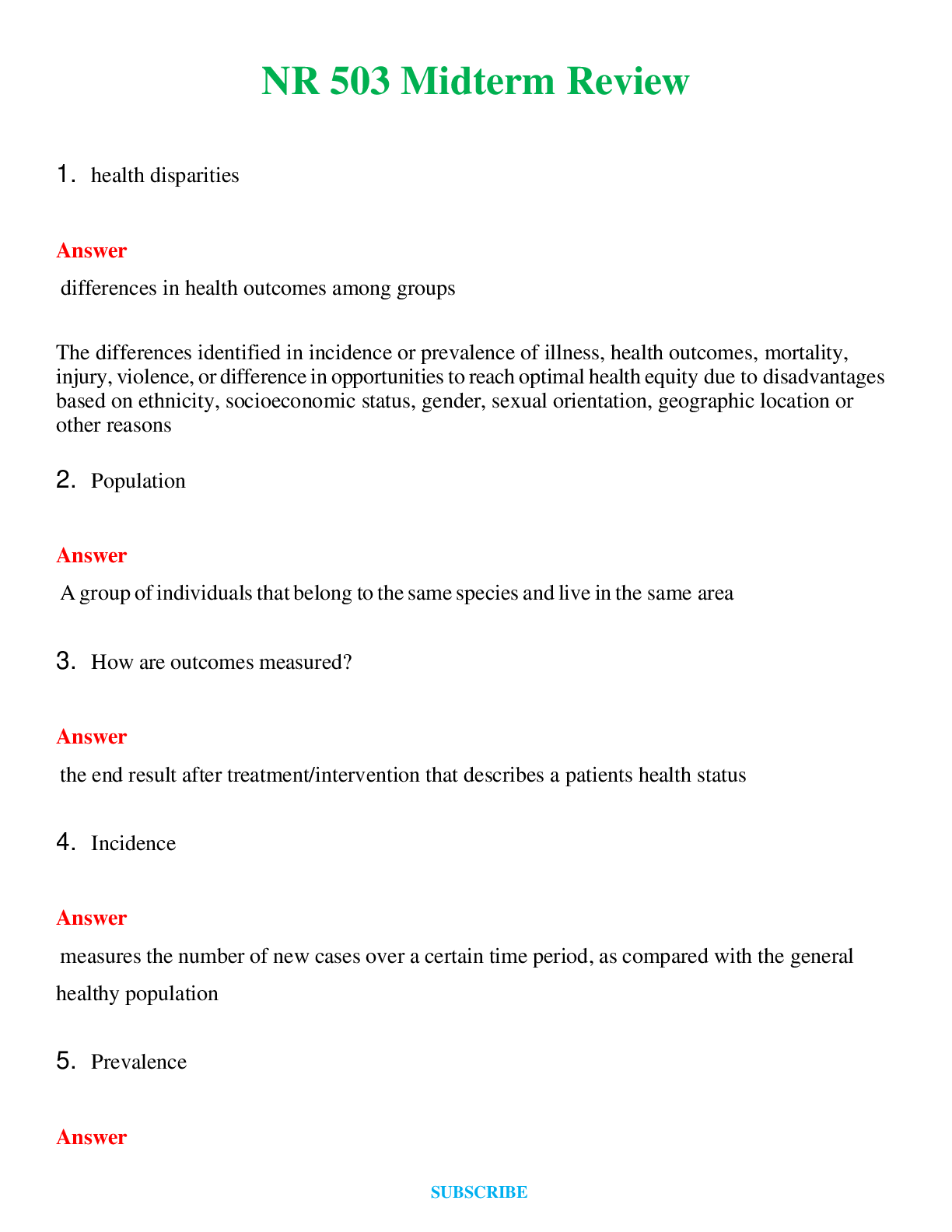
NR 503 Week 4 Midterm Exam (Epidemiology).SOLVED NR 503 Epidemiology midterm questions & answers: 1. The population of a city on February 15, 2005, was 36,600. The city has a passive surveillance ... system that collects hospital & private physician reports of influenza cases every month. During the period between January 1 & April 1, 2005, 2,200 new cases of influenza occurred in the city. Of these cases, 775 persons were ill with influenza according to surveillance reports on April 1, 2005. The prevalence rate of active influenza as of April 1, 2005, was: Correct! 20 per 1,000 population 2. The population of a city on February 15, 2005, was 36,600. The city has a passive surveillance system that collects hospital & private physician reports of influenza cases every month. During the period between January 1 & April 1, 2005, 2,200 new cases of influenza occurred in the city. Of these cases, 775 persons were ill with influenza according to surveillance reports on April 1, 2005. The monthly incidence rate of active cases of influenza for the 3-month period was: Correct! 20 per 1,000 population 3. What would be the effect on age-specific incidence rates of uterine cancer if women with hysterectomies were excluded from the denominator of incidence calculations assuming that most women who have had hysterectomies are older than 50 years of age? Correct!: Rates would increase in women older than 50 years of age but may decrease in younger women as they get older. 4. The ability of a single person to remain free of clinical illness following exposure to an infectious agent is known as: Correct!: Immunity 5. Which of the following reasons can explain why a person who did not consume the infective food item got sick? Correct: All of the above 6. Which of the food items (or combination of items) is most likely to be the infective item(s)? Correct!: Ice cream only 7. The case-fatality rate associated with plague is lowest in which community? Correct Answer: Community C 8. The incidence & prevalence rates of a chronic childhood illness for a specific community are given below. Correct Answer: The duration of disease is becoming longer. 9. The following table gives the mean annual age-specific mortality rates from measles during the first 25 years of life in successive 5-year periods. You may assume that the population is in a steady state (i.e., migrations out are equal to migrations in). Based on the information above, one may conclude: Correct Answer: Children ages 5 to 9 had the highest rate of death in all periods 10. In a country with a population of 16 million people, 175,000 deaths occurred during the year ending December 31, 2005. These included 45,000 deaths from tuberculosis (TB) in 135,000 persons who were sick with TB. Assume that the population remained constant throughout the year. Not all 135,000 cases of TB were contracted during 2005. Which of the following statements is true? Correct Answer: None of the above 11. In 2001, a state enacted a law that required the use of safety seats for all children under 7 years of age & m&atory seatbelt use for all persons. The table above lists the number of deaths due to motor vehicle accidents (MVAs) & the total population by age in 2000 (before the law) & in 2005 (4 years after the law was enacted). Correct Answer: Correct, because both the total & the age-adjusted mortality rates are higher in 2005 than in 2000 12. Which of the following is an advantage of active surveillance? Correct!: More accurate due to reduced reporting burden for health care providers 13. A disease has an incidence of 10 per 1,000 persons per year, & 80% of those affected will die within 1 year. Prior to the year 2000, only 50% of cases of the disease were detected by physician diagnosis prior to death. In the year 2000, a lab test was developed that identified 90% of cases an average of 6 months prior to symptom onset; however, the prognosis did not improve after diagnosis. Which statement is true concerning the duration of the disease after the development of the lab test? Correct Answer: Mean duration of a case of the disease is longer in 2000 14. What is the overall attack rate in persons who did not eat ice cream? Correct!: 33% 15. The table above describes the number of illnesses & deaths caused by plague in four communities. The proportionate mortality ratio associated with plague is lowest in which community? Correct!: Community D 16. Which of the following is characteristic of a single-exposure, common-vehicle outbreak? Correct!: The epidemic curve has a normal distribution when plotted against the logarithm of time 17. The following table gives the mean annual age-specific mortality rates from measles during the first 25 years of life in successive 5-year periods. You may assume that the population is in a steady state (i.e., migrations out are equal to migrations in). Correct Answer: 2.4 3.3 2.0 0.6 0.1 18. A disease has an incidence of 10 per 1,000 persons per year, & 80% of those affected will die within 1 year. Prior to the year 2000, only 50% of cases of the disease were detected by physician diagnosis prior to death. In the year 2000, a lab test was developed that identified 90% of cases an average of 6 months prior to symptom onset; however, the prognosis did not improve after diagnosis. Comparing the epidemiology of the disease prior to 2000 with the epidemiology of the disease after the development of the lab test, which statement is true concerning the disease in 2000? Correct Answer: Incidence is higher & prevalence is higher than in 1999 19. A survey was conducted among 1,000 r&omly sampled adult males in the United States in 2005. The results from this survey are shown below. The researchers stated that there was a doubling of risk of hypertension in each age group younger than 60 years of age. You conclude that the researchers' interpretation: Correct!: is incorrect because prevalence rates are estimated 20. Which of the following is a condition which may occur during the incubation period? Correct!: Transmission of infection 21. The incidence & prevalence rates of a chronic childhood illness for a specific community are given below. Based on the data, which of the following interpretations best describes disease X? Correct! :The duration of disease is becoming longer. 22. A disease has an incidence of 10 per 1,000 persons per year, & 8 [Show More]

Last updated: 3 years ago

Preview 1 out of 6 pages

Buy Now

Instant download

We Accept:

Payment methods accepted on Scholarfriends (We Accept)
Preview image of NR 503 Week 4 Midterm Exam (Epidemiology). SOLVED document

Buy this document to get the full access instantly

Instant Download Access after purchase

Buy Now

Instant download

We Accept:

Payment methods accepted on Scholarfriends (We Accept)

Reviews( 0 )

$15.00

Buy Now

We Accept:

Payment methods accepted on Scholarfriends (We Accept)

Instant download

Can't find what you want? Try our AI powered Search

129
0

Document information


Connected school, study & course


About the document


Uploaded On

Sep 06, 2021

Number of pages

6

Written in

All

Seller


Profile illustration for A+ Grades
A+ Grades

Member since 4 years

1 Documents Sold

Additional information

This document has been written for:

Uploaded

Sep 06, 2021

Downloads

 0

Views

 129

Document Keyword Tags

Recommended For You

Get more on EXAM »

$15.00
What is Scholarfriends

Scholarfriends.com Online Platform by Browsegrades Inc. 651N South Broad St, Middletown DE. United States.

We are here to help

We're available through e-mail, Twitter, and live chat.
 FAQ
 Questions? Leave a message!


Copyright © Scholarfriends · High quality services·