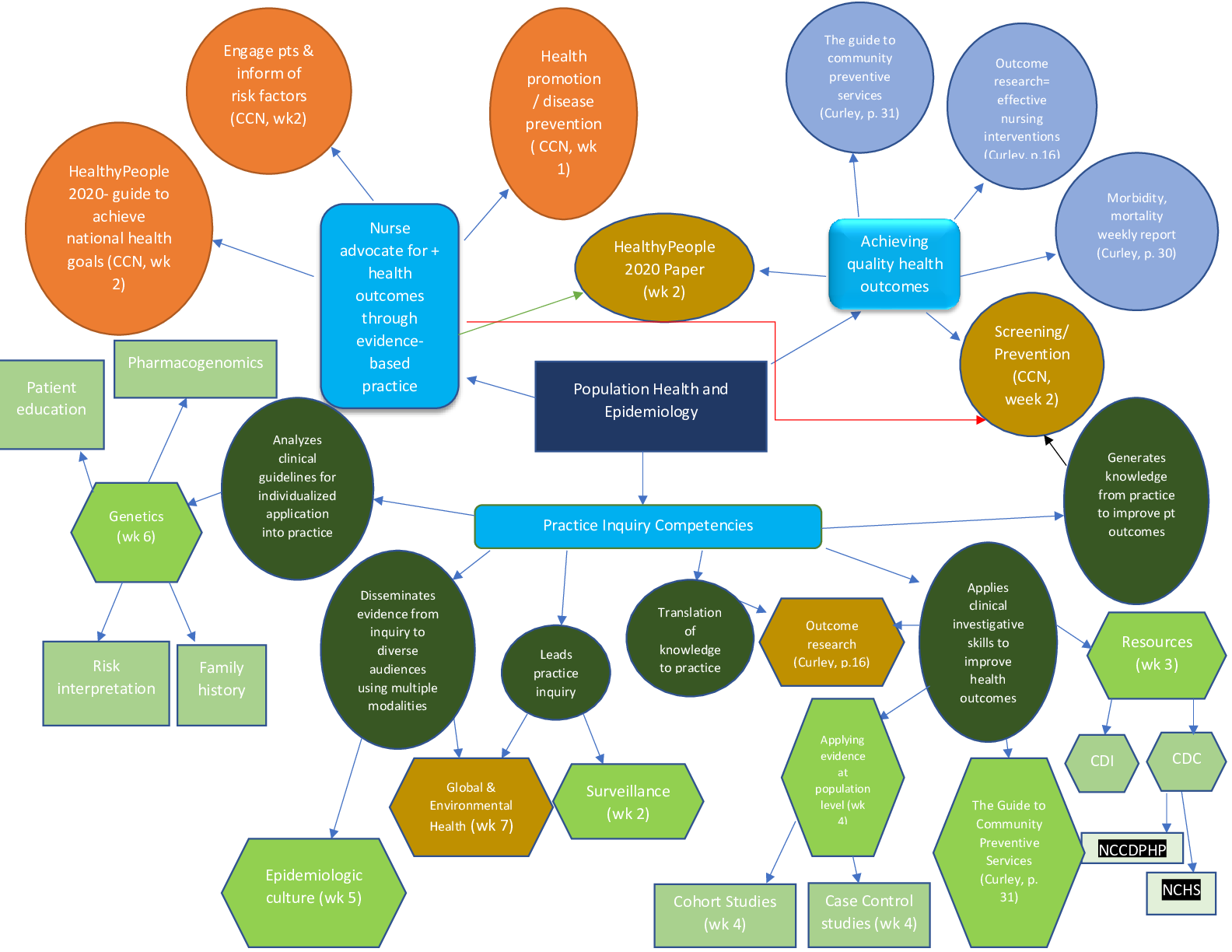
NR-503 Population Health, Epidemiology & Statistical Principles
Mid term Exam
1. Rapid Cycle Improvement (RCI)
- "quality improvement method that identifies, implements and measures changes made to improve a
...
NR-503 Population Health, Epidemiology & Statistical Principles
Mid term Exam
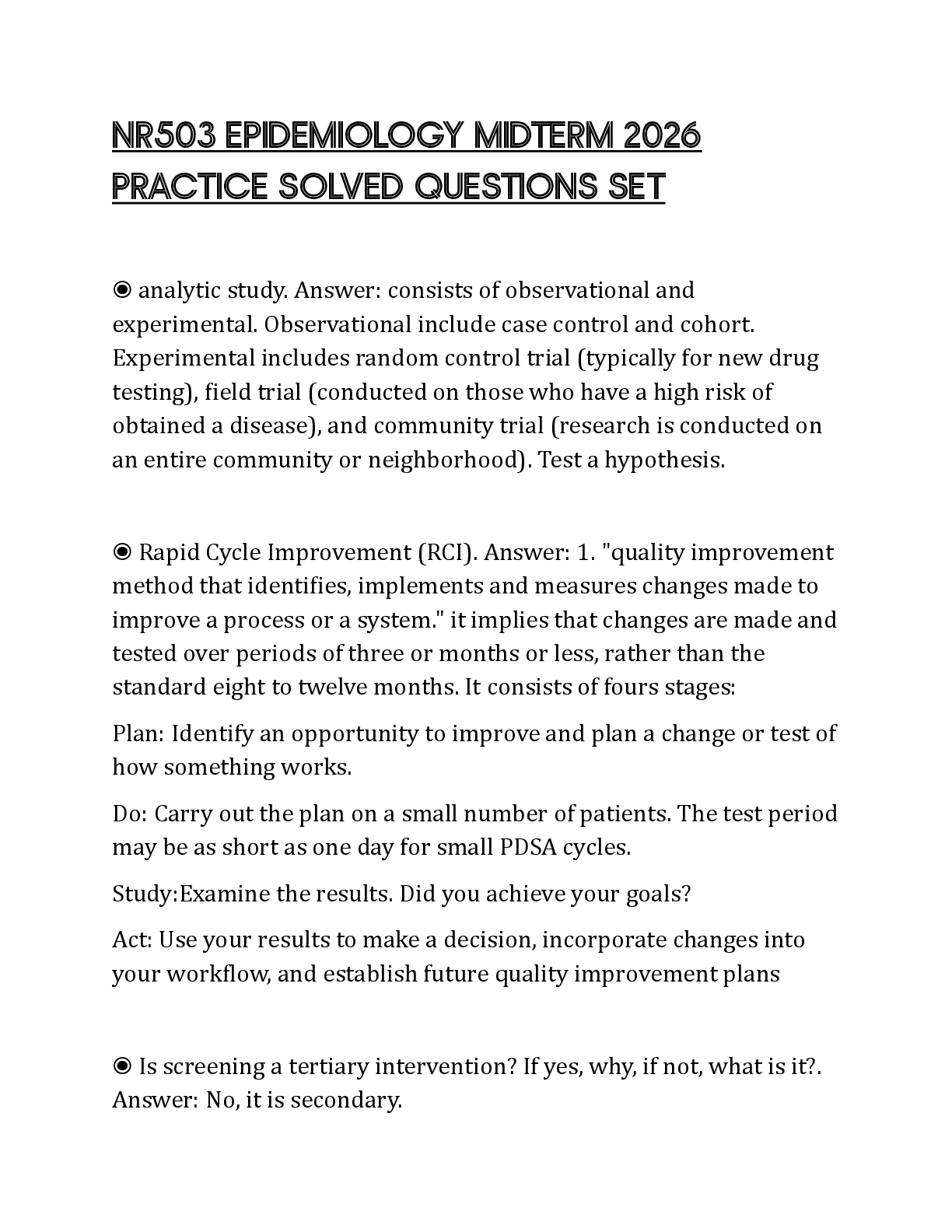
1. Rapid Cycle Improvement (RCI)
- "quality improvement method that identifies, implements and measures changes made to improve a process or a system." it implies that changes are made and tested over periods of three or months or less, rather than the standard eight to twelve months. It consists of four stages:
• Plan: Identify an opportunity to improve and plan a change or test of how something works.
• Do: Carry out the plan on a small number of patients. The test period may be as short as one day for small PDSA cycles.
• Study: Examine the results. Did you achieve your goals?
• Act: Use your results to make a decision, incorporate changes into your workflow, and establish future quality improvement plans
2. Where would an NP look to find a screening test?
-
3. What determines if a screening test should be used?
-
4. Is screening a tertiary intervention? If yes, why, if not, what is it?
-
5. How does a provider determine the usefulness, appropriateness, of a screening test?
-
6. Can you explain what "descriptive epidemiology" means? What is the purpose? How is it used?
-
7. How are causation and descriptive epidemiology related, how do they work together to aid evidence-based care?
-
8. 4 types of casual relationships
-
9. What does "causation" mean? Can you relate causation to primary, secondary and tertiary interventions?
-
10. Are you able to discuss "surveillance" and its relationship to "causation"?
-
11. Epidemiology
-
12. Population Health
-
13. Outcomes
-
14. aggregate
-
15. Community
-
16. data
-
17. Prevalence
-
18. Incidence
-
19. surveillance
-
20. high-risk
-
21. Morbidity
-
22. mortality
-
23. vital statistics
- s
24. Cases
-
25. Social Justice
-
26. Inter-professional collaboration
-
27. Healthy People 2020
aims to reach four overarching goals:
-
28. Determinants of care/health
-
29. risk analysis
-
30. health disparities
-
31. Sensitivity
-
32. Specificity
-
33. Positive predictive value
-
34. Epidemiological triangle
-
35. confounding variable
-
36. Study Methods
-
37. descriptive study AKA Natural history of disease
-
38. analytic study
-
39. absolute risk
-
40. risk factors
-
41. relative risk
-
42. Odds Ratio
-
43. Attributable risk
-
44. Incidence Rate
-
45. prevalence rate
-
46. What is the case-control study and how does it differ (or how is it the same) as the cohort study design?
-
47. What is the case-control study and how does it differ (or is it the same) as the cohort study design?
-
48. What is different in a randomized control trial than, for instance, a case-control study (or a cohort study)? What does it mean to show a causal relationship?
-
49. Can you talk about the ways bias shows up in a study design (such as, selection bias) etc?
-
50. Volunteer Bias
-
51. Exclusion bias
-
52. Withdrawal bias
-
53. Informational bias
-
54. Measurement bias
-
55. What is each type of study used for, its purpose, and its outcomes? How are the outcomes different in each study design? Measured?
-
56. What is an intervention group? Where is it found?
-
57. prospective study
-
58. Retrospective
-
59. Cohort study
-
60. Case-control study
-
61. Randomized Control Trial
-
62. cross-sectional study
-
63. What is meant by "scientific misconduct"?
-
64. Random error
-
65. Systemic error
-
66. Confounding error
-
67. What is the highest level of data findings? How is evidence appraised?
-
68. What factors determine quality of care?
-
69. How is a websites credibility determined?
-
70. What are key indicators when assessing a model of care?
-
71. How would you explain the Triple Aim Initiative (model) to a colleague?
-
72. How does social justice and health inequalities influence population health care provision? Why is this critical information for the provision of evidence-based care?
-
73. What is the Campaign for Action?
-
74. Explain the difference between primary, secondary, and tertiary care.
-
75. Why do epidemiological research?
-
76. cohort study
-
77. cross- sectional study
-
78. Case-control study
-
79. investigate multiple exposures on a single disease
-
80. investigate multiple outcomes
-
81. disease rare
-
82. accurate assessment of exposure status
-
83. anxiety about stability of exposure status
-
84. cross sectional
-
85. Case-control study
-
86. cohort
-
87. Hierarchy of Evidence
-
88. Airborne microorganisms
-
89. fecal-oral transmission
-
90. Direct contact
91. Sexual contact infection
-
92. insect or animal bite
93. communicable disease
94. Ten elements of surveillance
-
95. How nurses apply epidemiological concepts
-
96. 5 W’s of Descriptive Epidemiology
-
[Show More]