*NURSING  >  STUDY GUIDE  >  NSG 6430 Week 9 knowledge check (All)

NSG 6430 Week 9 knowledge check

Document Content and Description Below

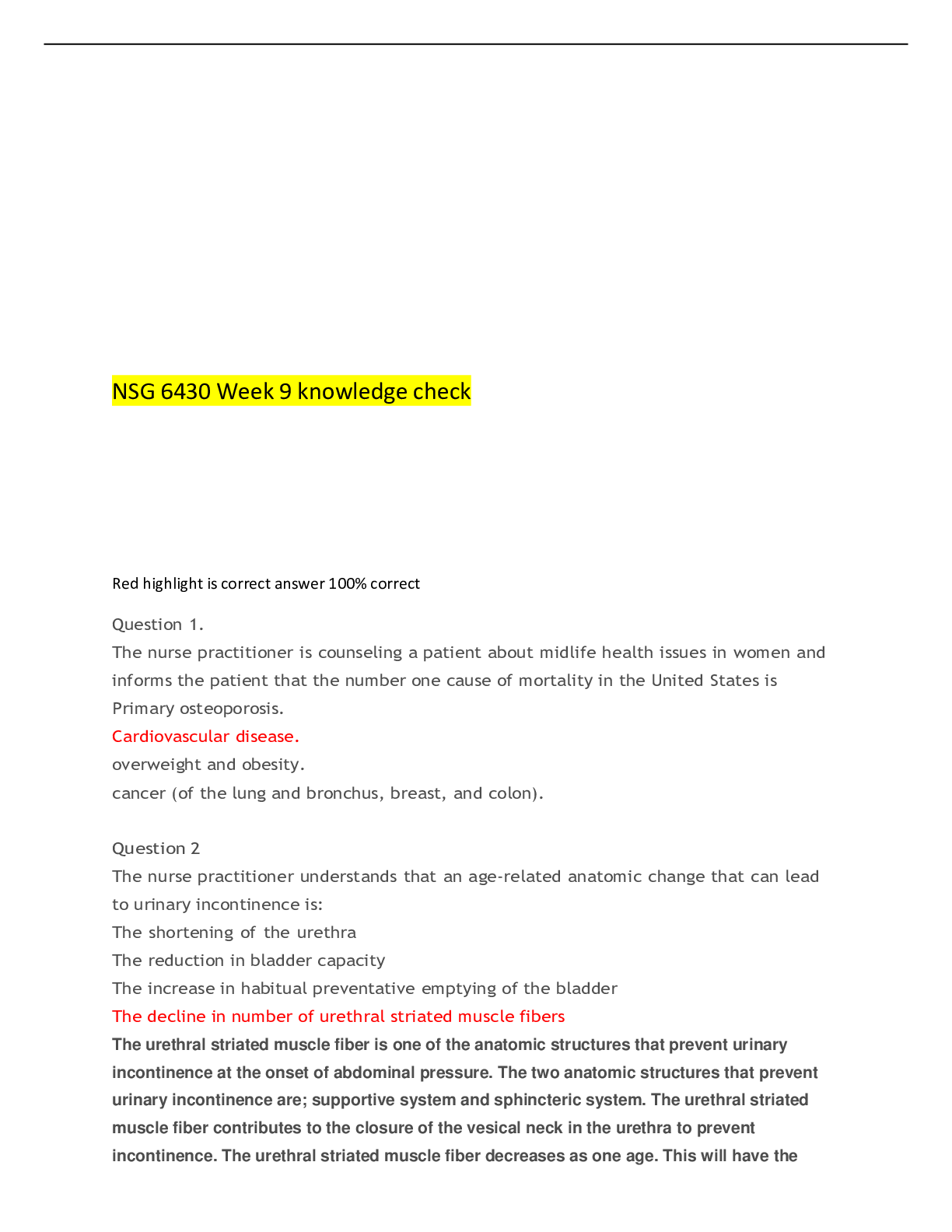
NSG 6430 Week 9 knowledge check Red highlight is correct answer 100% correct Question 1. The nurse practitioner is counseling a patient about midlife health issues in women and informs the patient ... that the number one cause of mortality in the United States is Primary osteoporosis. Cardiovascular disease. overweight and obesity. cancer (of the lung and bronchus, breast, and colon). Question 2 The nurse practitioner understands that an age-related anatomic change that can lead to urinary incontinence is: The shortening of the urethra The reduction in bladder capacity The increase in habitual preventative emptying of the bladder The decline in number of urethral striated muscle fibers The urethral striated muscle fiber is one of the anatomic structures that prevent urinary incontinence at the onset of abdominal pressure. The two anatomic structures that prevent urinary incontinence are; supportive system and sphincteric system. The urethral striated muscle fiber contributes to the closure of the vesical neck in the urethra to prevent incontinence. The urethral striated muscle fiber decreases as one age. This will have the effect of reducing the of the sphincter muscles to stand the abdominal pressure and prevent urinary incontinence. The shortening of the urethra only occurs in women and this means it does not happen for men. The change in the bladder capacity is a physiological change and not an anatomic change. For this reason, the decline in the number of urethral striated muscle fibers is the cause of urinary incontinence among the aged 3. Pelvic muscle contraction that is strategically timed to increase intraurethral pressure just before and after the event that causes urinary incontinence? Kegel contraction Detrusor maneuver Reverse bladder contraction Knack maneuver Question 4 The nurse practitioner is evaluating a patient for pyelonephritis and understands it is distinguished from cystitis in that: The infection has descended to the bladder. The infection has ascended to the kidneys. The infection is caused by E. coli bacteria. The infection occurs only in pregnant women. The nurse practitioner understands that pyelonephritis is distinguished from cystitis based on the ascendance to the kidney. Cystitis only affects the bladder while the pyelonephritis affects the kidneys. Both conditions are caused by E.coli bacteria Question 5 The nurse practitioner is reviewing antibiotic treatment guidelines for uncomplicated lower UTIs and the latest recommendations include which of the following? Seven-day regimens are now recommended. Three times a day of oral antibiotics are now recommended. Three-day regimens are now recommended. A single dose is now recommended. [Show More]

Last updated: 3 years ago

Preview 1 out of 2 pages

Buy Now

Instant download

We Accept:

Payment methods accepted on Scholarfriends (We Accept)
Preview image of NSG 6430 Week 9 knowledge check document

Buy this document to get the full access instantly

Instant Download Access after purchase

Buy Now

Instant download

We Accept:

Payment methods accepted on Scholarfriends (We Accept)

Reviews( 0 )

$5.00

Buy Now

We Accept:

Payment methods accepted on Scholarfriends (We Accept)

Instant download

Can't find what you want? Try our AI powered Search

79
0

Document information


Connected school, study & course


About the document


Uploaded On

Sep 12, 2020

Number of pages

2

Written in

All

Seller


Profile illustration for Good grade
Good grade

Member since 5 years

395 Documents Sold

Reviews Received
56
16
7
7
18
Additional information

This document has been written for:

Uploaded

Sep 12, 2020

Downloads

 0

Views

 79

Document Keyword Tags

Recommended For You

Get more on STUDY GUIDE »

$5.00
What is Scholarfriends

Scholarfriends.com Online Platform by Browsegrades Inc. 651N South Broad St, Middletown DE. United States.

We are here to help

We're available through e-mail, Twitter, and live chat.
 FAQ
 Questions? Leave a message!


Copyright © Scholarfriends · High quality services·