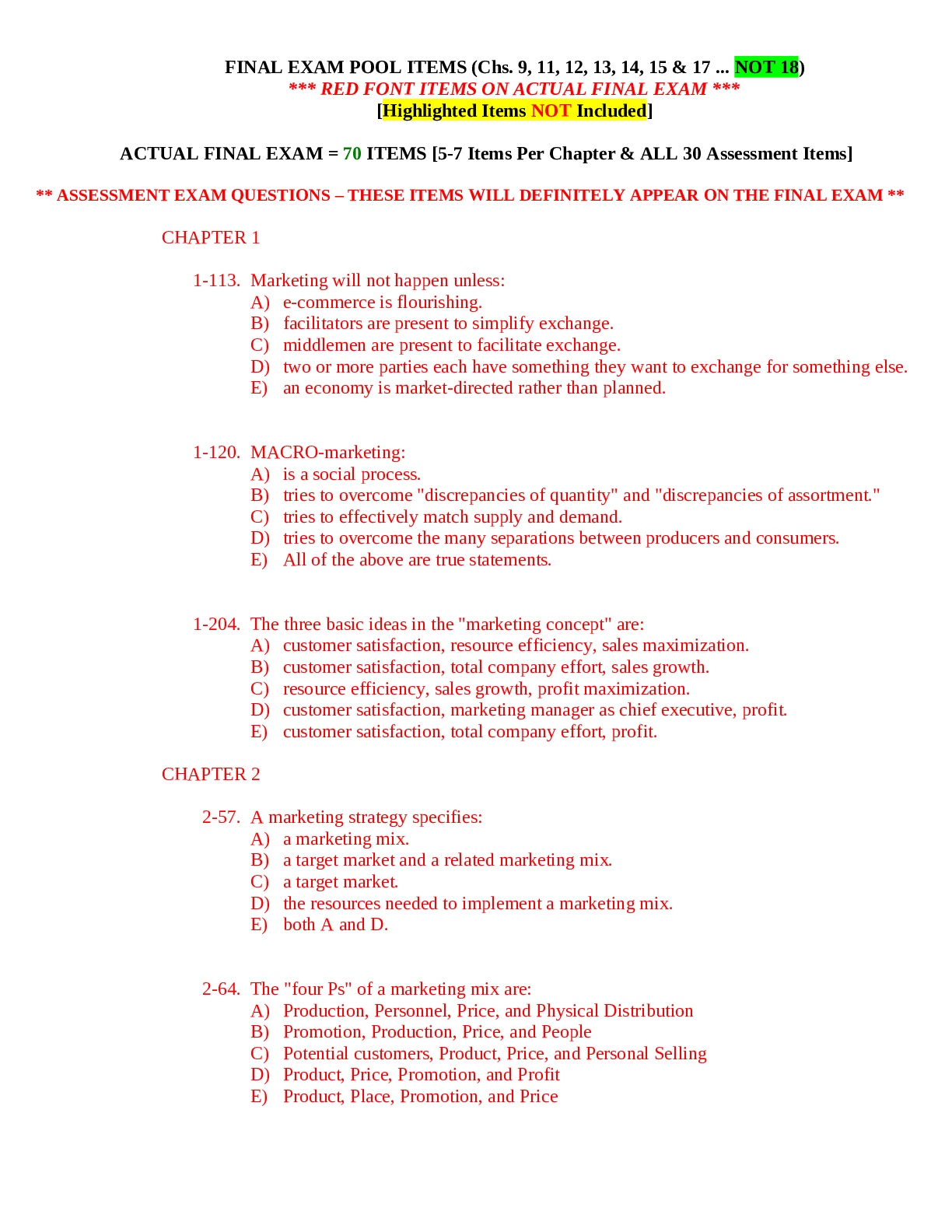
1-113. Marketing will not happen unless:
A) e-commerce is flourishing.
B) facilitators are present to simplify exchange.
C) middlemen are present to facilitate exchange.
D) two or more parties each have something the
...
1-113. Marketing will not happen unless:
A) e-commerce is flourishing.
B) facilitators are present to simplify exchange.
C) middlemen are present to facilitate exchange.
D) two or more parties each have something they want to exchange for something else.
E) an economy is market-directed rather than planned.
1-120. MACRO-marketing:
A) is a social process.
B) tries to overcome "discrepancies of quantity" and "discrepancies of assortment."
C) tries to effectively match supply and demand.
D) tries to overcome the many separations between producers and consumers.
E) All of the above are true statements.
1-204. The three basic ideas in the "marketing concept" are:
A) customer satisfaction, resource efficiency, sales maximization.
B) customer satisfaction, total company effort, sales growth.
C) resource efficiency, sales growth, profit maximization.
D) customer satisfaction, marketing manager as chief executive, profit.
E) customer satisfaction, total company effort, profit.
CHAPTER 2
2-57. A marketing strategy specifies:
A) a marketing mix.
B) a target market and a related marketing mix.
C) a target market.
D) the resources needed to implement a marketing mix.
E) both A and D.
2-64. The "four Ps" of a marketing mix are:
A) Production, Personnel, Price, and Physical Distribution
B) Promotion, Production, Price, and People
C) Potential customers, Product, Price, and Personal Selling
D) Product, Price, Promotion, and Profit
E) Product, Place, Promotion, and Price
2-101. A "marketing plan" is:
A) a marketing program.
B) a marketing strategy.
C) a marketing strategy--plus the time-related details for carrying it out.
D) a target market and a related marketing mix.
E) a plan that contains the necessary operational decisions.
CHAPTER 3
3-81. Market segmentation:
A) means the same thing as marketing strategy planning.
B) assumes that most submarkets can be satisfied by the same marketing mix.
C) is the same thing as positioning.
D) tries to identify homogeneous submarkets within a product-market.
E) All of the above are true.
3-135. "Positioning" is a marketing management aid which refers to:
A) a product's ability to provide both immediate satisfaction and social responsibility.
B) how customers think about proposed and/or present brands in a market.
C) a firm's ability to distribute products through middlemen who are in the right position to reach target customers.
D) how a firm approaches customer relationship management.
E) all of the above.
CHAPTER 4
4-94. Rising costs and inflation are part of the uncontrollable environment.
A) technological
B) economic
C) competitive
D) legal
E) cultural and social
[Show More]