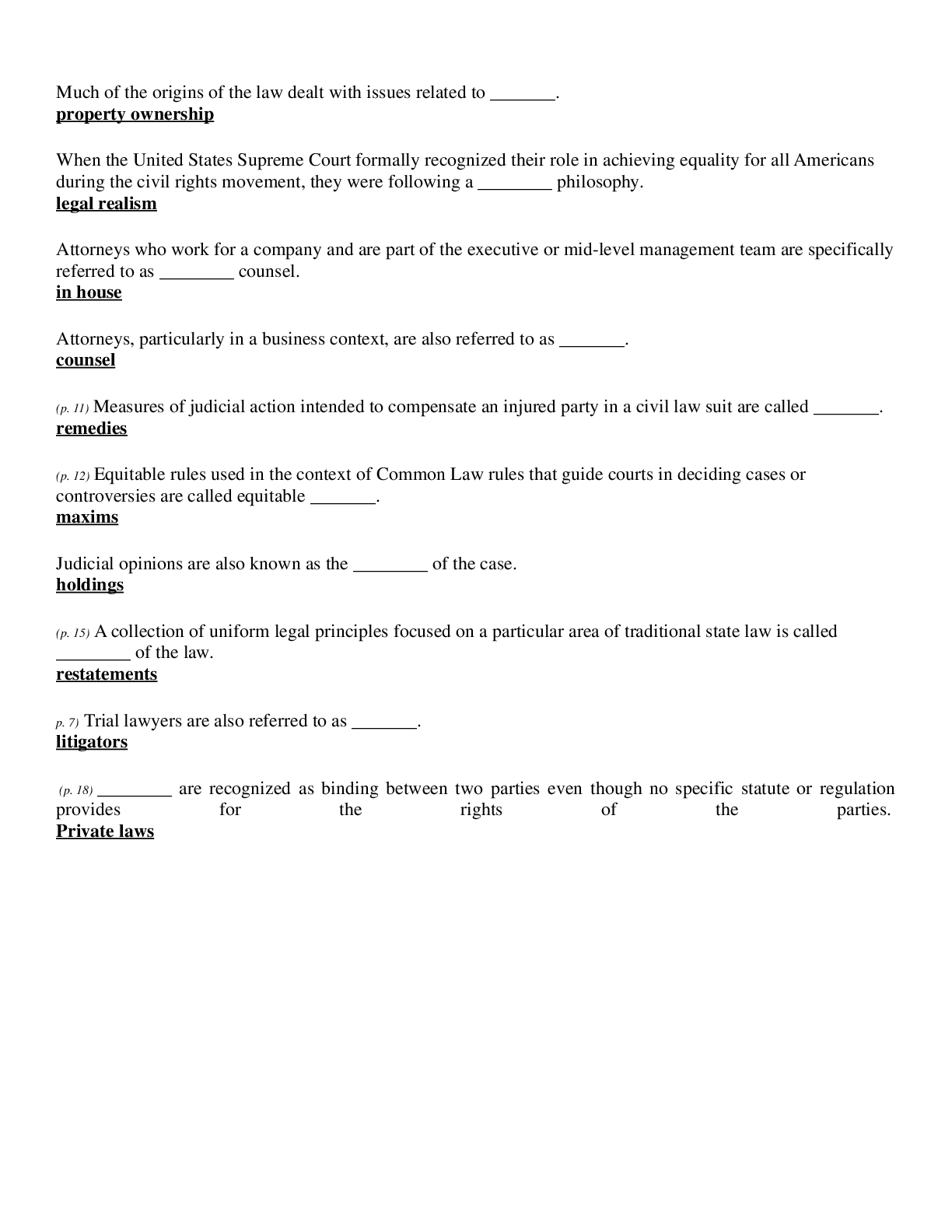
Much of the origins of the law dealt with issues related to _______.
property ownership
When the United States Supreme Court formally recognized their role in achieving equality for all Americans
during the civil righ
...
Much of the origins of the law dealt with issues related to _______.
property ownership
When the United States Supreme Court formally recognized their role in achieving equality for all Americans
during the civil rights movement, they were following a ________ philosophy.
legal realism
Attorneys who work for a company and are part of the executive or mid-level management team are specifically
referred to as ________ counsel.
in house
Attorneys, particularly in a business context, are also referred to as _______.
counsel
(p. 11) Measures of judicial action intended to compensate an injured party in a civil law suit are called _______.
remedies
(p. 12) Equitable rules used in the context of Common Law rules that guide courts in deciding cases or
controversies are called equitable _______.
maxims
Judicial opinions are also known as the ________ of the case.
holdings
(p. 15) A collection of uniform legal principles focused on a particular area of traditional state law is called
________ of the law.
restatements
p. 7) Trial lawyers are also referred to as _______.
litigators
(p. 18) ________ are recognized as binding between two parties even though no specific statute or regulation
provides for the rights of the parties.
Private laws
(p. 4) Legal positivists believe that agreed upon laws should be uniformly and strictly enforced and may only be
changed by the government.
TRUE
(p. 5) Law today is crucial to business by creating some degree of reliability to be used in business planning and
commercial transactions.
TRUE
Law must always be considered when making business decisions and when planning.
(p. 8) States tend to amend their constitutions less frequently than is the case with the United States Constitution.
FALSE
It is much more difficult to change the U.S. Constitution than individual state constitutions.
(p. 9) A presidential veto may be overridden by a 2/3 majority vote of the Senate.
FALSE
A repeal of a presidential veto requires a 2/3 vote of Congress.
(p. 4) Legal Realism is the oldest form of American jurisprudence and was founded during the American
Revolution and forms the basis for the United States Constitution.
FALSE
Legal realism arose after World War I.
(p. 10) Courts regularly question and overturn administrative agency decisions involving how and when an agency
enforces a regulation.
FALSE
Courts are highly differential to agency decisions.
(p. 11) The power of courts to establish law in matters not specifically addressed by statutes is very limited in
common law countries.
FALSE
Such power is limited in civil law countries but not so in common law countries.
(p. 11) Equitable remedies are available to compensate injured parties in both civil and criminal lawsuits.
FALSE
Equitable remedies are only available in civil cases.
(p. 11) Most states have separate courts of law and equity.
FALSE
Most modern courts are combined courts of law and equity.
(p. 12) A statute of limitations determines the maximum and minimum amounts of monetary relief that may be
granted in different types of civil law suits.
FALSE
A statute of limitations sets the time within which a law suit must be filed after an injury occurs.
(p. 15) The purpose of secondary sources of law is to increase uniformity and fairness across courts in the 50
states.
TRUE
Secondary sources of law allow each state to refer to a singular explanation of various laws for increased
consistency.
(p. 18) A wrongful act may violate civil law or criminal law but cannot violate both simultaneously.
FALSE
The same act may result in both civil and criminal liability.
(p. 18) A zoning law which regulates what a landowner may or may not do with their privately owned property is
an example of a public law.
TRUE
Zoning laws are based on statutes and ordinances.
(p. 18) Laws which require that police show reasonable cause and obtain a search warrant before entering a place
of business to search for evidence would be examples of substantive laws.
FALSE
Search and seizure laws are examples of procedural laws.
(p. 18) Criminal law is designed to compensate parties for money lost as a result of another's unlawful conduct.
FALSE
Only civil law actions may result in monetary damages.
(p. 18) For private law to be applied, there must be a statute or ordinance enacted that provides for the rights of the
parties.
FALSE
Statutes and ordinances result in public law.
(p. 18) Criminal law can also be characterized as public law but can never be considered private law.
TRUE
Criminal law must be statutory and is therefore public law.
(p. 18) Freedom of Speech, as defined in the Constitution, is an example of substantive law.
TRUE
Freedom of Speech is an individual right.
(p. 16) Restatements of the law are written and revised by the Congress and state legislatures as needed.
FALSE
Restatements of the law are written by the American Legal Institute.
(p. 9) All statutes have a statutory scheme but not all statutes have a legislative history.
FALSE
All statutes have both with the history showing the sponsor, debates and votes.
(p. 10) The common law is the law that all states follow to avoid confusion and to promote consistency from state
to state.
FALSE
The common law is made by state courts and varies from state to state.
(p. 11) Civil law systems reject and prohibit the use of precedent, relying solely on strict interpretations of
statutes.
FALSE
Civil law recognizes the general notion of precedent but its use is severely limited.
(p. 13) When a Pennsylvania appellate court makes a decision, stare decisis requires that Delaware trial courts
follow the case precedent when a case with a similar fact situation arises.
FALSE
Stare decisis and case precedent only apply in courts in the state in which the appellate court making the
decision sits.
(p. 20) Aggressive litigation generally results in a high monetary cost for a corporation.
TRUE
Aggressive litigation takes additional counsel time and assets which increases the cost of litigation.
(p. 20) Arbitration and mediation are preferred dispute resolution methods because they always result in a
satisfactory outcome for both sides of the dispute.
FALSE
While arbitration and mediation are legitimate and effective dispute resolution methods, they do not always
result in a satisfactory outcome for both sides of the dispute.
(p. 9, 10-11) Ordinances will preempt state level statutes.
FALSE
State level laws preempt local level laws.
(p. 20) Alternative dispute resolution, when used to settle a business dispute, is usually not subject to appeal to a
court.
TRUE
Alternative dispute resolution methods, unless there is a prior agreement are generally not subject to appeal to a
court.
(p. 15) Laws relating to contracts for the sale of goods are primarily found in the common law.
FALSE
Laws relating to contracts for the sale of goods are statutory.
(p. 10) The U.S. system of common law is deep-seated in the French common law established by the Norman
kings around 1066.
FALSE
The U.S. system of common law is deep-seated in the English common law established by the Norman kings
around 1066.
(p. 4) Jurisprudence refers to the conducting of a trial and the rendering of a judicial decision.
FALSE
Jurisprudence is the science and philosophy of law.
(p. 4) Black's Law Dictionary, as cited in the book defining the term law, includes each of the following except:
A. law is a body of rules.
B. law is conduct prescribed by a controlling authority.
C. law has a binding force.
D. law regulates personal ethics.
(p. 4) Jurisprudence is defined as:
A. adjudication of law suits.
B. the enactment of laws by a government body.
C. the science and philosophy of law.
D. the duties and obligations owed by a citizen.
Jurisprudence is defined as the science and philosophy of law.
(p. 4) Philip believes that moral values inherent in mankind should form the basis of law and that these principles
are a higher authority than man made law. Philip is a proponent of:
A. natural law.
B. legal realism.
C. legal positivism.
D. social law.
Natural law values moral values over national law.
(p. 6) Joshua is a highly accomplished soccer player and a successful coach. He is often hired by other coaches to
run soccer clinics and soccer camps for their teams. If Joshua decides to incorporate and sell stock to finance the
corporation, the area of law that he would need to be aware of with regard to the stock sales would be:
A. securities law.
B. intellectual property law.
C. contract law.
D. antitrust law.
Stocks are securities and subject to securities laws.
(p. 6) Mega Corporation has developed a strategic plan that calls for an emphasis on appealing to a younger
demographic. If it decided that such an appeal to a younger market would necessitate a change in the corporate
logo and trademark, such changes would require an understanding of:
A. securities law.
B. intellectual property law.
C. contract law.
D. antitrust law.
Corporate logos and trademarks are subject to intellectual property law.
(p. 9) The state of Delaware has passed a new law banning cell phone use while driving a motor vehicle within
the state. This law would be defined as a/an:
A. ordinance.
B. regulation.
C. statute.
D. common law.
When a law is passed by a state legislature, that law is a statute.
(p. 9) New York City has passed a law banning smoking of cigarettes and cigars in public bars and restaurants.
This law would be defined as a/an:
A. ordinance.
B. regulation.
C. statute.
D. common law.
When a law is passed at a local level, that law is an ordinance.
(p. 10) The official publication of federal statutory law is the:
A. Federal Register.
B. Consolidated Statutes of the United States.
C. Code of Congressional Statutes.
D. United States Code.
The United States Code arranges all existing federal laws in a system organized by title and divided into
chapters and sections.
(p. 10) Kathy, a fashion model, witnesses a motor vehicle accident but does not stop because she was late for her
pedicure and simply didn't want to get involved. Had she stopped she could have saved the life of Tom who was
thrown from the car and landed in a water filled ditch, without danger to herself. When Tom's widow hears that
Kathy could have easily saved Tom's life but chose to ignore the situation she sues Kathy. The state has no
"good samaritan" laws or duty to assist laws but such cases have been brought in the past. Which of the
following will the court apply when making a decision in this case?
A. statutory law
B. administrative law
C. common law
D. equity law
In the absence of written law, courts will look to the common law and case precedent.
(p. 11-12) Bradley collects historic memorabilia and one of his prized possessions is the pistol used by Aaron Burr
in his duel with Alexander Hamilton. After reading an article in a magazine Bradley discovers that Sam owns
the matching pistol, used by Hamilton in the duel. Bradley contacts Sam and offers him $500,000 for the pistol.
Sam e-mails Bradley that he accepts his offer but the transaction must be for cash and face to face. Bradley
responds that he'll be at Sam's home at noon the next day with the money. When he arrives, Sam informs him
that he's received an offer of $600,000 for the pistol and Bradley must pay that amount or he'll sell to the other
buyer. Bradley wants the weapon to complete the set. If he sues Sam, what course of action will best provide
him the results he desires?
A. sue for breach of contract and seek a legal remedy
B. sue for an injunction
C. bring a suit in equity and seek monetary damages
D. sue for breach of contract and seek a decree of specific performance
Specific performance is an equitable remedy available only when monetary damages will not be a sufficient
remedy.
(p. 11) Which of the following is not available in a court of equity?
A. an order for the payment of money damages for a breach of contract
B. an order prohibiting the building of a 16 foot fence in a residential neighborhood
C. an order requiring teachers to stop picketing in a particular area
D. an order requiring a party to turn over goods after being found guilty of breach of contract
Remedies in equity do not include monetary damages.
(p. 13) In Kauffman-Harmon v. Kauffman, when Mr. Kauffman sued his children to have all stock given to them
transferred back to him, claiming their possession was only a temporary trust:
A. the court found that a temporary trust had indeed been created and that Mr. Kauffman was the equitable
owner of the stock.
B. the court found that Mr. Kauffman was the equitable owner of the stock because the children had participated
in a fraud when accepting ownership of the stock.
C. the court found that the children owned the stock because Mr. Kauffman's request for the return of the stock
and the subsequent law suit came after the statute of limitations had run so he was barred from recovery.
D. the court found that the children owned the stock and Mr. Kauffman's claims were barred by the clean hands
doctrine.
Kauffman tried to shield assets from creditors and did not exhibit "clean hands".
(p. 13) A state's appellate court has made a decision in a particular case. That decision becomes case precedent in
all cases except those cases heard in:
A. the state's Supreme or highest court.
B. the state's special courts such as family or probate court.
C. the state's general trial court.
D. the state's inferior or small claims court.
Stare decisis requires only lower courts to follow case precedent.
(p. 14) In Flagiello v. Pennsylvania Hospital, the court had to balance the hospital's negligence against the
charitable immunity doctrine to determine whether Flagiello could recover for injuries sustained on the
hospital's property. The court determined that:
A. the charitable immunity doctrine was specifically and clearly written so they were bound to follow the clear
intent of the statutory scheme and find for the hospital.
B. the charitable immunity doctrine had been litigated in the past and stare decisis required that the court adhere
to established case precedent and find for the hospital.
C. current societal norms rendered the charitable immunity doctrine inapplicable to this case and that
fundamental fairness allowed the court to deviate from established case precedent and find for Flagiello.
[Show More]