Question 1 Quiz 1 Prof. Nursing Practice NUR3805
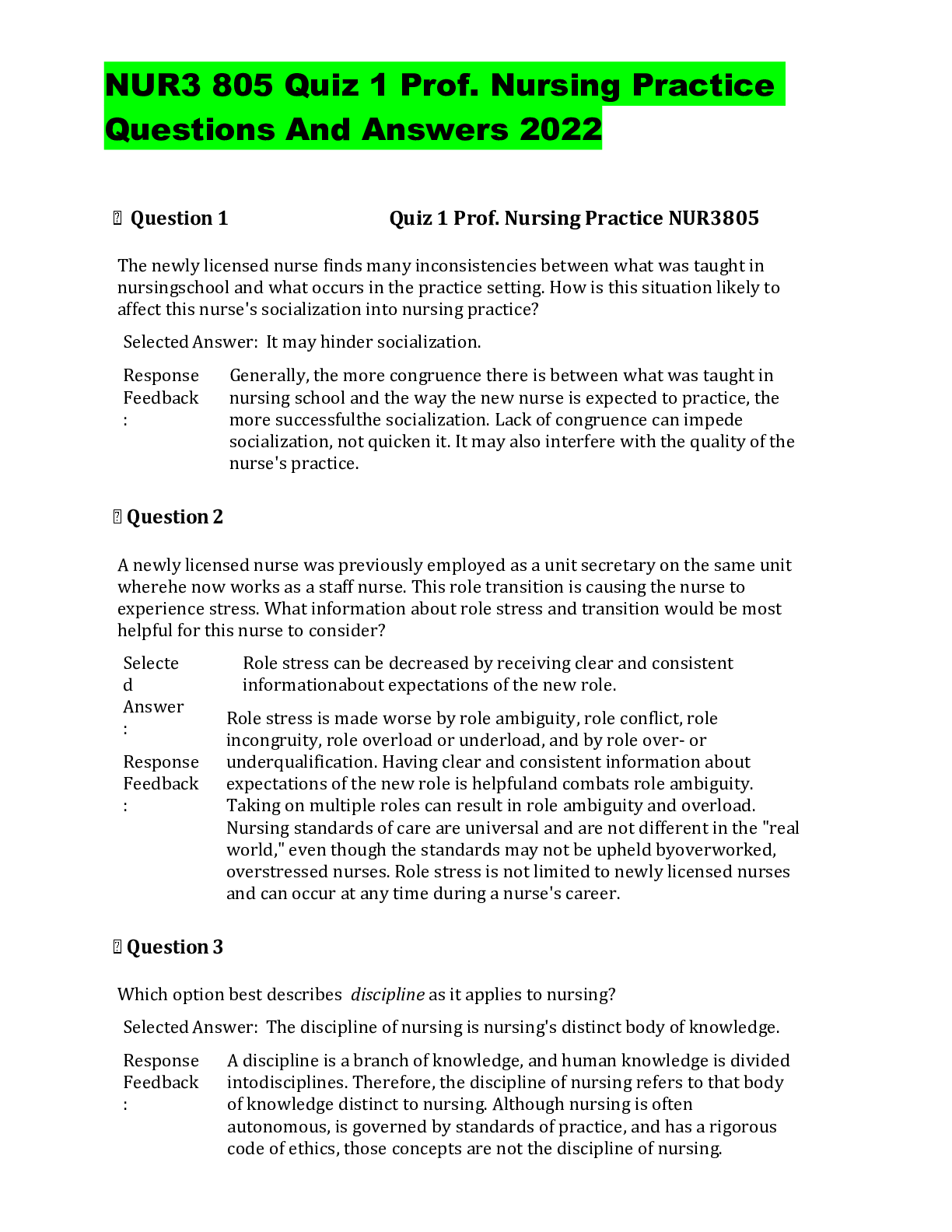
The newly licensed nurse finds many inconsistencies between what was taught in nursing
school and what occurs in the practice setting. How is this situation likely to
...
Question 1 Quiz 1 Prof. Nursing Practice NUR3805
The newly licensed nurse finds many inconsistencies between what was taught in nursing
school and what occurs in the practice setting. How is this situation likely to affect this
nurse's socialization into nursing practice?
Selected Answer: It may hinder socialization.
Response
Feedback:
Generally, the more congruence there is between what was taught in nursing
school and the way the new nurse is expected to practice, the more successful
the socialization. Lack of congruence can impede socialization, not quicken
it. It may also interfere with the quality of the nurse's practice.
Question 2
A newly licensed nurse was previously employed as a unit secretary on the same unit where
he now works as a staff nurse. This role transition is causing the nurse to experience stress.
What information about role stress and transition would be most helpful for this nurse to
consider?
Selected
Answer:
Role stress can be decreased by receiving clear and consistent information
about expectations of the new role.
Response
Feedback:
Role stress is made worse by role ambiguity, role conflict, role incongruity,
role overload or underload, and by role over- or underqualification. Having
clear and consistent information about expectations of the new role is helpful
and combats role ambiguity. Taking on multiple roles can result in role
ambiguity and overload. Nursing standards of care are universal and are not
different in the "real world," even though the standards may not be upheld by
overworked, overstressed nurses. Role stress is not limited to newly licensed
nurses and can occur at any time during a nurse's career.
Question 3
Which option best describes discipline as it applies to nursing?
Selected Answer: The discipline of nursing is nursing's distinct body of knowledge.
Response
Feedback:
A discipline is a branch of knowledge, and human knowledge is divided into
disciplines. Therefore, the discipline of nursing refers to that body of
knowledge distinct to nursing. Although nursing is often autonomous, is
governed by standards of practice, and has a rigorous code of ethics, those
concepts are not the discipline of nursing.
This study source was downloaded by 100000827141222 from CourseHero.com on 06-30-2022 05:42:24 GMT -05:00
https://www.coursehero.com/file/105765756/10-NUR3805-Quiz-1-Transition-docx/
Question 4
The newly licensed nurse has theoretical knowledge and technical skill abilities but has
difficulty working within the constraints of the nursing unit. What issue associated with role
development does this situation exemplify?
Selected Answer: Reality shock
Response
Feedback:
Transition shock or reality shock may happen when the perceived role comes
into conflict with the performed role. Role sending involves the members of
the role set communicating role expectations. Role formation is affected by
factors such as personality, attitudes, qualifications, educational preparation,
and clarity of communication. Role mastery is when a person demonstrates
behaviors that meet the societal or cultural expectations associated with the
specific role.
Question 5
Which organization published a 1965 position paper that identified associate degree nurses as
"technical nurses"?
Selected Answer: The American Nurses Association
Response
Feedback:
In 1965, the American Nurses Association published a position paper on
education of nurses that differentiated nurses with baccalaureate degrees and
nurses with associate degrees as professional and technical nurses. The other
organizations listed did not publish such papers.
Question 6
The nurse's research is directed toward testing a specific hypothesis deduced from a theory.
Which research approach does this work represent?
Selected Answer: Positivist
Response
Feedback:
The positivist approach deals with natural law and assumes that there is a
body of facts and principles to be discovered and understood that is
independent of the context. In this approach, hypotheses are deduced from the
theory to be tested in research. The dynamic approach is also referred to as
constructivist. In this approach theories are inductively constructed and give
insights into social contexts and personal meanings. This approach uses
naturalistic settings and observational method
[Show More]