Question 1
S. is a 59-year-old female who has been followed for several years for aortic
regurgitation. Serial echocardiography has demonstrated normal ventricular function,
but the patient was lost to follow-up for t
...
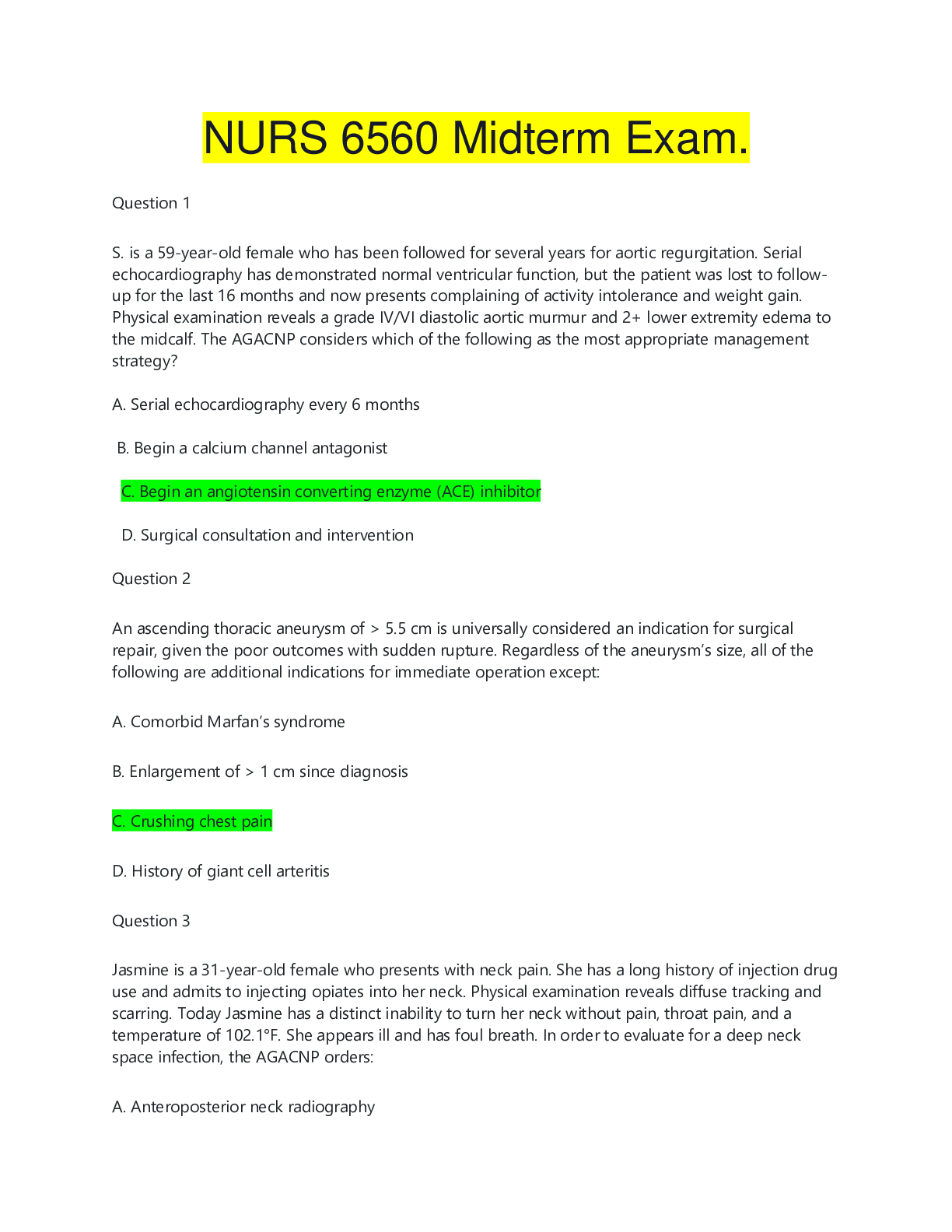
Question 1
S. is a 59-year-old female who has been followed for several years for aortic
regurgitation. Serial echocardiography has demonstrated normal ventricular function,
but the patient was lost to follow-up for the last 16 months and now presents
complaining of activity intolerance and weight gain. Physical examination reveals a
grade IV/VI diastolic aortic murmur and 2+ lower extremity edema to the midcalf. The
AGACNP considers which of the following as the most appropriate management
strategy?
A. Serial echocardiography every 6 months B. Begin a calcium channel antagonist
C. Begin an angiotensin converting enzyme (ACE) inhibitor D. Surgical consultation
and intervention
Question 2
An ascending thoracic aneurysm of > 5.5 cm is universally considered an indication for
surgical repair, given the poor outcomes with sudden rupture. Regardless of the
aneurysm’s size, all of the following are additional indications for immediate operation
except:
A. Comorbid Marfan’s syndrome B. Enlargement of > 1 cm since diagnosis
C. Crushing chest pain D. History of giant cell arteritis
Question 3
Jasmine is a 31-year-old female who presents with neck pain. She has a long history of
injection drug use and admits to injecting opiates into her neck. Physical examination
reveals diffuse tracking and scarring. Today Jasmine has a distinct inability to turn her
neck without pain, throat pain, and a temperature of 102.1°F. She appears ill and has
foul breath. In order to evaluate for a deep neck space infection, the AGACNP orders:
A. Anteroposterior neck radiography B. CT scan of the neck C. White blood cell
(WBC) differential D. Aspiration and culture of fluid
Question 4
Mr. Draper is a 39-year-old male recovering from an extended abdominal procedure. As
a result of a serious motor vehicle accident, he has had repair of a small bowel
perforation, splenectomy, and repair of a hepatic laceration. He will be on total
parenteral nutrition postoperatively. The AGACNP recognizes that the most common
complications of parenteral nutrition are a consequence of:
A. Poorly calculated solution B. Resultant diarrhea and volume contraction C. The
central venous line used for infusion D. Bowel disuse and hypomotility
Question 5
Mr. Mettenberger is being discharged following his hospitalization for reexpansion of his
second spontaneous pneumothorax this year. He has stopped smoking and does not
appear to have any overt risk factors. While doing his discharge teaching, the AGACNP
advises Mr. Mettenberger that his current risk for another pneumothorax is:
A. < 10% B. 25-50% C. 50-75% D. > 90
Question 6
One of the earliest findings for a patient in hypovolemic shock is:
A. A drop in systolic blood pressure (SBP) < 10 mm Hg for > 1 minute when sitting up
B. A change in mental status C. SaO2 of < 88% D. Hemoglobin and hematocrit
(H&H) < 9 g/dL and 27%
Question 7
Traumatic diaphragmatic hernias present in both acute and chronic forms. Patients with
a more chronic form are most likely to be present with:
A. Respiratory insufficiency B. Sepsis C. Bowel obstruction D. Anemia
Question 8
The AGACNP is managing a patient in the ICU who is being treated for a pulmonary
embolus. Initially the patient was stable, awake, alert, and oriented, but during the last
several hours the patient has become increasingly lethargic. At change of shift, the
oncoming staff nurse appreciates a profound change in the patient’s mental status from
the day before. Vital signs and hemodynamic parameters are as follows: BP 88/54 mm
Hg Pulse 110 bpm Respiratory rate 22 breaths per minute SaO2 93% on a 50% mask
Systemic vascular resistance (SVR) 1600 dynes ∙ sec/cm5 Cardiac index 1.3 L/min
Pulmonary capillary wedge pressure (PCWP) 8 mm Hg This clinical picture is most
consistent with which shock state?
A. Hypovolemic B. Cardiogenic C. Distributive D. Obstructive
Question 9
When counseling patients to prevent postoperative pulmonary complications, the
AGACNP knows that with respect to smoking cessation, the American College of
Surgeons and National Surgical Quality Improvement Program guidelines are clear that
patients who stop smoking _____ weeks before surgery have no increased risk of
smokingrelated pulmonary complications.
A. 2 B. 4 C. 6 D. 8
Question 10
Mitch C. is a 39-year-old male who is brought to the ED by paramedics. According to the
report of a neighbor, Mitch was distraught over a breakup with his fiancée and
attempted to commit suicide by mixing some chemicals from under his kitchen sink and
drinking them; afterward he changed his mind and knocked on his neighbor’s door
asking for help. Mitch is awake but stuporous, and the neighbor has no idea what he
drank. Visual inspection of his mouth and oropharynx reveals some edema and
erythema. He is coughing and has large amounts of pooling saliva. Mitch is not capable
of answering questions but he appears in pain. Endoscopy reveals full thickness
mucosal injury with mucosal sloughing, ulceration, and exudate. The AGACNP knows
that the appropriate course of treatment must include:
A.At least 6 hours of observation in the emergency department B. Periodic
esophagram C. Aggressive fluid resuscitation D.Esophagogastrectomy
Question 11
Jared V. is a 35-year-old male who presents for evaluation of a dry cough. He reports
feeling well overall but notices that he gets out of breath more easily than he used to
when playing soccer. A review of systems yields results that are essentially benign,
although the patient does admit to an unusual rash on his legs. Physical examination
reveals scattered erythematous nodules on both shins. There is no drainage, discomfort,
or itch. Additionally, diffuse, mildly enlarged lymph nodes are appreciated bilaterally.
Results of a comprehensive metabolic panel and complete blood count are within
normal limits. Twelve-lead ECG reveals sinus bradycardia at 58 bpm. Chest radiography
reveals bilateral hilar and mediastinal lymphadenopathy. The AGACNP suspects:
A.Bronchiectasis B. Pulmonary fibrosis C. Sarcoidosis D.Lung carcinoma
Question 12
Mrs. Miller is a 44-year-old female who is on postoperative day 1 following a total
abdominal hysterectomy. Her urine output overnight was approximately 200 mL. The
appropriate response for the AGACNP would be to order:
A.A urinalysis and culture B. 1 liter of NSS over 8 hours C. Encourage increased
mobility D.Liberalize salt in the diet
Question 13
All of the following are risk factors for spontaneous pneumothorax except:
A.Connective tissue disease B. Scuba diving C. Chronic obstructive pulmonary
disease (COPD) D.Central line insertion
Question 14
The AGACNP is going over preoperative information and instructions with a patient who
is having a major transverse abdominal procedure tomorrow morning. The patient is
very nervous and is asking a lot of questions. The AGACNP prescribes a sleeping agent
because he knows that anxiety and sleeplessness may:
A.Lead to hypoxia due to hyperventilation B. Increase the physiologic stress response
postoperatively C. Contribute to risk of delirium and prolonged length of stay
D.Decrease p.o. intake and produce nutritional risk
Question 15
In a patient with thyroid nodules, which of the following is the diagnostic study of choice
to rule out thyroid cancer?
A.Radioiodine scanning B. Percutaneous needle biopsy C. CT scan D.Ultrasound
Question 16
When counseling a patient about treatment modalities for achalasia, the AGACNP
advised that which of the following is the treatment of choice?
A.Calcium channel antagonists B. Intrasphincter botulinum injection C. Pneumatic
dilation D.Myotomy and partial fundoplication
Question 17
Mr. Liu is a 52-year-old male who has a history of thyroidectomy. He presents
complaining of numbness and tingling in his legs and feet and generalized fatigue.
Physical examination reveals a positive Chvostek’s sign. Which of the following
laboratory studies should be ordered first?
A.Renal function tests B. Parathyroid hormone C. Calcium D.Magnesium
Question 18
V. is a 75-year-old male patient who, during a recent wellness evaluation, was found to
have a new onset grade II/VI crescendo-decrescendo cardiac murmur at the 2nd
intercostal space, right sternal border. He is symptom free and reports no limitations to
his usual daily activity. He specifically denies activity intolerance or near syncope, and
he is very active physically. Echocardiography reveals a mild aortic calcification. The
AGACNP knows that ongoing management for R. V. must include:
A.Annual or biannual serial echocardiography B. Modification of activity level
C. Baseline cardiac catheterization D. Statin therapy
Question 19
The lower esophageal sphincter is characterized by periods of intermittent relaxation
called transient lower esophageal sphincter relaxations. These relaxations are
independent of the relaxation triggered by swallowing and are the most common cause
of:
A. Physiologic reflux B. Symptomatic esophagitis C. Barrett’s metaplasia
D.Esophageal carcinoma
Question 20
While reviewing morning labs on a postoperative patient, the AGACNP notes that the
patient’s basic metabolic panel is as follows: Na+ 132 mEq/L K+ 4.6 mEq/L Cl- 87 mEq/L
CO2 25 mEq/L A normal saline infusion is ordered in an attempt to avoid:
A.Hyperkalemia B. Hypernatremia C. Metabolic alkalosis D.Metabolic acidosis
Question 21
W. is a 49-year-old man who presents for evaluation. He has a long history of alcohol
and tobacco use, with a 65-year pack history and an admitted 14-drink-per-week alcohol
habit. He is getting worried because he can no longer swallow his bourbon. He is not a
good historian but he does admit to a 1+ year history of bloating, heartburn, and
progressive difficulty swallowing food. He didn’t worry too much about his symptoms
until he stopped being able to swallow bourbon. He thinks he has lost approximately 15
lbs in the last year. He denies any blood in his stool and has not had any vomiting. The
AGACNP knows that the most likely diagnosis is:
A.Zenker’s diverticulum B. Achalasia C. Esophageal carcinoma D.Hiatal hernia
Question 22
Which of the following treatment modalities has no role in the treatment of shock?
A.Lactated Ringer’s B. Fresh frozen plasma (FFP) C. Vasopressors D.Colloid
solutions
Question 23
The development of coronary artery disease (CAD) and, ultimately, plaque formation is
a multifactorial process that includes endothelial injury from hypertension, cigarette
smoking, and dyslipidemia. These events lead to endothelial cell dysfunction, which is
theorized to result in:
A.Decreased nitric oxide production B. Smooth muscle cell atrophy C. Collagen
degradation D.Enlarged arterial lumen
Question 24
Mr. Comstock is a 71-year-old male who presents with a general sense of feeling weak
and unwell; he thinks he has the flu even though he received a flu vaccination this year.
He describes a vague collection of symptoms, including weakness, nausea, dizziness,
and “getting out of breath” very easily. He says he can barely climb the steps anymore
without stopping to rest. Of the possible differential diagnoses, coronary artery disease
(CAD) is high among the probabilities because of his age and gender. His physical
examination is unremarkable except that he appears weak. His vital signs are as
follows: temperature 98.0°F, pulse 100 bpm, respiratory rate 16 b.p.m., and BP 178/100
mm Hg. A chest radiograph is within normal limits with no acute pulmonary infection. A
12-lead ECG reveals inverted T waves in leads V1 to V5. The AGACNP is suspicious that
most of his symptoms are:
A. Psychosomatic B. Early congestive heart failure (CHF) C. Anginal equivalents
D.Normal age-related changes
Question 25
Mrs. Carpenter is a 59-year-old female who presents with an acute myocardial
infarction. She is acutely short of breath and has coarse rales on auscultation. Physical
examination reveals a grade V/VI systolic murmur, loudest at the point of maximal
impulse with radiation to the midaxillary line. The AGACP recognizes:
A. Acute mitral valve regurgitation B. Acute aortic valve regurgitation
C. Acute cardiac tamponade D. Acute pulmonary embolus
Question 26
Mr. Nelson is a 65-year-old male who has been advised that he is a candidate for
coronary artery bypass grafting. He has been doing some internet research and is
asking about whether or not he should have a “beating heart” bypass. Regarding offpump coronary bypass grafting, the AGACNP advises Mr. Nelson that:
A.There is a slightly higher risk of neurologic complications B. Long-term results
suggest that the grafts do not stay open as long as those in traditional bypass grafting
C. The incidence of off-pump bypass grafting has increased significantly in the last 10
years D.The off-pump procedure is considerably more expensive but is correlated
with better long-term outcomes
Question 27
Mrs. McCallum is a 48-year-old female who presents for evaluation of a vague set of
gastrointestinal symptoms. She feels generally well and has always been healthy, but
lately she has had a lot of heartburn and a sense of reflux in her throat. Most recently
she has had a recurring sense of food getting stuck in her throat. The AGACNP knows
that which diagnostic study should be performed first?
A.Barium swallow B. Upper endoscopy C. Esophageal manometry
D.Ambulatory pH monitoring
Question 28
Mr. Key is a 53-year-old male patient who developed empyema following a serious bout
of bacterial pneumonia. He presented as septic and was started immediately on
intravenous antibiotics and drainage of the sinus cavity. Forty-eight hours later, he is
much improved clinically and drainage has receded. The next step in his care would be:
A.A CT scan B. Eloesser’s procedure C. Decortication D.Reexpansion
Question 29
Mrs. Bowers is a 41-year-old patient who requires surgical management of
osteomyelitis. She has a long history of methamphetamine use and has a BMI of 17.9
kg/m2 . She clearly is nutritionally depleted and volume contracted, but she has no
clear chronic medical history except for unmedicated hypertension, which may be due
to her chronic stimulant use. She denies alcohol use but admits to a 1½ pack a day
cigarette habit. A primary postoperative concern for Mrs. Bowers is:
A.Excess bleeding B. Thromboemboli development C. Poor wound healing
D.Renal failure
Question 30
The congenital diaphragmatic hernia that occurs more often in women and does not
usually produce symptoms until midlife is known as:
A.Zenker’s hernia B. Bochdalek’s hernia C. Morgagni’s hernia D.Atraumatic
hernia
Question 31
B. is a 67-year-old male who is being discharged following inpatient management for
unstable angina. S. B. did not know that he had coronary artery disease (CAD) and in
fact had not seen a health care provider for many years. While reviewing his lifestyle
habits, he admits that he is obese, has poor eating habits, does not engage in any
purposeful physical activity, and smokes two packs of cigarettes daily. He verbalizes
that he is grateful that this was not a “real” heart attack and does not seem receptive to
lifestyle management strategies. The AGACNP advises him that it is important to take
this “warning” attack serio
[Show More]














.png)


.png)