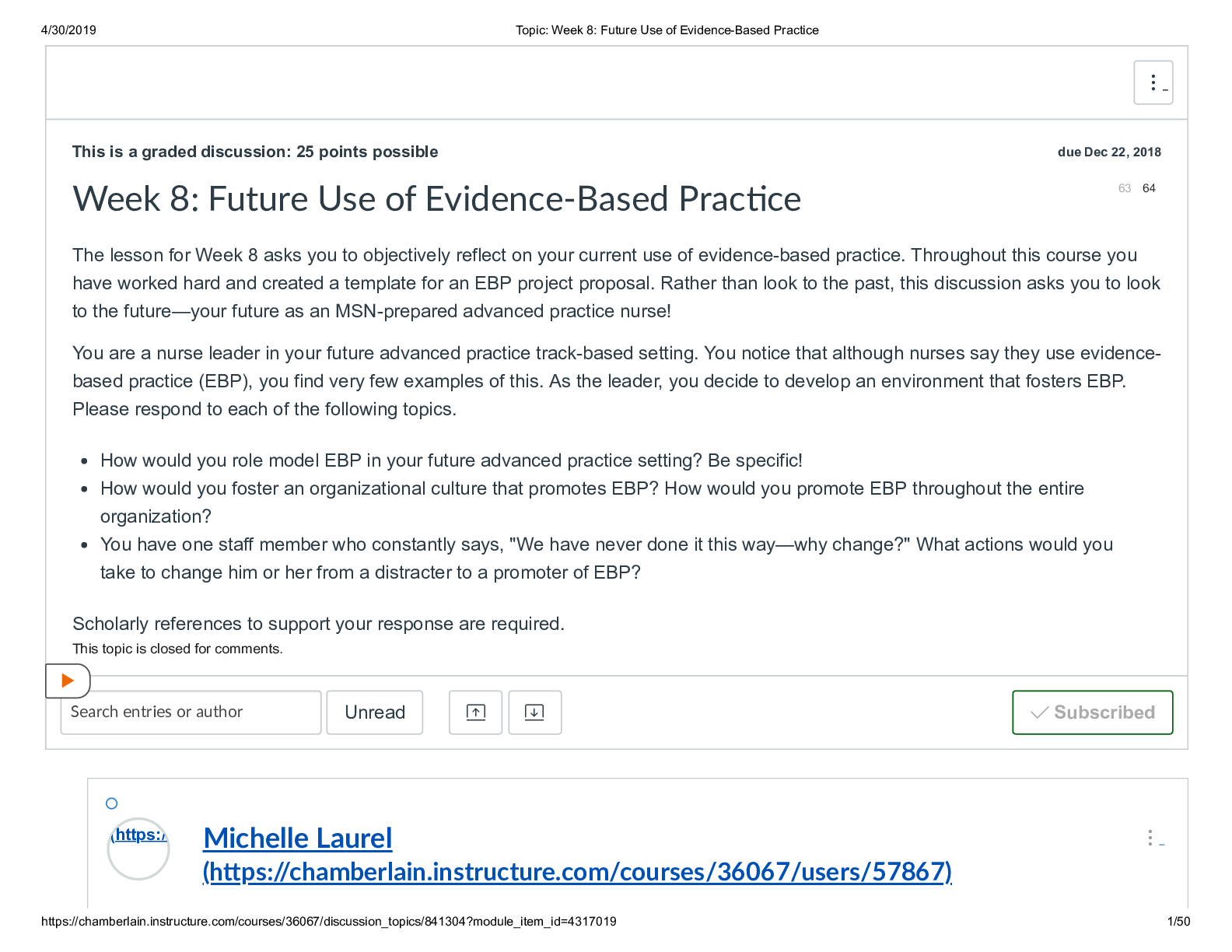
The lesson for Week 8 asks you to objectively reflect on your current use of evidence-based practice. Throughout this course you
have worked hard and created a template for an EBP project proposal. Rather than look to t
...
The lesson for Week 8 asks you to objectively reflect on your current use of evidence-based practice. Throughout this course you
have worked hard and created a template for an EBP project proposal. Rather than look to the past, this discussion asks you to look
to the future—your future as an MSN-prepared advanced practice nurse!
You are a nurse leader in your future advanced practice track-based setting. You notice that although nurses say they use evidencebased practice (EBP), you find very few examples of this. As the leader, you decide to develop an environment that fosters EBP.
Please respond to each of the following topics.
How would you role model EBP in your future advanced practice setting? Be specific!
How would you foster an organizational culture that promotes EBP? How would you promote EBP throughout the entire
organization?
You have one staff member who constantly says, "We have never done it this way—why change?" What actions would you
take to change him or her from a distracter to a promoter of EBP?
Scholarly references to support your response are required.
Unread Subscribed
(https:// Michelle Laurel (hz ps://chamberlain.instructure.com/courses/36067/users/57867)
4/30/2019 Topic: Week 8: Future Use of Evidence-Based Practice
https://chamberlain.instructure.com/courses/36067/discussion_topics/841304?module_item_id=4317019 2/50
Dec 14, 2018
Dr. Turner and Class,
As a nurse leader it is important to role model the values and behaviors you wish to see in the work environment. An
environment that fosters evidence-based practice and a continual drive to deliver quality healthcare is that which empowers
others to question what can be done to improve, inquiry to a better and safer way and look outside the box for solutions to
issues. Leaders can model this behavior by taking a proactive approach to problem solving in way that reflects creativity and
innovation while merging knowledge, technology and practices. Modeling engagement, ownership and the capacity to innovate
and adapt quickly is crucial for a leader and displays investment and commitment to the change dynamic. This level of
leadership requires that the strategic frame for the organization incorporates change as a normative part of the operating
decision-making infrastructure (Porter-O’Grady & Malloch, 2018).
I personally have a very positive outlook regarding change and enjoy the challenge of creating buy-in amongst my staff when
faced with a change in practice. As a future leader I hope to continue to model a positive attitude and challenge my nursing staff
to take on projects with a proactive approach to evidence-base practice change. Fostering an organizational culture that
promotes EBP can take time and energy and can best happen through the implementation of successful projects shared with
other departments of the organization. Having opportunities to showcase EBP projects with other areas and disciplines can
breakdown barriers related to uncertainty and frustration with change and can work to promote collaboration among healthcare
teams.
Toxic behaviors within an organization are seldom the result of one individual process gone awry but are instead the cumulation
of many dysfunctions leading to a negative culture (Porter- O’Grady & Malloch, 2018). A team member who argues against
change or comments that a change was previously attempted and did not work requires additional coaching in terms of selfassessment and self-awareness. I would approach the individual and inquire as to why they feel the way they do about change
and what prevents them from making further attempts at improving care. Helping individuals realize that the change process
sometimes must go through numerous revisions before a product comes to fruition is a normal part of change and growth. I
used to frequently hear “But this is how we have always done it” and have now banned this phrase from being said at meetings
due to the negative connotation that it brings and the halting affect that it has on change. As a future advanced practice nurse, I
hope to have meaningful conversations with individuals that carry this mind set that focuses on the impact that individual
attitudes have on culture and their ability to raise up a team and an organization. I want individuals like this to realize the
potential they have in making and supporting change and the power they possess to help grow the nursing profession.
[Show More]