ASSURANCE SERVICES
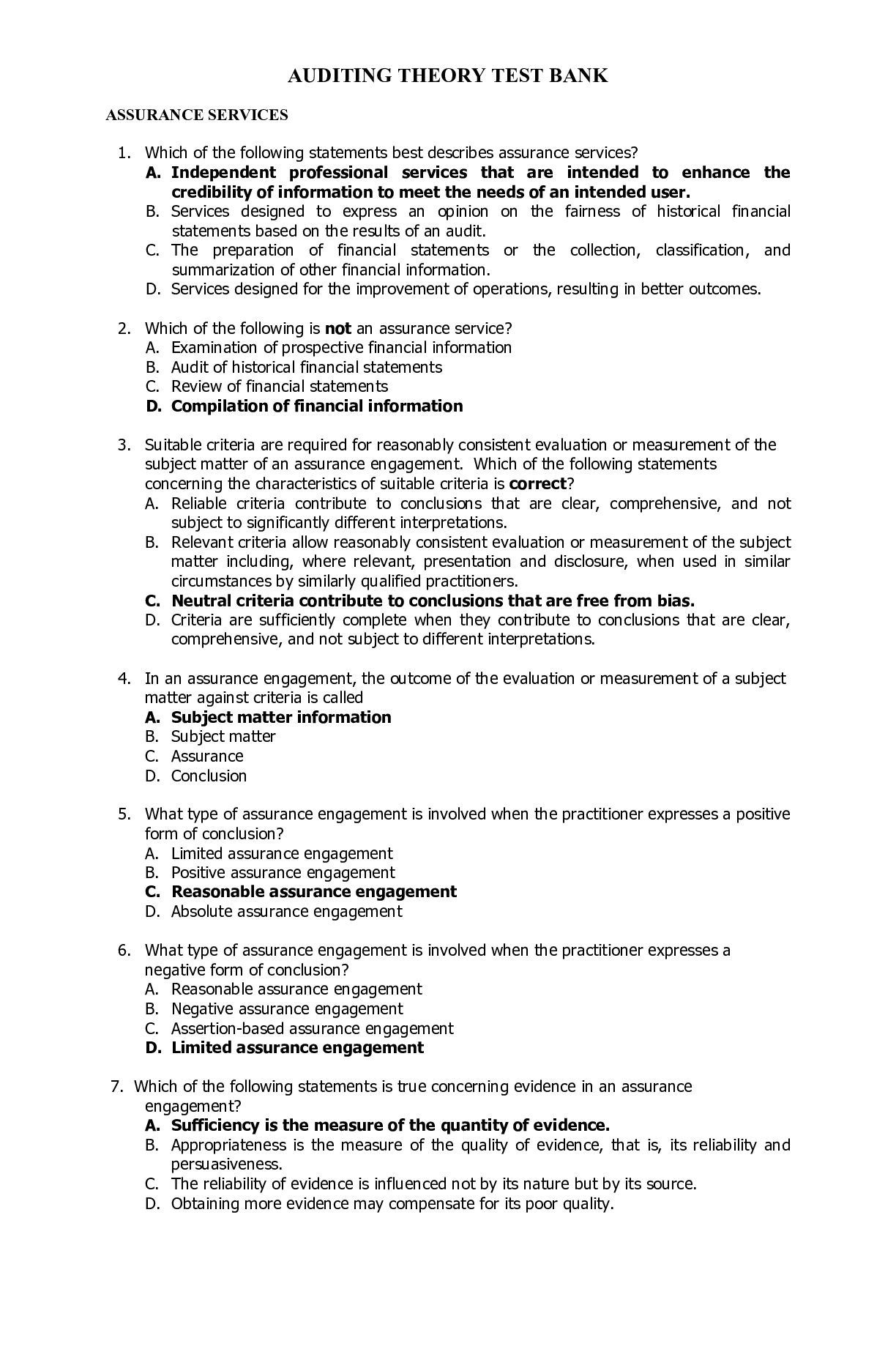
1. Which of the following statements best describes assurance services?
A. Independent professional services that are intended to enhance the credibility of information to meet the needs of an intend
...
ASSURANCE SERVICES
1. Which of the following statements best describes assurance services?
A. Independent professional services that are intended to enhance the credibility of information to meet the needs of an intended user.
B. Services designed to express an opinion on the fairness of historical financial statements based on the results of an audit.
C. The preparation of financial statements or the collection, classification, and summarization of other financial information.
D. Services designed for the improvement of operations, resulting in better outcomes.
2. Which of the following is not an assurance service? A. Examinationofprospectivefinancialinformation B. Auditofhistoricalfinancialstatements
C. Reviewoffinancialstatements
D. Compilation of financial information
3. Suitable criteria are required for reasonably consistent evaluation or measurement of the subject matter of an assurance engagement. Which of the following statements concerning the characteristics of suitable criteria is correct?
A. Reliable criteria contribute to conclusions that are clear, comprehensive, and not
subject to significantly different interpretations.
B. Relevantcriteriaallowreasonablyconsistentevaluationormeasurementofthesubject
matter including, where relevant, presentation and disclosure, when used in similar
circumstances by similarly qualified practitioners.
C. Neutralcriteriacontributetoconclusionsthatarefreefrombias.
D. Criteria are sufficiently complete when they contribute to conclusions that are clear, comprehensive, and not subject to different interpretations.
4. In an assurance engagement, the outcome of the evaluation or measurement of a subject matter against criteria is called
A. Subject matter information
B. Subjectmatter
C. Assurance D. Conclusion
5. What type of assurance engagement is involved when the practitioner expresses a positive form of conclusion?
A. Limitedassuranceengagement
B. Positiveassuranceengagement
C. Reasonableassuranceengagement
D. Absolute assurance engagement
6. What type of assurance engagement is involved when the practitioner expresses a negative form of conclusion?
A. Reasonableassuranceengagement
B. Negativeassuranceengagement
C. Assertion-basedassuranceengagement
D. Limited assurance engagement
7. Which of the following statements is true concerning evidence in an assurance engagement?
A. Sufficiency is the measure of the quantity of evidence.
B. Appropriateness is the measure of the quality of evidence, that is, its reliability and persuasiveness.
C. Thereliabilityofevidenceisinfluencednotbyitsnaturebutbyitssource.
D. Obtaining more evidence may compensate for its poor quality.
8. Assurance engagement risk is the risk
A. That the practitioner expresses an inappropriate conclusion when the subject matter information is materially misstated.
B. Of expressing an inappropriate conclusion when the subject matter information is not materially misstated.
C. Through loss from litigation, adverse publicity, or other events arising in connection with a subject matter reported on.
D. Of expressing an inappropriate conclusion when the subject matter information is either materially misstated or not materially misstated.
9. Reducing assurance engagement risk to zero is very rarely attainable or cost beneficial as a result of the following factors, except
A. Theuseofselectivetesting.
B. The fact that much of the evidence available to the practitioner is persuasive rather
than conclusive.
C. The practitioner may not have the required assurance knowledge and skills to gather and evaluate evidence.
D. The use of judgment in gathering and evaluating evidence and forming conclusions based on that evidence.
10. The Philippine Framework for Assurance Engagements
A. Contains basic principles, essential procedures, and related guidance for the
performance of assurance engagements.
B. Defines and describes the elements and objectives of an assurance engagement, and identifies engagements to which PSAs, PSREs, and PSAEs apply.
C. Provides a frame of reference for CPAs in public practice when performing audits, reviews, and compilations of historical financial information.
D. Establishes standards and provides procedural requirements for the performance of assurance engagements.
AUDITING AND RELATED SERVICES
Page |2
Page |3
11. PSRE 2400 (Engagements to Review Financial Statements), as amended by the AASC in
February 2008, applies to
A. Reviewsofanyhistoricalfinancialinformationofanauditclient.
B. Reviews of any historical financial information by a practitioner other than
the entity�s auditor.
C. Reviews of historical financial or other information by a practitioner other than the entity�s auditor.
D. Reviews of historical financial or other information of an audit client.
12. When performing a compilation engagement, the accountant is required to A. Assessinternalcontrols.
B. Make inquiries of management to assess the reliability and completeness of the
information provided.
C. Verifymattersandexplanations.
D. Obtain a general knowledge of the business and operations of the entity.
13. Inquiries and analytical procedures ordinarily form the basis for which type of engagement?
A. Agreed-uponprocedures. B. Audit.
C. Examination.
D. Review.
14. A practitioner should accept an assurance engagement only if
A. Thesubjectmatterisintheformoffinancialinformation.
B. Thecriteriatobeusedarenotavailabletotheintendedusers.
C. The practitioner�s conclusion is to be contained in a written report.
D. The subject matter is the responsibility of either the intended users or the practitioner.
15. The auditor is required to maintain professional skepticism throughout the audit. Which of the following statements concerning professional skepticism is false?
A. A belief that management and those charged with governance are honest
and have integrity relieves the auditor of the need to maintain professional
skepticism.
B. Maintaining professional skepticism throughout the audit reduces the risk of using inappropriate assumptions in determining the nature, timing, and extent of the audit procedures and evaluating the results thereof.
C. Professionalskepticismisnecessarytothecriticalassessmentofauditevidence.
D. Professional skepticism is an attitude that includes questioning contradictory audit
evidence obtained.
16. Which of the following best describes the reason why independent auditors report on financial statements?
A. A management fraud may exist and it is more likely to be detected by independent
auditors.
B. Different interests may exist between the company preparing the statements and the persons using the statements.
C. A misstatement of account balances may exist and is generally corrected as the result of the independent auditors� work.
D. Poorly designed internal control may be in existence.
17. Which of the following professionals has primary responsibility for the performance of an audit?
A. Themanagingpartnerofthefirm.
B. Theseniorassignedtotheengagement.
C. Themanagerassignedtotheengagement.
D. The partner in charge of the engagement.
18. What is the proper organizational role of internal auditing?
A. To serve as an independent, objective assurance and consulting activity that adds value to operations.
B. Toassisttheexternalauditorinordertoreduceexternalauditfees.
C. Toperformstudiestoassistintheattainmentofmoreefficientoperations.
D. To serve as the investigative arm of the audit committee of the board of directors.
Page |4
19. Operational audits generally have been conducted by internal and COA auditors, but may be performed by certified public accountants. A primary purpose of an operational audit is
to provide
A. A measure of management performance in meeting organizational goals.
B. The results of internal examinations of financial and accounting matters to a company�s top-level management.
C. Aid to the independent auditor, who is conducting the examination of the financial statements.
D. A means of assurance that internal accounting controls are functioning as planned.
20. Which of the following terms best describes the audit of a taxpayer�s return by a BIR auditor?
A. Operationalaudit. B. Internalaudit.
C. Complianceaudit. D. Government audit.
[Show More]


, 5e Jerry Weygandt, Paul Kimmel (Test Bank).png)






, Mary Purbhoo.png)

.png)
.png)
.png)
.png)
.png)
.png)





.png)


