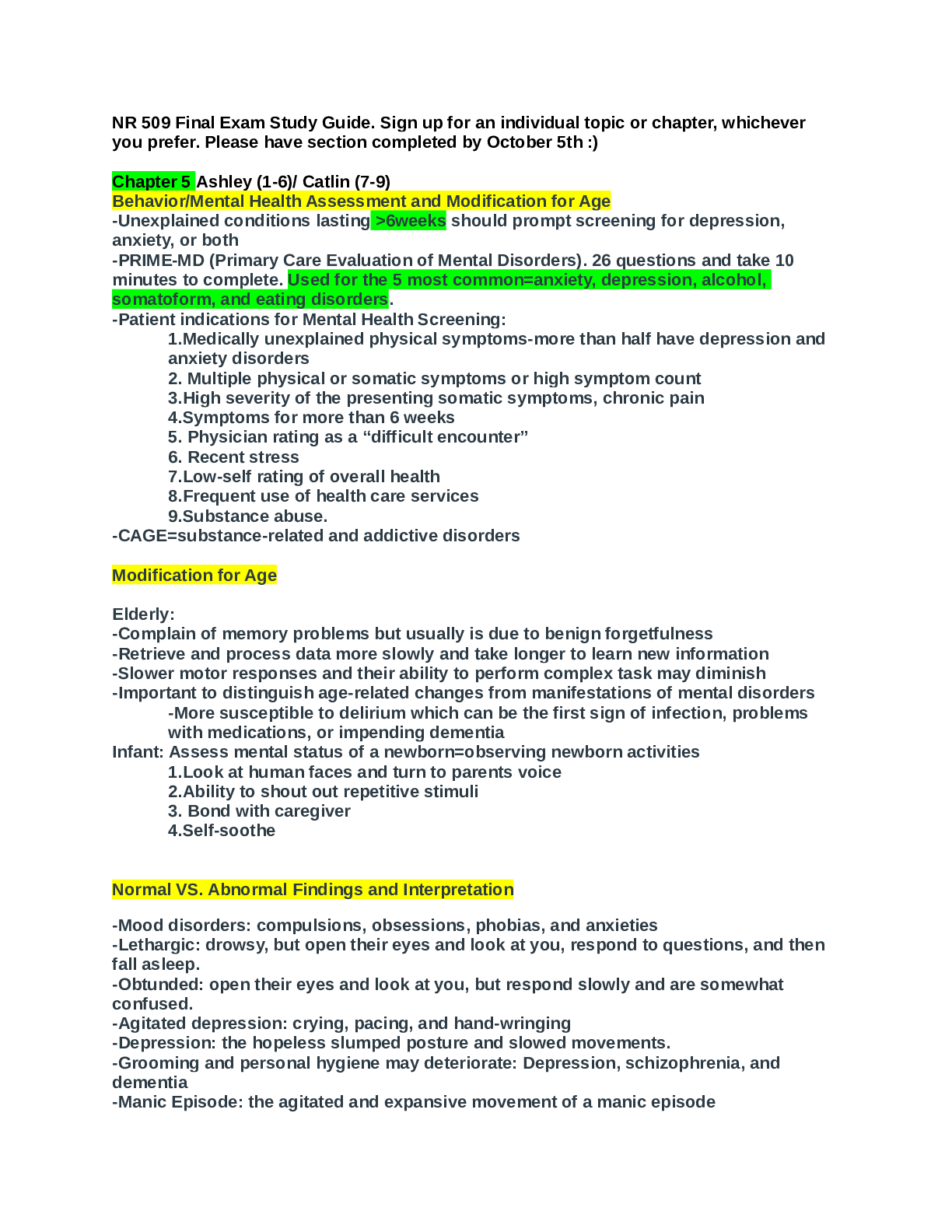
NR 509 Final Study Guide Behavior/Mental Health Assessment and Modification for Age
1. Assessment: a. b. Many mental health disorders are masked by other clinical conditions; 20% of primary care outpatients have mental
...
NR 509 Final Study Guide Behavior/Mental Health Assessment and Modification for Age
1. Assessment: a. b. Many mental health disorders are masked by other clinical conditions; 20% of primary care outpatients have mental disorders(50-70% go undetected and untreated)
c. Physical symptoms account for approx 50% of office visits d.
⅓ of physical symptoms are unexplained; in 20-25% those symptoms become chronic
e. Symptoms and Behaviors: i. Sorting symptom is a challenge; can be unexplained symptoms 1. Patients who have unexplained symptoms depression and anxiety exceeds 50%
ii. Physical or “somatic” symptoms account for 50% of U.S. office visits 1. Pain, fatigue, palpitations, GI symptoms, sexual dysfunction, dizziness or loss of balance
2. Symptoms that present as clusters are called “functional syndromes” such as IBS, fibromyalgia, chronic fatigue, TMJ disorder, and multiple chemical sensitivity
3. The presence of symptom overlap is high in the common functional syndromes such as fatigue, headache, sleep disturbance, pain, GI upset
iii. Patients with unexplained and somatic symptoms are often frequent users of the health care system and termed “difficult patients”
iv. Patients with symptoms that last longer than 6 weeks are recognized as chronic and should be screened for depression and anxiety.
a. A two tiered approach is recommended for screening. A brief screening with questions that yield high sensitivity then a more detailed investigation when indicated
V. Patient who warrant a mental health screening include:
1. medically unexplained physical symptoms 2. Multiple physical or somatic symptoms 3. High severity of the presenting somatic symptom 4. Chronic pain 5. Symptoms longer than 6 weeks 6. Physician stating “a difficult encounter” 7. Recent stress8. Low self-rating of overall health
9. Frequent use of health care services
10.Substance abuse
2. Adjustment for age:
A. Elderly:
a. Older adults may complain of memory problems but usually is due
to benign forgetfulness.
b. Older adults retrieve and process data more slowly and take longer
to learn new information
c. Older adults may have slower motor responses and their ability to
perform complex task may diminish
d. It is important to try to distinguish age-related changes from
manifestations of mental disorders
e. Older patients are more susceptible to delirium which could be the
first sign of infection, problems with medications, or impending
dementia
B. Newborn:
a. Assess mental status of a newborn by observing newborn activities
i. Look at human faces and turn to a parents voice
ii. Ability to shut out repetitive stimuli(such as a vacuum)
iii. Bond with caregiver
iv. self-soothe
b. Assess for mental status during alert periods
· Normal VS. Abnormal Findings and Interpretation
1. Attention:
a. Normal: able to focus and concentrate
b. Abnormal: inattentive and easily distracted
2. Memory
a. Normal: able to repeat immediate repetition of material given;
b. Abnormal: unable to repeat recent events
3. Orientation:
a. Normal: aware of person, place, and time
b. Abnormal: unaware of person, place, or time
4. Perception:
a. Normal: Sensory awareness of objects in the environment
b. Abnormal: hallucinations
5. Thought Process:
a. Normal: logic, coherent, and relevant thoughts
b. Abnormal: irrational thought
6. Thought Content:
a. Normal: Has insight and judgement
b. Abnormal: impaired judgement and irrational behaviors
7. Insighta. Normal: able to distinguish normal vs. abnormal
b. Abnormal: Unable to distinguish normal vs. abnormal
8. Judgement
a. Normal: good judgement
b. Abnormal: poor or bad
F· Speech Patterns
1. Note characters of speech
a. Slow speech= depression
b. Accelerated and Loud speech= mania
c. Articulation: are the words clear and distinct; does the speech have a
nasal quality
i. Dysarthria(defective articulation)
ii. Dysphonia-impaired volume, quality or pitch
iii. Aphasia-disorder of speech
d. Fluency: reflects rate, flow and melody of speech and the content and
words used. Abnormalities include
i. Hesitancies and gaps in flow
ii. Disturbed inflections such as monotone
iii. Circumlocutions, in which phrases or sentences are substituted for
a word the person cannot think of ie. “what you write with” instead
of “pen”
iv. Paraphrasias, words are malformed(“I write with a den”), wrong (I
write with a bar) or made up (I write with a dar)
v. Fluency abnormalities indicate aphasia from cerebrovascular
infarction.
vi. Aphasia may be receptive(impaired comprehension with fluent
speech) OR expressive(with preserved comprehension and slow
nonfluent speech)
vii. A person who can write a correct sentence does NOT have aphasia
e. Testing for Aphasia
i. Word Comprehension: Ask the patient to follow one-stage
commands such as “Point to your nose”
ii. Repetition: Ask the patient to repeat a phrase of one-syllable words
“ No ifs, ands, or buts”
iii. Naming: Ask the patient to name the parts of a watch
iv. Reading Comprehension: Ask the patient to read a paragraph aloud
v. Writing: Ask the patient to write a sentence
· Mental Status Examination
1. Five components of the mental status examination
a. Appearance and Behavior
i. Note level of consciousness: is the patient awake and alert, doesthe patient understand your questions and respond appropriately
1. If the patient does not respond then speak to the patient by
name in a loud voice
2. Lethargic patients are drowsy but open their eyes and look
at you, respond to questions, then fall back asleep
3. Obtunded patients open their eyes and look at you but
respond slowly and are somewhat confused
ii. Note posture and motor behavior:does the patient sit or lie quietly
or prefer to walk around; note the pace, range, and type of
movement
1. Look for tense posture, restlessness, and anxious fidgeting;
the crying, pacing, and hand wringing of agitated depression
2. The hopeless slumped posture and slowed movement of
depression
3. The agitated and expansive movements of manic episodes
iii. Note Dress, Grooming, and Personal hygiene: how is the patient
dressed, clean and presentable?, how is grooming compared to
those of similar age, compare one side to the other
1. May deteriorate in depression, schizophrenia, and dementia
2. Excessive fastidiousness may be seen OCD
3. One-sided negligence may result from a lesion in the
opposite parietal cortex; usually the non-dominant side
iv. Note facial expression: observe the face at rest and during
conversation; are changes in expression appropriate
1. Note Expressions of anxiety, depression, apathy, anger,
elation, or facial immobility in parkinsonism
v. Manner, Affect, and Relationship to People and Things: assess the
patients external expression of the inner emotional state(Affect). Is
the affect appropriate to topics being discussed?, seem
exaggerated at points, labile, blunted, or flat?
1. Paranoia= anger, hostility, suspiciousness, or evasiveness
2. Mania= elation and euphoria
3. Schizophrenia=flat affect with remoteness
4. Dementia and Anxiety or Depresion= apathy(dulled affect
with detachment and indifference)
5. Hallucinations=schizophrenia, alcohol withdrawal, and
systemic toxicity
b. Speech and Language= SEE ABOVE in language patterns
c. Mood: Ask patient to describe his/her mood, including usual level and
fluctuations related to life events
i. Moods range from sadness and melancholy, contentment, joy,
euphoria, and elation; anger and rage, anxiety and worry, to
detachment and indifference
ii.
iii.
If you suspect depression, assess its severity and any risk of
suicide
It is your responsibility as the provider to ask directly about suicidalthoughts. This may be the only way to uncover suicidal ideation and
plans that launch immediate intervention and treatment
d. Thought and Perception:
i. Thought Process: assess the logic, relevance, organization, and
coherence of the patients thought process throughout the interview;
does speech progress logically?, listen for patterns of speech that
suggest disorders; Variations and Abnormalities include:
1. Circumstantiality: speech with unnecessary detail,
indirection, and delay in reaching the point; Occurs in
patients with obsessions
2. Derailment: “tangential” speech with shifting topics that are
loosely connected or unrelated; seen in schizophrenia,
manic episodes, and other psychotic disorders
3. Flight of Ideas: a continuous flow of accelerated speech with
abrupt changes from one topic to the next; most frequently
seen in manic episodes
4. Neologisms: Invented or distorted words, or words with new
and highly idiosyncratic meanings; observed in
schizophrenia, psychotic disorders, and aphasia
5. Incoherence: Speech that is incomprehensible and illogical,
with lack of meaningful connections, abrupt changes in topic,
or disordered grammar or word use. Flight of ideas, when
severe, may produce incoherence. Seen in severe
psychotic disturbances usually schizophrenia
6. Blocking: Sudden interruption of speech in mid sentence or
before the idea is completed, attributed to “losing the
thought.” Blocking occurs in normal people. May be striking
in schizophrenia
7. Confabulation: Fabrication of facts or events in response to
ques- tions, to fill in the gaps from impaired memory. Seen in
Korsakoff syndrome from alcholism
8. Perseveration: Persistent repetition of words or ideas
Occurs in schizophrenia and other psychotic disorders
9. Echolalia:Repetition of the words and phrases of others.
Occurs in manic episodes and schizophrenia
10.Clanging: Speech with choice of words based on sound,
rather than meaning, as in rhyming and punning. For
example, “Look at my eyes and nose, wise eyes and rosy
nose. Two to one, the ayes have it!” Seen in schizophrenia
and manic episodes
ii. Thought Content: to assess follow patients cues rather than
asking direct questions; “Can you tell me more about that” or “What
do you think about times like these?” Abnormalities in content
include
1. Compulsions: Repetitive behaviors that the person feels driven to
perform in response to an obsession, aimed at preventing or reducinganxiety or a dreaded event or situation; these behaviors are excessive
and unrealistically connected to the provoking stimulus
2. Obsessions: Delusions
3. Recurrent persistent thoughts, images, or urges experienced as
intrusive and unwanted that the person tries to ignore, suppress, or
neutralize with other thoughts or actions (for example, performing a
compulsive behavior)
4. Phobias :Persistent irrational fears, accompanied by a compelling
desire to avoid provoking stimulus
5. Anxieties: Apprehensive anticipation of future danger or misfortune
accompanied by feelings of worry, distress, and/or somatic
symptoms of tension
6. Feelings of Unreality: A sense that the environment is strange, unreal,
or remote
7. Feelings of Depersonalization:A sense that one’s self or identity is
different, changed, unreal; lost; or detached from one’s mind or body
8. Delusions: False fixed personal beliefs that are not amenable to
change in light of conflicting evidence; types of delusions include:
a. ● Persecutory ● Grandiose ● Jealous ● Erotomanic—
the belief than another person is in love with the
individual ● Somatic—involves bodily functions or
sensations ● Unspecified—includes delusions of
reference without a prominent persecutory or
grandiose component, or the belief that external
events, objects, or people have a particular and
unusual personal significance (for example,
commands from the radio or television)
9. Compulsions, obsessions, phobias, and anxieties often occur in
anxiety disorders.
10. Delusions and feelings of unreality or depersonalization are often
associated with psychotic disorders
11. Delusions may also occur in delirium, severe mood disorders, and
dementia
iii. Perceptions: Purse false perceptions, “When you heard the voice speaking to
you, what did you say?” Abnormalities in perception include
1. Illusions: Misinterpretations of real external stimuli, such as
mistaking rustling leaves for the sound of voices. Illuisions may
occur in grief reactions, delirium, acute and posttraumatic stress
disorders, and schizophrenia
2. Hallucinations: Perception-like experiences that seem real but, unlike
illusions, lack actual external stimulation. The person may or may not
recognize the experiences as false. Hallucinations may be auditory,
visual, olfactory, gustatory, tactile, or somatic. False perceptions
associated with dreaming, falling asleep, and awakening are not
classified as hallucinations. Hallucinations may occur in delirium,
dementia, posttraumatic stress disorder, schizophrenia, and
alcoholism
e. Insight:Patients with psychotic disorders often lack insight into their
illness, Denial of impairment may accompany some neurologic disorders
f. Judgement: may be poor in delirium, dementia, intellectual disability, and
psychotic states. Anxiety, mood disorders, intelligence, education, income,
and cultural values also influence judgementg. Cognitive Functions:
i. Orientations: Assess person, place and time
1. Disorientation is common when memory or attention is
impaired, as in delirium
ii. Attention: Digit Span, Serial 7s, and Spelling Backward are used
to test attention
1. Digit Span: recite a series of digits and ask patient to repeat;
try increasing the series to a multiple numbers; choose digits
such as street numbers and zip codes and not consecutive
numbers Causes of poor performance include delirium,
dementia, intellectual disability, and performance
anxiety
2. Serial 7s: Tell patient to start at 100 and count back by 7s
3. Spelling Backward: Spell a 5 letter word and ask the patient
to repeat it backwards
iii. Remote Memory: Inquire about birthdays, anniversaries, social
security #, names of schools attended, jobs held, or past historical
events such as wars May be imparied in late dementia
iv. Recent Memory: Ask questions with answers you can check
against other sources; involve events of the day, weather,
appointment time, current meds, lab test Impaired in dementia
and delirium, Amnestic disorders impair memory or new
learning ability and reduce social or occupational functioning,
but lack the global feature of delirium or dementia. Anxiety,
depression, and intellectual disability may also impair recent
memory
v. New Learning Ability: Give the patient 3-4 words and ask them to
repeat the words. After 3-5min ask the patient to repeat the words.
h. Higher Cognitive Functions
i.
Information and vocabulary:Ask about work, hobbies, reading,
favorite television programs, or current events. Start with simple
questions, then move to more difficult questions. Note the person’s
grasp of information, complexity of the ideas, and choice of
vocabulary. Information and vocabulary are rela- tively
unaffected by psychiatric disorders except in severe cases.
Testing helps distinguish adults with life-long intellectual
impairment (whose infor- mation and vocabulary are limited)
from those with mild or moderate dementia (whose
information and vocabulary are fairly well preserved).
ii. Calculating Ability: Test ability to do arithmetical calculations; start
with simple addition, or pose practical functionally important
questions such as if something cost 78 cents and you give the clerk
$1 how much change should your receive Poor performance
suggests dementia or aphasia, but should be measured against
the patient’s fund of knowledge and education.
iii. Abstract Thinking: ask the patient about what certain proverbsmean or explain the similarity between two things such as an apple
and orange. Concrete responses are common in people with intellectual
disability, delirium, or dementia, but may also reflect limited education.
Patients with schizophrenia may respond concretely or with personal and
bizarre interpretations
iv. Constructional Ability: ability to copy figures of increasing
complexity onto a piece of blank unlined paper. With intact vision
and motor ability, poor constructional ability suggests dementia or
parietal lobe damage. Intellectual disability can also impair
performance.
i. Special Techniques for the Mental Exam
i. Mini-Mental State Examination: brief test used to screen for
cognitive dysfunction or dementia, and follow the patients course
over time
j. Recording Your Findings
i. Example of normal findings:The patient is alert, well-groomed, and
cheerful. Speech is fluent and words are clear. Thought processes are
coherent, insight is good. The patient is oriented to person, place, and time.
Serial 7s accurate; recent and remote memory intact. Calculations intact.
ii.
Example of findings that suggest dementia: “The patient appears sad
and fatigued; clothes are wrinkled. Speech is slow and words are mumbled.
Thought processes are coherent, but insight into current life reverses is
limited. The patient is oriented to person, place, and time. Digit span, serial
7s, and calculations accurate, but responses delayed. Clock drawing is good.
·
Screening for Depression: BECKY PECK
Generalized Anxiety Disorder: WONGEL MARKOS
Depressive Disorders: CRYSTAL SHAGENA/Ada Ejimadu
Depressive Disorders ( pg 156) Ada Ejimadu
Depression and anxiety disorders are a common cause of hospitalization in the United
States, and mental illness is associated with increased risks for chronic medical
conditions, decreased life expectancy, disability, substance abuse, and suicide.
About 19million adult American or almost 7% have major depression with other co-
existing anxiety disorder or substance abuse. Depression is as common in women as
men, and the prevalence of postpartum depression is about 7% to 13%. Most patients
with chronic medical conditions have depression. Symptoms of depression in high-risk
patients may be subtle and may include;I. Low self-esteem II. III.
Loss of pleasure in daily activities (Anhedonia) Sleep disorder,
IV. Difficulty concentrating or making decisions.
Look carefully for symptoms of depression in vulnerable patients, especially those who are young, female, single, divorced or separated, seriously or chronically ill, bereaved, or have other psychiatric disorders, including substance abuse. A personal or family history of depression also places patients at risk.
Asking two simple questions about mood and anhedonia appears to be as effective as using more detailed instruments. All positive screening tests warrant full diagnostic interviews. Failure to diagnose depression can have fatal consequences—the presence of an affective disorder is associated with an 11-fold increased risk for suicide.
Depression screening · Over the past 2 weeks, have you felt down, depressed, or hopeless? · Over the past 2 weeks, have you felt little interest or pleasure in doing things ·(anhedonia)?
Depression tends to be long-lasting and can recur. Because of these two factors, a waitand-see approach to treatment is not desirable and timely treatment is necessary. Suicide I. Suicide is the second leading cause of death among 15- to 24-year olds.
II. Suicide rates are highest among those ages 45 to 54 years, followed by elderly adults ≥age 85 years.
III. IV. Men have suicide rates nearly four times higher than women, though women are
three times more likely to attempt suicide. V. Men are most likely to use firearms to commit suicide, VI. while women are most likely to use poison.
VII. Overall, suicides in non-Hispanic whites account for about 90% of all suicides.
VIII. American Indian/Alaska Native women ages 15 to 24 years have the highest suicide rates of any racial/ethnic group.
Substance Use Disorders, Including Alcohol and Prescription Drugs.
[Show More]





![Preview of eBook [PDF] Barash, Cullen, and Stoelting's Clinical Anesthesia 9th Edition By Bruce F. Cu](https://browseimages.nyc3.digitaloceanspaces.com/paper-images/2024/Aug/29/8DF2QRTq2024-08-29-10-3966d0259b7c4b5.png)
![Preview of eBook [PDF] Burns' Pediatric Primary Care 7th Edition BY Dawn Lee Garzon Maaks,, Nancy Bar](https://browseimages.nyc3.digitaloceanspaces.com/paper-images/2024/Aug/26/WR2rowXX2024-08-26-02-0966cc625bea839.png)