*NURSING > QUESTIONS and ANSWERS > NR 506 HEALTHCARE POLICY: TD (Reference Hogg M A Van Knippenberg D) (All)
NR 506 HEALTHCARE POLICY: TD (Reference Hogg M A Van Knippenberg D)
Document Content and Description Below
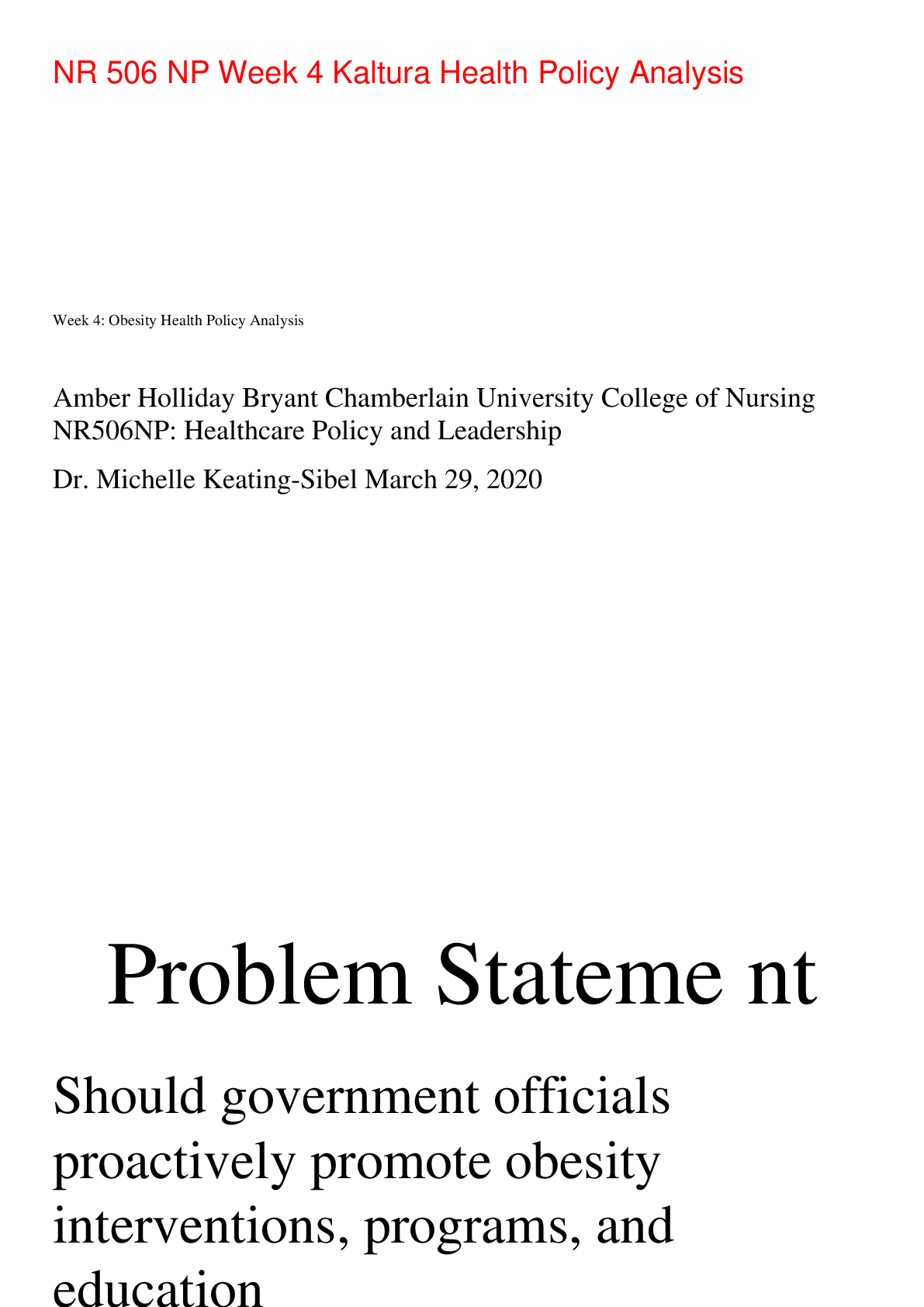
NR 506 HEALTHCARE POLICY: TD (Reference Hogg M A Van Knippenberg D) Week 1, TD1 The Four Spheres of Political Action in Nursing. Please discuss the four spheres of political action in nursing. In add ... ition, please develop a brief argument sharing how these spheres are interconnected and overlapping by applying an example from your practice. Nursing should not consist of only the monotonous tasks completed to provide basic patient care, but rather nursing today is multidimensional where nurses are responsible for the protection, promotion, and prevention of disease or injury for individuals, families, communities, and population. For this reason, nurses have the opportunity to become politically involved impacting and improving the level of care that they are able to provide. According to Chaffee, Mason, & Leavitt (2014), the four spheres of political action in nursing include workplace or workforce, government, professional organization, and community. Each of these sphere have their own independent functions, but they can also overlap and affect the other sphere working together to create changes. Workplace sphere addresses issues regarding jobs and patient care, as well as influencing policies and procedures. It can be in any setting like acute care, home care, nursing homes, school based clinics, occupational health clinics, and physician’s office. Government sphere addresses laws and regulations regarding practice, as well as influencing local, state, and national policies. Government actions can consists of laws requiring to keep birth records, immunizations, legal establishment of drinking age, laws determining what health services people are eligible for at certain age. Government has grown bigger and centralized, which plays a important role in nursing. Government also influences systems for healthcare, and nursing service, and determines who receives what type of health services. Professional organizations sphere addresses the many areas that shape the practice ofnursing, as well as influence practice standards, and credentialing. Professional organizations should be a visible force within its community, and must have a national presence. Professional organizations take a leadership role on calling for the development of policies that can improve the health of the communities, and ensure the provision of quality nursing care. Community sphere addresses issues regarding community health as well as influencing the activity throughout the community. Community includes special interest organizations like habitat for humanity, food banks, community organizations, and county workforce centers. Nurses have the responsibility to promote the welfare of the community, and its members. Nurses visible in the community represent the entire profession. Nurses are capable of influencing policy making in order to improve problems in the community and healthcare system. Literature often shows that nurses view themselves as politically powerless. They see their role at the bedside as a technical activity, not a political opportunity. What nurses do not realize is the very act of being a nurse makes one politically involved (Cameron, Ceci, & Salas, 2011). An example from my practice is banned smoking at the campus of my hospital, which is a community hospital. Political spheres includes the workplace and community, possibly government with the federally mandated health insurance laws rolling out. This is important as the negative effects of smoking and second hand smoke are well documented, and patients requiring hospitalized care do not need to be exposed. Reference: Cameron, B., Ceci, C., & Salas, A. S. (2011). Nursing and the Political. Nursing Philosophy,12(3), 153-155. doi:10.1111/j.1466-769X.2011.00499.x. Chaffee, M. W., Mason, D. J., & Leavitt, J. K. (2014). A Framework for Action in Policy and Politics. Policy & Politics in Nursing and Health Care, 1. Week 1, TD2 A wave of pandemic illness can host a variety of ethical considerations. Please apply the importance of ethics to the process of policymaking regarding pandemic outbreak and other future pandemic issues. Ethical consideration during a wave of pandemic illness involves critical reflection on moral or ethical problems faced in health care setting. It is a collective forethought and a broad consensus in place to tackle moral and ethical dilemmas that may arise in situation of a pandemic illness. According to Cooper (2012), there are many ways to define ethics, some are more technical and precise than others. Ethics can be defined as the attempt to state and evaluate principles by which ethical problems may be solved (Cooper, 2012). Government and health care leaders make decision based on the ethical values in case of a catastrophe. Ethical framework acts as a guide in decision making during a pandemic by guiding the ethical decision making process, and informed by ethical values. The topic of ethics comes up whenever there is pandemic illness outbreak. Some of the ethical issues of concerns regarding pandemic illness include healthcare workers being exposedto illness, prohibiting travel to prevent spread of illness, and access to healthcare with an increase in demand and potential shortage of healthcare workers. In the event of a pandemic a pandemic illness the Centers of Disease Control and Prevention (CDC) has worked with the Ethics Subcommittee of the advisory committee to develop a plan of care. Professional colleges and associations should provide, by way of their codes of ethics, clear guidance to members in advance of a major communicable disease outbreak, such as pandemic flu. Existing mechanisms should be identified, or means should be developed, to inform college members as to expectations and obligations regarding the duty to provide care during a communicable disease outbreak. In a study on influenza pandemic by Devani, M., Gupta, & Devani, B.(2011), there were three main ethical consideration for planning and response: ethical allocation of scarce resources, obligations and duties of healthcare workers to treat patients, and the balance between conflicting individual and community interests. Most challenging part was identified as how to allocate scarce life saving resources in case of a pandemic (Devani et al., 2011). Indication of clear goal for possible future pandemics is essential in making difficult choices (Devani et al., 2011). Also the important issues between duty to save the patients and protecting own life were also identified as a key issue (Devani et al., 2011). This study also threw light on how to strike balance between civil liberties and individual freedom (Devani et al., 2011). Pandemic planning for current and future outbreaks should be a cooperative and shared responsibility that balances community and individual interests (Devani et al., 2011). References:Cooper, T. L. (2012). The responsible administrator: An approach to ethics for the administrative role. John Wiley & Sons. Devnani, M., Gupta, A. K., & Devnani, B. (2011). Planning and response to influenza A (H1N1) pandemic: ethics, equity and justice. Indian J Med Ethics, 8(4), 237-240. Peer response TD, WEEK 1 It can be acknowledge easily that all nurses particularly advanced practice nurses (APNs) are touched by policy and politics of health care system and the impact of policies, legislation, and regulations developed in those arenas have on the way they practice their profession. According to Matthews (2012), goals of political advocacy involves better nurse involvement in delivering access to care, influencing the coast and quality of care, determining the scope and authority of practice, and increasing and improving the healthcare workforce. As the healthcare system continues to evolve, more and more APNs and nurses are choosing to take advocacy role, working to get health care policies, which reflects nursing’s perspective, implemented. The privilege of participating in association advocacy is an important benefit of membership in one’s professional organization (Matthews, 2012). The four spheres of political action in nursing workplace, government, professional organization, and community are well recognized as the areas where nurses can be politically involved. Majority of APNs acknowledge the importance of political activism for patient advocacy and overall nursing profession. Larger and larger numbers of APNs are currently politically active to some degree. APNs participation includes, but are not limited to, sending letters to legislators, attending lobbying days, contributing financially toadvanced practice organizations and campaigns, engaging in social media, staying informed, and educating others. Political involvement does not need to be a time-consuming activity, any small amount of time and effort helps. Reference: Matthews, J. (2012). Role of professional organizations in advocating for the nursing profession. The Online Journal of Issues in Nursing, 17(3). doi: 10.3912/OJIN.Vol17No01Man03 Peer response, TD2, WEEK1 Hello Brittany, A number of challenging ethical issues are raised by a potential influenza pandemic. Ethical concerns associated with the planning, preparedness and responses to future pandemics are important to consider, making sure that the response efforts are not delayed in the occurrence of a pandemic. These include priority of access to healthcare resources with increased demand and possible shortages, responsibilities of healthcare workers with risks to their own health, and the fine balance between decreasing disease spread through isolation while protecting the right of individuals. According to Rid, & Emanuel (2014), the global response to the current Ebolaoutbreak has initially been slow and inadequate. Now that the response is picking up, the international community needs more focus on strengthening of health systems and infrastructure and less on experimental treatments (Rid, & Emanuel, 2014). Adoption of containment measures with a view to strengthen health systems and infrastructure is the most effective way to curb this epidemic and prevent future ones; it has positive externalities for health promotion and offers fair benefits to communities who engage in research in this outbreak (Rid, & Emanuel, 2014). Experimental Ebola treatments or vaccines should only be deployed in clinical trials. If trials are done, they must meet the eight ethical principles for research (Rid, & Emanuel, 2014). The international community needs to show that it can meet the challenge of this public health emergency, while learning the lessons for future Ebola and other epidemics (Rid, & Emanuel, 2014). Just like environmental pollutants, and pandemics have no boundaries. Ethics are essential in the process of policymaking regarding pandemic outbreak, and other emerging pandemic issues. Reference: Rid, A., & Emanuel, E. J. (2014). Ethical considerations of experimental interventions in the Ebola outbreak. The Lancet, 384(9957), 1896-1899. doi: http://dx.doi.org/10.1016/S0140-6736(14)61315-5 Week2, TD 1 Dr. Dragone and Class, I will have to admit that before starting this class, I never realized that nurses can make such a big impact on policy making. I have never been a big fan of policies and politics. That being said I am picking a topic that is close to home. Being a mother of 3young children, every day I deal with the topic of nutrition for the kids in schools. Having good, and proper, nutrition in schools is the front line defense for childhood obesity. More than one third of our children are overweight in the US (Bratskeir, 2015). Changes are always being make and I understand that food needs to be appealing to children but if you were to compare what children across the world eat for their lunches at school the US can barely compare. For instance following are some basic lunches around the world (Bratskeir, 2015): USA: Fried "popcorn" chicken, mashed potatoes, peas, fruit cup and a chocolate chip cookie Brazil: Pork with mixed veggies, black beans and rice, salad, bread and baked plantains Finland: Pea soup, beet salad, carrot salad, bread and pannakkau (dessert pancake) with fresh berries France: Steak, carrots, green beans, cheese and fresh fruit Greece: Baked chicken over orzo, stuffed grape leaves, tomato and cucumber salad, fresh oranges, and Greek yogurt with pomegranate seeds Italy: Local fish on a bed of arugula, pasta with tomato sauce, caprese salad, baguette and some grapes Spain: Sautéed shrimp over brown rice and vegetables, gazpacho, fresh peppers, bread and an orange Our children are in school for a major part of their lives. We expect them to get a good education so why not good meals. Childhood obesity on the rise and there are many factors that can cause this. I believe that using the incrementalism or pilot method to try and implement change would be best for my idea since I am looking at trying to make a change in pieces or steps (CCN, 2016). Incremental approach offers the best way to reduce the destructiveness ofconflicts over difficult issues. This approach sometimes serves as a method to reduce the magnitude of the problem that can not be eliminated completely. I am a parent who either makes my children breakfast and lunches from home or I put money into a school lunch account for them to purchase lunches of choice during the week. So my idea is to start with one school at a time and only make lunches using freshest ingredients from the local farmes instead of serving pre-made or preserved food. The downfall of this may be an increase in the price of lunches. This price increase can be curbed be making a deal with the local farmers. References Bratskeir, K. (2015, February 25). Photos of school lunches from around the world will make American kids want to study abroad. retrieved from: http://www.huffingtonpost.com/2015/02/25/school-lunches- around-the-world_n_6746164.html Chamberlain College of Nursing, (2016). NR-506 Week 2: Context and process of policy making related to healthcare. [Online Lesson]. Downers Grove, IL. DeVry Education Group. Week 2, TD2 Dr. Dragone and class, One of the healthcare policies that I have experienced personally, which has been unsuccessful, is mandatory influenza vaccination at my workplace. From this year, to continue working for the organization that I am employed for, influenza vaccination has been made mandatory otherwise the next step is termination from the job. Few years before that, employees were given a choice between wearing a facemask during influenza season or getting the vaccineitself. Rather than focusing on systems and policies that actually prevent flu transmission, many institutions are now focused on setting a misguided and ineffective policy, which mandates that healthy healthcare workers wear a mask for eight to twelve hours while on duty if unvaccinated. There are multiple viruses, which cause influenza and influenza like illness. One size-fits-all vaccine mandates do not recognize biodiversity and the fact that individuals have unique biological and genetic factors that can make them more or less susceptible to suffering a vaccine reaction, injury or death. Influenza viruses constantly evolve and, depending upon the year, the flu shot may or may not match strains associated with reported influenza cases. According to Hooper, Breathnach, & Iqbal (2014), mandating vaccination should only be implemented if there is sufficient reason to think that this will increase vaccination rates and decrease the prevalence of influenza amongst staff and patients. It has been argued that there is good reason to think that the former claim is true, but only limited evidence to suggest that the latter is true (Hooper et al., 2014). The ethical arguments presented appear to favor consideration of a mandatory scheme although we accept this is partly due to a lack of data suggesting staff would be strongly opposed to this (Hooper et al., 2014). The existence of unofficial compulsion, whereby colleagues within the currently operating voluntary schemes put those who refuse to be vaccinated under undue pressure, also supports a change in the current system (Hooper et al., 2014). Using incrementalism as the policy making model to make the policy of mandatory influenza vaccination more effective, I would attempt to overcome employee resistance through careful education and open communication between hospital leadership and staff, as well as I will also imply the policies that permit certain reasonable exclusions and allow employees who cannot receive influenza vaccination to wear masks when they are in the presence of patientsduring the influenza season. Reference: Hooper, C. R., Breathnach, A., & Iqbal, R. (2014). Is there a case for mandating influenza vaccination in healthcare workers?. Anaesthesia, 69(2), 95-100. doi: 10.1111/anae.12561 Peer response Week2, TD 1 Hello Irma, This topic is close to my heart as I am a mother of three young school going children. This thought crosses my mind almost everyday on my drive to their schools. Teachers, coaches, and all educational staff should be required to attend a bus safety course at the start of each school year. Often, these are the people who are seen as role models of outlined safety rules who set the example for those who they mentor. Many children take the school bus to school. What may come, as more of a surprise is that this has been shown to be the safest way to get to school. That’s not to say that there aren’t important steps to taken to make sure that children stay safe while boarding, leaving, or riding the bus. Drivers especially need to be on the lookout for school buses and obey the law that says you must stop if the red lights are on and the stop arm is extended. One thing that needs to be done as a parent is to sit down with your children, especially if they ride the school bus and are waiting to get on the school bus. Children need to be told about the dangers that are out there. Tell them about what you need to do as a child or as a passenger. Even if the school bus stops, the stop arms out, the emergency equipment is activated, does not necessarily mean that the traffic that's approaching both from the front and the rear is going to stop, so kids need to be taught to look before they cross the road. Walking school bus program has the potential to improve children’s pedestrian safetybehaviors through two ways: (1) walking with an adult decreases children's pedestrian risk by almost 70% and (2) adult leaders can teach and model safe street crossing behaviors on the way to and from school (Mendoza et al., 2012). Children's pedestrian safety is important to promoting active commuting, since it influences parents' decisions on their children's active commuting (Mendoza et al., 2012). Application of this walking school bus program by using incrementalism, or pilot study method can sure prove to increase the safety of school children near designated bus stops. Reference: Mendoza, J. A., Watson, K., Chen, T. A., Baranowski, T., Nicklas, T. A., Uscanga, D. K., & Hanfling, M. J. (2012). Impact of a pilot walking school bus intervention on children's pedestrian safety behaviors: A pilot study. Health & place, 18(1), 24-30. doi: 10.1016/j.healthplace.2011.07.004 Peer respone, Week 2, TD2 Hello Joel, The Baker Act has long been associated with problems since it’s enactment. There are those who say that the Baker Act is a tool to help those who need help and can’t come to terms with it. Then there are those who say that the Baker Act is being used improperly. While it is true that some people do need help regarding their mental health issues, involuntary confinement is a complex issue that can be used as a tool to help or as a tool for harm and should not be taken lightly. There may be individuals who present themselves as a potential harm to themselves and/or others and who do meet the criteria for the Baker Act, and in keeping with the law, will be involuntarily committed. Unfortunately for many, they were never a real threat to themselves or others and hereafter will have a mental health history of commitment. If an individual did notmeet the criteria and this can be documented, it is an abuse of the Florida involuntary commitment law-the Baker Act. In a study by Brennaman (2015), delays to involuntary mental health examinations experienced by individuals in emergency departments (EDs) were studied. Being an ED nurse myself, I have seen way to often. The struggle to find a placement sometimes takes days, in the meanwhile already dried up resources of as ED department is misused even further. Florida statute specifies that involuntary mental health examinations shall take place only at state- designated facilities without unnecessary delay, no longer than 12h until transfer for individuals in hospital EDs (Brennaman, 2015). Individuals in EDs needing involuntary mental health examinations sometimes wait for admission to inpatient units because of unavailability of mental health services (Brennaman, 2015). Almost 48.8% of participants waited longer than the 12 h maximum allowed by Florida law for transfer to an authorized facility (Brennaman, 2015). Factors that associated with prolonged waits were being male, increased age, being a Medicare beneficiary, and being intoxicated (Brennaman, 2015). Using dual signature based on incrementalism will definitely curb the misuse or overuse of Baker Act. Reference: Brennaman, L. (2015). Exceeding the Legal Time Limits for Involuntary Mental Health Examinations A Study of Emergency Department Delays. Policy, Politics, & Nursing Practice, 1527154415602296. doi: 10.1177/1527154415602296 Week 3, TD1 Describe the various elements necessary for effective leadership within a coalition. A coalition is made up of a group of individuals that share a common interest who are willing to work together to achieve a mutual goal. One of the first nursing coalitions that were formed in the Unites States was the American Society of Superintendents of Training Schools forNurses in 1893, but today they are known as National League of Nurses (NLN). This coalition consists of nursing educators, educations agencies, healthcare organizations, and interested members of the public who share the common goal of building a strong and diverse nursing workforce by means of promoting excellence in nursing education. According to Brown, Feinberg, & Greenberg (2012), internal and external coalition functioning is an important predictor of coalition success that has been linked to perceived coalition effectiveness, coalition goal achievement, coalition ability to support evidence-based programs, and coalition sustainability. Understanding which aspects of coalition functioning best predict coalition success requires the development of valid measures of empirically unique coalition functioning constructs (Brown et al., 2012). Components of effective leadership within a coalition includes: 1) Clear organizational structure 2) Membership capacity to do the work 3) Sustainability Leadership strategies must include effective communication, conflict resolution, perceptions of fairness, and shared decision-making. Effective leadership, opportunities for leadership development, and staff supports are frequently identified as most essential elements of an effective coalition. Effective leaders are open, task oriented, and supportive to the group. For the past five years I have been employed with the same employer, and for the largest part credit goes to the effective and extremely supportive leadership. In last five years, from a community hospital, I have seen my hospital to become chest pain, and stroke certified. Recently we also got accredited as a Magnet hospital. We are very high on patient satisfaction score, and are rated among the best 25 companies to work for. Reference: [Show More]
Last updated: 3 years ago
Preview 1 out of 44 pages

Buy this document to get the full access instantly
Instant Download Access after purchase
Buy NowInstant download
We Accept:

Reviews( 0 )
$5.00
Can't find what you want? Try our AI powered Search
Document information
Connected school, study & course
About the document
Uploaded On
Sep 13, 2021
Number of pages
44
Written in
All

Additional information
This document has been written for:
Uploaded
Sep 13, 2021
Downloads
0
Views
124