Module 1 Problem Set
Due No due date Points 5 Questions 52 Time Limit None
Attempt History
Attempt Time Score
LATEST Attempt 1 323 minutes 0 out of 5 *
* Some questions not yet graded
Score for this qui
...
Module 1 Problem Set
Due No due date Points 5 Questions 52 Time Limit None
Attempt History
Attempt Time Score
LATEST Attempt 1 323 minutes 0 out of 5 *
* Some questions not yet graded
Score for this quiz: 0 out of 5 * Submitted Jun 20 at 11:09pm This attempt took 323 minutes.
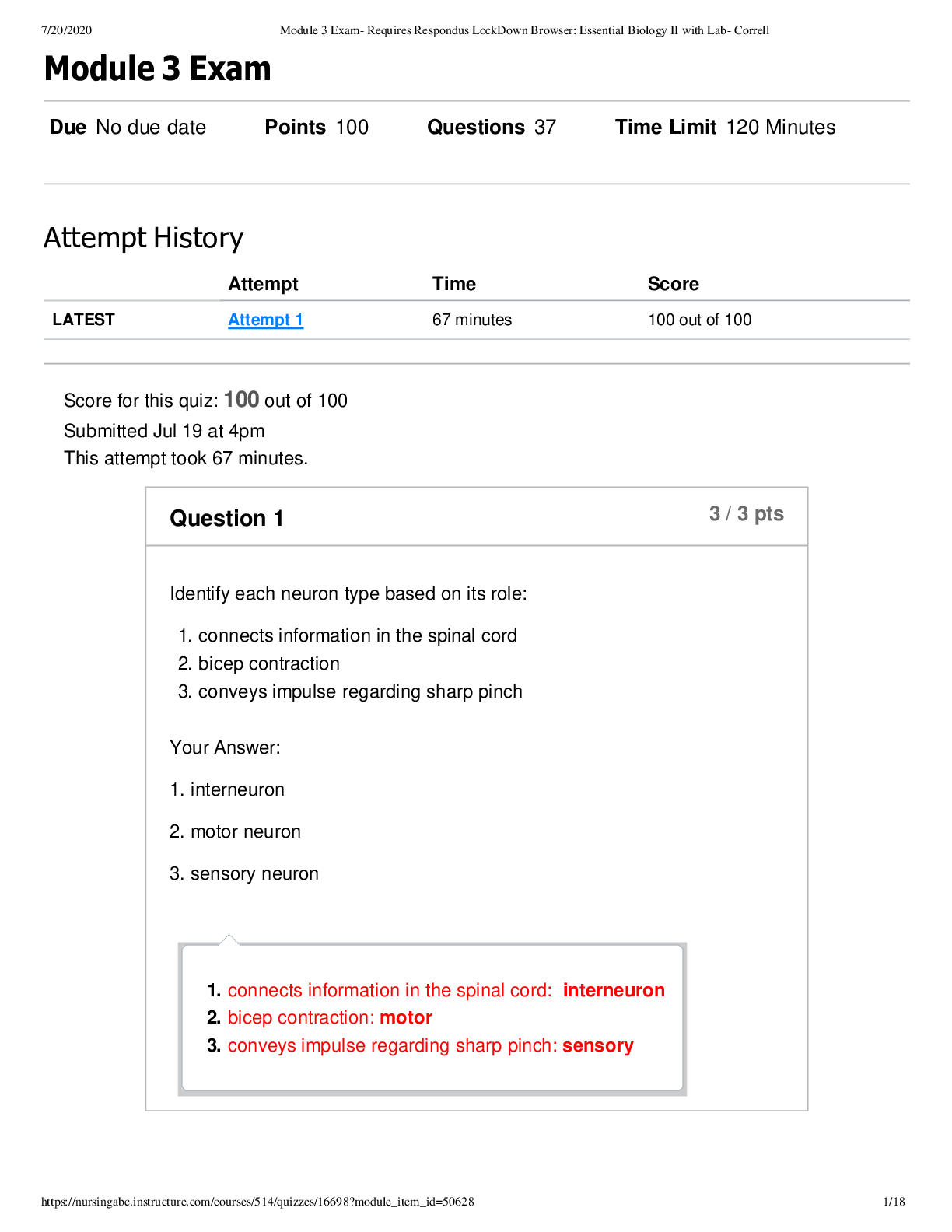
Question 3
Not yet graded / 0 pts
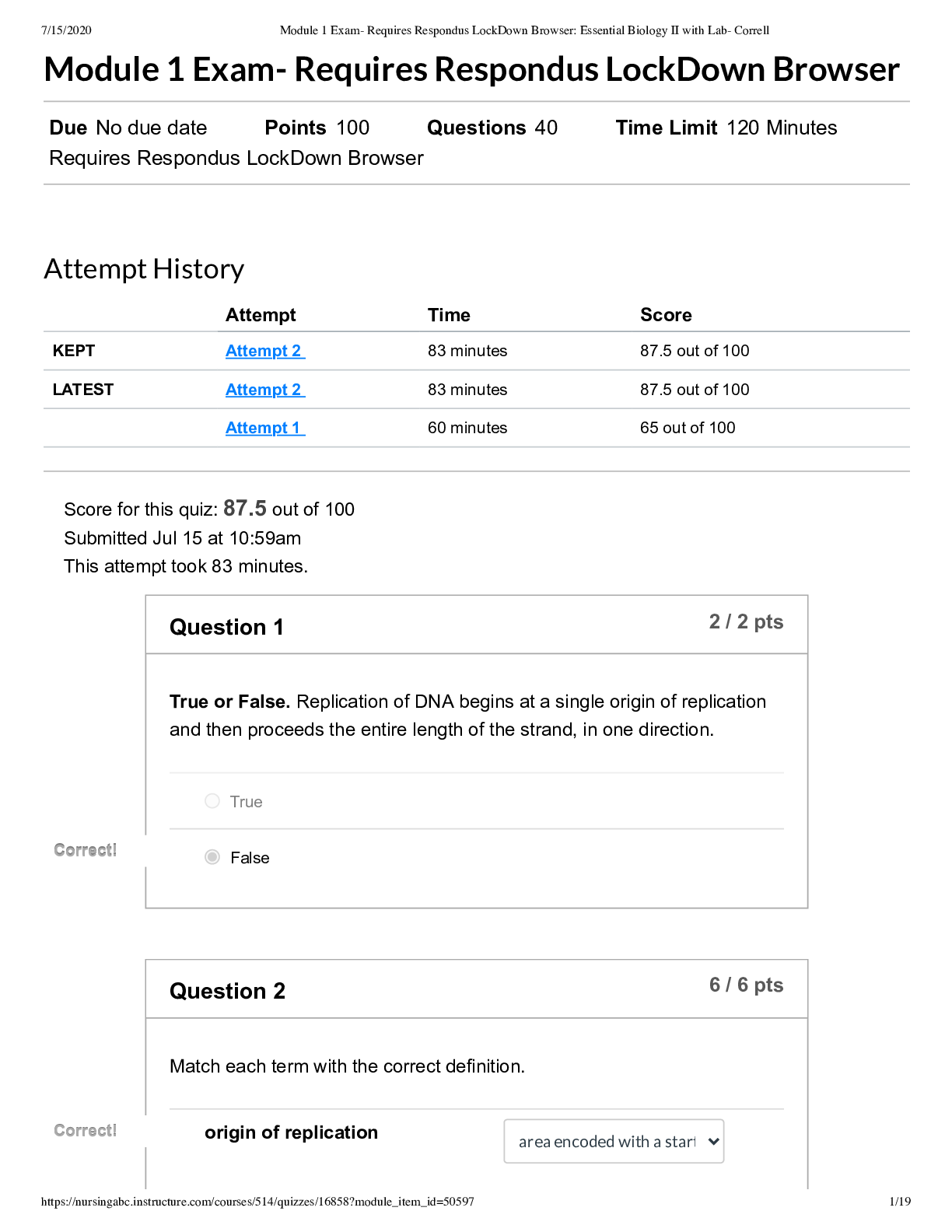
What is the purpose of the origin of replication, and how many can be found on a chromosome?
Your Answer:
This is the point on DNA where replications tarts. With replication you can get precise duplication of of copies of a portion of DNA. For chromosomes of bacteria you can find one. For archaea it is three. Eukarya can have many.
Origins of replication encode a “start” signal to initiate
replication. There are many along the cell so that replication can occur in many places and in both directions.
Mismatch repair proteins will scan the DNA, identify the error, and subsequently remove the thymine and replace it with a cytosine. If mismatch repair proteins are defective, or ineffective, errors in base pairing will be passed onto daughter cells. Furthermore, the accumulation of such errors can lead to the development of life-threatening cancers.
Nucleotide Excision:
Nucleases are enzymes that cut DNA. Specifically, nucleases will cleave out a short stretch of DNA on the new strand, and the template strand will again be used to determine the correct complementary pairs to fill in the gap. As with the initial synthesis, DNA polymerase will again have the role of facilitating the attachment of nucleotides in the excised region. Once the correct stretch of base pairs has been added, DNA ligase will bind and seal together the new base pairs to the original
Mismatches :
"DNA polymerases and mismatch repair proteins are helpful for identifying and remediating single- nucleotide errors, but sometimes entire stretches of the newly synthesized strand may be erroneous. Mismatch repair occurs when other proteins identify inappropriately mismatched nucleotides and replace them with the correct nucleotide" (1.2 DNA
Replication II).
DNA polymerase and mismatch repair are best used for single-nucleotide repairs or very short stretches. Larger areas, such as those spanning along a chromosome, require nucleotide excision.
Question 14
Not yet graded / 0 pts
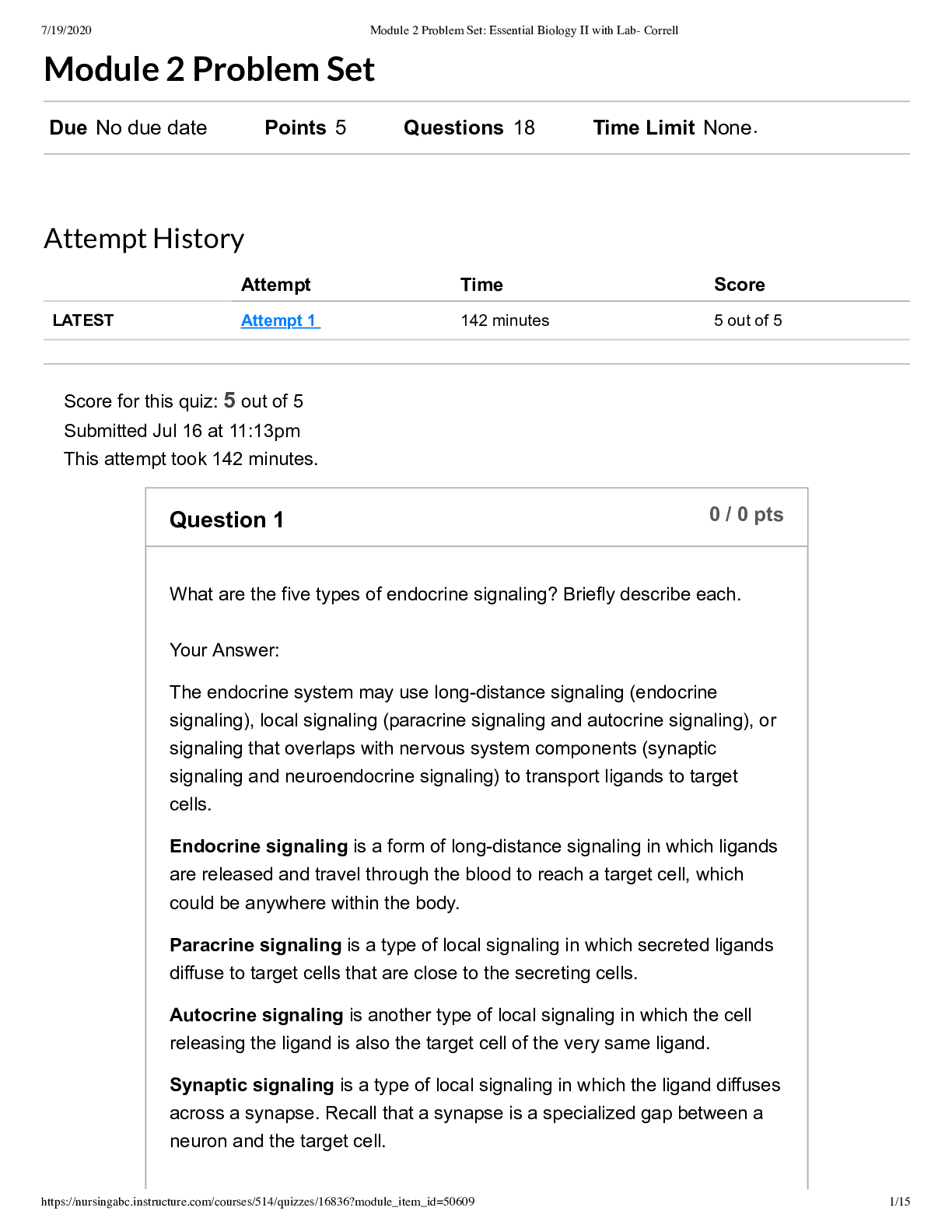
What is a telomere? What happens to telomeres during successive rounds of replication?
Your Answer:
Telomeres are specialized nucleotide sequences that serve as a protective tail on the ends of strands. In addition to acting as a buffer to lessen the impacts of this gradual shortening, telomeres have a secondary function. Specifically, proteins associated with telomeres prevent the cell from deploying error repairs within the telomeric DNA.
Telomeres get shorter with each replication and this is one of the "why people age" theories as stated below,
"It is hypothesized that the gradual shortening of telomeres within somatic cells over the lifetime of an organism underlies the predictable aging process that involves the unpleasant changes that humans encounter as they grow old" (1.2 DNA Replication).
Telomeres are specialized nucleotide sequences that serve as protective tails on the end of the strands. With each round of replication, the telomere gets shorter.
Question 26
Not yet graded / 0 pts
Broadly speaking, what are the three main stages of transcription?
Your Answer:
Within the nucleus, DNA is used to synthesize a primary RNA transcript (pre-mRNA). RNA processing results in a mature mRNA transcript. The mRNA is exported from the nucleus into the cytoplasm where the mRNA is translated on a ribosome into a polypeptide chain.
Transcription, which is characterized by the process of synthesizing RNA from DNA, is the first step in protein synthesis. RNA that is synthesized from a complementary DNA strand is called messenger RNA (mRNA)
Initiation, elongation and termination are the 3 steps of the above process.
Initiation, elongation, and termination.
Question 36
Not yet graded / 0 pts
How does initiation of translation begin? What is the role of initiator tRNA? Describe the completed complex.
Your Answer:
Translation is initiated when the start codon (AUG) is encountered along the mRNA. AUG also encodes for the amino acid methionine (Met), which is added by an initiator tRNA. There is an exit tunnel for the completed polypeptide.
Translation is initiated when a start codon is encountered along the mRNA. The initiator tRNA attaches a methionine (because that is also coded for by the “start codon” AUG). The translation initiation complex, consisting of the large subunit with its attached mRNA, tRNA, and small ribosomal subunit, is formed.
Question 38
Not yet graded / 0 pts
What are the three main steps of the termination of translation?
Your Answer:
Termination of translation can be broken down into 3 steps: (1) binding of a releasing factor, (2) liberation of the completed polypeptide chain, and
(3) disassembly of the translation initiation complex.
Releasing factors bind once a stop codon is reached. These competitively bind to the A-site but add a water molecule instead of an amino acid. The completed polypeptide is
released from the complex. Disassembly of the complex then occurs.
Question 39
Not yet graded / 0 pts
Choose a mutation (point, substitution, or insertion/deletion), define it, and describe potential consequences of this mutation.
Your Answer:
Mutations are changes in DNA that can either be beneficial by giving rise to new genes or detrimental by resulting in abnormal phenotypes. Types of mutations include (1) point mutations, (2) substitutions, and (3)
insertions and deletions. I will discuss point mutations. Point mutations occur when a single nucleotide is changed within a gene. Point mutations that occur in gametes give rise to the inheritance patterns of some genetic diseases.
sickle cell is an example of a gene mutation
Point mutations occur when a single nucleotide is changed within a gene; this type of mutation results in a single amino acid being transcribed inappropriately.
Substitution-type mutations occur when a single nucleotide and its partner are substituted with another pair of nucleotides. This type of mutation may be silent, and phenotypic changes are therefore not observed; it may be missense, in which no change occurs or the wrong amino
acid is inserted; or it may be nonsense, in which stop codons are inserted and short, non-functional proteins arise.
Insertion mutations and deletion mutations occur from the gain and loss, respectively, of nucleotides within a gene. This type of mutation can result in nonsense-type outcomes (short proteins), missense-type outcomes, or too many amino acids (proteins are too big, which will impact function)
Question 43
Not yet graded / 0 pts
How is regulation controlled at the transcription level?
Your Answer:
Control elements that are located close to the RNA promoter are called proximal control elements. In contrast, distal control elements are located further away from the promoter region. The broadest group includes general transcription factors. These proteins are required for all genes that encode for proteins.
Transcription factors bind to control elements along the DNA. These factors can keep a steady, low level of transcription (general factors). More specific factors can be used to increase the rate of transcription when necessary.
Question 47
Not yet graded / 0 pts
If all different types of somatic cells have the same genetic information, how is it that genes for insulin are not being transcribed in brain cells?
Your Answer:
cells in our body start out as stem cells and depending on where they are located they are triggered to "act a certain way" for example if you have a skin cell it will form into a skin cell and nota cell for your liver or in the question root, you wont have an insulin cell in your brain. When cells fail to do their function you get what many people know of which is cancer.
Because different combinations of activators are needed to transcribe specific genes (and to synthesize the desired protein product).
Question 49
Not yet graded / 0 pts
Describe alternative splicing as a regulatory mechanism and why it is beneficial.
Your Answer:
Alternative splicing is a type of RNA processing that involves the splicing and rejoining of different regions from one primary transcript. The benefit of alternative splicing is the production of more than one kind of mRNA from a single primary transcript.
Alternative splicing is a type of RNA processing that involves the splicing and rejoining of different regions from one primary transcript. The benefit of alternative splicing is the production of more than one kind of mRNA from a single primary transcript. You can get different combinations of exons (resulting in different mRNA different protein products) all from one primary transcript.
Quiz Score: 0 out of 5
[Show More]