Physiology > EXAM > Physiology Exam 1 SG (All)
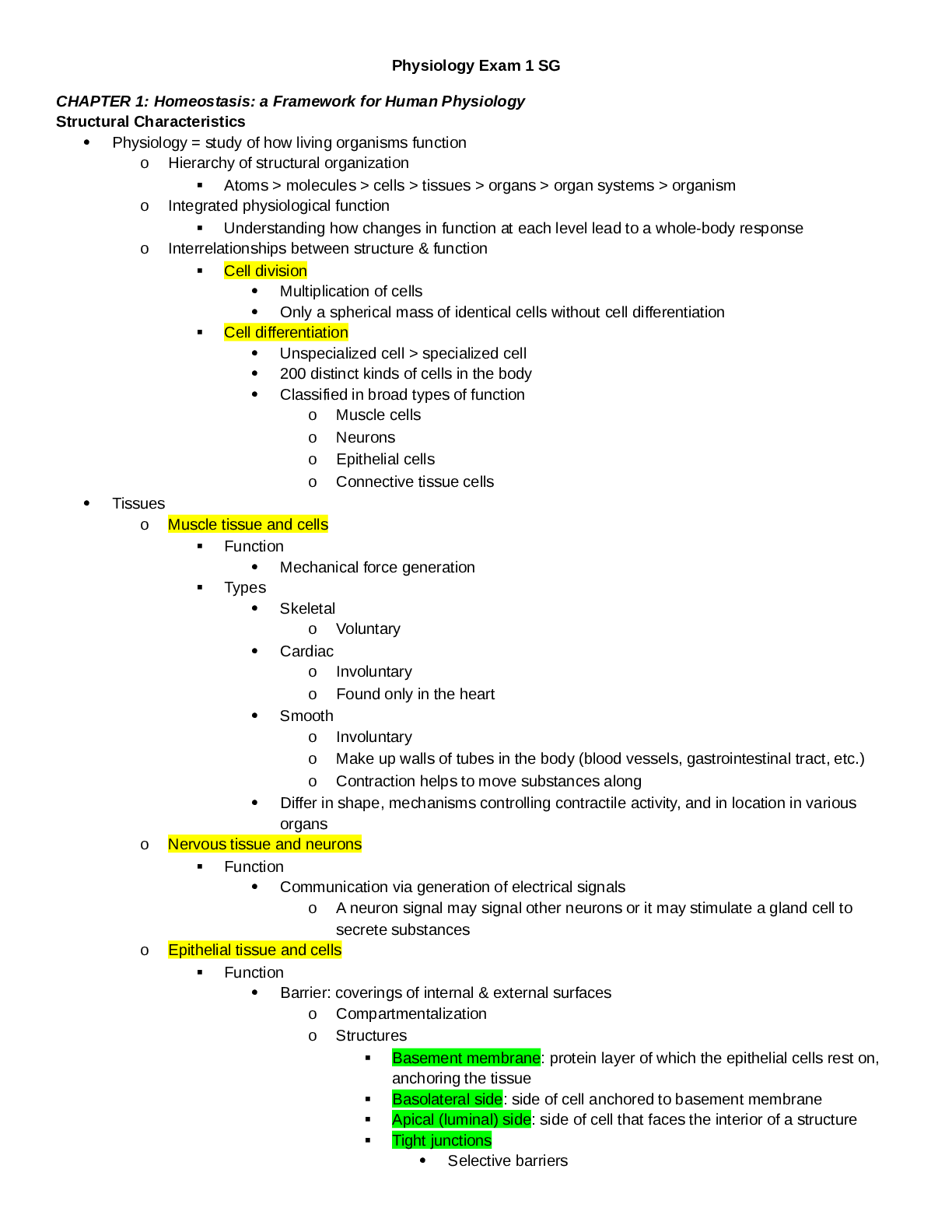
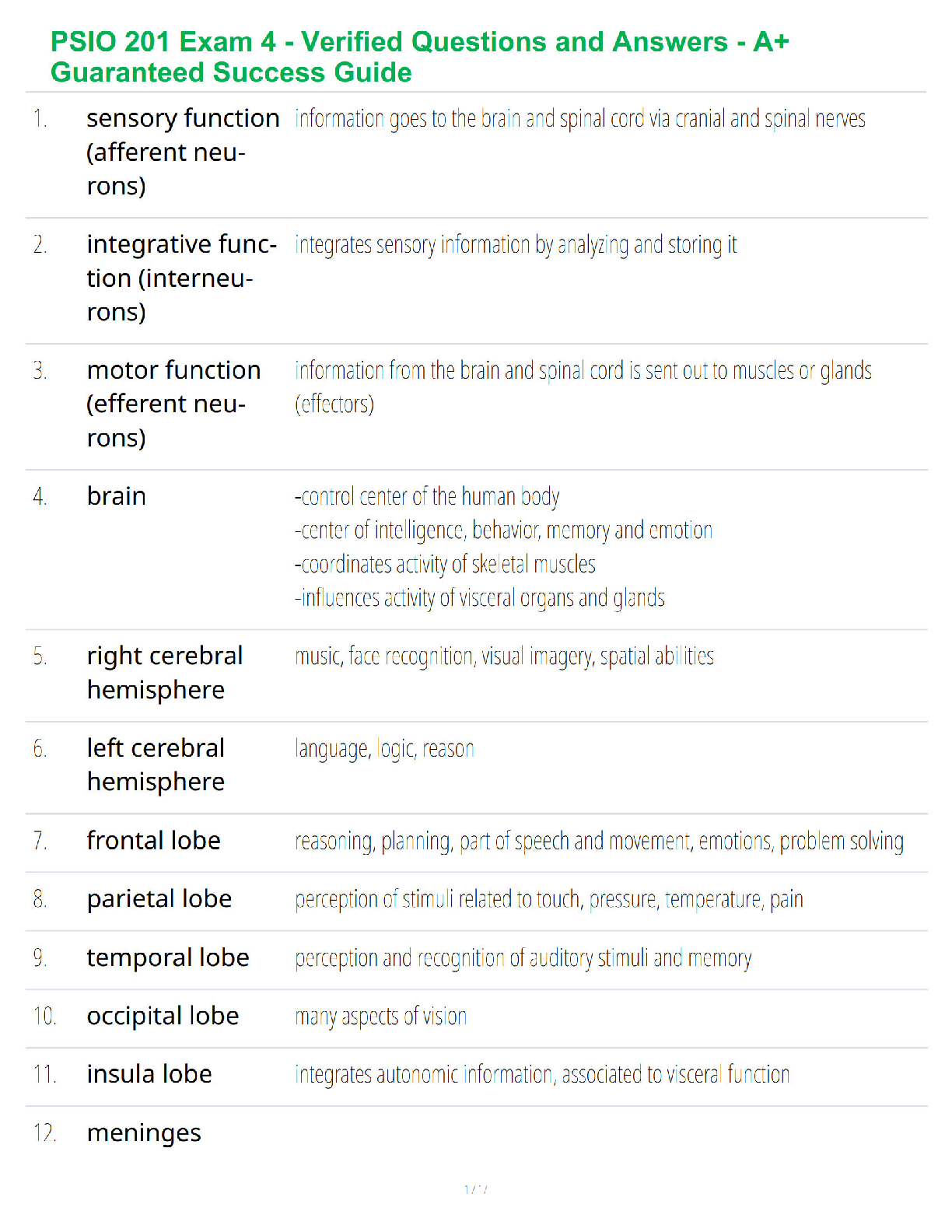
CHAPTER 1: Homeostasis: a Framework for Human Physiology Structural Characteristics Physiology = study of how living organisms function o Hierarchy of structural organization Atoms > molec ... ules > cells > tissues > organs > organ systems > organism o Integrated physiological function Understanding how changes in function at each level lead to a whole-body response o Interrelationships between structure & function Cell division Multiplication of cells Only a spherical mass of identical cells without cell differentiation Cell differentiation Unspecialized cell > specialized cell 200 distinct kinds of cells in the body Classified in broad types of function o Muscle cells o Neurons o Epithelial cells o Connective tissue cells Tissues o Muscle tissue and cells Function Mechanical force generation Types Skeletal o Voluntary Cardiac o Involuntary o Found only in the heart Smooth o Involuntary o Make up walls of tubes in the body (blood vessels, gastrointestinal tract, etc.) o Contraction helps to move substances along Differ in shape, mechanisms controlling contractile activity, and in location in various organs o Nervous tissue and neurons Function Communication via generation of electrical signals o A neuron signal may signal other neurons or it may stimulate a gland cell to secrete substances o Epithelial tissue and cells Function Barrier: coverings of internal & external surfaces o Compartmentalization o Structures Basement membrane: protein layer of which the epithelial cells rest on, anchoring the tissue Basolateral side: side of cell anchored to basement membrane Apical (luminal) side: side of cell that faces the interior of a structure Tight junctions Selective barriers Regulate exchange of molecules Selective secretion & absorption of ions & organic molecules Protection Type of epithelium (simple or stratified) that forms a region reflects the function of that epithelium o Connective tissue and cells Function “Connect”, anchor, & support different parts of the body Formation of extracellular matrix o Collagen fibers and elastin (protein) fibers, polysaccharides o Provides scaffolding for cellular attachments o Cell signaling Types Tendons, ligaments, blood, bone, cartilage, & adipose tissue Organs: discrete structure that performs a specific function o 2+ types of tissue Often comprised of all 4 cell/tissue types Arranged in sheets, tubes, layers, bundles, & strips o Functional unit: “working unit” of an organ Smaller, similar subunits to the organ EX: nephrons in kidneys Organ system: several organs working together t [Show More]
Last updated: 3 years ago
Preview 1 out of 20 pages
Buy this document to get the full access instantly
Instant Download Access after purchase
Buy NowInstant download
We Accept:
Can't find what you want? Try our AI powered Search
Connected school, study & course
About the document
Uploaded On
Sep 23, 2021
Number of pages
20
Written in
All
This document has been written for:
Uploaded
Sep 23, 2021
Downloads
0
Views
61
Scholarfriends.com Online Platform by Browsegrades Inc. 651N South Broad St, Middletown DE. United States.
We're available through e-mail, Twitter, and live chat.
FAQ
Questions? Leave a message!
Copyright © Scholarfriends · High quality services·