BIO 251 Quiz 7
Return to Assessment List
Part 1 of 1 - 100.0/ 100.0 Points
From chapter 23 (23.1-23.7)
Question 1 of 10
10.0 / 10.0 Points
Which are three features of the mucosa and submucosa that are differe
...
BIO 251 Quiz 7
Return to Assessment List
Part 1 of 1 - 100.0/ 100.0 Points
From chapter 23 (23.1-23.7)
Question 1 of 10
10.0 / 10.0 Points
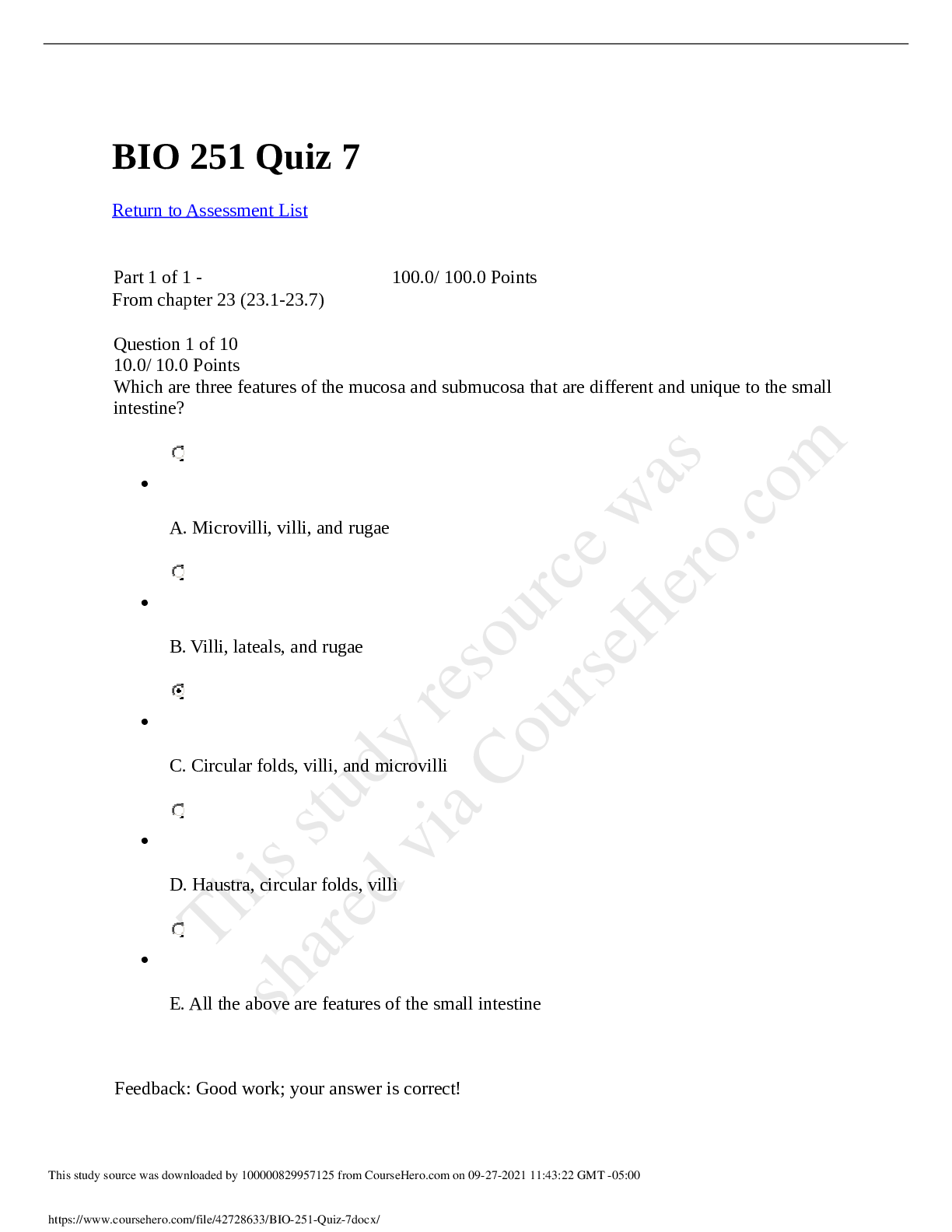
Which are three features of the mucosa and submucosa that are different and unique to the small intestine?
•
A. Microvilli, villi, and rugae
•
B. Villi, lateals, and rugae
•
C. Circular folds, villi, and microvilli
•
D. Haustra, circular folds, villi
•
E. All the above are features of the small intestine
Feedback: Good work; your answer is correct!
Question 2 of 10
10.0 / 10.0 Points
Our body’s ability to absorb vitamins from foods and supplements we take is vital to our health. Why do you think consuming some fat in the diet is important?
•
A. We need fat to help with absorption of fat-soluble vitamins such as A, D, E, and K
•
B. We need fat to help with absorption of water-soluble vitamins such as C, B1, B6 and B9
•
C. We need fat to help with absorption of protein
•
D. We need fat to help with absorption of fiber
•
E. None of the above
Feedback: Good work; your answer is correct! Question 3 of 10
10.0 / 10.0 Points
The is the thin layer of the mucosa responsible for pulling the mucosa into its many folds which increases the surface area of the alimentary canal.
•
A. Muscularis (externa)
•
B. Submucosa
•
C. Serosa
•
D. Muscularis mucosa
•
E. None of the above
Feedback: Good work; your answer is correct! Question 4 of 10
10.0 / 10.0 Points
The two regulatory mechanisms (controls) of the digestive system are and
.
•
A. Neural and hormonal
•
B. Hormonal and enzymatic
•
C. Neural and enzymatic
•
D. The digestive system only has enzymatic control and nothing else
•
E. None of the above
Feedback: Good work; your answer is correct! Question 5 of 10
10.0 / 10.0 Points
Which of the following is not considered an accessory organ of digestion?
•
A. Pancreas
•
B. Large intestine
•
C. Gallbladder
•
D. Liver
•
E. None of the above are considered accessory organs of digestion
Feedback: Good work; your answer is correct! Question 6 of 10
10.0 / 10.0 Points
The stomach is protected from self-digestion by the . When this breaks down,
can form and be painful.
•
A. Muscularis mucosa; nodules
•
B. Mucosal barrier; ulcers
•
C. Duodenum; ulcers
•
D. Serosa; nodules
•
E. None of the above is correct
Feedback: Good work; your answer is correct! Question 7 of 10
10.0 / 10.0 Points
The correctly sequenced sections of the small intestine are: , ,
.
•
A. Duodenum; jejunum; ileum
•
B. Ileum, jejunum; duodenum
•
C. Duodenum; ileum; jejunum
•
D. Jejunum; duodenum; ileum
•
E. None of the above is correct
Feedback: Good work; your answer is correct! Question 8 of 10
10.0 / 10.0 Points
Which organ below produces bile for use in digestion?
•
A. Pancreas
B. Liver
•
C. Gallbladder
•
D. Duodenum
•
E. None of the above
Feedback: Good work; your answer is correct! Question 9 of 10
10.0 / 10.0 Points
Mechanical digestion occurs when food is broken into smaller pieces, but the chemical makeup of the food does not change. The following is associated with mechanical digestion except
.
•
A. Segmentation
•
B. Churning
C. Mastication
•
D. Enzymes
•
E. Chewing
Feedback: Good work; your answer is correct! Question 10 of 10
10.0 / 10.0 Points
In which organ below does the majority of digestion occur?
•
A. Small intestine
•
B. Liver
•
C. Pancreas
•
D. Large intestine
•
E. Stomach
Feedback: Good work; your answer is correct!
[Show More]