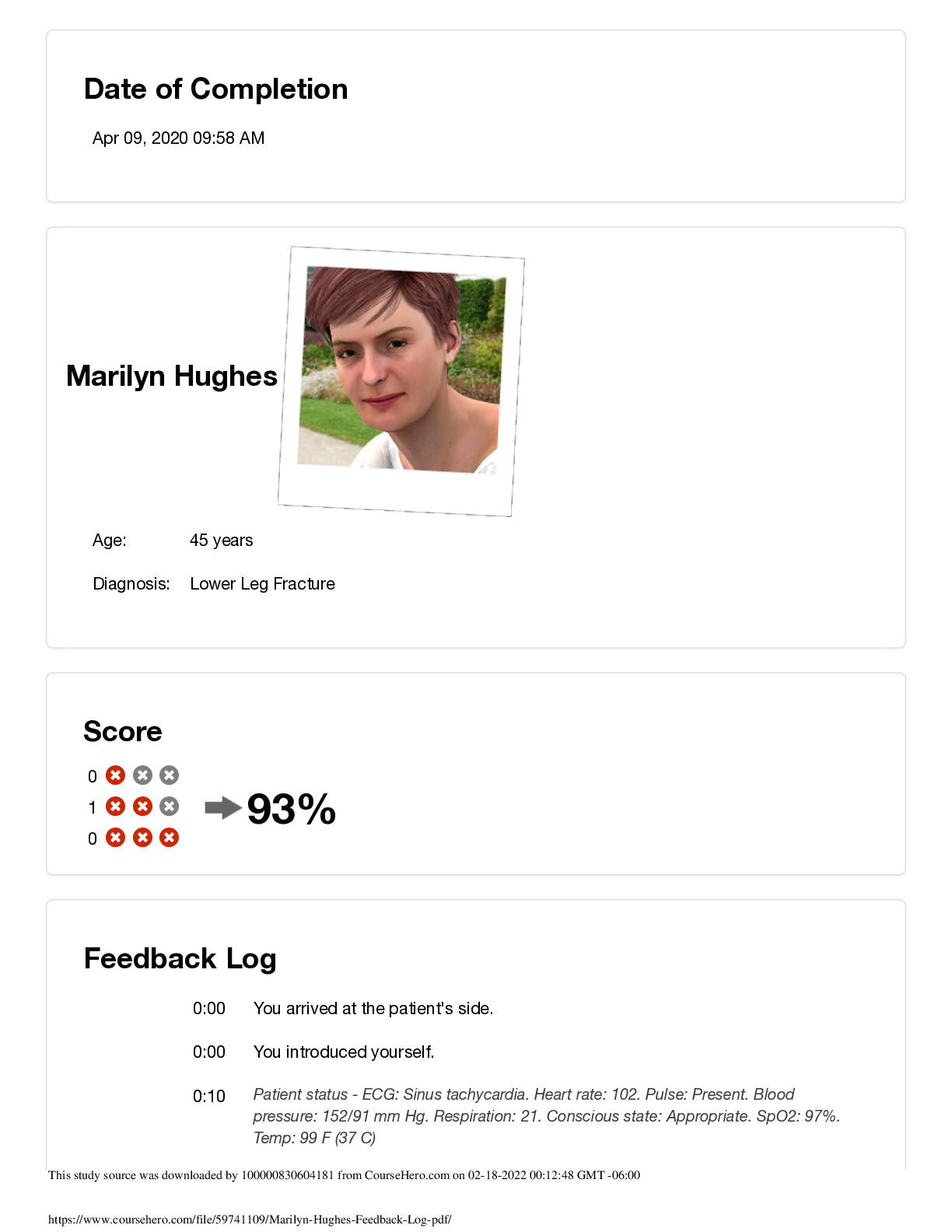
Date of Completion
Apr 09, 2020 09:58 AM
Feedback Log
0:00 You arrived at the patient's side.
0:00 You introduced yourself.
0:10 Patient status - ECG: Sinus tachycardia. Heart rate: 102. Pulse: Present. Blood
p
...
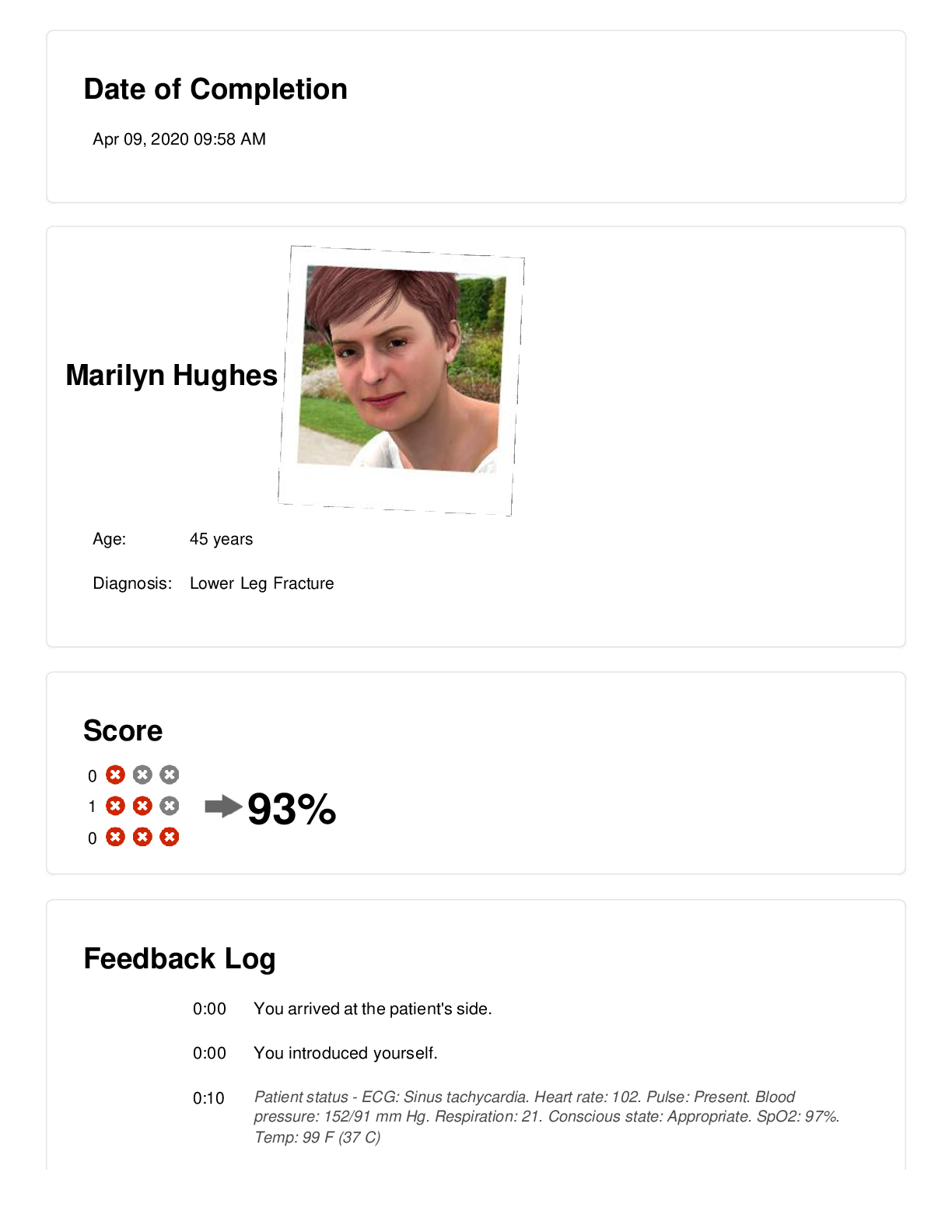
Date of Completion
Apr 09, 2020 09:58 AM
Feedback Log
0:00 You arrived at the patient's side.
0:00 You introduced yourself.
0:10 Patient status - ECG: Sinus tachycardia. Heart rate: 102. Pulse: Present. Blood
pressure: 152/91 mm Hg. Respiration: 21. Conscious state: Appropriate. SpO2: 97%.
Temp: 99 F (37 C)
0:11 You washed your hands. To maintain patient safety, it is important to wash your
hands as soon as you enter the room.
1:10 Patient status - ECG: Sinus tachycardia. Heart rate: 103. Pulse: Present. Blood
pressure: 152/91 mm Hg. Respiration: 21. Conscious state: Appropriate. SpO2: 98%.
Temp: 99 F (37 C)
1:38 You identified the patient. To maintain patient safety, it is important that you
quickly identify the patient.
1:51 You looked for normal breathing. She is breathing at 21 breaths per minute. The
chest is moving normally on both sides.
2:10 Patient status - ECG: Sinus tachycardia. Heart rate: 104. Pulse: Present. Blood
pressure: 156/93 mm Hg. Respiration: 21. Conscious state: Appropriate. SpO2: 98%.
Temp: 99 F (37 C)
2:21 You attached the pulse oximeter. It is a good idea to monitor the saturation and
pulse here. This will allow you to reassess the patient continuously.
2:32 You checked the radial pulse. The pulse is strong, 105 per minute and regular. It
is correct to assess the patient's vital signs.
2:59 You measured the blood pressure at 152/92 mm Hg. It is appropriate to monitor
the patient by measuring the blood pressure.
3:10 Patient status - ECG: Sinus tachycardia. Heart rate: 105. Pulse: Present. Blood
pressure: 155/93 mm Hg. Respiration: 21. Conscious state: Appropriate. SpO2: 98%.
Temp: 99 F (37 C)
3:24 You checked the temperature at the mouth. The temperature was 99 F (37 C).
3:35 You asked the patient if she had any pain. She replied: 'Yes! Ahh...'
3:41 You asked the patient where the pain was located. She replied: 'It's in my left
leg.'
3:49 You asked the patient if she could describe her pain. She replied: 'It feels like the
bandage is too tight.'
3:54 You asked the patient if anything made the pain better. She replied: 'No. Please
give me something for the pain!'
3:59 You asked the patient if anything made the pain worse. She replied: 'It gets
worse when somebody touches my leg.'
4:05 You asked the patient if the pain went anywhere. She replied: 'No, not really.'
4:10 You asked the patient how long she had pain for. She replied: 'Since I got back
from surgery...'
4:10 Patient status - ECG: Sinus tachycardia. Heart rate: 106. Pulse: Present. Blood
pressure: 157/94 mm Hg. Respiration: 21. Conscious state: Appropriate. SpO2: 98%.
Temp: 99 F (37 C)
4:14 You asked: How bad is the pain? She replied: 'It's really bad, about 8.'
4:23 You asked the patient if she needed anything for the pain. She replied: 'Yes.
Please!'
4:28 You asked the patient if the pain was better after the medication. She replied:
'No, it's actually worse.'
5:08 You assessed the patient's dressing. This is correct. Assessing any dressings the
patient has is always important.
5:10 Patient status - ECG: Sinus tachycardia. Heart rate: 106. Pulse: Present. Blood
pressure: 154/92 mm Hg. Respiration: 21. Conscious state: Appropriate. SpO2: 98%.
Temp: 99 F (37 C)
5:35 You checked the pedal pulse. The pulse is strong, 105 per minute and regular.
The pulse is absent on the left side, though. Correct. This is part of a
neurovascular assessment when compartment syndrome is suspected.
6:00 You examined the patient's legs. The lower left leg looks cyanotic. The dressing
seems really tight. There is prolonged capillary refill in the toes on the left side.
There is normal skin turgor. Her skin is cool, and she is very sweaty.
6:10 Patient status - ECG: Sinus tachycardia. Heart rate: 107. Pulse: Present. Blood
pressure: 155/93 mm Hg. Respiration: 21. Conscious state: Appropriate. SpO2: 98%.
Temp: 99 F (37 C)
6:33 You asked the patient if she could move her toes. She replied: 'No. I don't think
so.'
6:33 You have performed a Glasgow Coma Scale (GCS) assessment by checking
relevant responses. The GCS is 15.
6:40 You asked the patient if she could feel her toes. She replied: 'My left foot feels
really numb.'
7:10 Patient status - ECG: Sinus tachycardia. Heart rate: 107. Pulse: Present. Blood
pressure: 156/94 mm Hg. Respiration: 21. Conscious state: Appropriate. SpO2: 98%.
Temp: 99 F (37 C)
7:26 You listened to the lungs of the patient. The breath sounds are normal.
8:10 Patient status - ECG: Sinus tachycardia. Heart rate: 108. Pulse: Present. Blood
pressure: 158/95 mm Hg. Respiration: 21. Conscious state: Appropriate. SpO2: 98%.
Temp: 99 F (37 C)
8:29 You sat the patient up.
8:51 You assessed the patient's IV. The site had no redness, swelling, infiltration,
bleeding, or drainage. The dressing was dry and intact. This is correct. Assessing
any IVs the patient has is always important.
[Show More]






.png)


.png)

