*NURSING > Syllabus > Chamberlain College of NursingNR 603nr603_advanced_clinical_diagnosis_and_practice_across_the_lifesp (All)
Chamberlain College of NursingNR 603nr603_advanced_clinical_diagnosis_and_practice_across_the_lifespan_syllabus
Document Content and Description Below
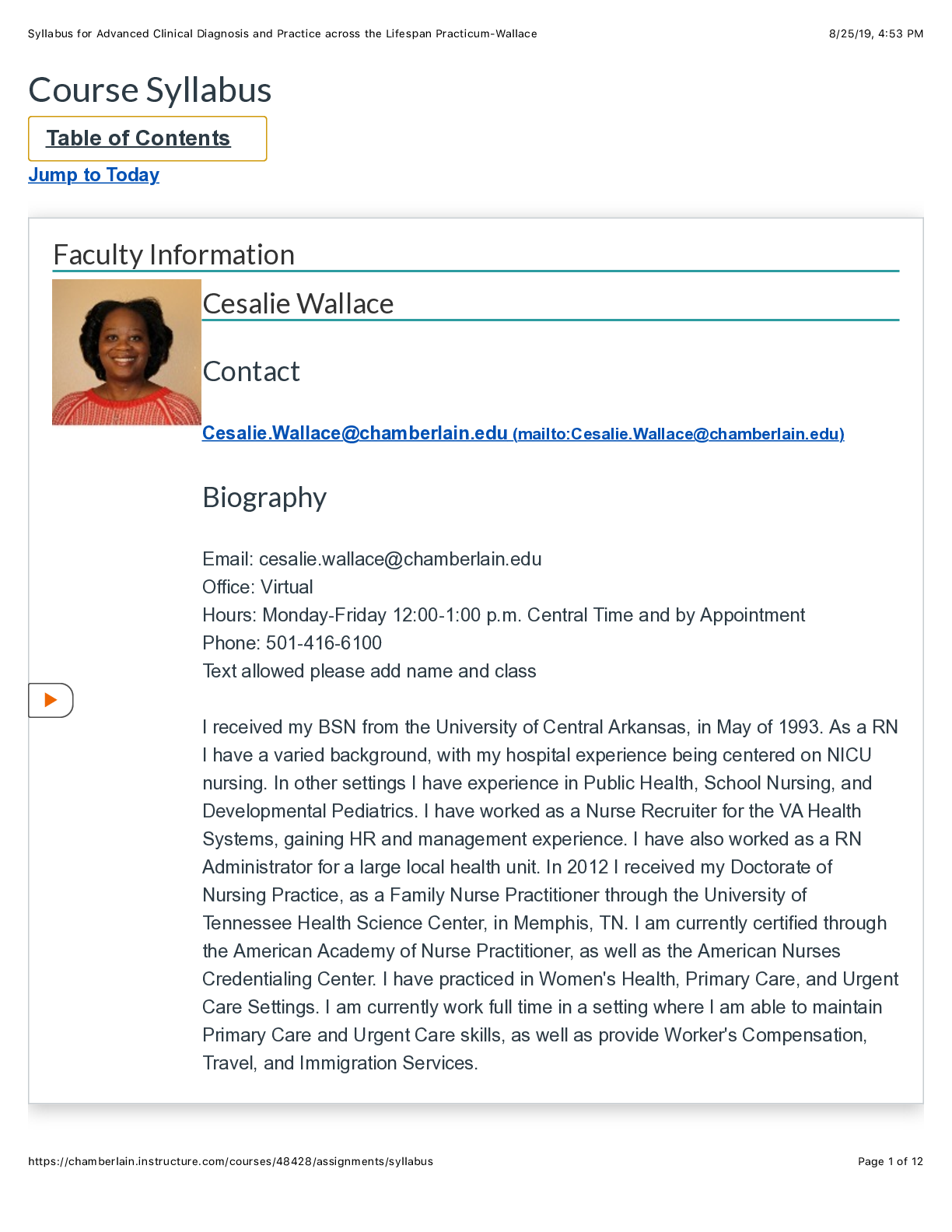
Course Code: NR603 Course Title: Advanced Clinical Diagnosis and Practice Across the Lifespan Syllabus Top Information Course Number: NR603 Course Title: Advanced Clinical Diagnosis and P ... ractice Across the Lifespan Course Credit: 3 credits (0.5 Theory; 2.5 Clinical) Pre-requisite: NR601, NR602 Course Text Buttaro, T.M., Trybulski, J., Bailey, P., & Sandburg-Cook, J. (2013). Primary care: A collaborative practice. (4th ed.). St. Louis, MO: Elsevier Mosby. (E-book) Required across all FNP courses: Textbook 2 • American Psychological Association. (2010). Publication manual of the American Psychological Association (6th ed.). Washington, DC: Author. Recommended across all FNP courses: Textbook 3 • Goroll, A., & Mulley, A. (2014). Primary care medicine: Office evaluation and management of the adult patient (7th ed.). China: Wolters Kluwer Health. Course Description This course continues to expand the theoretical and practical knowledge of diagnostic principles specific to the role of the FNP, for the healthcare needs of individuals of all ages. Students will further develop their skills related to health promotion, prevention of illness, diagnosis, and NR-603 Syllabus Retrieved on 10/30/15 hf management of complex acute and chronic conditions, including behavioral health. Care strategies will include patient education, protocol development, follow-up, and referral through a clinical practicum experience in a precepted advanced practice setting. Course Outcomes 1 Utilize critical inquiry and judgment to evaluate the design, implementation, and outcomes of strategies developed for health promotion, health protection, disease prevention, and treatment models across diverse healthcare delivery systems. (PO 7) 2 Assimilate primary care competencies into specialty nurse practitioner practice that exemplify professional values, scholarship, service, and culturally competent global awareness and support ongoing professional and personal development. (PO 9) 3 Plan for healthcare delivery system negotiation and management of human and physical resources in a fiscally responsible manner to support high-quality and cost-effective care and decision-making. (PO 3) 4 Synthesize health promotion, health protection, disease prevention, and treatment across the lifespan. (PO 1) 5 Demonstrate patient-centered care through the nurse practitioner patient relationship across the lifespan. (PO 7) 6 Promote safety and quality patient outcomes through integration of the teaching-coaching functions across the lifespan. (PO 1) 7 Exemplify a commitment to the professional role of the family nurse practitioner when providing care across the lifespan. (PO 5) 8 Apply management and leadership concepts in diverse healthcare delivery systems to improve health outcomes across the lifespan. (PO 8) 9 Utilize continuous quality improvement strategies to promote healthcare quality and safety across the lifespan. (PO 2) Retrieved on 10/30/15 hf 10 Incorporates cultural preferences, values, health beliefs, and behaviors into healthcare across the lifespan. (PO 7) 11 Formulate differential diagnosis using critical thinking and integration and interpretation of different forms of data. (PO 1) 12 Reflect on personal and professional growth toward achieving competence as a family nurse practitioner. (PO 5, 10) Program Outcomes The MSN program outcomes are aligned with the American Association of Colleges of Nursing publication, The Essentials of Master’s Education in Nursing (2011). Upon completion of the MSN degree program, the graduate will be able to: 1. Practice safe, high-quality advanced nursing care based on concepts and knowledge from nursing and related disciplines. 2. Construct processes for leading and promoting quality improvement and safety in advanced nursing practice and healthcare delivery. 3. Use contemporary communication modalities effectively in advanced nursing roles. 4. Evaluate the design, implementation and outcomes of strategies developed to meet healthcare needs. 5. Develop a plan for lifelong personal and professional growth that integrates professional values regarding scholarship, service and global engagement. 6. Apply legal, ethical and human-caring principles to situations in advanced nursing practice. 7. Design patient-centered care models and delivery systems using the best available scientific evidence. 8. Manage human, fiscal and physical resources to achieve and support individual and organizational goals. 9. Compose a plan for systematic inquiry and dissemination of findings to support advanced nursing practice, patient-care innovation, and the nursing profession. 10. Collaborate interprofessionally in research, education, practice, health policy and leadership to improve population health outcomes. 11. Apply principles of informatics to manage data and information in order to support effective decision making. [Show More]
Last updated: 3 years ago
Preview 1 out of 18 pages
.png)
Buy this document to get the full access instantly
Instant Download Access after purchase
Buy NowInstant download
We Accept:

Reviews( 0 )
$9.00
Can't find what you want? Try our AI powered Search
Document information
Connected school, study & course
About the document
Uploaded On
Sep 29, 2021
Number of pages
18
Written in
All

Additional information
This document has been written for:
Uploaded
Sep 29, 2021
Downloads
0
Views
287

(1)-converted.png)