Understanding oneself sexually and having interpersonal sexual skills and integrity are two characteristics we
consider to be part of:
a. gender identity.
b. sexual intelligence.
c. sexual orientation.
d. sexual IQ.
...
Understanding oneself sexually and having interpersonal sexual skills and integrity are two characteristics we
consider to be part of:
a. gender identity.
b. sexual intelligence.
c. sexual orientation.
d. sexual IQ.
2. Which of the following best defines the psychosocial approach to understanding human sexuality?
a. The belief that biology plays a large role in human development and sexual orientation
b. The theory that similarities and differences between people are best explained in terms of
their culture
c. The view that emotions, attitudes, motivations, and social conditioning have a strong
impact on sexual attitudes, values and behaviors
d. The view that our peer groups have little influence on our values and beliefs
3. Thinking of intercourse as the only “real sex”:
a. has its roots in Buddhist religious philosophy.
b. lifts the performance pressures on both women and men.
c. may devalue sexual behaviors other than intercourse.
d. is a view that is supported by the authors.
4. Jamal believes that a "real" man always makes the first sexual advance in a relationship. Jamal's thinking
BEST reflects:
a. principles of courtly love.
b. heterosexism.
c. a lesser degree of acculturation.
d. adherence to rigid gender roles.
5. Which of the following is the BEST example of a potential effect of rigid gender-role conditioning?
a. A woman may feel reluctant to express her sexual desires to her male partner.
b. A man may feel uncomfortable if his female partner prefers oral sex to intercourse.
c. As a result of her religious affiliation, a woman feels guilty having sex for pleasure.
d. A man enjoys sex the most when his female partner initiates it.
6. The text uses the term “other sex” instead of “opposite sex” to:
a. be politically correct.
b. emphasize controversy in human sexuality.
c. emphasize that men and women are more different than alike.
d. emphasize that men and women are more alike than different.
7. If you want to have a successful conversation with one or both of your parents about sexuality, which of the
following guidelines might be helpful?
a. Ask specific detailed questions about their current sex lives.
b. Start with a low-key question.
c. Don't tell them that you're taking a human sexuality class.
d. Start with the parent with whom you have a relatively poor relationship.
[Show More]
.png)



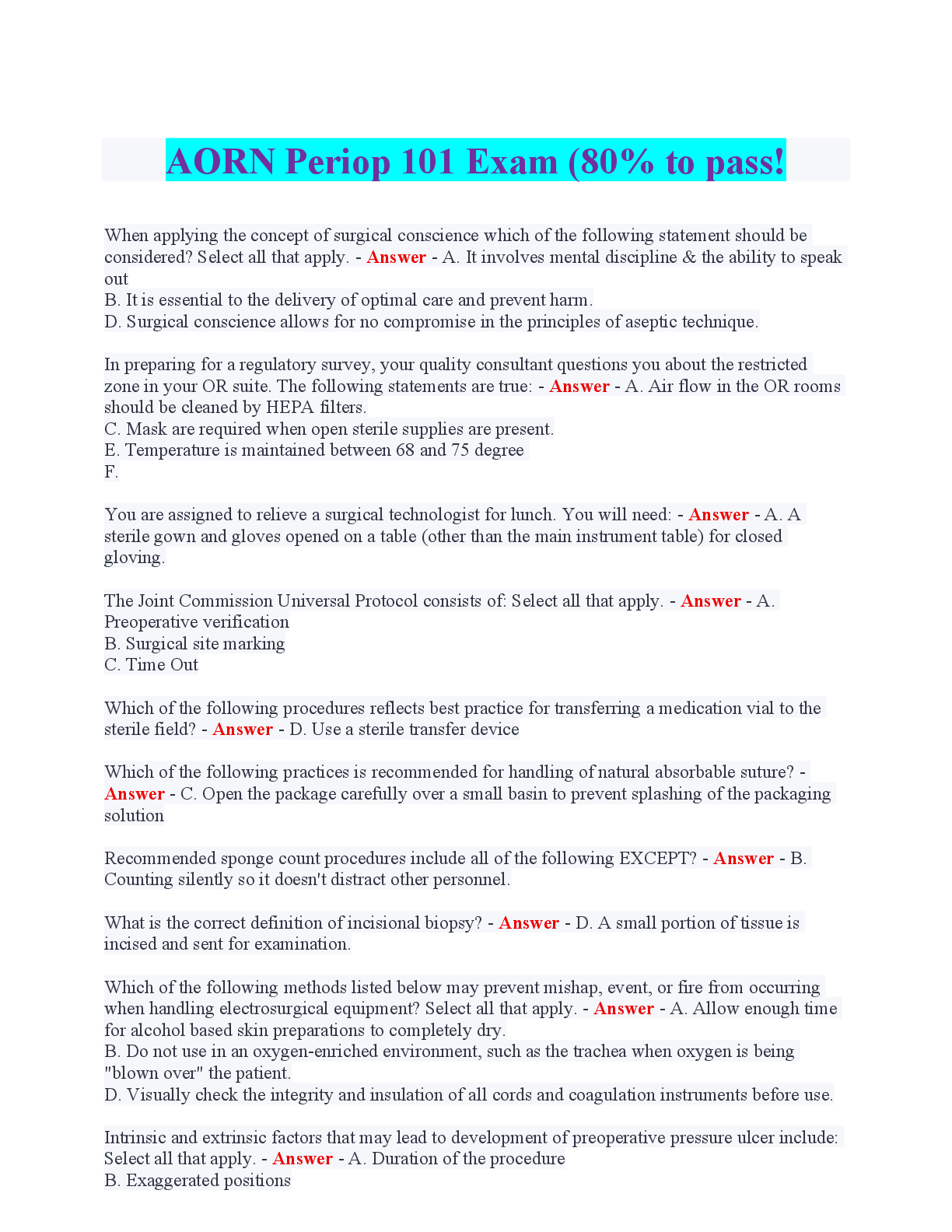
![Preview of AORN PERIOP 101 FINAL EXAM 2026 QUESTIONS AND VERIFIED ANSWERS [LATEST UPDATE]](https://browseimages.nyc3.digitaloceanspaces.com/paper-images/2026/04/07/sGJvJ3aH2026-04-07-04-5869d464cbba16f.png)







.png)

.png)


