Nursing Care of Patients With Central Nervous System Disorders
Document Content and Description Below
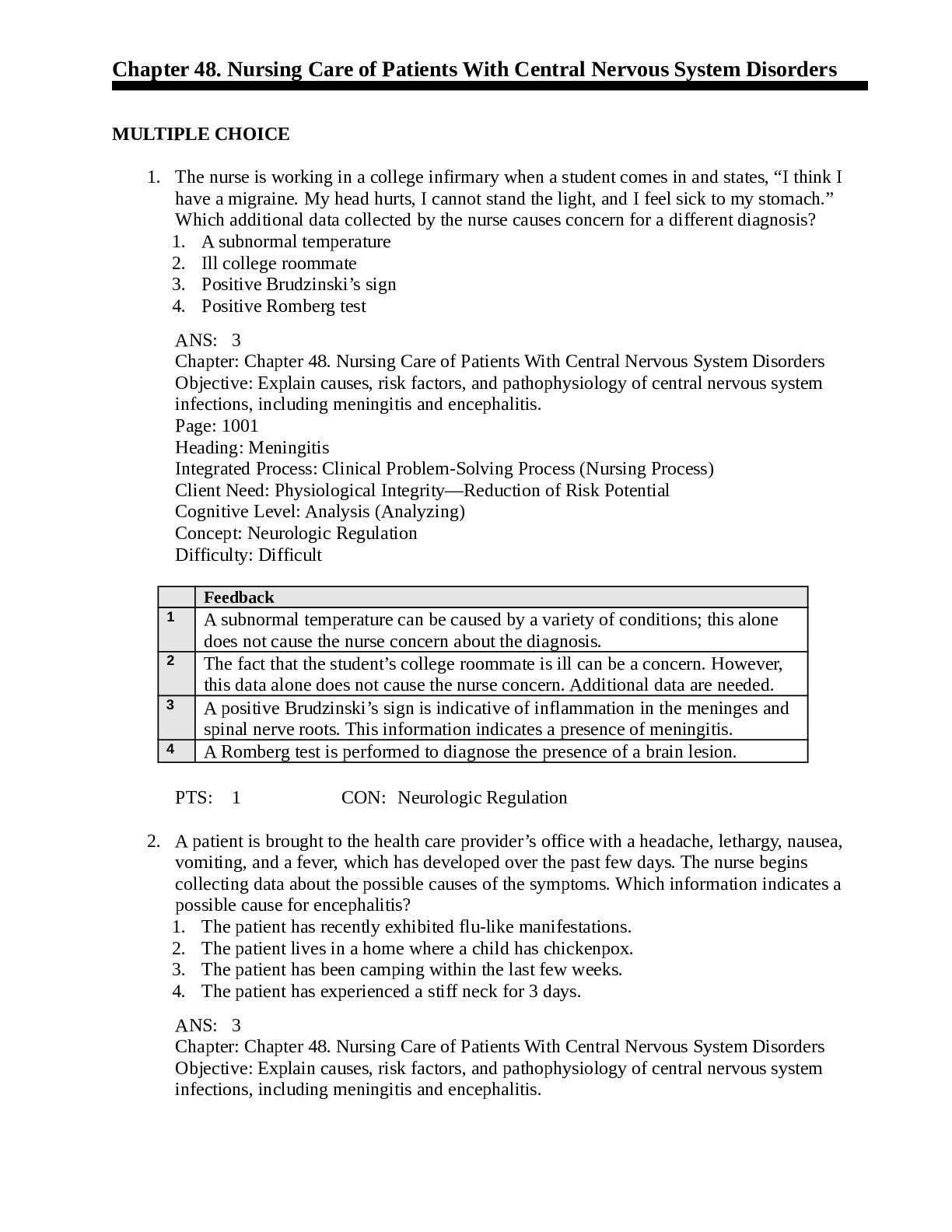
The nurse is caring for a patient brought to the emergency department after an automobile accident. The
patient is fully conscious. For what early signs of increased intracranial pressure (ICP) should the nurse be
aler
...
[Show More]
Last updated: 4 years ago
Preview 1 out of 19 pages
Instant download

Buy this Document to get the Full Access Instantly
Provided by Students Who Aced it
We Verify Document Content to Gurantee Accuracy
Reviews( 0 )
Document information
Connected school, study & course
About the document
Uploaded On
Oct 11, 2021
Number of pages
19
Written in
All

Additional information
This document has been written for:
Uploaded
Oct 11, 2021
Downloads
0
Views
163
Topic Tags
Recommended For You
Get more on EXAM »
$10
18 Pages
M 1/18 Anatomy of the Muscular system: Introduction & Muscles...
$12
12 Pages
ATI Medical Surgical Nursing-Care of Patients with Problems of...

$9
30 Pages
Central Nervous System CNS Chapter 4 Quiz BNF | 140 Questions...
$10
23 Pages
Chapter 48. Nursing Care of Patients With Central Nervous Syst...
$7
14 Pages
NURSING MISC<Chapter 48. Nursing Care of Patients With Central...

$16
19 Pages
Chapter 44: Care of Patients with Problems of the Central Nerv...

$10
7 Pages
ATI Medical Surgical Nursing, Care of Patients with Problems o...

$9
7 Pages
ATI Medical Surgical Nursing, Care of Patients with Problems o...

$16
19 Pages
ATI Medical Surgical Nursing, Care of Patients with Problems o...

$15
20 Pages
ATI Medical Surgical Nursing, Care of Patients with Problems o...
, All Correct, Download to Score A.png)
$7
10 Pages
ATI Pharmacology and the Nursing Process, Central Nervous Syst...
, Correct, Download to Score A.png)
$7
6 Pages
ATI Pharmacology and the Nursing Process, Central Nervous Syst...
, Correct, Download to Score A.png)
$7
5 Pages
ATI Pharmacology and the Nursing Process, Central Nervous Syst...

$7
43 Pages
NR565 / NR 565: Advanced Pharmacology Fundamentals Week 4 Chap...
More related documents below




.png)

.png)

.png)

