Chapter 9—Domestic U.S. and Global Logis-tics
TRUE/FALSE
1. The responsibility of transportation is to create both time utility and place utility, which means that products will be delivered at precisely the right
...
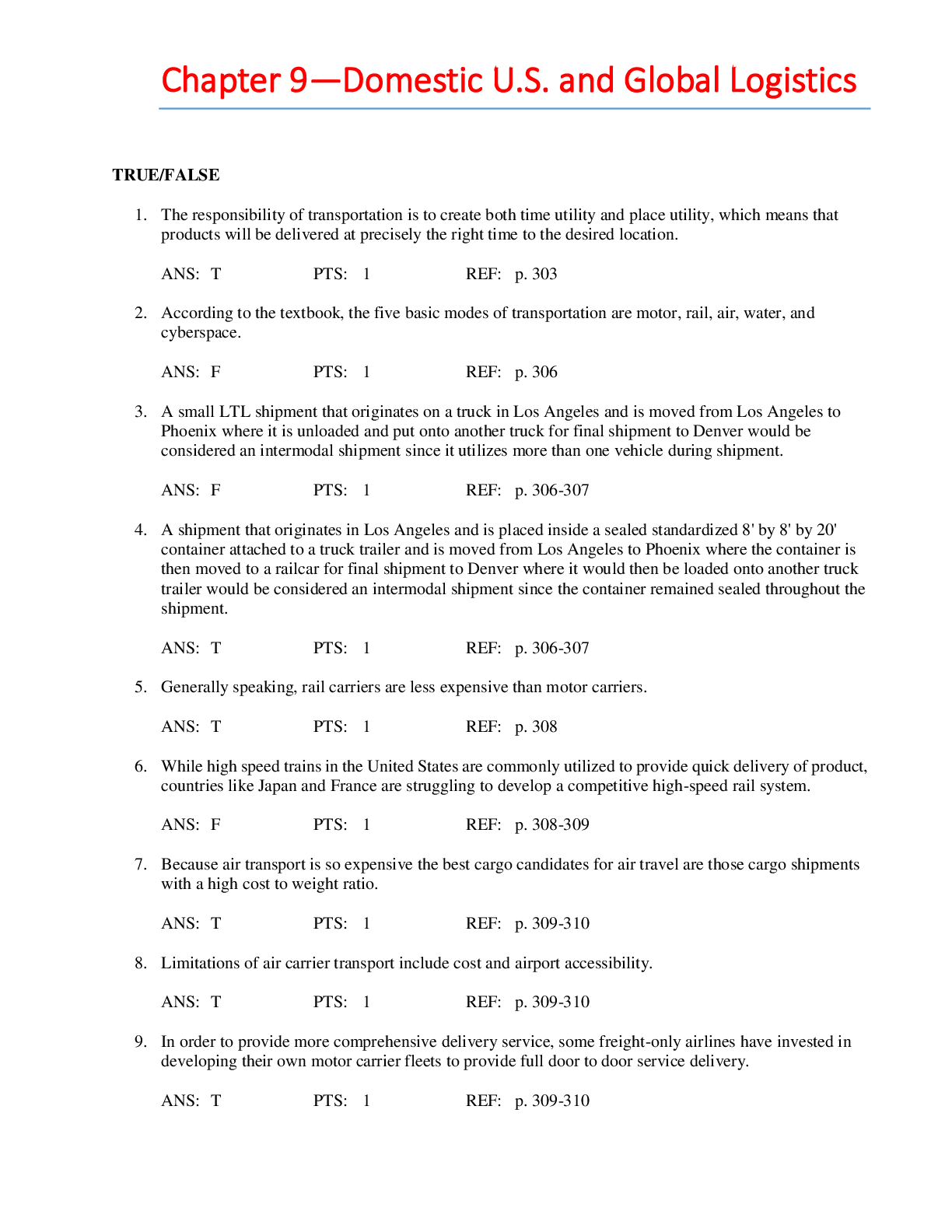
Chapter 9—Domestic U.S. and Global Logis-tics
TRUE/FALSE
1. The responsibility of transportation is to create both time utility and place utility, which means that products will be delivered at precisely the right time to the desired location.
T 1 p. 303
2. According to the textbook, the five basic modes of transportation are motor, rail, air, water, and cyberspace.
F 1 p. 306
3. A small LTL shipment that originates on a truck in Los Angeles and is moved from Los Angeles to Phoenix where it is unloaded and put onto another truck for final shipment to Denver would be considered an intermodal shipment since it utilizes more than one vehicle during shipment.
F 1 p. 306-307
4. A shipment that originates in Los Angeles and is placed inside a sealed standardized 8' by 8' by 20' container attached to a truck trailer and is moved from Los Angeles to Phoenix where the container is then moved to a railcar for final shipment to Denver where it would then be loaded onto another truck trailer would be considered an intermodal shipment since the container remained sealed throughout the shipment.
T 1 p. 306-307
5. Generally speaking, rail carriers are less expensive than motor carriers.
T 1 p. 308
6. While high speed trains in the United States are commonly utilized to provide quick delivery of product, countries like Japan and France are struggling to develop a competitive high-speed rail system.
F 1 p. 308-309
7. Because air transport is so expensive the best cargo candidates for air travel are those cargo shipments with a high cost to weight ratio.
T 1 p. 309-310
8. Limitations of air carrier transport include cost and airport accessibility.
T 1 p. 309-310
9. In order to provide more comprehensive delivery service, some freight-only airlines have invested in developing their own motor carrier fleets to provide full door to door service delivery.
T 1 p. 309-310
10. In cost-of-service pricing, the cost of shipping increases proportionally with distance.
F 1 p. 312
11. With FOB pricing, a supplier is the legal owner of a product until the product reaches its destination.
T 1 p. 313
12. When a supplier provides a price quote to a buyer for supplies that includes transportation to the buyer's location this is known as FOB destination pricing, or free on board to the shipment's destination.
T 1 p. 313
13. The primary difference between FOB origination and FOB destination is that FOB destination requires that the supplier legal own the product until it reaches the destination; in FOB origination the buyer takes ownership immediately and is thus responsible for arranging delivery.
T 1 p. 313
14. While transportation regulation and deregulation both have their supporters, proponents of regulation consider it to be good since it is said to encourage competition and allows the negotiation of prices to dictate market costs.
F 1 p. 316
15. The Department of Transportation was created by the 1920 Transportation Act.
F 1 p. 318
16. Private warehouses refer to warehouses that are owned by the firm storing the goods.
T 1 p. 321
17. Efficient supply chain management distribution requires that modern warehouses concentrate their efforts on a wide array of warehousing and distribution functions like storing purchases, work in progress inventories, and finished goods inventories, receiving shipments, breaking down shipments, repackaging, and the distribution of components.
T 1 p. 322
18. Risk pooling is a strategy that attempts to use fewer warehouses to decrease the required safety stock levels since the negatively correlated market demands reduce the overall demand variance across the markets which the centralized warehouse services.
T 1 p. 323
19. International intermediaries can provide shipping, consolidation, and other import and export services. Some examples of these international intermediaries include: foreign freight forwarders, NVOCCs, FTZs, and TOFCs.
F 1 p. 337
20. Some of the e-commerce related services that transportation companies offer nowadays to remain competitive include allowing customers to plan itineraries, get freight quotes, and track shipments online.
T 1 p. 337
MULTIPLE CHOICE
1. The supply chain management element that plans, implements, and controls the efficient, effective forward and reverse flow and storage of goods, services and related information between the point of origin and the point of consumption in order to meet customers' requirements is also referred to as:
a. Operations
b. Transportation planning
c. Logistics
d. Procurement
C 1 p. 303
2. Which of the following carriers typically transports goods for the company that owns the carrier, they are not subject to economic regulation, and since the fleets are rather large the cost of transport is very likely less than if the company had hired another company to provide the service?
a. Common carrier
b. Exempt Carrier
c. Contract Carrier
d. Private Carrier
D 1 p. 305
3. What does LTL stand for in the transportation industry?
a. Logistical Train-car Lift
b. Less-Than-Truckload
c. Large Truck Leasing
d. Local Train Logistics carriers
B 1 p. 306-307
4. Which of the following types of warehouses takes a large number of LTL shipments and repackages them in TL or CL quantities to a manufacturer or user-facility located in another area or region?
a. Consolidation warehouse
b. Private warehouse
c. Breakbulk warehouse
d. Public warehouse
A 1 p. 306-307
5. Which of the following modes of cargo transport can be characterized as being the most inexpensive and very slow, yet good for transporting very heavy goods a long-distance?
a. Air Carriers
b. Rail Carriers
c. Water Carriers
d. Motor Carriers
C 1 p. 306-310
6. What is the abbreviation for a truck trailer which is placed on a flat railcar that would then be pulled by a train engine?
a. TOFC
b. COFC
c. NVOCC
d. TTFC
A 1 p. 308
7. According to the textbook, the largest ocean containerships can carry how many twenty-foot containers?
a. Between 3,000 and 5,000
b. Between 5,000 and 8,000
c. Between 8,000 and 10,000
d. Over 10,000
D 1 p. 308-311
8. Real time location systems (RTLS) are used for the following type of transportation:
a. Motor carriers
b. Rail Carriers
c. Air carriers
d. Water carriers
B 1 p. 309
9. Which of the following is NOT a characteristic of cost-of-service pricing?
a. Prices are established based on fixed and variable costs of transportation
b. Prices vary based on volume and distance
c. Prices tend to rise as shipping distance increases
d. Carriers price their services at the highest levels the markets will bear
D 1 p. 312
10. According to the text, FOB destination pricing is typically preferred for all of the following EXCEPT:
a. High-value shipments
b. Buyer has little transportation expertise
c. Buyer is purchasing a reoccurring order
d. Small shipments
C 1 p. 313
11. The first major transportation regulation in the U.S. was which of the following:
a. Interstate Commerce Act
b. Motor Carrier Act
c. Granger Laws
d. Interstate Initiation Act
C 1 p. 316-317
12. Which of the following would be considered an act of deregulation?
a. Reed Bullwinkle act legalized rate bureaus or conferences
b. Granger law Established maximum rates, prohibited discrimination, and forbade mergers for railroads.
c. Trucking Industry Regulatory Reform Act Motor carriers freed from filing rates with the Interstate Commerce Commission
d. Freight Forwarders Act Allowed Interstate Commerce Commission control over freight forwarders; controlled entry, rates, and services.
C 1 p. 316-318
13. The transportation legislation that created the Interstate Commerce Commission (ICC) was which of the following:
a. Interstate Commerce Act
b. Motor Carrier Act
c. Granger Laws
d. Interstate Initiation Act
A 1 p. 317
14. Which of the following legislative acts is NOT in support of transportation deregulation?
a. Railroad Revitalization and Regulatory Reform Act
b. Staggers Rail Act
c. FAA Authorization Act
d. Reed-Bulwinkle Act
D 1 p. 317-320
15. The acts of receiving shipments, breaking down shipments, repackaging shipments, and distributing components to a manufacturing location or finished products to customers by a distribution center is referred to as:
a. Piggy backing
b. Crossdocking
c. Transshipping
d. Customs Brokering
B 1 p. 321
16. According to the text, currently the three largest private warehouse operators in North America are:
a. United Parcel Service, Wal-Mart and Sears Holding Corp.
b. United Parcel Service, Target and U.S. Army
c. Target, Microsoft and U.S. Army
d. Wal-Mart, Ford Motor Corp. and U.S. Army
A 1 p. 321
17. Public warehouses can provide a wide range of services. Which of the following is NOT one of the services offered by public warehouses?
a. Breakbulk
b. Assembly
c. Repackaging
d. High security shipment
D 1 p. 322
18. Which of the following is NOT consistent with a decentralized warehousing system?
a. Higher safety stocks required
b. Shorter lead times
c. Lower transportation fees
d. Lower total operating costs
D 1 p. 323
19. A furniture manufacturer presently owns a total of four warehouses in the following cities Sacramento, Phoenix, Cincinnati, and Atlanta. The average inventory levels for the four warehouses are 8000 units, 10,000 units, 10,000 units, and 8000 units, respectively. They plan on moving all of their inventory to one warehouse in Memphis. Using the square root rule, what will be the required average inventory level at the new central Memphis warehouse required to maintain the system's present 98% customer service level? (Choose the closest answer.)
a. 9000
b. 18000
c. 20000
d. 24500
D 1 p. 323-324
20. According to the text, a warehouse location strategy that proposes locating a warehouse closest to the sources of supply is referred to as:
a. Market positioned strategy
b. Supply positioned strategy
c. Product positioned strategy
d. Intermediately positioned strategy
C 1 p. 325
21. The following are all examples of lean warehousing capabilities EXCEPT:
a. Decreased assembly operations
b. Greater emphasis on crossdocking
c. Reduced lot sizes and shipping quantities
d. Increased automation
A 1 p. 326
22. A transportation intermediary used to consolidate large numbers of small shipments to fill entire truck trailers or rail cars to achieve truckload or carload transportation rates is referred to as:
a. Consolidation forwarder
b. Load broker
c. Transportation broker
d. Freight forwarder
D 1 p. 330
23. Which of the following was NOT mentioned in the textbook as being one of the more popular logistics management software applications?
a. Transportation management systems
b. Freight management systems
c. Warehouse management systems
d. Returns management systems
B 1 p. 333-336
24. Which of the following is similar to a travel agent for cargo since they provide services like documentation completion, special rate handling, and customs clearance, in addition to their consolidating of small shipments to fill entire truckloads?
a. Transportation Broker
b. Freight Forwarder
c. Shippers' Association
d. Integrated Logistics Service Provider
B 1 p. 336-337
25. Which of the following international intermediaries helps foreign buyers and sellers find each other and then handles all of the shipping arrangements and documentation preparation?
a. Customs broker
b. Foreign freight forwarder
c. Trading company
d. NVOCC
C 1 p. 337
SHORT ANSWER
1. Warehousing is considered a very important part of the transportation process. Why is it, though, that many buildings that used to be called warehouses typically refer to themselves as distribution centers nowadays?
5 p. 318-319
2. Does risk pooling favor a centralized or decentralized warehousing system? Why?
5 p. 321-323
3. List and explain three capabilities of lean warehousing.
5 p. 324-325
4. Suppose you have a shipment of products that needs to be transported. What type of service does each of the following intermediaries offer?
• Freight forwarders
• Transportation brokers
• Shippers' Associations
5 p. 328-329
ESSAY
1. International Cosmopolitan is a company that sells an enormous amount of fine jewelry worldwide from its headquarters in Paris, France. Presently 10% of their revenues come from sales in the United States. International Cosmopolitan would like to grow the business by about 200% over the next three years. Presently, a majority of their product is kept in a private warehouse in France.
Based on the above information and your knowledge of international transportation, answer the questions below in the hopes of providing International Cosmopolitan with some preliminary information that will aid them in creating a successful logistical itinerary:
• Which modes of transportation should be utilized in getting the product from International Cosmopolitan's warehouse in France to a distribution center in United States? Why?
• Which intermediaries should International Cosmopolitan consider in finding customers in United States and exporting the product out of a France? Why?
• Which intermediary should International Cosmopolitan consider in helping them import the product into United States? Why?
• Briefly discuss their warehousing plan. Does it make sense? Why?
• Which modes of transportation should be utilized in getting the product from International Cosmopolitan's warehouse in France to distribution Center in United States? Why?
• Which intermediaries should International Cosmopolitan consider in finding customers in United States and exporting the product out of a France? Why?
• Which intermediary should International Cosmopolitan consider in helping them import the product into United States? Why?
• Briefly discuss their warehousing plan. Does it make sense? Why?
10
2. As a logistics specialist for your organization you are being asked to develop a model, which will aid your company in future global expansion projects.
Answer the following questions as part of your initial step in developing a helpful model.
• List 5 key components of the local infrastructure that must be investigated before committing to expansion? Why are these important?
• Provide 3 aspects of government relating to logistics that need to be considered before committing to expansion?
• List 5 key components of the local infrastructure that must be investigated before committing to expansion? Why are these important?
• Provide 3 aspects of government relating to logistics that need to be considered before committing to expansion?
3. List the five modes of transportation. For each mode provide a brief description (or examples) of the type of cargo that typically travels via that mode of transport.
[Show More]