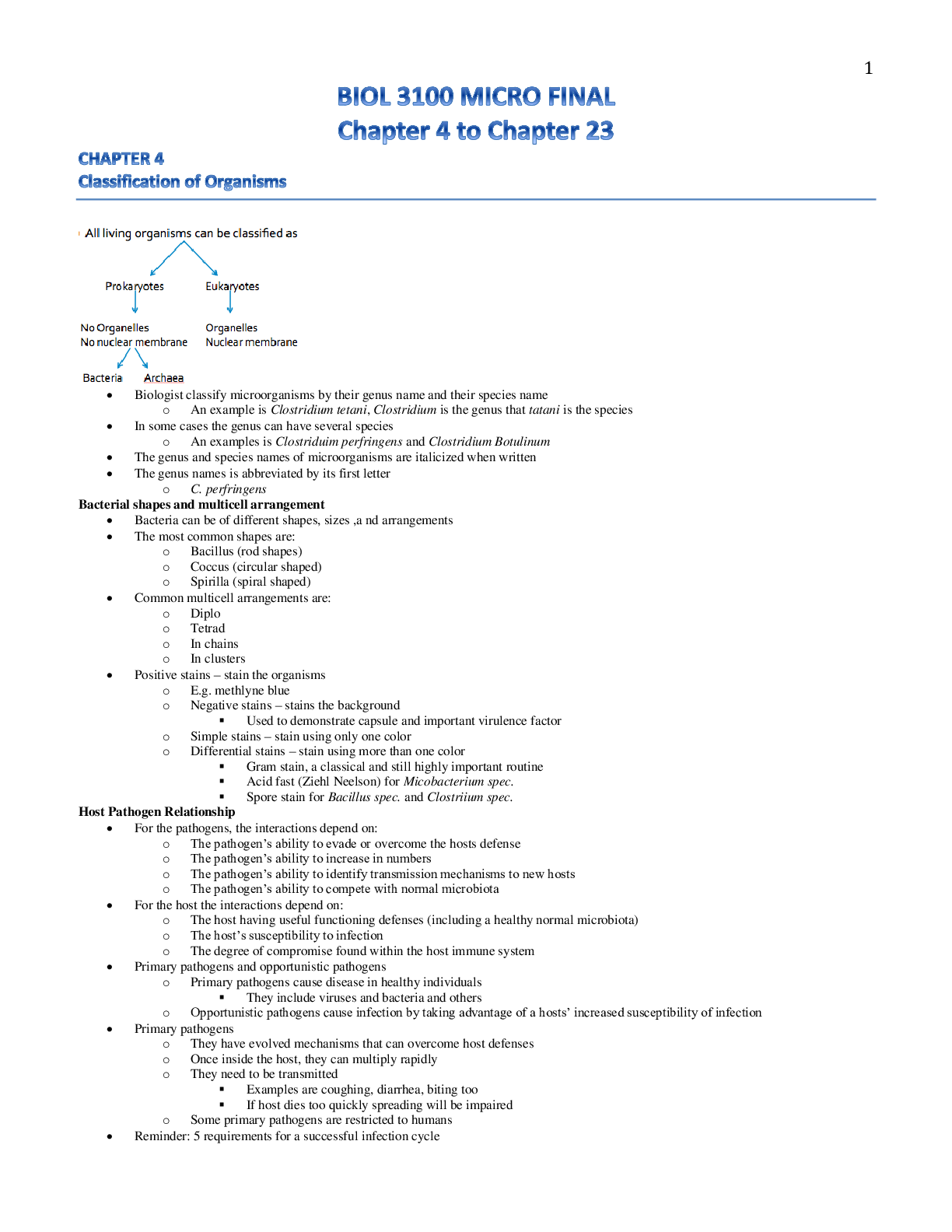
CHAPTER 4
Classification of Organisms
CHAPTER 5
Requirement for a successful infection
1. Entry – getting in
2. Establishment – staying in
3. Defeat the host defenses
4. Damage the host
5. Exit the host – gettin
...
CHAPTER 4
Classification of Organisms
CHAPTER 5
Requirement for a successful infection
1. Entry – getting in
2. Establishment – staying in
3. Defeat the host defenses
4. Damage the host
5. Exit the host – getting out (be transmitted to another host)
CHAPTER 6
Mechanisms of Transmission
• There are three mechanisms of pathogen transmisiion
1. Contact transmission
• Person to person within short period of time, short distance
2. Vehicle transmission
Contaminated non living source-person after longer period od time and possible longer distance
3. Vector transmission
Person-living carrier-person
CHAPTER 7
Normal Microbiota
• Can protect us through microbial antagonism
o Many bacteria produce bacteriocins which are localized bacterial antibiotics
o Bactriocins can kill invading organisms but do not affect the bacteria that produce them
• Produces vitamins (Vit K and B)
• Stimulates and train our immune system
CHAPTER 8
How do Emerging and Re-emerging Infection Diseases Arise and Spread?
• Definitions
o Emerging infectious disease
Infectious disease whose incidences have increased over the past 30 years or threaten to increase
Includes new pathogens not observed before
• Mutated viruses
Includes disease whose etiology was no established before
o Re-emerging infectious disease
Infectious diseases we once thought to have overcome bounce back
CHAPTER 9
Bacterial Structures
• The bacterial cell wall
o The bacterial cell wall is a protective barrier against:
Osmotic pressure changes
Other environmental stresses
o The cell wall is a complex meshwork structure composed of several parts
o The key structure is peptidoglycan
o The cell wall is different in Gram-positive and Gram-negative bacteria
CHAPTER 10
Bacterial growth
• Each division of bacteria is called a generation
• The time between division is called generation time
• Some pathogen have excessively long generation times while other have very short generation time
• The shorter the generation time the faster the number of bacteria increases within the host
• Infectious organisms have specific growth requirements
CHAPTER 11
DNA Replication
Which of the following base pairs is mismatched?
a) Adenine: thymine
b) Guanine: uracil
c) Cytosine: guanine
d) Adenine: uracil
e) All are correct
CHAPTER 12
Viral Structure
What are viruses?
o Viruses are acellular, they do not have a cell membrane
o There are obligate intracellular parasites
o Viral genome subverts host cell’s machinery to reproduce
o Virus depend on host metabolism
Energy, materials, enzymes
CHAPTER 13
Viral Infection
Patterns of viral infections: damage to host cell
o Cytopathic viruses produce virions and cause morphological changes to host cells (cytopathology)
o Noncytopathic viruse produce virions but do not cause apparent cytopathology
Vital cytopathic effect
o Viruses induced changes to eukaryotic cell
Cell rounding
Cell aggregation
Inclusion bodies
CHAPTER 14
Parasitic Infections
o Parasites can be divided into two groups:
Protozoans – microscopic, single-celled eukaryotes
Helminthes – worms, macroscopic, multicellular eukaryotes with organ systems
o Disease causing parasites depend on their infected host for survival
o Involved often multiple host in which specific developmental stages are reached
Definitive host – where adults develop and sexual reproduction occurs
Intermediate host – where asexual reproduction occurs
CHAPTER 15
• Innate
o Limited specificity
o Immediately available, preformed or recruited withing hours after infection
o No memory
• Adaptive
o Specific
o Takes several days to develop
CHAPTER 16
• Introduction: Initiation of the Adaptive Immune Response
o The adaptive immune response is the second line of defense
o The innate response is a prerequisite for the adaptive immune response
Alerts and activated the adaptive immune response via cytokines and chemokines
Presents antigens
o Dendritic cells are the most important innate cells for the proper development of an adaptive immune response. This is because:
They take up and process antigens
They migrate to lymph node and present antigens to T cells
They have enormous surface areas and can interact with many different T cells
CHAPTER 17
• Overview
o There are several reasons why host defense does not function properly or is absent:
o Immune defenses are normal but pathogen outsmarts the host
o Too little immune response
Acquired immune response
• HIV
CHAPTER 18
• Important Terminology
o Sterilization – the removal of all living microbe as wells as viruses and spores
Sterilization does not destroy prions
o Disinfection – kill or inhibits growth of pathogenic microorganisms by chemical or physical mean
Chemical to achieve this used on inanimate object is call a disinfectant
The chemical to achieve this used on skin and tissue is called and antiseptic
Some chemical can be used for both disinfection and antiseptic treatment
Some disinfecting agents do no affect spores
CHAPTER 19
• What is an antibiotic?
o Original term was used for antibacterial compounds produced by living microorganisms
o These were products of secondary metabolic pathways and served to defend the producer against other microbe in the environment
o Some of them were chemical modified
o Chemotherapeutics were entirely chemically synthesized compounds
o Today some use the term antibiotics for any drug inhibiting bacteria some use the term antimicrobics
CHAPTER 21
Corynebacterium Diphtheria
• Caused by the toxin produced by Cornebacterium diphtheriae
o Diphtheria toxin is a potent inhibitor of protein synthesis
• It is a localized infection
o Presents as sever pharyngitis
o Can be accompanies by plaque-like pseudomembranes in the throat
o Can be obliterate airways
• Toxinemia causes life threatening systemic symptoms
o Multiple organs can be affects
o Myocarditis
CHAPTER 22
General Feature of Gastrointestinal Disease
• Clinical symptoms of Gastrointestinal Infections
o The central denature in all cases is diarrhea
o The nature of the diarrhea is used to classify gastrointestinal infections into three categories:
Watery diarrhea: enterotoxin mediated such s in traveler’s diarrhea or in cholera
Dysentery: cytotoxin mediated such as in Shigella dysentery
CHAPTER 23
UTIs
• General Information Urinary Tract Infection (UTI)
o Urine is essentially sterile
o When passing through urethral opening urine becomes contaminated with normal microbiota and some epithelial cells
Refrigerate urine after collection!
o Presence of one type of microbe at >105 CFU/mL indicates UTI
o Presence inflammatory cells and erythrocytes indicates UTI
o UTIs are typically caused by bacteria, less often yeast
o UTIs are more common in women due to the closeness of the anus and contaminating fecal normal microbiota
[Show More]



.png)



.png)