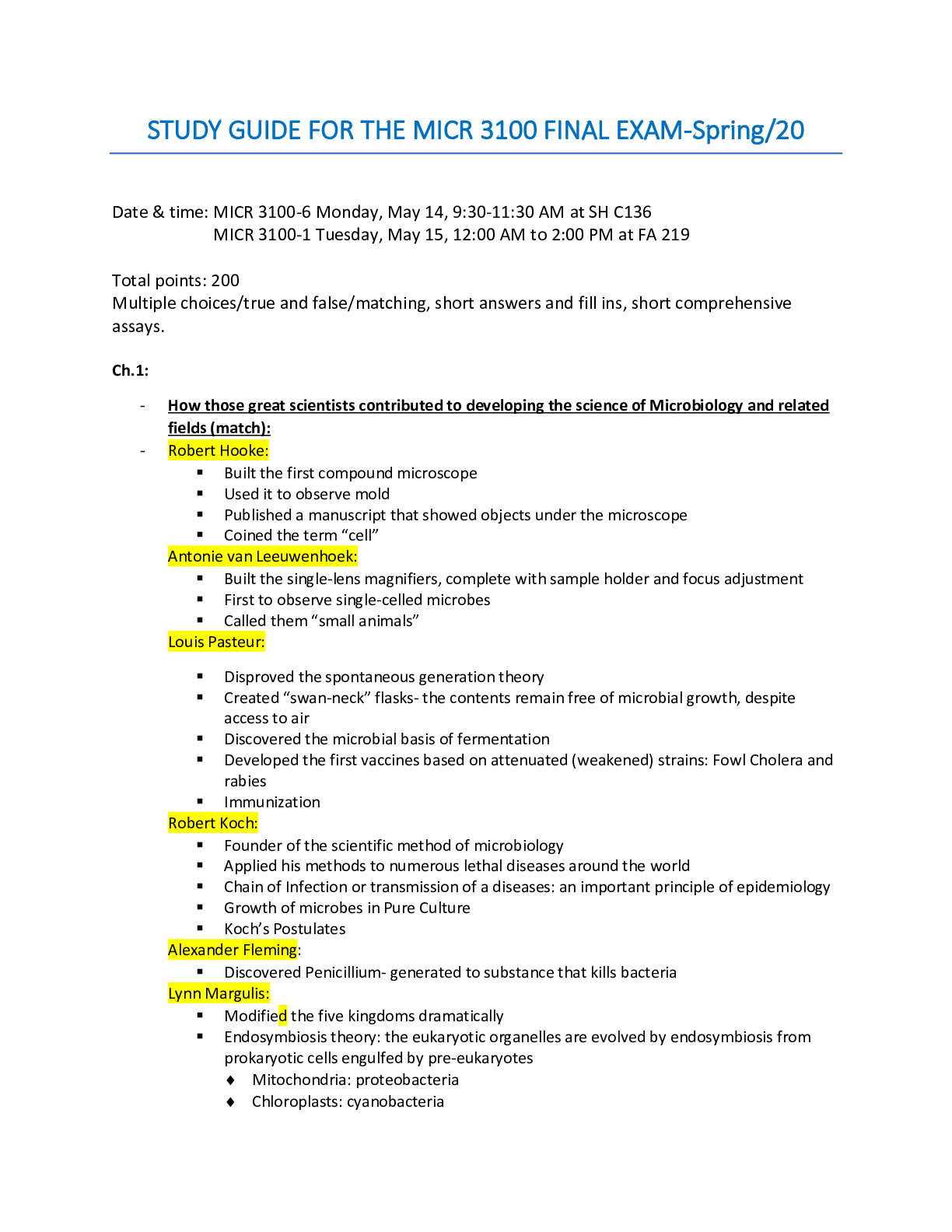
STUDY GUIDE FOR THE MICR 3100 FINAL EXAM-Spring/20
Date & time: MICR 3100-6 Monday, May 14, 9:30-11:30 AM at SH C136
MICR 3100-1 Tuesday, May 15, 12:00 AM to 2:00 PM at FA 219
...
STUDY GUIDE FOR THE MICR 3100 FINAL EXAM-Spring/20
Date & time: MICR 3100-6 Monday, May 14, 9:30-11:30 AM at SH C136
MICR 3100-1 Tuesday, May 15, 12:00 AM to 2:00 PM at FA 219
Total points: 200
Multiple choices/true and false/matching, short answers and fill ins, short comprehensive assays.
Ch.1:
- How those great scientists contributed to developing the science of Microbiology and related fields (match):
- Robert Hooke:
Built the first compound microscope
Used it to observe mold
Published a manuscript that showed objects under the microscope
Coined the term “cell”
Antonie van Leeuwenhoek:
Built the single-lens magnifiers, complete with sample holder and focus adjustment
First to observe single-celled microbes
Called them “small animals”
Louis Pasteur:
Disproved the spontaneous generation theory
Created “swan-neck” flasks- the contents remain free of microbial growth, despite access to air
Discovered the microbial basis of fermentation
Developed the first vaccines based on attenuated (weakened) strains: Fowl Cholera and rabies
Immunization
Robert Koch:
Founder of the scientific method of microbiology
Applied his methods to numerous lethal diseases around the world
Chain of Infection or transmission of a diseases: an important principle of epidemiology
Growth of microbes in Pure Culture
Koch’s Postulates
Alexander Fleming:
Discovered Penicillium- generated to substance that kills bacteria
Lynn Margulis:
Modified the five kingdoms dramatically
Endosymbiosis theory: the eukaryotic organelles are evolved by endosymbiosis from prokaryotic cells engulfed by pre-eukaryotes
• Mitochondria: proteobacteria
• Chloroplasts: cyanobacteria
Carl Woese:
Discovered and found prokaryotes that lived in hot springs and produced methane have DNA genomes very different from all other known life forms.
He called them Archaea
Discovered Archaea
Discovery replaced the scheme of five kingdom with three equally distinct groups: Bacteria, Archaea and Eukarya .
Archaea living in extreme environments produce exceptionally sturdy enzymes that can be used for industrial processes and for clinical identification procedures such as PCR amplification of DNA
- Understand Koch’s postulates
• Criteria for establishing a causative link between and infectious agent and diseases
1. Microbe is always present in diseased host
- Absent in healthy
2. Microbe is grown in pure culture
- No other microbes present
3. Pure microbe is introduced into healthy host
- Individual becomes sick
4. Same microbe is re- isolated from now sick individual
Ch.2: Excluded
Ch.3:
- The cell-membrane lipid diversity in different bacteria, different environmental conditions and between bacterial and other domains (archaea and eukarya).
Cell Membrane Lipid structure
• Membranes have equal parts of phospholipids and proteins
Membrane Lipids
• Phospholipid- has glycerol with ester links to two fatty acid and a phosphoryl head group
• Leaflets- two layers of phospholipids
Membrane Proteins
• Structural support
Some membranes proteins anchor together different layers of the cell envelope
Other proteins attach the membrane to the cytoskeleton or form the base structure extending out from the cell such as flagella
• Detection of environmental signals
• Secretion of virulence factors and communication signals
Membrane proteins complexes export toxins and cell signals across the envelope
• Ion transport and energy storage
Transport proteins manage ion flux between the cell and the exterior, ion transport generates gradients that store energy
Transport across the Cell Membrane
• The cell membrane acts as a semipermeable barrier
• Selective transport is essential for survival
• Passive Diffusion- small uncharged molecules like O2, CO2 and water can easily permeate the membrane
Some molecules like ethanol can disrupt the membrane—which can make molecules toxic to cells
Large strongly polar molecules (sugars) and charged molecules (amino acid) cannot penetrate the hydrophobic interior of the membrane and requires transport by specific proteins
Water molecules permeate the membrane, but rate of passage is increased by protein channels called aquaporin
• Osmosis-Water tends to diffuse across the membrane into the cell causing the expansion of cell volume
• Membrane-permeant weak acids and weak base- exist partly in an uncharged form that can diffuse across the membrane and increase or decrease, respectively, the H+ concentration within the cell
• Transmembrane ion gradients- polar molecules and charged molecules require transport through specific protein transporters
Passive transport: molecules move along their concentration gradient
Active transport: molecules move against their concentration gradient
Membrane Lipid Diversity
• Environmental stress:
Starvation stress increases bacterial production of lipids with an unusual type of phosphoryl head group
Cardiolipin or diphosphatidylycerol: a double phospholipid linked by a glycerol
- Concentration increase in bacteria grown to starvation
- Localizes to the cell poles
+ Binds certain environmental stress proteins
The fatty acid of phospholipids also very
- Fatty acid chains may be unsaturated
- May also contain cyclic structures
Membranes also include planar molecules that fill gaps between hydrocarbon chains
- In Eukaryotic membranes: sterols like cholesterol
- In bacteria: Hopanoids or hopanes- fit between the fatty acid side chains of membranes and limit their motion, thus stiffing the membrane.
Archaea have unique membrane lipid
- Archaea have the most extreme variations in phospholipid side- chain structures
- All archaeal phospholipids replace the ester link with an ether link(C-O-C)
- Archaeal hydrocarbon chains are branched terpeniod
- Terpeniod- polymeric structures derived from isoprene, in which every fourth carbon extends a methyl branch
- The structural differences in the cell wall of gram-positive, gram-negative bacteria and mycobacteria and between bacteria and archaeal and eukaryotic microorganisms.
• Peptidoglycan Structure
Most bacterial cells are made up of peptidoglycan
Long chains of peptidoglycan consist of:
o N-acetylglucosamine
o N-acetylmuramie
Peptidoglycan is unique to bacteria
The enzymes responsible for its biosynthesis make excellent targets for antibiotic
• Cell Wall of gram-positive bacteria (Firmicutes)
Have thick cell wall
3-20 layers of peptidoglycan threaded by teichoic acid
The capsule- made of polysaccharide and glycoprotein
o Protects cells from phagocytosis
o Found also in gram-negative cells
S-layer
o An additional protective layer found in free-living bacteria and archaea
o Crystalline layer or thick subunits consisting of protein or glycoprotein
o May contribute to cell shape and help protect the cell from osmotic stress
• Cell wall of gram-negative bacteria (Proteobacteria)
Have a thin cell wall
1-2 layers of peptidoglycan enclosed by an outer membrane
Covered by an outer membrane, which confers defensive abilities and toxigenic properties on many pathogens
Inward-facing leaflet includes lipoprotein
Outward-facing leaflet contains:
o Lipopolysaccharides
o Porins
• Mycobacteria
Have a complex multilayered enveloped (cell wall)
Includes defensive structure such as mycolic acids
Include unusual membrane lipids (mycolic acids) and unusual sugars (arabinogalactans)
Ch.4:
- Bacterial role in the nitrogen cycle (read from the book)
Nitrogen fixation: possess nitrogenase, which converts N2 to ammonium ions (NH4+)
o Nitrogen fixing bacteria may be free-living in soil or water or they may form symbiotic associations with plants or other organism
Nitrification- group of bacteria gains energy by converting or oxidizing ammonia to form nitrate
o Form of lithotrophy
Denitrification- other heterotrophic microbes can reduce nitrate to N2
o A process that uses nitrate and related inorganic forms of nitrogen as terminal electron acceptors for certain electron transport chains
o Denitrifying bacteria send an amount of nitrogen into the atmosphere that roughly balances the amount removed by nitrogen fixation
- Transport of materials across the cell membrane.
Facilitated Diffusion: solutes move across a membrane from a region of high concentration to one of lower concentration
o Ex: the aquaporin family that transports water and small polar molecules such as glycerol
- Active Transport Requires Energy:
o Coupled transport system: driving ion moving down its gradient is used to move a solute up its gradient
o In symport, the two molecules travel in the same direction
o In antiport, the actively transported molecule moves in the direction opposite to the driving ion
- ABC Transporters are Powered by ATP: the largest family of energy-driven transport system is the ATP-binding cassette superfamily (ABC transporters)
o Two main types:
o Uptake ABC transporters are critical for transporting nutrients
o Efflux ABC transporters are generally used as multidrug efflux pumps
- Siderophores Scavenge Iron:
o Siderophores are specialized molecules secreted to bind ferric ion (Fe3+) and transport it into the cell
o The iron is released into the cytoplasm and reduced to the more useful ferrous (Fe2+) form
::::::::::::::::::::::::::::::::::::::::CONTENT CONTINUED IN THE ATTACHMENT:::::::::::::::::::::::::::::::::::::::::::::::::::
[Show More]