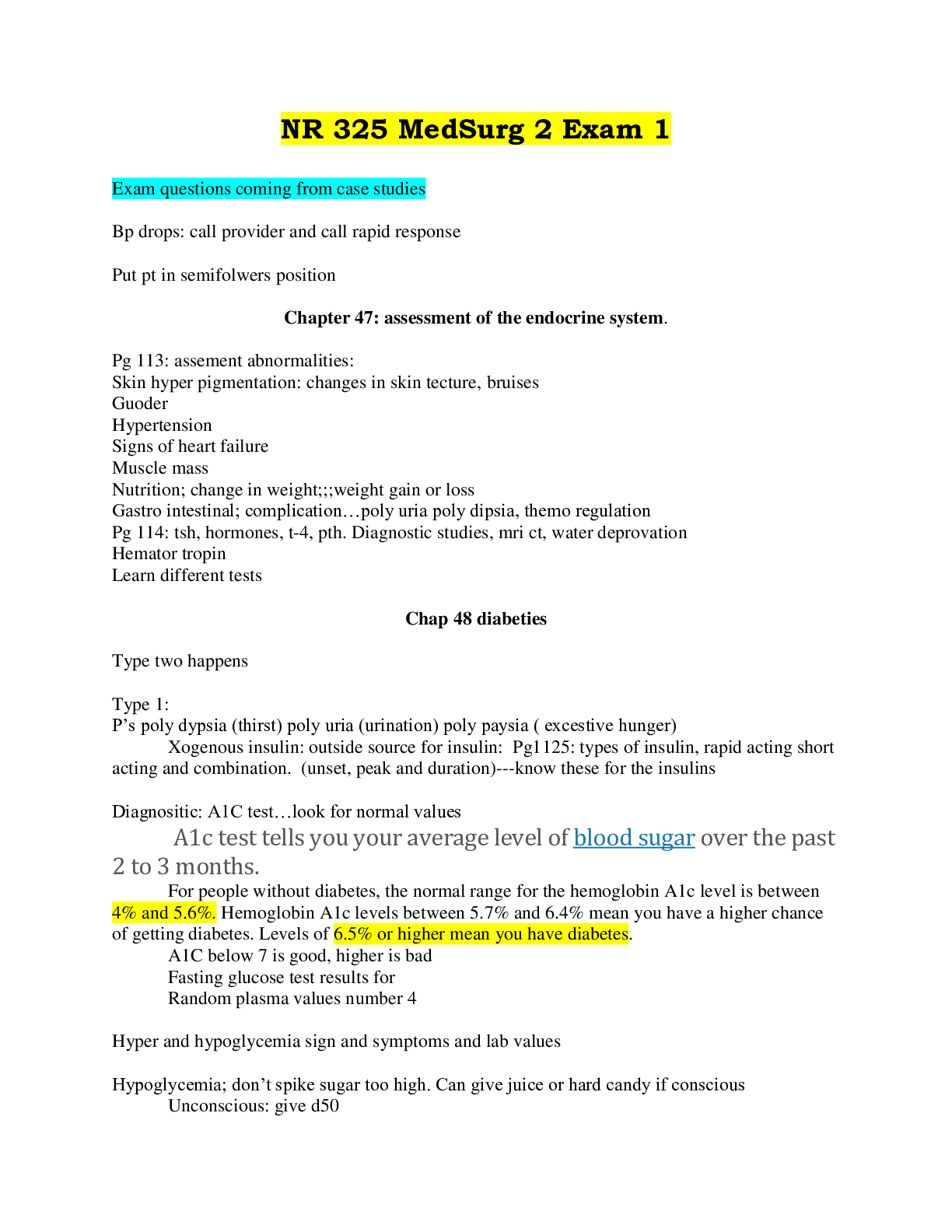
NR 325 MedSurg 2 Exam 1 NR 325 MedSurg 2 Exam 1
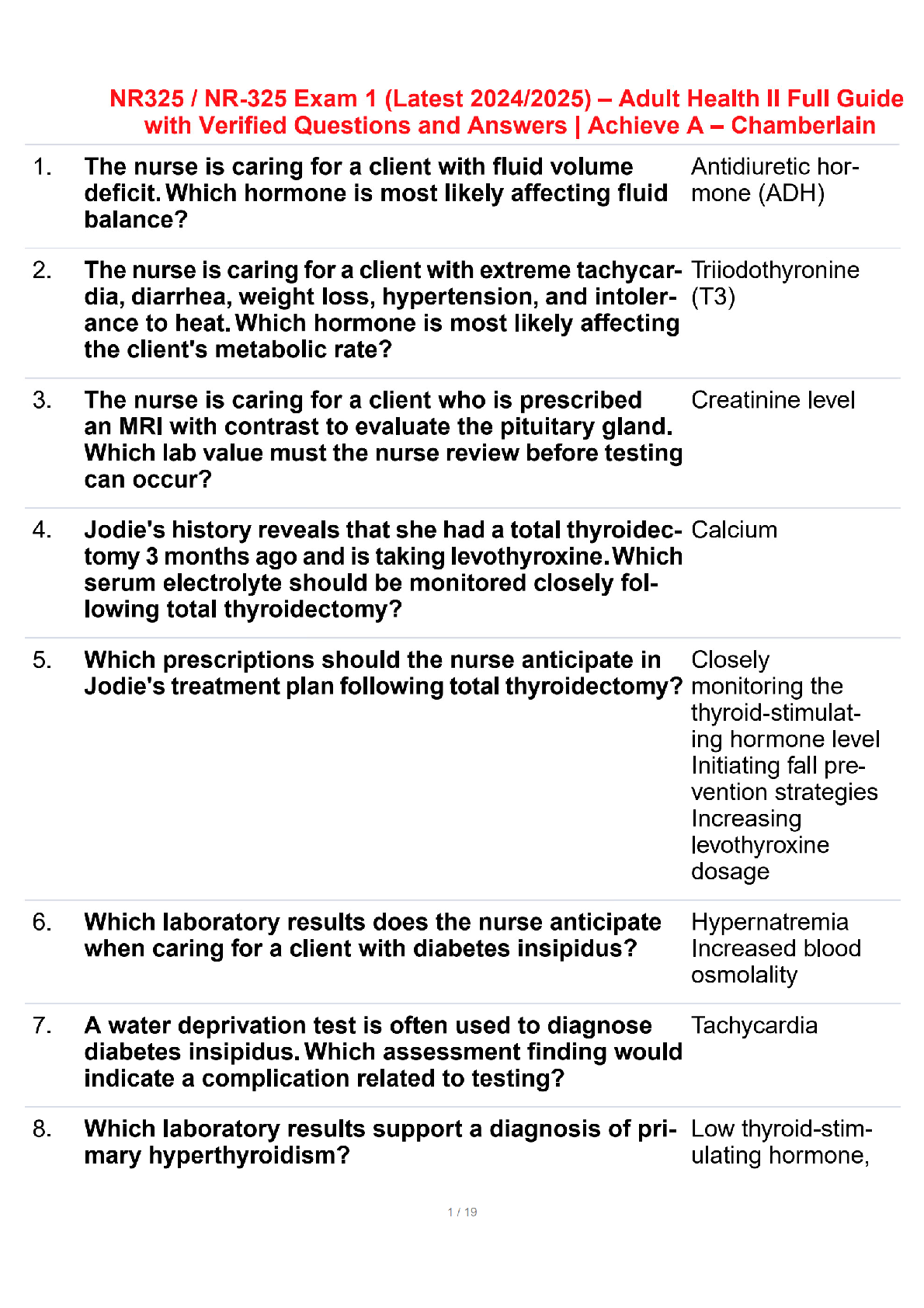
Exam questions coming from case studies
Bp drops: call provider and call rapid response
Put pt in semifolwers position
Chapter 47: assessment of the endocrine system.
...
NR 325 MedSurg 2 Exam 1 NR 325 MedSurg 2 Exam 1
Exam questions coming from case studies
Bp drops: call provider and call rapid response
Put pt in semifolwers position
Chapter 47: assessment of the endocrine system.
Pg 113: assement abnormalities:
Skin hyper pigmentation: changes in skin tecture, bruises
Guoder
Hypertension
Signs of heart failure
Muscle mass
Nutrition; change in weight;;;weight gain or loss
Gastro intestinal; complication…poly uria poly dipsia, themo regulation
Pg 114: tsh, hormones, t-4, pth. Diagnostic studies, mri ct, water deprovation
Hemator tropin
Learn different tests
Chap 48 diabeties
Type two happens
Type 1:
P’s poly dypsia (thirst) poly uria (urination) poly paysia ( excestive hunger)
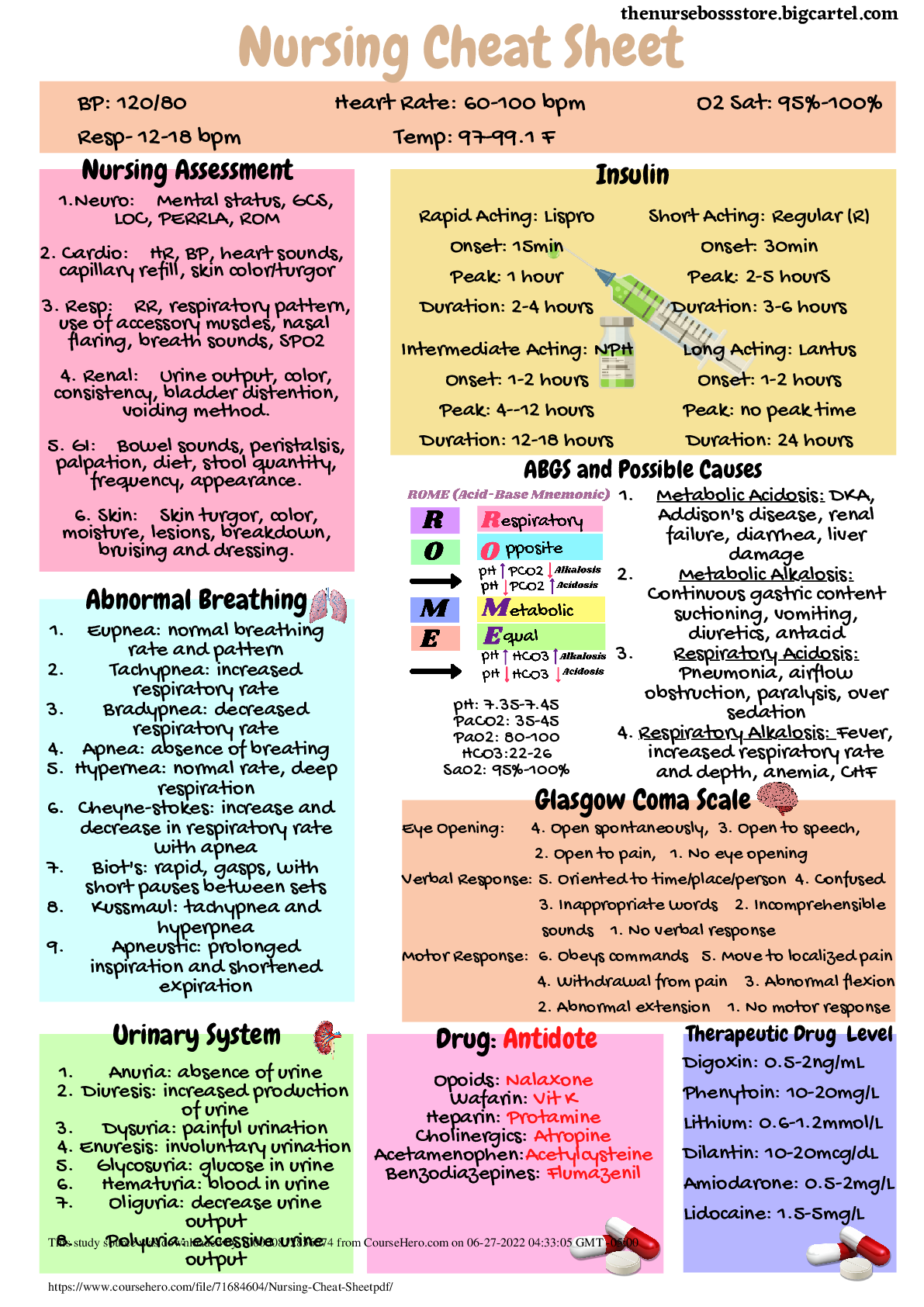
Xogenous insulin: outside source for insulin: Pg1125: types of insulin, rapid acting short
acting and combination. (unset, peak and duration)---know these for the insulins
Diagnositic: A1C test…look for normal values
A1c test tells you your average level of blood sugar over the past
2 to 3 months.
For people without diabetes, the normal range for the hemoglobin A1c level is between
4% and 5.6%. Hemoglobin A1c levels between 5.7% and 6.4% mean you have a higher chance
of getting diabetes. Levels of 6.5% or higher mean you have diabetes.
A1C below 7 is good, higher is bad
Fasting glucose test results for
Random plasma values number 4
Hyper and hypoglycemia sign and symptoms and lab values
Hypoglycemia; don’t spike sugar too high. Can give juice or hard candy if conscious
Unconscious: give d5070-110 or 80-120 blood value
Pg 1126: onset peak and duration…rapid acting..10-30mins..peak 30-3hrs.
Insulin store..once open can be good for up to 30 days
Insulin pump. Delivers continuous supply of insulin….need to monitor blood sugar.
-subcue injection and need to rotate the site of injection to prevent
The dawn phenomenon, also called the dawn effect, is the term used to describe an
abnormal early-morning increase in blood sugar (glucose) — usually between 2 a.m.
and 8 a.m. — in people with diabetes.
Some researchers believe the natural overnight release of the so-called counterregulatory hormones — including growth hormone, cortisol, glucagon and epinephrine
— increases insulin resistance, causing blood sugar to rise. High morning blood sugar
may also be caused by insufficient insulin the night before, insufficient anti-diabetic
medication dosages or carbohydrate snack consumption at bedtime.
-Rebound hyperglycemia
Type 2 diabetes
-metformin (oral)- cant use in pt who drink. Take it with food to minimize the GI side effects.
--need insulin during periods of stress or hospitalization
Pg 1130. Drug therapy. Different classes
Table 48-7
Blood sugar is too high they will not do the surgery because you will not heal properly.
They will give
Pg 1138
Diagnosis for hyperthyroidism:
Nursing management for hypoparathyroid pt would include:
Maintaining quiet subdued environment
Make sure calcium gluconate is kept at bed side
Observing pt for signs of tetany
SIADH: which of the follow laboratory findings should the nurse expect:
Low sodium
Increase urine osmolayity
High urine sodium
Increased urine specific gravidaDiabetes Insipidus one of the lab tests is a urinalysis:
Lab value shows: Decreased urine specific gravida < 1.005
Main complication with someone with cushings disease: bone loss= fractures
Prednisone: know how to monitor and administer
Nurse who is care for a pt with primary adrena insufinciency and I undergoing a stimulation
ACTH stimulation test:
Finding after iv injection of cosyntropin is given:
No change in plasma cortisol
Pt has cushings what would you see:
Sodium of 150 meq/L
Potassium 3.3 meq/L
Calcium 8.0 meq/L
Fasting glucose of 1.5mg/dl
Diabetic keto acidosis:
Pg 1142-1143: DKA
Cause is insulin deficiency
Type 1 and maybe seen in type 2 diabetic
If insulin insuffecifne glucose wont be used
Fat is burn and will see ketones
Kusmols respirations: shallow
Clinically: fruty breath, poor skin turger
Hyper glycemia: elevated levels
Give fluid: ns….insulin drip
Monitor breath sounds for fluid overload
Low potassium
Administer sodium bicarbonate
Establish a large bore ga IV: 16 and below
Pg 1144: emergency management
Treat hyper and hypoglycemia
Chronic complecations for DM
Diagnosis of retinopathy and neuropathy
Pg 1152
Delegation for diabetic patients
Urinary system and renal system quiz on Wednesday.Chapter 44 mainly on dialysis…..
Kidneys regulate the volume of extracellular fluid and excreats waste.
What are the two leading cause of ESRD ?
- Diabetes and hypertension.
What are the two leading cause of ESRD?
- Diabetes and hypertension
What are the two types of dialysis for end stage renal failure?
-hemodialysis and peritoneal dialysis.
Function of bladder, urithrea and uriters are.
Normal urin out put is 1500 ml a day and that varies about what you eat or drink. 20% is what
you eat or drink the rest is volume
Pg 1018 under bladder:
Bladder 400-600ml pt becomes uncomfortable
Pg 1019:
Older population decrease in size decrease renal blood flow
Althrsclorosis
GFR. Glomarolus filtration
Decrease urinary concentration
Decrease hormone secretion
Dehydration= increase risk for renal calculi (kidney stone)
Lithotripsy: soundwaves that break down kidney stones
1022: activity and exercise pattern
Sedentary lifestyle can lead to infection due to urine stasis
1025: table 44-7
Assement
Anuria 24hr urine is less than
Dysuria: difficult or painful urination
Oliguluria:Pg: 1025-26-27
Main: urinalysis: whats in it and values:
Urin culture
-clean catch ( how to do it)
Creatine clearance
1031: creatine clearance: muscle break down. Most accurate indicator of renal function.
Concentration test: measure specific gravity
How much urine is left after urination: increases with age. Less than 50ml
Residual urine is another test
BUN: need to know. You get creatinine. Phosphorus
Radio graphic: kub..it is an xray.
Renal arterial gram: give them an enema before
Assess for iodine sensitivity
Observe for signs ofbleeding and swelling
Pg 1031. Creatinine clearance values. Older (age 40 and above) decrease from
Bowel tests
After you take IV contrast test. Have them drink water
- Dibetic must delay intake of metphormen. Cant take metphorman for 48 hrs before.
Indoscope: inspect interior of bladder
NR responsibility is togive pt iv fluids for patients under general anesthisa. Urine might
be pink in color and have increased frequency
Whitaker study
Know whats normal for urinalysis tests
Answer NCLEX questions at the end of chapters
Chapter 45
UTI: most common in women
-bactrim (antibiotic)
-e coli
Causes of UTI: prodominat one is e-coliUpper vs lower UTI
Most UTIs only involve the urethra and bladder, in the lower tract.
Pilonephritis: shows in the way they walk (upper infection)
However, UTIs can involve the ureters and kidneys, in the upper tract
-chills and fever
Older adults tend to feel abdominal discomfort rather than pain in urinary pain
Pg 1036: drug choice drug for uncomplicated UTI: Bactrim
Drug alert: microdantin: pt should not be in sunlight and wear protective
clothing. If they have fever coughing and nv call physician.
Peridadin can cause urin to turn orange.
Health promotion:
Estimate the amount of fluid; pt weight in pounds and divide in half
1037: teach your patient
Cystitis: painful bladder syndrome. inflammation of the bladder
Lower urinary tract: frequeny urgency, nocturia, maybe peeing up to 60times a
day.
-patient teaching: diet, cranberry juice, don’t wear tights,
Pg 1041: glomerulus nephrities
3rd leading cause of esrd in the united states
Pg 1045: types of uti calculi
Common sites of obstruction are at the UPJ and ureterovesical junction (UVJ).
Lithotripsy- hematouria is common after this procedure.
Fluid intake should be 3 litters in active peopleWhat not to eat when you have a uti or esrd
Calcium milk cheese, dark ruffage, spinach
PKD: polycystic kidney disease: most life threating kidney disorder
polycystic kidney disease (PKD) a genetic kidney disorder in which the cortex
and medulla are filled with thin-walled cysts that enlarge and destroy
surrounding
tissue.
Pg 1061: caring for an incontinent patient
Caring for the Incontinent Patient
All members of the interprofessional care team are responsible for decreasing
the risk for incontinence and preventing complications such as skin breakdown
in patients who are experiencing incontinence.
Role of Nursing Personnel
Registered Nurse (RN)
• Assess for risk factors for incontinence or urinary retention.
• Determine type of incontinence that patient is experiencing.
• Develop plan of care to decrease incontinence.
• Teach patient ways to decrease incontinence such as pelvic floor muscle
(Kegel)
exercises.
• Assist patient in choosing appropriate products to contain urine.
Licensed Practical/Vocational Nurse (LPN/LVN)
• Use bladder scanner to estimate the postvoid residual volume (PVR).
• Catheterize patient and measure PVR.
• Administer medications to decrease incontinence or urinary retention.
Unlicensed Assistive Personnel (UAP)
• Assist incontinent patient to commode or bedpan at regular intervals.
• Clean patient and provide skin care.• Notify RN about new-onset incontinence in a previously continent patient.
Foley is a sterile procedure.
Table 45-62
Table 45-23
Table 45-6
Therapies for Elevated Potassium Levels
Regular Insulin IV
• Potassium moves into cells when insulin is given.
• IV glucose is given concurrently to prevent hypoglycemia.
• When effects of insulin diminish, potassium shifts back out of cells.
Sodium Bicarbonate
• Therapy can correct acidosis and cause a shift of potassium into cells.
Calcium Gluconate IV
• Generally used in advanced cardiac toxicity (with evidence of hyperkalemic
ECG
changes).
• Calcium raises the threshold for excitation, resulting in dysrhythmias.
Hemodialysis
• Most effective therapy to remove potassium.
• Works within a short time.
Sodium Polystyrene Sulfonate (Kayexalate)
• Cation-exchange resin is administered by mouth or retention enema.
• When resin is in the bowel, potassium is exchanged for sodium.
Therapy removes 1 mEq of potassium per gram of drug.
• It is mixed in water with sorbitol to produce osmotic diarrhea, allowing for
evacuation of potassium-rich stool from body
Dietary Restriction
• Potassium intake is limited to 40 mEq/day.
• Primarily used to prevent recurrent elevation. Not used for acute elevation.
Patiromer (Veltassa)
• Oral suspension that binds potassium in GI tract.
• It is used to treat chronic kidney disease.• It should not be used as an emergency drug for life-threatening
hyperkalemia.
• It has a delayed onset of action.
Pg 1075. Test question
Pg 1071: oliguric phase, reduction in the urine <400ml/day occurs first 1-7 days of injury to the
kidney.
pg 1072: diagnostic studies. Urinalysis, mri, (what is included in a urinalysis) know what is
normal in a urinalysis
pg 1080: drug therapy for hypertension, hyper kylemia, nbd,
nutritional therapy table 46-10, table 46-11
Elderly gfr decreases.
Lythotripsy: what happens to a patient after taking. Monitor for bleeding, cardiac dysrthmia,
-expect blood in urine, sedements in the urine.
- report weight gain, infection, chills fever
Pt who has acute glomerulus nephritis…cause is strep throat
Esrd: diet low sodium, low phosphorus diet, low protein (increase carbohydrate)
Cant take blood pressure on hemodyalyiss pt
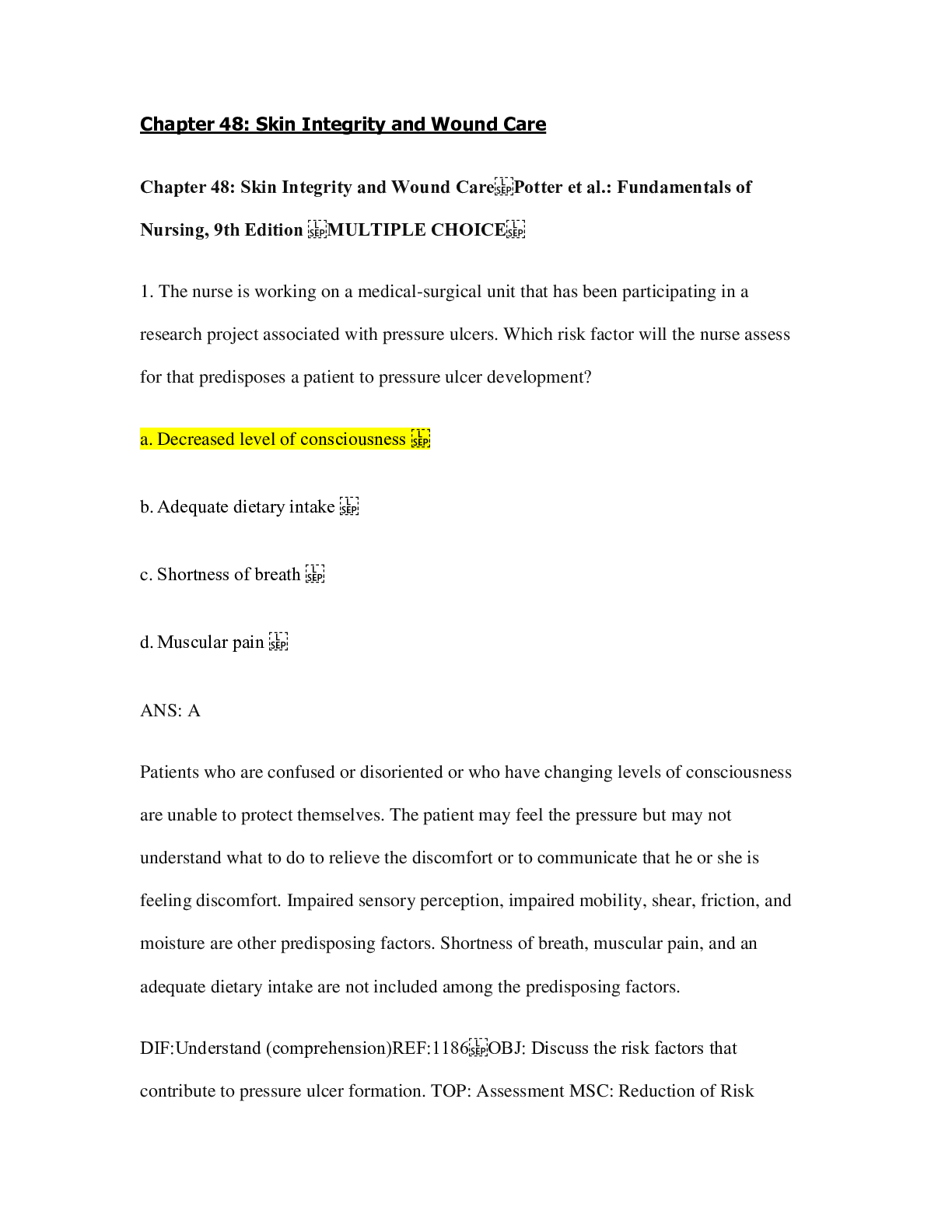
1. Which descriptions characterize acute kidney injury (select all that apply)?
a. Primary cause of death is infection.
b. It almost always affects older people.
c. Disease course is potentially reversible.
d. Most common cause is diabetic nephropathy.
e. Cardiovascular disease is most common cause of death.
2. RIFLE defines three stages of AKI based on changes in
a. blood pressure and urine osmolality.
b. fractional excretion of urinary sodium.
c. estimation of GFR with the MDRD equation.
d. serum creatinine or urine output from baseline.
3. During the oliguric phase of AKI, the nurse monitors the patient for (select all
that apply)
a. hypotension.b. ECG changes.
c. hypernatremia.
d. pulmonary edema.
e. urine with high specific gravity.
4. If a patient is in the diuretic phase of AKI, the nurse must monitor for which
serum electrolyte imbalances?
a. Hyperkalemia and hyponatremia
b. Hyperkalemia and hypernatremia
c. Hypokalemia and hyponatremia
d. Hypokalemia and hypernatremia
5. A patient is admitted to the hospital with chronic kidney disease. The nurse
understands that this condition is characterized by
a. progressive irreversible destruction of the kidneys.
b. a rapid decrease in urine output with an elevated BUN.
c. an increasing creatinine clearance with a decrease in urine output.
d. prostration, somnolence, and confusion with coma and imminent death.
6. Nurses must teach patients at risk for developing chronic kidney disease.
Individuals considered to be at increased risk include (select all that apply)
a. older African Americans.
b. patients more than 60 years old.
c. those with a history of pancreatitis.
d. those with a history of hypertension.
e. those with a history of type 2 diabetes.
7. Patients with chronic kidney disease experience an increased incidence of
cardiovascular disease related to (select all that apply)
a. hypertension.
b. vascular calcifications.
c. a genetic predisposition.
d. hyperinsulinemia causing dyslipidemia.
e. increased high-density lipoprotein levels.
8. Nutritional support and management are essential across the entire
continuum of chronic kidney disease. Which statements would be considered
true related to nutritional therapy (select all that apply)?
a. Fluid is not usually restricted for patients receiving peritoneal dialysis.
b. Sodium and potassium may be restricted in someone with advanced CKD.c. Decreased fluid intake and a low-potassium diet are hallmarks of the diet for
a patient receiving hemodialysis.
d. Decreased fluid intake and a low-potassium diet are hallmarks of the diet for
a patient receiving peritoneal dialysis.
e. Decreased fluid intake and a diet with phosphate-rich foods are hallmarks of
a diet for a patient receiving hemodialysis.
9. An ESRD patient receiving hemodialysis is considering asking a relative to
donate a kidney for transplantation. In assisting the patient to make a decision
about treatment, the nurse informs the patient that
a. successful transplantation usually provides better quality of life than that
offered by dialysis.
b. if rejection of the transplanted kidney occurs, no further treatment for the
renal failure is available.
c. hemodialysis replaces the normal functions of the kidneys, and patients do
not have to live with the continual fear of rejection.
d. the immunosuppressive therapy following transplantation makes the
10. To assess the patency of a newly placed arteriovenous graft for dialysis, the
nurse should (select all that apply)
a. monitors the BP in the affected arm.
b. irrigates the graft daily with low-dose heparin.
c. palpates the area of the graft to feel a normal thrill.
d. listen with a stethoscope over the graft to detect a bruit.
e. frequently monitors the pulses and neurovascular status distal to the graft.
11. A major advantage of peritoneal dialysis is
a. the diet is less restricted, and dialysis can be performed at home.
b. the dialysate is biocompatible and causes no long-term consequences.
c. high glucose concentrations of the dialysate cause a reduction in appetite,
promoting weight loss.
d. no medications are required because of the enhanced
12. A kidney transplant recipient complains of having fever, chills, and dysuria
over the past 2 days. What is the first action that the nurse should take?
a. Assess temperature and initiate workup to rule out infection.
b. Reassure the patient that this is common after transplantation.
c. Provide warm cover for the patient and give 1 g acetaminophen orally.
d. Notify the nephrologist that the patient has developed symptoms of acuterejection.
1. a, c, 2. d, 3. b, d, 4. c, 5. a, 6. a, b, d, e, 7. a, b, d, 8. a, b, c, 9. a, 10. c, d, e, 11.
[Show More]



 Adult Medical Surgical.png)