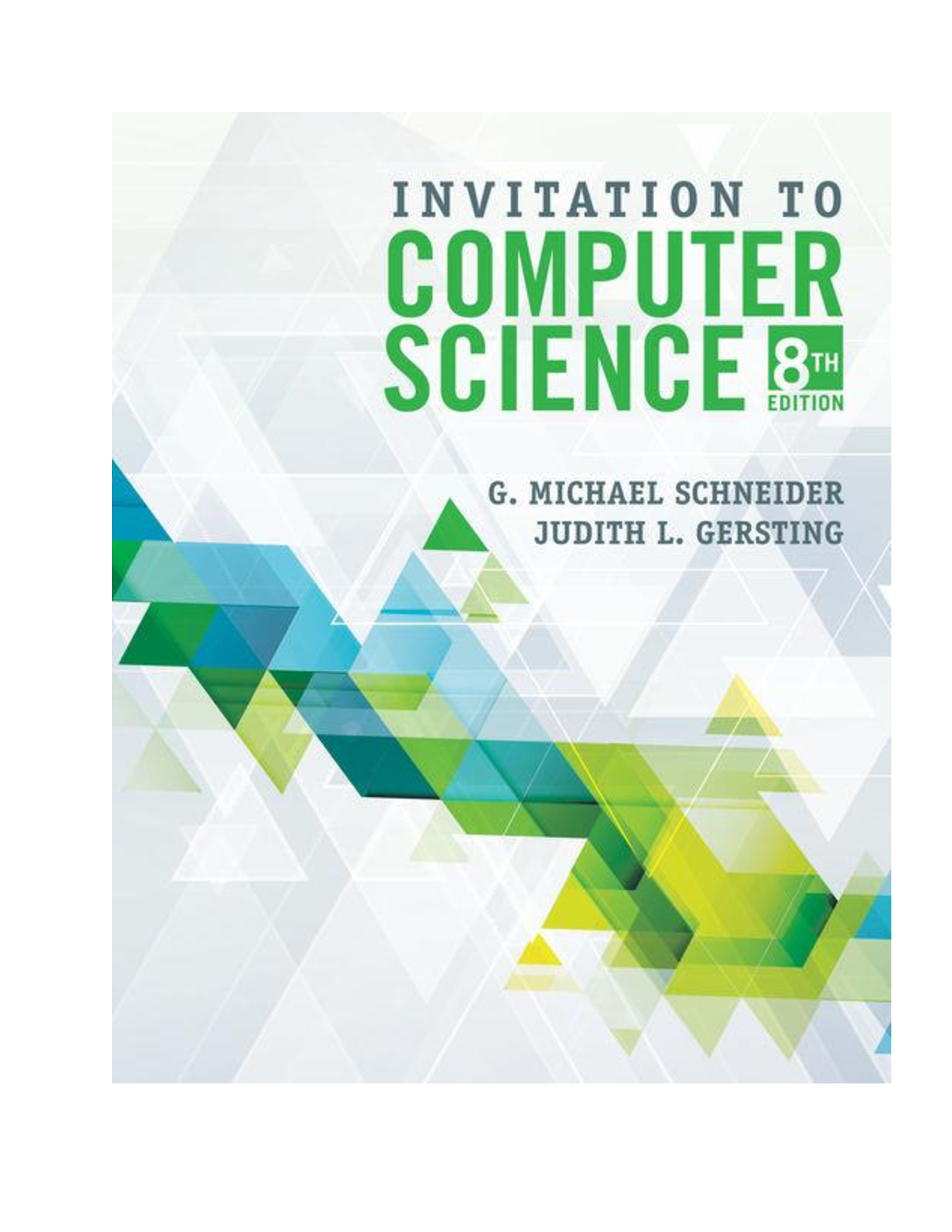
eBook for Invitation to Computer Science 8th Edition by G.Michael Schneider, Judith Gersting
Get all 17 Chapters eBook PDF.
Table of Contents
Preface to the Eighth Edition
Chapter 1: An Introduction to Compute
...
eBook for Invitation to Computer Science 8th Edition by G.Michael Schneider, Judith Gersting
Get all 17 Chapters eBook PDF.
Table of Contents
Preface to the Eighth Edition
Chapter 1: An Introduction to Computer Science
1.1 Introduction
1.2 The Definition of Computer Science
1.3 Algorithms
1.4 A Brief History of Computing
1.5 Organization of the Text
Exercises
Challenge Work
Level 1: The Algorithmic Foundations of Computer Science
Chapter 2: Algorithm Discovery and Design
2.1 Introduction
2.2 Representing Algorithms
2.3 Examples of Algorithmic Problem Solving
2.4 Conclusion
Exercises
Challenge Work
Chapter 3: The Efficiency of Algorithms
3.1 Introduction
3.2 Attributes of Algorithms
3.3 Measuring Efficiency
3.4 Analysis of Algorithms
3.5 When Things Get Out of Hand
3.6 Summary of Level 1
Exercises
Challenge Work
Level 2: The Hardware World
Chapter 4: The Building Blocks: Binary Numbers, Boolean Logic, and Gates
4.1 Introduction
4.2 The Binary Numbering System
4.3 Boolean Logic and Gates
4.4 Building Computer Circuits
4.5 Control Circuits
4.6 Conclusion
Exercises
Challenge Work
Chapter 5: Computer Systems Organization
5.1 Introduction
5.2 The Components of a Computer System
5.3 Putting the Pieces Together-the Von Neumann Architecture
5.4 Non-Von Neumann Architectures
5.5 Summary of Level 2
Exercises
Challenge Work
Level 3: The Virtual Machine
Chapter 6: An Introduction to System Software and Virtual Machines
6.1 Introduction
6.2 System Software
6.3 Assemblers and Assembly Language
6.4 Operating Systems
Exercises
Challenge Work
Chapter 7: Computer Networks and Cloud Computing
7.1 Introduction
7.2 Basic Networking Concepts
7.3 Communication Protocols
7.4 Network Services and Benefits
7.5 Cloud Computing
7.6 A History of the Internet and the World Wide Web
7.7 Conclusion
Exercises
Challenge Work
Chapter 8: Information Security
8.1 Introduction
8.2 Threats and Defenses
8.3 Encryption
8.4 Web Transmission Security
8.5 Embedded Computing
8.6 Conclusion
8.7 Summary of Level 3
Exercises
Challenge Work
Level 4: The Software World
Chapter 9: Introduction to High-Level Language Programming
9.1 The Language Progression
9.2 A Family of Languages
9.3 Two Examples in Five-Part Harmony
9.4 Feature Analysis
9.5 Meeting Expectations
9.6 The Big Picture: Software Engineering
9.7 Conclusion
Exercises
Challenge Work
Chapter 10: The Tower of Babel: Programming Languages
10.1 Why Babel?
10.2 Procedural Languages
10.3 Special-Purpose Languages
10.4 Alternative Programming Paradigms
10.5 New Languages Keep Coming
10.6 Conclusion
Exercises
Challenge Work
Chapter 11: Compilers and Language Translation
11.1 Introduction
11.2 The Compilation Process
11.3 Conclusion
Exercises
Challenge Work
Chapter 12: Models of Computation
12.1 Introduction
12.2 What Is a Model?
12.3 A Model of a Computing Agent
12.4 A Model of an Algorithm
12.5 Turing Machine Examples
12.6 The Church-Turing Thesis
12.7 Unsolvable Problems
12.8 Conclusion
12.9 Summary of Level 4
Exercises
Challenge Work
Level 5: Applications
Chapter 13: Simulation and Modeling
13.1 Introduction
13.2 Computational Modeling
13.3 Running the Model and Visualizing Results
13.4 Conclusion
Exercises
Challenge Work
Chapter 14: Ecommerce, Databases, and Data Science
14.1 Introduction
14.2 Ecommerce
14.3 Databases
14.4 Data Science
14.5 Conclusion
Exercises
Challenge Work
Chapter 15: Artificial Intelligence
15.1 Introduction
15.2 A Division of Labor
15.3 Knowledge Representation
15.4 Recognition Tasks
15.5 Reasoning Tasks
15.6 Robots and Drones
15.7 Conclusion
Exercises
Challenge Work
Chapter 16: Computer Graphics and Entertainment: Movies, Games, and Virtual Communities
16.1 Introduction
16.2 Computer-Generated Imagery (CGI)
16.3 Video Gaming
16.4 Multiplayer Games and Virtual Communities
16.5 Conclusion
16.6 Summary of Level 5
Exercises
Challenge Work
Level 6: Social Issues in Computing
Chapter 17: Making Decisions about Computers, Information, and Society
17.1 Introduction
17.2 Case Studies
17.3 Personal Privacy and Social Media
17.4 Fake News, Politics, and Social Media
17.5 Conclusion
17.6 Summary of Level 6
Exercises
Answers to Practice Problems
Index
[Show More]