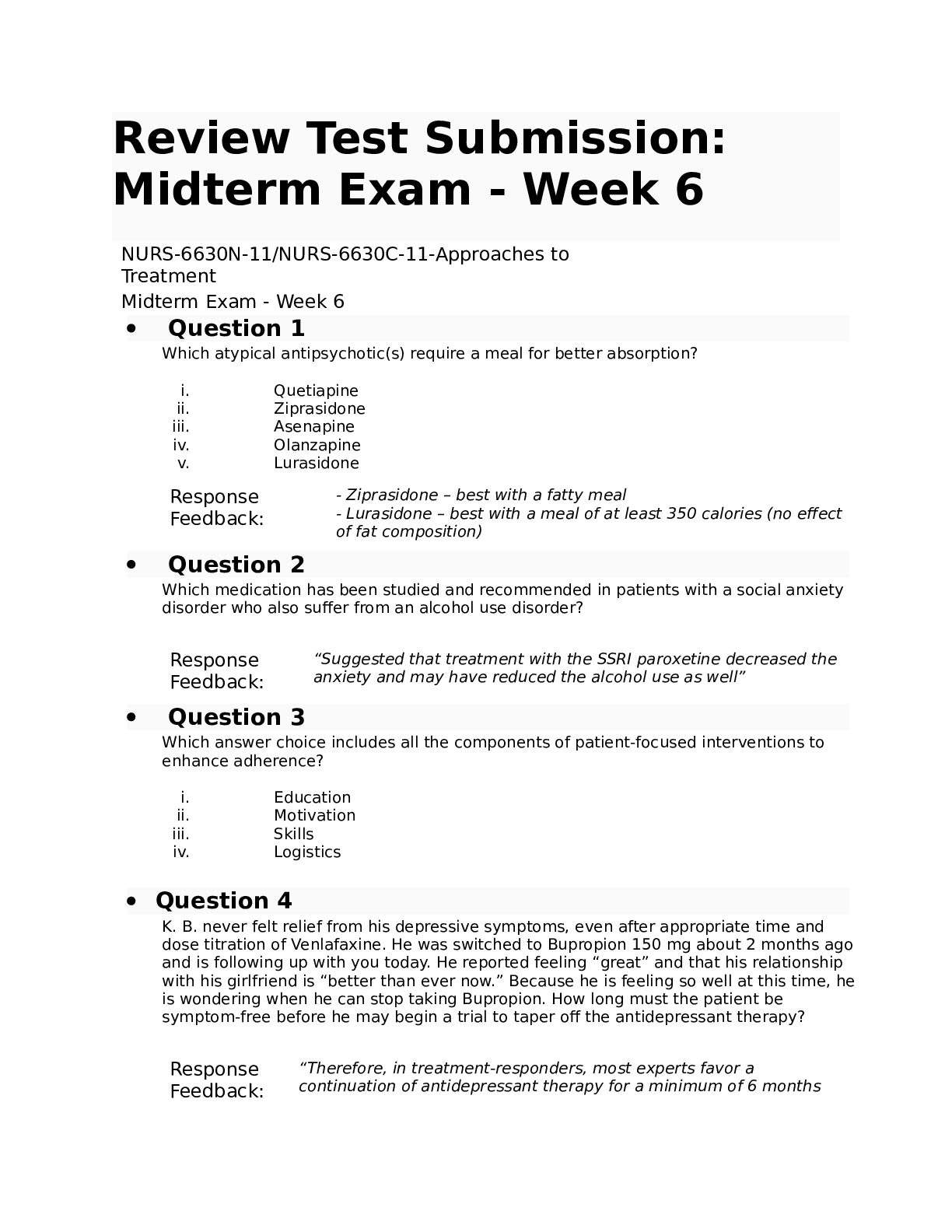
Which atypical antipsychotic(s) require a meal for better absorption?
i. Quetiapine
ii. Ziprasidone
iii. Asenapine
iv. Olanzapine
v. Lurasidone
Response
Feedback:
- Ziprasidone – best with a fatty meal
- Lurasid
...
Which atypical antipsychotic(s) require a meal for better absorption?
i. Quetiapine
ii. Ziprasidone
iii. Asenapine
iv. Olanzapine
v. Lurasidone
Response
Feedback:
- Ziprasidone – best with a fatty meal
- Lurasidone – best with a meal of at least 350 calories (no effect
of fat composition)
Question 2
Which medication has been studied and recommended in patients with a social anxiety
disorder who also suffer from an alcohol use disorder?
Response
Feedback:
“Suggested that treatment with the SSRI paroxetine decreased the
anxiety and may have reduced the alcohol use as well”
Question 3
Which answer choice includes all the components of patient-focused interventions to
enhance adherence?
i. Education
ii. Motivation
iii. Skills
iv. Logistics
Question 4
K. B. never felt relief from his depressive symptoms, even after appropriate time and
dose titration of Venlafaxine. He was switched to Bupropion 150 mg about 2 months ago
and is following up with you today. He reported feeling “great” and that his relationship
with his girlfriend is “better than ever now.” Because he is feeling so well at this time, he
is wondering when he can stop taking Bupropion. How long must the patient be
symptom-free before he may begin a trial to taper off the antidepressant therapy?
Response
Feedback:
“Therefore, in treatment-responders, most experts favor a
continuation of antidepressant therapy for a minimum of 6 months
following the achievement of remission.”
Question 5
In order for the NMDA receptor to fully open and allow an influx of calcium, both
glutamate and glycine must bind to cause a depolarization of the cell that will ultimately
displace which ion? Is the NMDA receptor an ionotropic or metabotropic receptor?
Question 6
What is the strongest established risk factor for bipolar disorder?
Response
Feedback:
“The strongest established risk factor for BPD is a family
history of BPD
[Show More]