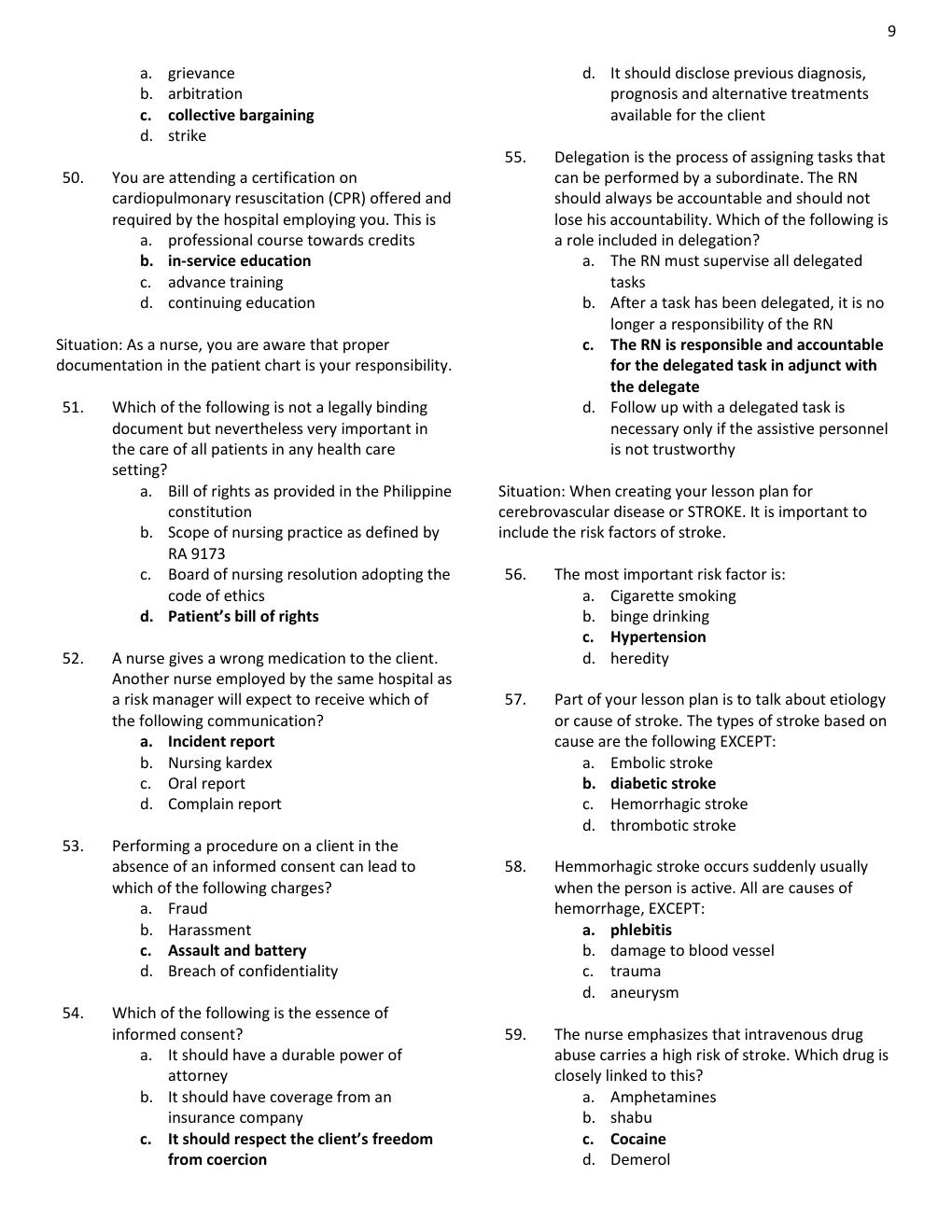
NCLEX-RN NURSING BOARD PRACTICE TEST COMPILATION (COMPLETE SOLUTIONS NURSING PRACTICE 1-5). Test Bank with Complete Questions and Solutions 547 PAGES. To clarify, this is the test bank, not the textbook. You get immediat
...
NCLEX-RN NURSING BOARD PRACTICE TEST COMPILATION (COMPLETE SOLUTIONS NURSING PRACTICE 1-5). Test Bank with Complete Questions and Solutions 547 PAGES. To clarify, this is the test bank, not the textbook. You get immediate access to download your test bank. You will receive a complete test bank; in other words, all chapters will be there. Test banks come in PDF format; therefore, you do not need specialized software to open them.
PREVIEW.....
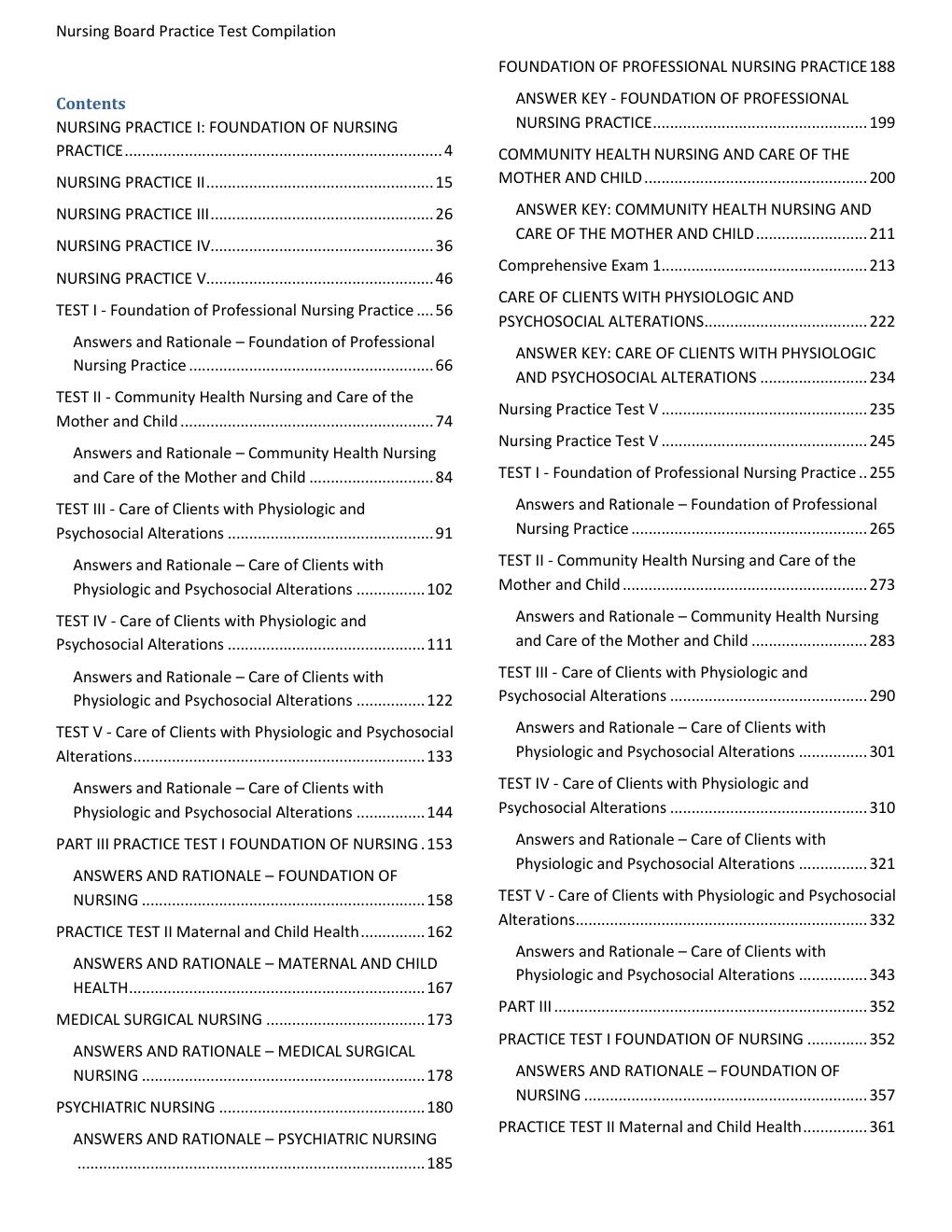
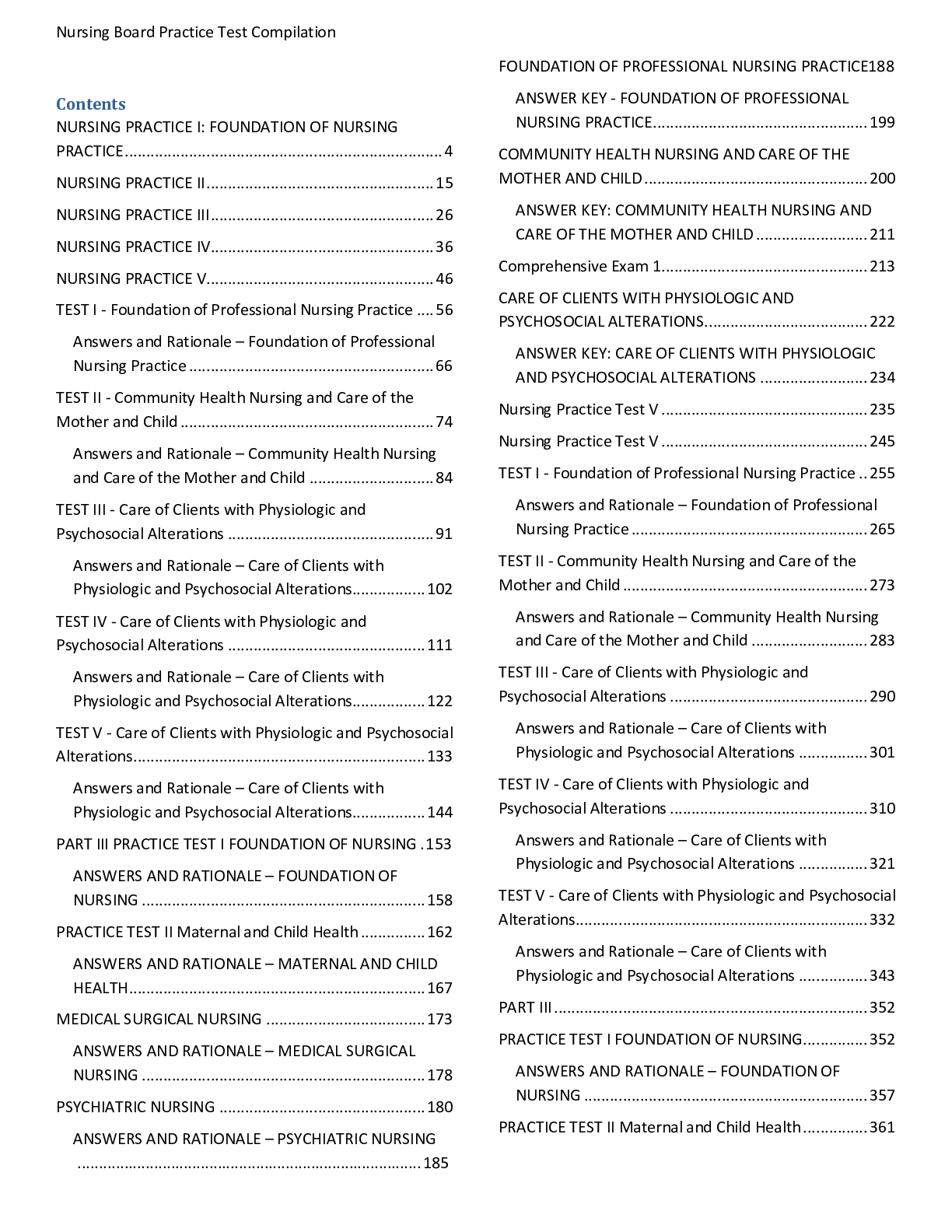
Contents NURSING PRACTICE I: FOUNDATION OF NURSING PRACTICE .......................................................................... 4 NURSING PRACTICE II ..................................................... 15 NURSING PRACTICE III .................................................... 26 NURSING PRACTICE IV.................................................... 36 NURSING PRACTICE V..................................................... 46 TEST I - Foundation of Professional Nursing Practice .... 56 Answers and Rationale – Foundation of Professional Nursing Practice ......................................................... 66
TEST II - Community Health Nursing and Care of the Mother and Child ........................................................... 74
Answers and Rationale – Community Health Nursing and Care of the Mother and Child ............................. 84
TEST III - Care of Clients with Physiologic and Psychosocial Alterations ................................................ 91 Answers and Rationale – Care of Clients with Physiologic and Psychosocial Alterations ................ 102
TEST IV - Care of Clients with Physiologic and Psychosocial Alterations .............................................. 111 Answers and Rationale – Care of Clients with Physiologic and Psychosocial Alterations ................ 122
TEST V - Care of Clients with Physiologic and Psychosocial Alterations .................................................................... 133
Answers and Rationale – Care of Clients with Physiologic and Psychosocial Alterations ................ 144
PART III PRACTICE TEST I FOUNDATION OF NURSING . 153 ANSWERS AND RATIONALE – FOUNDATION OF NURSING .................................................................. 158
PRACTICE TEST II Maternal and Child Health ............... 162 ANSWERS AND RATIONALE – MATERNAL AND CHILD HEALTH ..................................................................... 167
MEDICAL SURGICAL NURSING ..................................... 173 ANSWERS AND RATIONALE – MEDICAL SURGICAL NURSING .................................................................. 178
PSYCHIATRIC NURSING ................................................ 180 ANSWERS AND RATIONALE – PSYCHIATRIC NURSING ................................................................................. 185
FOUNDATION OF PROFESSIONAL NURSING PRACTICE 188 ANSWER KEY - FOUNDATION OF PROFESSIONAL NURSING PRACTICE .................................................. 199
COMMUNITY HEALTH NURSING AND CARE OF THE MOTHER AND CHILD .................................................... 200 ANSWER KEY: COMMUNITY HEALTH NURSING AND CARE OF THE MOTHER AND CHILD .......................... 211
Comprehensive Exam 1................................................ 213 CARE OF CLIENTS WITH PHYSIOLOGIC AND PSYCHOSOCIAL ALTERATIONS ...................................... 222 ANSWER KEY: CARE OF CLIENTS WITH PHYSIOLOGIC AND PSYCHOSOCIAL ALTERATIONS ......................... 234
Nursing Practice Test V ................................................ 235 Nursing Practice Test V ................................................ 245 TEST I - Foundation of Professional Nursing Practice .. 255 Answers and Rationale – Foundation of Professional Nursing Practice ....................................................... 265
TEST II - Community Health Nursing and Care of the Mother and Child ......................................................... 273
Answers and Rationale – Community Health Nursing and Care of the Mother and Child ........................... 283
TEST III - Care of Clients with Physiologic and Psychosocial Alterations .............................................. 290 Answers and Rationale – Care of Clients with Physiologic and Psychosocial Alterations ................ 301
TEST IV - Care of Clients with Physiologic and Psychosocial Alterations .............................................. 310 Answers and Rationale – Care of Clients with Physiologic and Psychosocial Alterations ................ 321
TEST V - Care of Clients with Physiologic and Psychosocial Alterations .................................................................... 332
Answers and Rationale – Care of Clients with Physiologic and Psychosocial Alterations ................ 343
PART III ......................................................................... 352 PRACTICE TEST I FOUNDATION OF NURSING .............. 352 ANSWERS AND RATIONALE – FOUNDATION OF NURSING .................................................................. 357 PRACTICE TEST II Maternal and Child Health ............... 361ANSWERS AND RATIONALE – MATERNAL AND CHILD
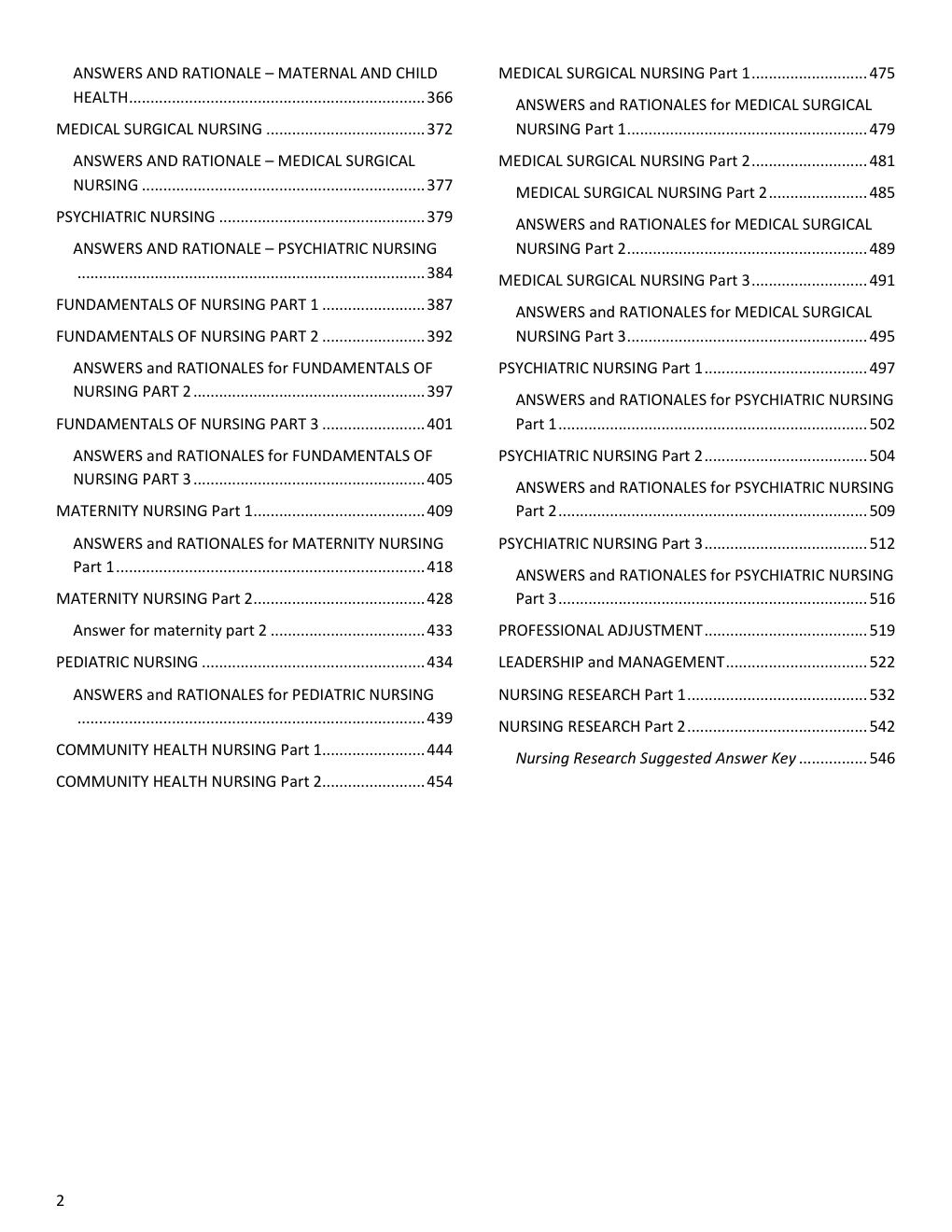
HEALTH ..................................................................... 366
MEDICAL SURGICAL NURSING ..................................... 372
ANSWERS AND RATIONALE – MEDICAL SURGICAL
NURSING .................................................................. 377
PSYCHIATRIC NURSING ................................................ 379
ANSWERS AND RATIONALE – PSYCHIATRIC NURSING
................................................................................. 384
FUNDAMENTALS OF NURSING PART 1 ........................ 387
FUNDAMENTALS OF NURSING PART 2 ........................ 392
ANSWERS and RATIONALES for FUNDAMENTALS OF
NURSING PART 2 ...................................................... 397
FUNDAMENTALS OF NURSING PART 3 ........................ 401
ANSWERS and RATIONALES for FUNDAMENTALS OF
NURSING PART 3 ...................................................... 405
MATERNITY NURSING Part 1 ........................................ 409
ANSWERS and RATIONALES for MATERNITY NURSING
Part 1 ........................................................................ 418
MATERNITY NURSING Part 2 ........................................ 428
Answer for maternity part 2 .................................... 433
PEDIATRIC NURSING .................................................... 434
ANSWERS and RATIONALES for PEDIATRIC NURSING
................................................................................. 439
COMMUNITY HEALTH NURSING Part 1........................ 444
COMMUNITY HEALTH NURSING Part 2........................ 454
MEDICAL SURGICAL NURSING Part 1 ........................... 475
ANSWERS and RATIONALES for MEDICAL SURGICAL
NURSING Part 1 ........................................................ 479
MEDICAL SURGICAL NURSING Part 2 ........................... 481
MEDICAL SURGICAL NURSING Part 2 ....................... 485
ANSWERS and RATIONALES for MEDICAL SURGICAL
NURSING Part 2 ........................................................ 489
MEDICAL SURGICAL NURSING Part 3 ........................... 491
ANSWERS and RATIONALES for MEDICAL SURGICAL
NURSING Part 3 ........................................................ 495
PSYCHIATRIC NURSING Part 1 ...................................... 497
ANSWERS and RATIONALES for PSYCHIATRIC NURSING
Part 1 ........................................................................ 502
PSYCHIATRIC NURSING Part 2 ...................................... 504
ANSWERS and RATIONALES for PSYCHIATRIC NURSING
Part 2 ........................................................................ 509
PSYCHIATRIC NURSING Part 3 ...................................... 512
ANSWERS and RATIONALES for PSYCHIATRIC NURSING
Part 3 ........................................................................ 516
PROFESSIONAL ADJUSTMENT ...................................... 519
LEADERSHIP and MANAGEMENT ................................. 522
NURSING RESEARCH Part 1 .......................................... 532
NURSING RESEARCH Part 2 .......................................... 542
Nursing Research Suggested Answer Key ................ 546
235.
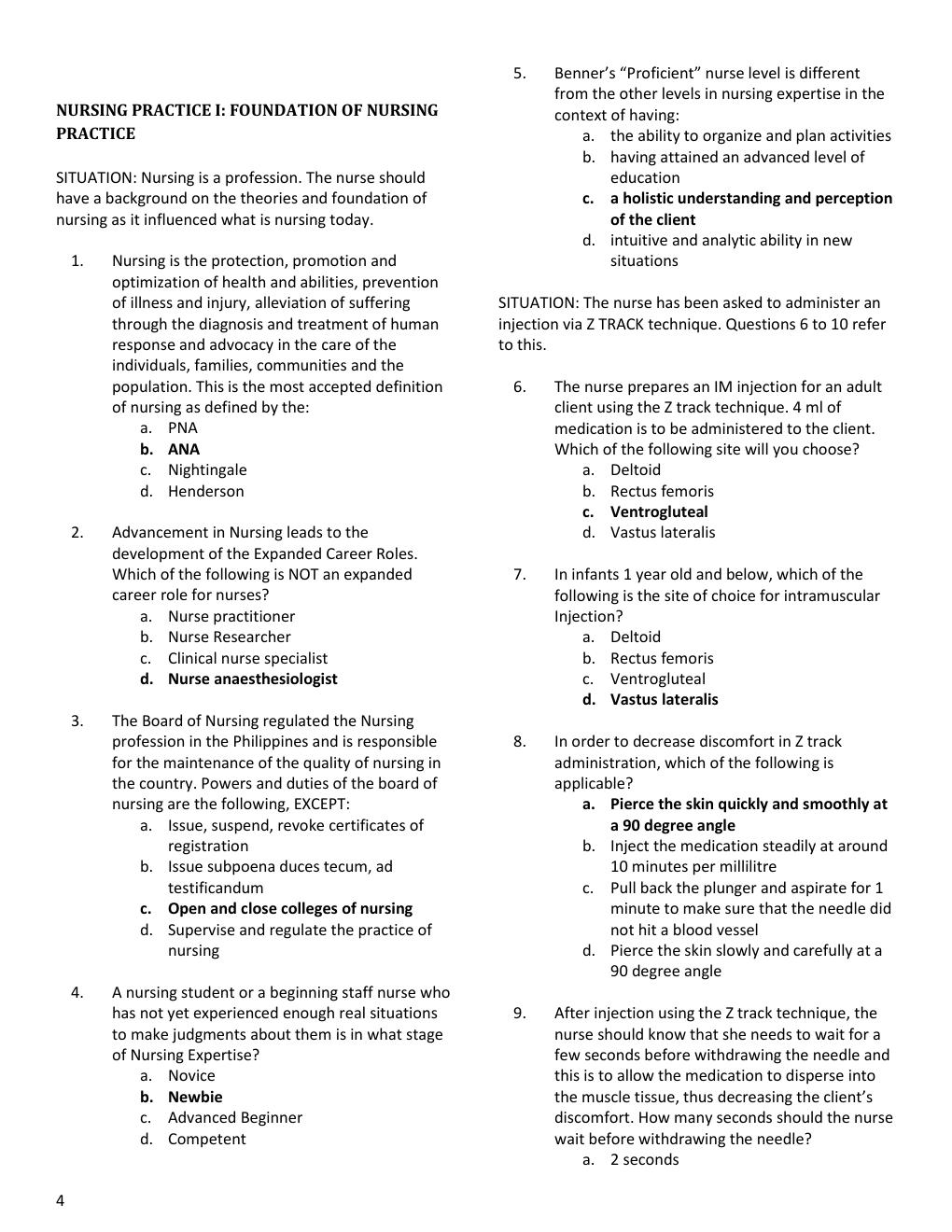
NURSING PRACTICE I: FOUNDATION OF NURSING
PRACTICE
SITUATION: Nursing is a profession. The nurse should
have a background on the theories and foundation of
nursing as it influenced what is nursing today.
1. Nursing is the protection, promotion and
optimization of health and abilities, prevention
of illness and injury, alleviation of suffering
through the diagnosis and treatment of human
response and advocacy in the care of the
individuals, families, communities and the
population. This is the most accepted definition
of nursing as defined by the:
a. PNA
b. ANA
c. Nightingale
d. Henderson
2. Advancement in Nursing leads to the
development of the Expanded Career Roles.
Which of the following is NOT an expanded
career role for nurses?
a. Nurse practitioner
b. Nurse Researcher
c. Clinical nurse specialist
d. Nurse anaesthesiologist
3.
The Board of Nursing regulated the Nursing
profession in the Philippines and is responsible
for the maintenance of the quality of nursing in
the country. Powers and duties of the board of
nursing are the following, EXCEPT:
a. Issue, suspend, revoke certificates of
registration
b. Issue subpoena duces tecum, ad
testificandum
c. Open and close colleges of nursing
d. Supervise and regulate the practice of
nursing
4. A nursing student or a beginning staff nurse who
has not yet experienced enough real situations
to make judgments about them is in what stage
of Nursing Expertise?
a. Novice
b. Newbie
c. Advanced Beginner
d. Competent
4
9.
Benner’s “Proficient” nurse level is different
from the other levels in nursing expertise in the
context of having:
a. the ability to organize and plan activities
b. having attained an advanced level of
education
c. a holistic understanding and perception
of the client
d. intuitive and analytic ability in new
situations
SITUATION: The nurse has been asked to administer an
injection via Z TRACK technique. Questions 6 to 10 refer
to this.
6.
The nurse prepares an IM injection for an adult
client using the Z track technique. 4 ml of
medication is to be administered to the client.
Which of the following site will you choose?
a. Deltoid
b. Rectus femoris
c. Ventrogluteal
d. Vastus lateralis
7.
In infants 1 year old and below, which of the
following is the site of choice for intramuscular
Injection?
a. Deltoid
b. Rectus femoris
c. Ventrogluteal
d. Vastus lateralis
8.
In order to decrease discomfort in Z track
administration, which of the following is
applicable?
a. Pierce the skin quickly and smoothly at
a 90 degree angle
b. Inject the medication steadily at around
10 minutes per millilitre
c. Pull back the plunger and aspirate for 1
minute to make sure that the needle did
not hit a blood vessel
d. Pierce the skin slowly and carefully at a
90 degree angle
After injection using the Z track technique, the
nurse should know that she needs to wait for a
few seconds before withdrawing the needle and
this is to allow the medication to disperse into
the muscle tissue, thus decreasing the client’s
discomfort. How many seconds should the nurse
wait before withdrawing the needle?
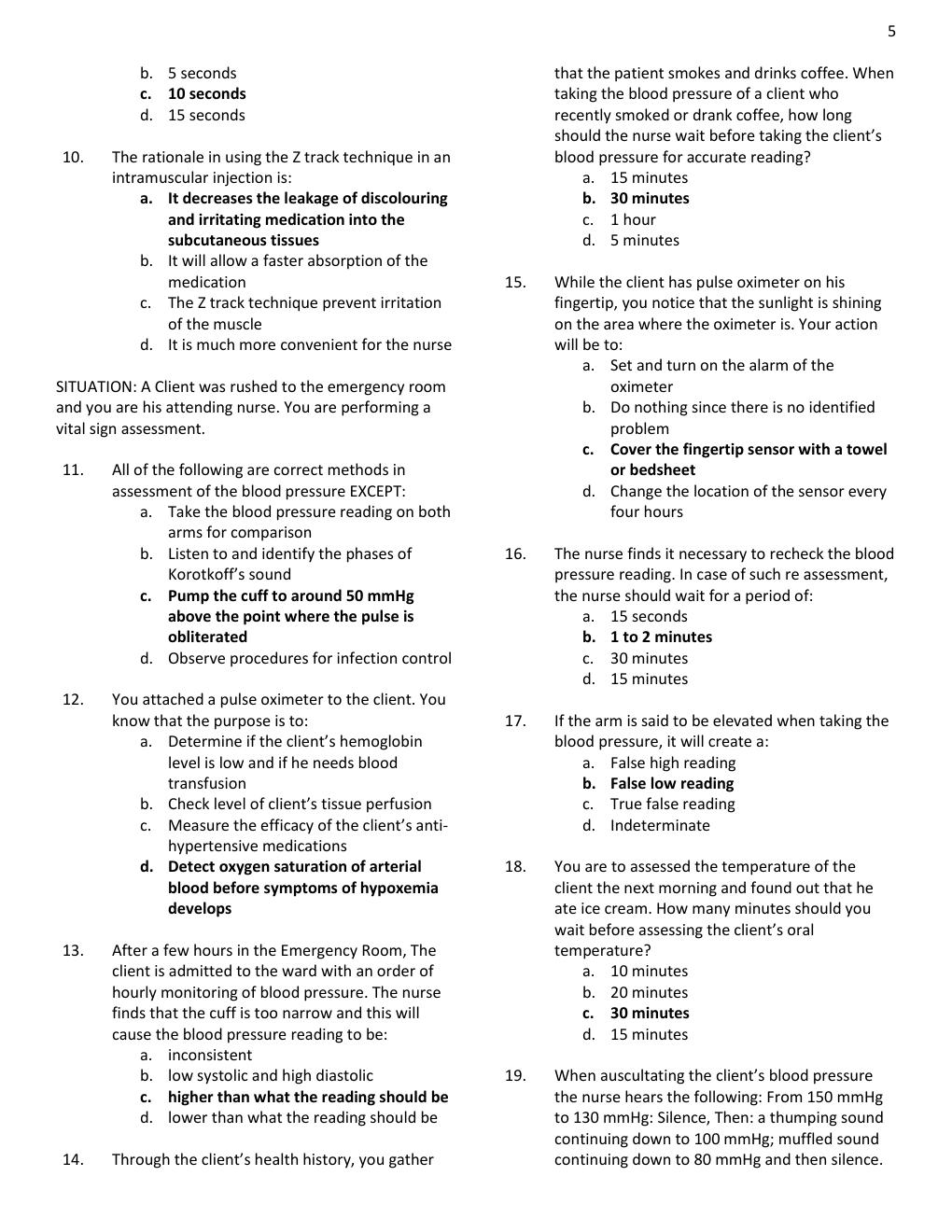
a. 2 seconds5
b. 5 seconds
c. 10 seconds
d. 15 seconds
10.
The rationale in using the Z track technique in an
intramuscular injection is:
a. It decreases the leakage of discolouring
and irritating medication into the
subcutaneous tissues
b. It will allow a faster absorption of the
medication
c. The Z track technique prevent irritation
of the muscle
d. It is much more convenient for the nurse
SITUATION: A Client was rushed to the emergency room
and you are his attending nurse. You are performing a
vital sign assessment.
11.
All of the following are correct methods in
assessment of the blood pressure EXCEPT:
a. Take the blood pressure reading on both
arms for comparison
b. Listen to and identify the phases of
Korotkoff’s sound
c. Pump the cuff to around 50 mmHg
above the point where the pulse is
obliterated
d. Observe procedures for infection control
12.
You attached a pulse oximeter to the client. You
know that the purpose is to:
a. Determine if the client’s hemoglobin
level is low and if he needs blood
transfusion
b. Check level of client’s tissue perfusion
c. Measure the efficacy of the client’s anti-
hypertensive medications
d. Detect oxygen saturation of arterial
blood before symptoms of hypoxemia
develops
13.
After a few hours in the Emergency Room, The
client is admitted to the ward with an order of
hourly monitoring of blood pressure. The nurse
finds that the cuff is too narrow and this will
cause the blood pressure reading to be:
a. inconsistent
b. low systolic and high diastolic
c. higher than what the reading should be
d. lower than what the reading should be
14.
Through the client’s health history, you gather
18.
17.
16.
that the patient smokes and drinks coffee. When
taking the blood pressure of a client who
recently smoked or drank coffee, how long
should the nurse wait before taking the client’s
blood pressure for accurate reading?
a. 15 minutes
b. 30 minutes
c. 1 hour
d. 5 minutes
15. While the client has pulse oximeter on his
fingertip, you notice that the sunlight is shining
on the area where the oximeter is. Your action
will be to:
a. Set and turn on the alarm of the
oximeter
b. Do nothing since there is no identified
problem
c. Cover the fingertip sensor with a towel
or bedsheet
d. Change the location of the sensor every
four hours
The nurse finds it necessary to recheck the blood
pressure reading. In case of such re assessment,
the nurse should wait for a period of:
a. 15 seconds
b. 1 to 2 minutes
c. 30 minutes
d. 15 minutes
If the arm is said to be elevated when taking the
blood pressure, it will create a:
a. False high reading
b. False low reading
c. True false reading
d. Indeterminate
You are to assessed the temperature of the
client the next morning and found out that he
ate ice cream. How many minutes should you
wait before assessing the client’s oral
temperature?
a. 10 minutes
b. 20 minutes
c. 30 minutes
d. 15 minutes
19. When auscultating the client’s blood pressure
the nurse hears the following: From 150 mmHg
to 130 mmHg: Silence, Then: a thumping sound
continuing down to 100 mmHg; muffled sound
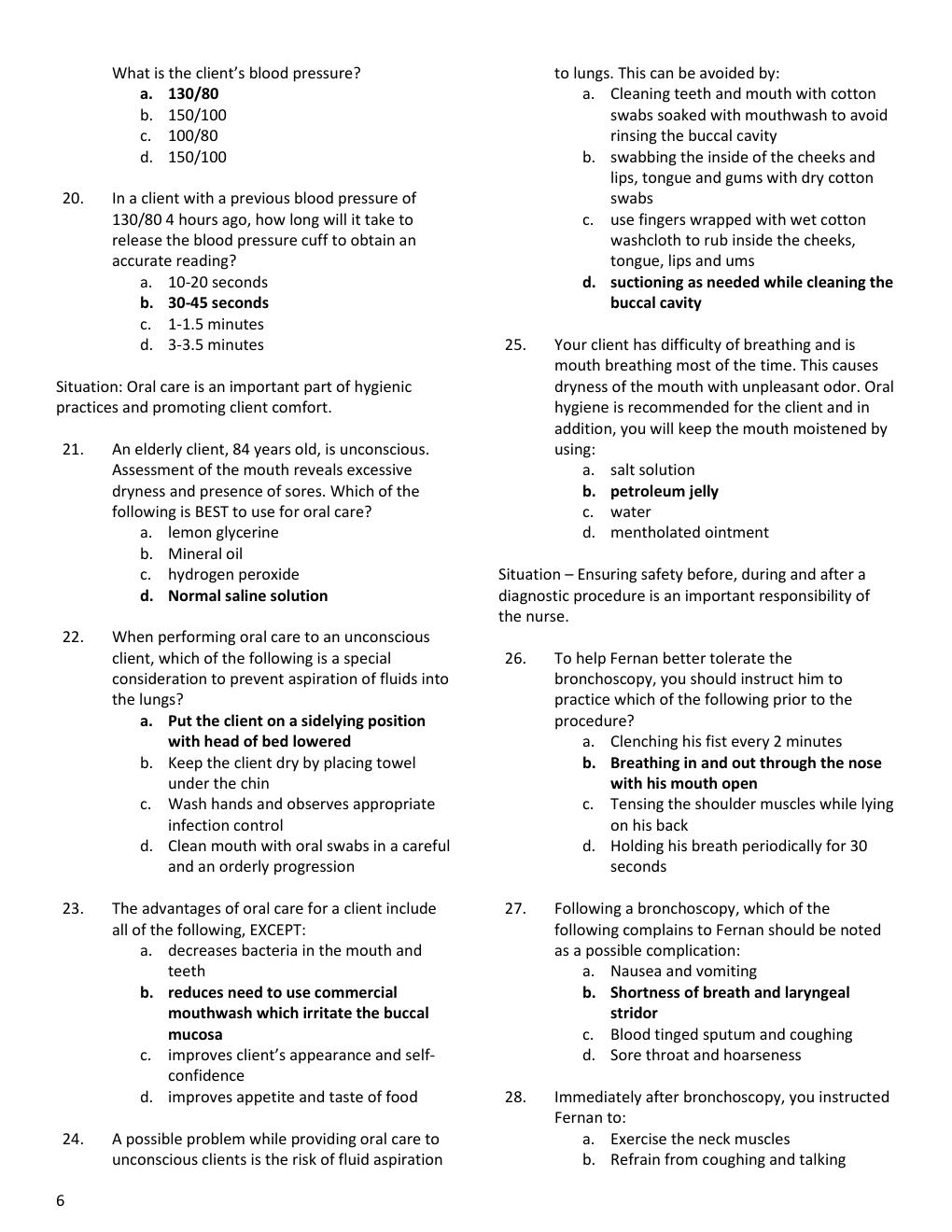
continuing down to 80 mmHg and then silence.What is the client’s blood pressure?
a. 130/80
b. 150/100
c. 100/80
d. 150/100
to lungs. This can be avoided by:
a. Cleaning teeth and mouth with cotton
swabs soaked with mouthwash to avoid
rinsing the buccal cavity
20.
In a client with a previous blood pressure of
130/80 4 hours ago, how long will it take to
release the blood pressure cuff to obtain an
accurate reading?
a. 10-20 seconds
b. 30-45 seconds
c. 1-1.5 minutes
d. 3-3.5 minutes
Situation: Oral care is an important part of hygienic
practices and promoting client comfort.
21. An elderly client, 84 years old, is unconscious.
Assessment of the mouth reveals excessive
dryness and presence of sores. Which of the
following is BEST to use for oral care?
a. lemon glycerine
b. Mineral oil
c. hydrogen peroxide
d. Normal saline solution
22. When performing oral care to an unconscious
client, which of the following is a special
consideration to prevent aspiration of fluids into
the lungs?
a. Put the client on a sidelying position
with head of bed lowered
b. Keep the client dry by placing towel
under the chin
c. Wash hands and observes appropriate
infection control
d. Clean mouth with oral swabs in a careful
and an orderly progression
23.
The advantages of oral care for a client include
all of the following, EXCEPT:
a. decreases bacteria in the mouth and
teeth
b. reduces need to use commercial
mouthwash which irritate the buccal
mucosa
c. improves client’s appearance and self-
confidence
d. improves appetite and taste of food
24. A possible problem while providing oral care to
unconscious clients is the risk of fluid aspiration
6
28.
27.
b. swabbing the inside of the cheeks and
lips, tongue and gums with dry cotton
swabs
c. use fingers wrapped with wet cotton
washcloth to rub inside the cheeks,
tongue, lips and ums
d. suctioning as needed while cleaning the
buccal cavity
25.
Your client has difficulty of breathing and is
mouth breathing most of the time. This causes
dryness of the mouth with unpleasant odor. Oral
hygiene is recommended for the client and in
addition, you will keep the mouth moistened by
using:
a. salt solution
b. petroleum jelly
c. water
d. mentholated ointment
Situation – Ensuring safety before, during and after a
diagnostic procedure is an important responsibility of
the nurse.
26.
To help Fernan better tolerate the
bronchoscopy, you should instruct him to
practice which of the following prior to the
procedure?
a. Clenching his fist every 2 minutes
b. Breathing in and out through the nose
with his mouth open
c. Tensing the shoulder muscles while lying
on his back
d. Holding his breath periodically for 30
seconds
Following a bronchoscopy, which of the
following complains to Fernan should be noted
as a possible complication:
a. Nausea and vomiting
b. Shortness of breath and laryngeal
stridor
c. Blood tinged sputum and coughing
d. Sore throat and hoarseness
Immediately after bronchoscopy, you instructed
Fernan to:
a. Exercise the neck muscles
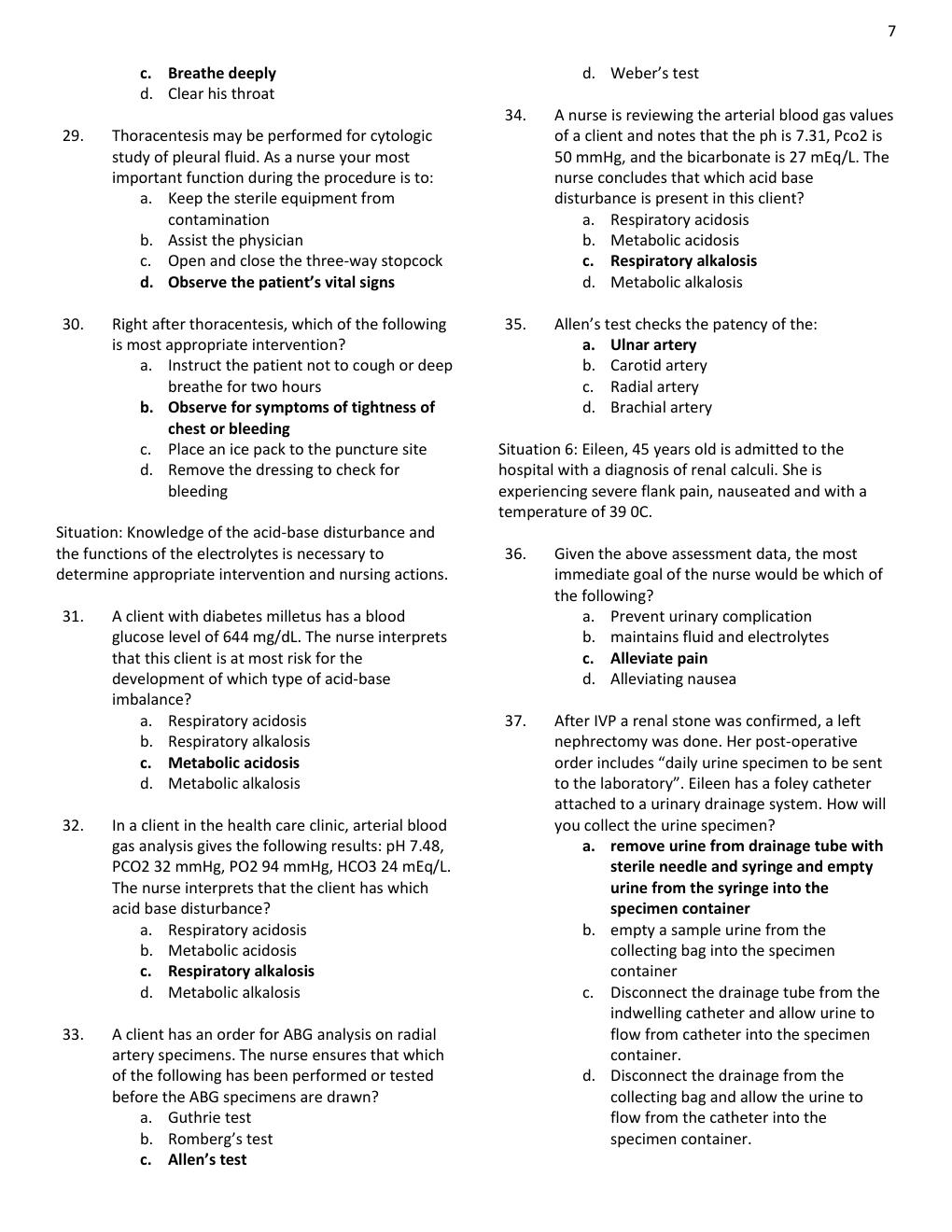
b. Refrain from coughing and talking7
c. Breathe deeply
d. Clear his throat
29.
Thoracentesis may be performed for cytologic
study of pleural fluid. As a nurse your most
important function during the procedure is to:
a. Keep the sterile equipment from
contamination
b. Assist the physician
c. Open and close the three-way stopcock
d. Observe the patient’s vital signs
30.
Right after thoracentesis, which of the following
is most appropriate intervention?
a. Instruct the patient not to cough or deep
breathe for two hours
b. Observe for symptoms of tightness of
chest or bleeding
c. Place an ice pack to the puncture site
d. Remove the dressing to check for
bleeding
Situation: Knowledge of the acid-base disturbance and
the functions of the electrolytes is necessary to
determine appropriate intervention and nursing actions.
31.
A client with diabetes milletus has a blood
glucose level of 644 mg/dL. The nurse interprets
that this client is at most risk for the
development of which type of acid-base
imbalance?
a. Respiratory acidosis
b. Respiratory alkalosis
c. Metabolic acidosis
d. Metabolic alkalosis
32.
In a client in the health care clinic, arterial blood
gas analysis gives the following results: pH 7.48,
PCO2 32 mmHg, PO2 94 mmHg, HCO3 24 mEq/L.
The nurse interprets that the client has which
acid base disturbance?
a. Respiratory acidosis
b. Metabolic acidosis
c. Respiratory alkalosis
d. Metabolic alkalosis
33.
A client has an order for ABG analysis on radial
artery specimens. The nurse ensures that which
of the following has been performed or tested
before the ABG specimens are drawn?
a. Guthrie test
b. Romberg’s test
c. Allen’s test
d. Weber’s test
34. A nurse is reviewing the arterial blood gas values
of a client and notes that the ph is 7.31, Pco2 is
50 mmHg, and the bicarbonate is 27 mEq/L. The
nurse concludes that which acid base
disturbance is present in this client?
a. Respiratory acidosis
b. Metabolic acidosis
c. Respiratory alkalosis
d. Metabolic alkalosis
35.
Allen’s test checks the patency of the:
a. Ulnar artery
b. Carotid artery
c. Radial artery
d. Brachial artery
Situation 6: Eileen, 45 years old is admitted to the
hospital with a diagnosis of renal calculi. She is
experiencing severe flank pain, nauseated and with a
temperature of 39 0C.
36.
Given the above assessment data, the most
immediate goal of the nurse would be which of
the following?
a. Prevent urinary complication
b. maintains fluid and electrolytes
c. Alleviate pain
d. Alleviating nausea
37.
After IVP a renal stone was confirmed, a left
nephrectomy was done. Her post-operative
order includes “daily urine specimen to be sent
to the laboratory”. Eileen has a foley catheter
attached to a urinary drainage system. How will
you collect the urine specimen?
a. remove urine from drainage tube with
sterile needle and syringe and empty
urine from the syringe into the
specimen container
b. empty a sample urine from the
collecting bag into the specimen
container
c. Disconnect the drainage tube from the
indwelling catheter and allow urine to
flow from catheter into the specimen
container.
d. Disconnect the drainage from the
collecting bag and allow the urine to
flow from the catheter into the
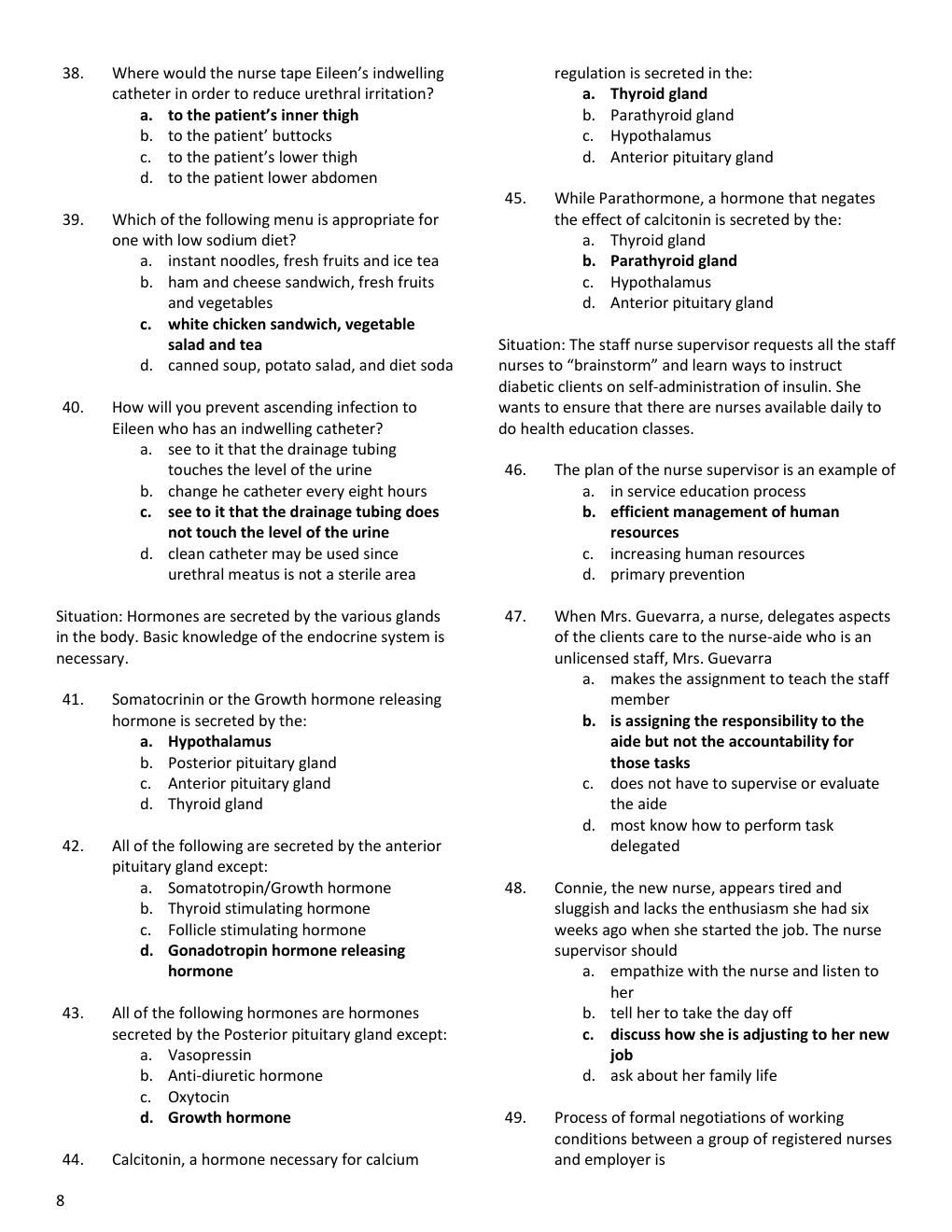
specimen container.38. Where would the nurse tape Eileen’s indwelling
catheter in order to reduce urethral irritation?
a. to the patient’s inner thigh
b. to the patient’ buttocks
c. to the patient’s lower thigh
d. to the patient lower abdomen
regulation is secreted in the:
a. Thyroid gland
b. Parathyroid gland
c. Hypothalamus
d. Anterior pituitary gland
39. Which of the following menu is appropriate for
one with low sodium diet?
a. instant noodles, fresh fruits and ice tea
b. ham and cheese sandwich, fresh fruits
and vegetables
c. white chicken sandwich, vegetable
salad and tea
d. canned soup, potato salad, and diet soda
40. How will you prevent ascending infection to
Eileen who has an indwelling catheter?
a. see to it that the drainage tubing
touches the level of the urine
b. change he catheter every eight hours
c. see to it that the drainage tubing does
not touch the level of the urine
d. clean catheter may be used since
urethral meatus is not a sterile area
Situation: Hormones are secreted by the various glands
in the body. Basic knowledge of the endocrine system is
necessary.
41.
Somatocrinin or the Growth hormone releasing
hormone is secreted by the:
a. Hypothalamus
b. Posterior pituitary gland
c. Anterior pituitary gland
d. Thyroid gland
42.
All of the following are secreted by the anterior
pituitary gland except:
a. Somatotropin/Growth hormone
b. Thyroid stimulating hormone
c. Follicle stimulating hormone
d. Gonadotropin hormone releasing
hormone
43.
All of the following hormones are hormones
secreted by the Posterior pituitary gland except:
a. Vasopressin
b. Anti-diuretic hormone
c. Oxytocin
d. Growth hormone
44.
8
Calcitonin, a hormone necessary for calcium
45. While Parathormone, a hormone that negates
the effect of calcitonin is secreted by the:
a. Thyroid gland
b. Parathyroid gland
c. Hypothalamus
d. Anterior pituitary gland
Situation: The staff nurse supervisor requests all the staff
nurses to “brainstorm” and learn ways to instruct
diabetic clients on self-administration of insulin. She
wants to ensure that there are nurses available daily to
do health education classes.
46.
The plan of the nurse supervisor is an example of
a. in service education process
b. efficient management of human
resources
c. increasing human resources
d. primary prevention
47. When Mrs. Guevarra, a nurse, delegates aspects
of the clients care to the nurse-aide who is an
unlicensed staff, Mrs. Guevarra
a. makes the assignment to teach the staff
member
b. is assigning the responsibility to the
aide but not the accountability for
those tasks
c. does not have to supervise or evaluate
the aide
d. most know how to perform task
delegated
48.
Connie, the new nurse, appears tired and
sluggish and lacks the enthusiasm she had six
weeks ago when she started the job. The nurse
supervisor should
a. empathize with the nurse and listen to
her
b. tell her to take the day off
c. discuss how she is adjusting to her new
job
d. ask about her family life
49.
Process of formal negotiations of working
conditions between a group of registered nurses
and employer is9
a. grievance
b. arbitration
c. collective bargaining
d. strike
50.
You are attending a certification on
cardiopulmonary resuscitation (CPR) offered and
required by the hospital employing you. This is
a. professional course towards credits
b. in-service education
c. advance training
d. continuing education
Situation: As a nurse, you are aware that proper
documentation in the patient chart is your responsibility.
51. Which of the following is not a legally binding
document but nevertheless very important in
the care of all patients in any health care
setting?
a. Bill of rights as provided in the Philippine
constitution
b. Scope of nursing practice as defined by
RA 9173
c. Board of nursing resolution adopting the
code of ethics
d. Patient’s bill of rights
52. A nurse gives a wrong medication to the client.
Another nurse employed by the same hospital as
a risk manager will expect to receive which of
the following communication?
a. Incident report
b. Nursing kardex
c. Oral report
d. Complain report
53.
Performing a procedure on a client in the
absence of an informed consent can lead to
which of the following charges?
a. Fraud
b. Harassment
c. Assault and battery
d. Breach of confidentiality
54. Which of the following is the essence of
informed consent?
a. It should have a durable power of
attorney
b. It should have coverage from an
insurance company
c. It should respect the client’s freedom
from coercion
d. It should disclose previous diagnosis,
prognosis and alternative treatments
available for the client
55. Delegation is the process of assigning tasks that
can be performed by a subordinate. The RN
should always be accountable and should not
lose his accountability. Which of the following is
a role included in delegation?
a. The RN must supervise all delegated
tasks
b. After a task has been delegated, it is no
longer a responsibility of the RN
c. The RN is responsible and accountable
for the delegated task in adjunct with
the delegate
d. Follow up with a delegated task is
necessary only if the assistive personnel
is not trustworthy
Situation: When creating your lesson plan for
cerebrovascular disease or STROKE. It is important to
include the risk factors of stroke.
56.
The most important risk factor is:
a. Cigarette smoking
b. binge drinking
c. Hypertension
d. heredity
57.
Part of your lesson plan is to talk about etiology
or cause of stroke. The types of stroke based on
cause are the following EXCEPT:
a. Embolic stroke
b. diabetic stroke
c. Hemorrhagic stroke
d. thrombotic stroke
58. Hemmorhagic stroke occurs suddenly usually
when the person is active. All are causes of
hemorrhage, EXCEPT:
a. phlebitis
b. damage to blood vessel
c. trauma
d. aneurysm
59.
The nurse emphasizes that intravenous drug
abuse carries a high risk of stroke. Which drug is
closely linked to this?
a. Amphetamines
b. shabu
c. Cocaine
d. Demerold. Iron 75 mg/100 ml
60. A participant in the STROKE class asks what is a
risk factor of stroke. Your best response is:
a. “More red blood cells thicken blood
and make clots more possible.”
b. “Increased RBC count is linked to high
cholesterol.”
c. “More red blood cell increases
hemoglobin content.”
d. “High RBC count increases blood
pressure.”
Situation: Recognition of normal values is vital in
assessment of clients with various disorders.
61. A nurse is reviewing the laboratory test results
for a client with a diagnosis of severe
dehydration. The nurse would expect the
hematocrit level for this client to be which of the
following?
a. 60%
b. 47%
c. 45%
d. 32%
62. A nurse is reviewing the electrolyte results of an
assigned client and notes that the potassium
level is 5.6 mEq/L. Which of the following would
the nurse expect to note on the ECG as a result
of this laboratory value?
a. ST depression
b. Prominent U wave
c. Inverted T wave
d. Tall peaked T waves
63. A nurse is reviewing the electrolyte results of an
assigned client and notes that the potassium
level is 3.2 mEq/L. Which of the following would
the nurse expect to note on the ECG as a result
of this laboratory value?
a. U waves
b. Elevated T waves
c. Absent P waves
d. Elevated ST Segment
64. Dorothy underwent diagnostic test and the
result of the blood examination are back. On
reviewing the result the nurse notices which of
the following as abnormal finding?
a. Neutrophils 60%
b. White blood cells (WBC) 9000/mm
c. Erythrocyte sedimentation rate (ESR) is
39 mm/hr
10
65. Which of the following laboratory test result
indicate presence of an infectious process?
a. Erythrocyte sedimentation rate (ESR) 12
mm/hr
b. White blood cells (WBC) 18,000/mm3
c. Iron 90 g/100ml
d. Neutrophils 67%
Situation: Pleural effusion is the accumulation of fluid in
the pleural space. Questions 66 to 70 refer to this.
66. Which of the following is a finding that the nurse
will be able to assess in a client with Pleural
effusion?
a. Reduced or absent breath sound at the
base of the lungs, dyspnea, tachpynea
and shortness of breath
b. Hypoxemia, hypercapnea and
respiratory acidosis
c. Noisy respiration, crackles, stridor and
wheezing
d. Tracheal deviation towards the affected
side, increased fremitus and loud breath
sounds
67.
Thoracentesis is performed to the client with
effusion. The nurse knows that the removal of
fluid should be slow. Rapid removal of fluid in
thoracentesis might cause:
a. Pneumothorax
b. Cardiovascular collapse
c. Pleurisy or Pleuritis
d. Hypertension
68.
3 Days after thoracentesis, the client again
exhibited respiratory distress. The nurse will
know that pleural effusion has reoccurred when
she noticed a sharp stabbing pain during
inspiration. The physician ordered a closed tube
thoracotomy for the client. The nurse knows
that the primary function of the chest tube is to:
a. Restore positive intrathoracic pressure
b. Restore negative intrathoracic pressure
c. To visualize the intrathoracic content
d. As a method of air administration via
ventilator
69.
The chest tube is functioning properly if:
a. There is an oscillation
b. There is no bubbling in the drainage
bottle11
c. There is a continuous bubbling in the
waterseal
d. The suction control bottle has a
continuous bubbling
70.
In a client with pleural effusion, the nurse is
instructing appropriate breathing technique.
Which of the following is included in the
teaching?
a. Breath normally
b. Hold the breath after each inspiration
for 1 full minute
c. Practice abdominal breathing
d. Inhale slowly and hold the breath for 3
to 5 seconds after each inhalation
SITUATION: Health care delivery system affects the
health status of every filipino. As a Nurse, Knowledge of
this system is expected to ensure quality of life.
71. When should rehabilitation commence?
a. The day before discharge
b. When the patient desires
c. Upon admission
d. 24 hours after discharge
77.
72. What exemplified the preventive and promotive
programs in the hospital?
a. Hospital as a center to prevent and
control infection
b. Program for smokers
c. Program for alcoholics and drug addicts
d. Hospital Wellness Center
73. Which makes nursing dynamic?
a. Every patient is a unique physical,
emotional, social and spiritual being
b. The patient participate in the overall
nursing care plan
c. Nursing practice is expanding in the light
of modern developments that takes
place
d. The health status of the patient is
constantly changing and the nurse must
be cognizant and responsive to these
changes
74.
Prevention is an important responsibility of the
nurse in:
a. Hospitals
b. Community
c. Workplace
d. All of the above
75.
This form of Health Insurance provides
comprehensive prepaid health services to
enrollees for a fixed periodic payment.
a. Health Maintenance Organization
b. Medicare
c. Philippine Health Insurance Act
d. Hospital Maintenance Organization
Situation: Nursing ethics is an important part of the
nursing profession. As the ethical situation arises, so is
the need to have an accurate and ethical decision
making.
76.
The purpose of having a nurses’ code of ethics is:
a. Delineate the scope and areas of nursing
practice
b. identify nursing action recommended for
specific health care situations
c. To help the public understand
professional conduct expected of
nurses
d. To define the roles and functions of the
health care givers, nurses, clients
The principles that govern right and proper
conduct of a person regarding life, biology and
the health professionals is referred to as:
a. Morality
b. Religion
c. Values
d. Bioethics
78. A subjective feeling about what is right or wrong
is said to be:
a. Morality
b. Religion
c. Values
d. Bioethics
79.
Values are said to be the enduring believe about
a worth of a person, ideas and belief. If Values
are going to be a part of a research, this is
categorized under:
a. Qualitative
b. Experimental
c. Quantitative
d. Non Experimental
80.
The most important nursing responsibility where
ethical situations emerge in patient care is to:
a. Act only when advised that the action is
ethically soundb. Not takes sides, remain neutral and fair
c. Assume that ethical questions are the
responsibility of the health team
d. Be accountable for his or her own
actions
81. Why is there an ethical dilemma?
a. the choices involved do not appear to be
clearly right or wrong
b. a client’s legal right co-exist with the
nurse’s professional obligation
c. decisions has to be made based on
societal norms.
d. decisions has to be mad quickly, often
under stressful conditions
82.
According to the code of ethics, which of the
following is the primary responsibility of the
nurse?
a. Assist towards peaceful death
b. Health is a fundamental right
c. Promotion of health, prevention of
illness, alleviation of suffering and
restoration of health
d. Preservation of health at all cost
83. Which of the following is TRUE about the Code
of Ethics of Filipino Nurses, except:
a. The Philippine Nurses Association for
being the accredited professional
organization was given the privilege to
formulate a Code of Ethics for Nurses
which the Board of Nursing
promulgated
b. Code for Nurses was first formulated in
1982 published in the Proceedings of the
Third Annual Convention of the PNA
House of Delegates
c. The present code utilized the Code of
Good Governance for the Professions in
the Philippines
d. Certificates of Registration of registered
nurses may be revoked or suspended for
violations of any provisions of the Code
of Ethics.
84.
Violation of the code of ethics might equate to
the revocation of the nursing license. Who
revokes the license?
a. PRC
b. PNA
c. DOH
d. BON
12
85.
Based on the Code of Ethics for Filipino Nurses,
what is regarded as the hallmark of nursing
responsibility and accountability?
a. Human rights of clients, regardless of
creed and gender
b. The privilege of being a registered
professional nurse
c. Health, being a fundamental right of
every individual
d. Accurate documentation of actions and
outcomes
Situation: As a profession, nursing is dynamic and its
practice is directed by various theoretical models. To
demonstrate caring behaviour, the nurse applies various
nursing models in providing quality nursing care.
86. When you clean the bedside unit and regularly
attend to the personal hygiene of the patient as
well as in washing your hands before and after a
procedure and in between patients, you indent
to facilitate the body’s reparative processes.
Which of the following nursing theory are you
applying in the above nursing action?
a. Hildegard Peplau
b. Dorothea Orem
c. Virginia Henderson
d. Florence Nightingale
87. A communication skill is one of the important
competencies expected of a nurse. Interpersonal
process is viewed as human to human
relationship. This statement is an application of
whose nursing model?
a. Joyce Travelbee
b. Martha Rogers
c. Callista Roy
d. Imogene King
88.
The statement “the health status of an individual
is constantly changing and the nurse must be
cognizant and responsive to these changes” best
explains which of the following facts about
nursing?
a. Dynamic
b. Client centred
c. Holistic
d. Art
89.
Virginia Henderson professes that the goal of
nursing is to work interdependently with other
health care working in assisting the patient to13
gain independence as quickly as possible. Which
of the following nursing actions best
demonstrates this theory in taking care of a 94
year old client with dementia who is totally
immobile?
a. Feeds the patient, brushes his teeth,
gives the sponge bath
b. Supervise the watcher in rendering
patient his morning care
c. Put the patient in semi fowler’s position,
set the over bed table so the patient can
eat by himself, brush his teeth and
sponge himself
d. Assist the patient to turn to his sides and
allow him to brush and feed himself only
when he feels ready
90.
In the self-care deficit theory by Dorothea Orem,
nursing care becomes necessary when a patient
is unable to fulfil his physiological, psychological
and social needs. A pregnant client needing
prenatal check-up is classified as:
a. Wholly compensatory
b. Supportive Educative
c. Partially compensatory
d. Non compensatory
Situation: Documentation and reporting are just as
important as providing patient care, As such, the nurse
must be factual and accurate to ensure quality
documentation and reporting.
91. Health care reports have different purposes. The
availability of patients’ record to all health team
members demonstrates which of the following
purposes:
a. Legal documentation
b. Research
c. Education
d. Vehicle for communication
92. When a nurse commits medication error, she
should accurately document client’s response
and her corresponding action. This is very
important for which of the following purposes:
a. Research
b. Legal documentation
c. Nursing Audit
d. Vehicle for communication
93.
POMR has been widely used in many teaching
hospitals. One of its unique features is SOAPIE
charting. The P in SOAPIE charting should
94.
include:
a. Prescription of the doctor to the
patient’s illness
b. Plan of care for patient
c. Patient’s perception of one’s illness
d. Nursing problem and Nursing diagnosis
The medical records that are organized into
separate section from doctors or nurses has
more disadvantages than advantages. This is
classified as what type of recording?
a. POMR
b. Modified POMR
c. SOAPIE
d. SOMR
95. Which of the following is the advantage of SOMR
or Traditional recording?
a. Increases efficiency in data gathering
b. Reinforces the use of the nursing
process
c. The caregiver can easily locate proper
section for making charting entries
d. Enhances effective communication
among health care team members
Situation: June is a 24 year old client with symptoms of
dyspnea, absent breath sounds on the right lung and
chest x ray revealed pleural effusion. The physician will
perform thoracentesis.
96.
Thoracentesis is useful in treating all of the
following pulmonary disorders except:
a. Hemothorax
b. Hydrothorax
c. Tuberculosis
d. Empyema
97. Which of the following psychological preparation
is not relevant for him?
a. Telling him that the gauge of the needle
and anesthesia to be used
b. Telling him to keep still during the
procedure to facilitate the insertion of
the needle in the correct place
c. Allow June to express his feelings and
concerns
d. Physician’s explanation on the purpose
of the procedure and how it will be done
98.
Before thoracentesis, the legal consideration you
must check is:
a. Consent is signed by the clientb. Medicine preparation is correct
c. Position of the client is correct
d. Consent is signed by relative and
physician
99. As a nurse, you know that the position for June
before thoracentesis is:
a. Orthopneic
b. Low fowlers
c. Knee-chest
d. Sidelying position on the affected side
100. Which of the following anaesthetics drug is used
for thoracentesis?
a. Procaine 2%
b. Demerol 75 mg
c. Valium 250 mg
d. Phenobartbital 50 mg
1415
D. Follicle stimulating hormone
NURSING PRACTICE II
Situation: Mariah is a 31 year old lawyer who has been
married for 6 months. She consults you for guidance in
relation with her menstrual cycle and her desire to get
pregnant.
1. She wants to know the length of her menstrual
cycle. Her previous menstrual period is October
22 to 26. Her LMB is November 21. Which of the
following number of days will be your correct
response?
A. 29
B. 28
C. 30
D. 31
2. You advised her to observe and record the signs
of Ovulation. Which of the following signs will
she likely note down?
1. A 1 degree Fahrenheit rise in basal body
temperature
2.
Cervical mucus becomes copious and
clear
3. One pound increase in weight
4. Mittelschmerz
A. 1, 2, 4
B. 1, 2, 3
C. 2, 3, 4
D. 1, 3, 4
3. You instruct Mariah to keep record of her basal
temperature every day, which of the following
instructions is incorrect?
A. If coitus has occurred; this should be
reflected in the chart
B. It is best to have coitus on the evening
following a drop in BBT to become
pregnant
C. Temperature should be taken
immediately after waking and before
getting out of bed
D. BBT is lowest during the secretory
phase
4. She reports an increase in BBT on December 16.
Which hormone brings about this change in her
BBT?
A. Estrogen
B. Gonadotropine
C. Progesterone
5. The following month, Mariah suspects she is
pregnant. Her urine is positive for Human
chorionic gonadotrophin. Which structure
produces Hcg?
A. Pituitary gland
B. Trophoblastic cells of the embryo
C. Uterine deciduas
D. Ovarian follicles
Situation: Mariah came back and she is now pregnant.
6. At 5 month gestation, which of the following
fetal development would probably be achieve?
A. Fetal movement are felt by Mariah
B. Vernix caseosa covers the entire body
C. Viable if delivered within this period
D. Braxton hicks contractions are observed
7. The nurse palpates the abdomen of Mariah.
Now At 5 month gestation, What level of the
abdomen can the fundic height be palpated?
A. Symphysis pubis
B. Midpoint between the umbilicus and the
xiphoid process
C. Midpoint between the symphysis pubis
and the umbilicus
D. Umbilicus
8. She worries about her small breasts, thinking
that she probably will not be able to breastfeed
her baby. Which of the following responses of
the nurse is correct?
A. “The size of your breast will not affect
your lactation”
B. “You can switch to bottle feeding”
C. “You can try to have exercise to increase
the size of your breast”
D. “Manual expression of milk is possible”
9. She tells the nurse that she does not take milk
regularly. She claims that she does not want to
gain too much weight during her pregnancy.
Which of the following nursing diagnosis is a
priority?
A. Potential self-esteem disturbance
related to physiologic changes in
pregnancy
B. Ineffective individual coping related to
physiologic changes in pregnancy
C. Fear related to the effects of pregnancy
D. Knowledge deficit regarding nutritionalrequirements of pregnancies related to
lack of information sources
10. Which of the following interventions will likely
ensure compliance of Mariah?
A. Incorporate her food preferences that
are adequately nutritious in her meal
plan
B. Consistently counsel toward optimum
nutritional intake
C. Respect her right to reject dietary
information if she chooses
D. Inform her of the adverse effects of
inadequate nutrition to her fetus
Situation: Susan is a patient in the clinic where you work.
She is inquiring about pregnancy.
11. Susan tells you she is worried because she
develops breasts later than most of her friends.
Breast development is termed as:
A. Adrenarche
B. Thelarche
C. Mamarche
D. Menarche
12. Kevin, Susan’s husband tells you that he is
considering vasectomy After the birth of their
new child. Vasectomy involves the incision of
which organ?
A. The testes
B. The epididymis
C. The vas deferens
D. The scrotum
13. On examination, Susan has been found of having
a cystocele. A cystocele is:
A. A sebaceous cyst arising from the vulvar
fold
B. Protrusion of intestines into the vagina
C. Prolapse of the uterus into the vagina
D. Herniation of the bladder into the
vaginal wall
14. Susan typically has menstrual cycle of 34 days.
She told you she had coitus on days 8, 10, 15 and
20 of her menstrual cycle. Which is the day on
which she is most likely to conceive?
A. 8th day
B. Day 15
C. 10th day
D. Day 20
16
15. While talking with Susan, 2 new patients arrived
and they are covered with large towels and the
nurse noticed that there are many cameraman
and news people outside of the OPD. Upon
assessment the nurse noticed that both of them
are still nude and the male client’s penis is still
inside the female client’s vagina and the male
client said that “I can’t pull it”. Vaginismus was
your first impression. You know that The
psychological cause of Vaginismus is related to:
A. The male client inserted the penis too
deeply that it stimulates vaginal closure
B. The penis was too large that is why the
vagina triggered its defense to attempt
to close it
C. The vagina does not want to be
penetrated
D. It is due to learning patterns of the
female client where she views sex as
bad or sinful
Situation: Overpopulation is one problem in the
Philippines that causes economic drain. Most Filipinos
are against in legalizing abortion. As a nurse, Mastery of
contraception is needed to contribute to the society and
economic growth.
16. Supposed that Dana, 17 years old, tells you she
wants to use fertility awareness method of
contraception. How will she determine her
fertile days?
A. She will notice that she feels hot, as if
she has an elevated temperature.
B. She should assess whether her cervical
mucus is thin, copious, clear and
watery.
C. She should monitor her emotions for
sudden anger or crying
D. She should assess whether her breasts
feel sensitive to cool air
17. Dana chooses to use COC as her family planning
method. What is the danger sign of COC you
would ask her to report?
A. A stuffy or runny nose
B. Slight weight gain
C. Arthritis like symptoms
D. Migraine headache
18. Dana asks about subcutaneous implants and she
asks, how long will these implants be effective.
Your best answer is:
A. One month17
B. Five years
C. Twelve months
D. 10 years
19. Dana asks about female condoms. Which of the
following is true with regards to female
condoms?
A. The hormone the condom releases
might cause mild weight gain
B. She should insert the condom before
any penile penetration
C. She should coat the condom with
spermicide before use
D. Female condoms, unlike male condoms,
are reusable
20. Dana has asked about GIFT procedure. What
makes her a good candidate for GIFT?
A. She has patent fallopian tubes, so
fertilized ova can be implanted on them
B. She is RH negative, a necessary
stipulation to rule out RH incompatibility
C. She has normal uterus, so the sperm can
be injected through the cervix into it
D. Her husband is taking sildenafil, so all
sperms will be motile
Situation: Nurse Lorena is a Family Planning and
Infertility Nurse Specialist and currently attends to
FAMILY PLANNING CLIENTS AND INFERTILE COUPLES.
The following conditions pertain to meeting the nursing
needs of this particular population group.
21. Dina, 17 years old, asks you how a tubal ligation
prevents pregnancy. Which would be the best
answer?
A. Prostaglandins released from the cut
fallopian tubes can kill sperm
B. Sperm cannot enter the uterus because
the cervical entrance is blocked.
C. Sperm can no longer reach the ova,
because the fallopian tubes are blocked
D. The ovary no longer releases ova as
there is nowhere for them to go.
22. The Dators are a couple undergoing testing for
infertility. Infertility is said to exist when:
A. A woman has no uterus
B. A woman has no children
C. A couple has been trying to conceive for
1 year
D. A couple has wanted a child for 6
months
23. Another client named Lilia is diagnosed as having
endometriosis. This condition interferes with
fertility because:
A. Endometrial implants can block the
fallopian tubes
B. The uterine cervix becomes inflamed
and swollen
C. The ovaries stop producing adequate
estrogen
D. Pressure on the pituitary leads to
decreased FSH levels
24. Lilia is scheduled to have a
hysterosalphingogram. Which of the following
instructions would you give her regarding this
procedure?
A. She will not be able to conceive for 3
months after the procedure
B. The sonogram of the uterus will reveal
any tumors present
C. Many women experience mild bleeding
as an after effect
D. She may feel some cramping when the
dye is inserted
25. Lilia’s cousin on the other hand, knowing nurse
Lorena’s specialization asks what artificial
insemination by donor entails. Which would be
your best answer if you were Nurse Lorena?
A. Donor sperm are introduced vaginally
into the uterus or cervix
B. Donor sperm are injected intra-
abdominally into each ovary
C. Artificial sperm are injected vaginally to
test tubal patency
D. The husband’s sperm is administered
intravenously weekly
Situation: You are assigned to take care of a group of
patients across the lifespan.
26. Pain in the elder persons requires careful
assessment because they:
A. experienced reduce sensory perception
B. have increased sensory perception
C. are expected to experience chronic pain
D. have a decreased pain threshold
27. Administration of analgesics to the older persons
requires careful patient assessment because
older people:
A. are more sensitive to drugsB. have increased hepatic, renal and
gastrointestinal function
D. Chronic poverty
C. have increased sensory perception
D. mobilize drugs more rapidly
28. The elderly patient is at higher risk for urinary
incontinence because of:
A. increased glomerular filtration
B. decreased bladder capacity
C. diuretic use
D. dilated urethra
29. Which of the following is the MOST COMMON
sign of infection among the elderly?
A. decreased breath sounds with crackles
B. pain
C. fever
D. change in mental status
30. Priorities when caring for the elderly trauma
patient:
A. circulation, airway, breathing
B. airway, breathing, disability (neurologic)
C. disability (neurologic), airway, breathing
D. airway, breathing, circulation
31. Preschoolers are able to see things from which
of the following perspectives?
A. Their peers
B. Their own and their mother’s
C. Their own and their caregivers’
D. Only their own
32. In conflict management, the win-win approach
occurs when:
A. There are two conflicts and the parties
agree to each one
B. Each party gives in on 50% of the
disagreements making up the conflict
C. Both parties involved are committed to
solving the conflict
D. The conflict is settled out of court so the
legal system and the parties win
33. According to the social-interactional perspective
of child abuse and neglect, four factors place the
family members at risk for abuse. These risk
factors are the family members at risk for abuse.
These risk factors are the family itself, the
caregiver, the child, and
A. The presence of a family crisis
B. The national emphasis on sex
C. Genetics
18
34. Which of the following signs and symptoms
would you most likely find when assessing and
infant with Arnold-Chiari malformation?
A. Weakness of the leg muscles, loss of
sensation in the legs, and restlessness
B. Difficulty swallowing, diminished or
absent gag reflex, and respiratory
distress
C. Difficulty sleeping, hypervigilant, and an
arching of the back
D. Paradoxical irritability, diarrhea, and
vomiting.
35. A parent calls you and frantically reports that her
child has gotten into her famous ferrous sulfate
pills and ingested a number of these pills. Her
child is now vomiting, has bloody diarrhea, and is
complaining of abdominal pain. You will tell the
mother to:
A. Call emergency medical services (EMS)
and get the child to the emergency room
B. Relax because these symptoms will pass
and the child will be fine
C. Administer syrup of ipecac
D. Call the poison control center
36. A client says she heard from a friend that you
stop having periods once you are on the “pill”.
The most appropriate response would be:
A. “The pill prevents the uterus from
making such endometrial lining, that is
why periods may often be scant or
skipped occasionally.”
B. “If your friend has missed her period,
she should stop taking the pills and get a
pregnancy test as soon as possible.”
C. “The pill should cause a normal
menstrual period every month. It
sounds like your friend has not been
taking the pills properly.”
D. “Missed period can be very dangerous
and may lead to the formation of
precancerous cells.”
37. The nurse assessing newborn babies and infants
during their hospital stay after birth will notice
which of the following symptoms as a primary
manifestation of Hirschsprung’s disease?
A. A fine rash over the trunk
B. Failure to pass meconium during the
first 24 to 48 hours after birth19
C. The skin turns yellow and then brown
over the first 48 hours of life
D. High-grade fever
38. A client is 7 months pregnant and has just been
diagnosed as having a partial placenta previa.
She is stable and has minimal spotting and is
being sent home. Which of these instructions to
the client may indicate a need for further
teaching?
A. Maintain bed rest with bathroom
privileges
B. Avoid intercourse for three days.
C. Call if contractions occur.
D. Stay on left side as much as possible
when lying down.
39. A woman has been rushed to the hospital with
ruptured membrane. Which of the following
should the nurse check first?
A. Check for the presence of infection
B. Assess for Prolapse of the umbilical
cord
C. Check the maternal heart rate
D. Assess the color of the amniotic fluid
40. The nurse notes that the infant is wearing a
plastic-coated diaper. If a topical medication
were to be prescribed and it were to go on the
stomachs or buttocks, the nurse would teach the
caregivers to:
A. avoid covering the area of the topical
medication with the diaper
B. avoid the use of clothing on top of the
diaper
C. put the diaper on as usual
D. apply an icepack for 5 minutes to the
outside of the diaper
41. Which of the following factors is most important
in determining the success of relationships used
in delivering nursing care?
A. Type of illness of the client
B. Transference and counter transference
C. Effective communication
D. Personality of the participants
42. Grace sustained a laceration on her leg from
automobile accident. Why are lacerations of
lower extremities potentially more serious
among pregnant women than other?
A. lacerations can provoke allergic
responses due to gonadotropic hormone
release
B. a woman is less able to keep the
laceration clean because of her fatigue
C. healing is limited during pregnancy so
these will not heal until after birth
D. increased bleeding can occur from
uterine pressure on leg veins
43. In working with the caregivers of a client with an
acute or chronic illness, the nurse would:
A. Teach care daily and let the caregivers
do a return demonstration just before
discharge
B. Difficulty swallowing, diminished or
absent gag reflex, and respiratory
distress.
C. Difficulty sleeping, hypervigilant, and an
arching of the back
D. Paradoxical irritability, diarrhea, and
vomiting
44. Which of the following roles BEST exemplifies
the expanded role of the nurse?
A. Circulating nurse in surgery
B. Medication nurse
C. Obstetrical nurse
D. Pediatric nurse practitioner
45. According to DeRosa and Kochura’s (2006)
article entitled “Implement Culturally Competent
Health Care in your work place,” cultures have
different patterns of verbal and nonverbal
communication. Which difference does?
A. NOT necessarily belong?
B. Personal behavior
C. Subject matter
D. Eye contact
E. Conversational style
46. You are the nurse assigned to work with a child
with acute glomerulonephritis. By following the
prescribed treatment regimen, the child
experiences a remission. You are now checking
to make sure the child does not have a relapse.
Which finding would most lead you to the
conclusion that a relapse is happening?
A. Elevated temperature, cough, sore
throat, changing complete blood count
(CBC) with diiferential
B. A urine dipstick measurement of 2+
proteinuria or more for 3 days, or the
child found to have 3-4+ proteinutria
plus edema.C. The urine dipstick showing glucose in the
urine for 3 days, extreme thirst, increase
in urine output, and a moon face.
D. A temperature of 37.8 degrees (100
degrees F), flank pain, burning
frequency, urgency on voiding, and
cloudy urine.
47. The nurse is working with an adolescent who
complains of being lonely and having a lack of
fulfillment in her life. This adolescent shies away
from intimate relationships at times yet at other
times she appears promiscuous. The nurse will
likely work with this adolescent in which of the
following areas?
A. Isolation
B. Lack of fulfillment
C. Loneliness
D. Identity
48. The use of interpersonal decision making,
psychomotor skills, and application of
knowledge expected in the role of a licensed
health care professional in the context of public
health welfare and safety is an example of:
A. Delegation
B. Responsibility
C. Supervision
D. Competence
49. The painful phenomenon known as “back labor”
occurs in a client whose fetus in what position?
A. Brow position
B. Breech position
C. Right Occipito-Anterior Position
D. Left Occipito-Posterior Position
50. FOCUS methodology stands for:
A. Focus, Organize, Clarify, Understand
and Solution
B. Focus, Opportunity, Continuous, Utilize,
Substantiate
C. Focus, Organize, Clarify, Understand,
Substantiate
D. Focus, Opportunity, Continuous
(process), Understand, Solution
SITUATION: The infant and child mortality rate in the low
to middle income countries is ten times higher than
industrialized countries. In response to this, the WHO
and UNICEF launched the protocol Integrated
Management of Childhood Illnesses to reduce the
morbidity and mortality against childhood illnesses.
20
51. If a child with diarrhea registers two signs in the
yellow row in the IMCI chart, we can classify the
patient as:
A. Moderate dehydration
B. Severe dehydration
C. Some dehydration
D. No dehydration
52. Celeste has had diarrhea for 8 days. There is no
blood in the stool, he is irritable, his eyes are
sunken, the nurse offers fluid to Celeste and he
drinks eagerly. When the nurse pinched the
abdomen it goes back slowly. How will you
classify Celeste’s illness?
A. Moderate dehydration
B. Severe dehydration
C. Some dehydration
D. No dehydration
53. A child who is 7 weeks has had diarrhea for 14
days but has no sign of dehydration is classified
as:
A. Persistent diarrhea
B. Dysentery
C. Severe dysentery
D. Severe persistent diarrhea
54. The child with no dehydration needs home
treatment. Which of the following is not
included in the rules for home treatment in this
case?
A. Forced fluids
B. When to return
C. Give vitamin A supplement
D. Feeding more
55. Fever as used in IMCI includes:
A. Axillary temperature of 37.5 or higher
B. Rectal temperature of 38 or higher
C. Feeling hot to touch
D. All of the above
E. A and C only
Situation: Prevention of Dengue is an important nursing
responsibility and controlling it’s spread is a priority once
outbreak has been observed.
56. An important role of the community health
nurse in the prevention and control of Dengue
H-fever includes:
A. Advising the elimination of vectors by
keeping water containers covered21
B. Conducting strong health education drives/campaign directed towards proper garbage disposal
C. Explaining to the individuals, families, groups and community the nature of the disease and its causation
D. Practicing residual spraying with insecticides
57. Community health nurses should be alert in observing a Dengue suspect. The following is NOT an indicator for hospitalization of H-fever suspects? A. Marked anorexia, abdominal pain and vomiting
B. Increasing hematocrit count C. Cough of 30 days D. Persistent headache
58. The community health nurses’ primary concern in the immediate control of hemorrhage among patients with dengue is: A. Advising low fiber and non-fat diet B. Providing warmth through light weight covers
C. Observing closely the patient for vital signs leading to shock
D. Keeping the patient at rest
59. Which of these signs may NOT be REGARDED as a truly positive signs indicative of Dengue Hfever? A. Prolonged bleeding time B. Appearance of at least 20 petechiae within 1cm square
C. Steadily increasing hematocrit count D. Fall in the platelet count
60. Which of the following is the most important treatment of patients with Dengue H-fever? A. Give aspirin for fever B. Replacement of body fluids C. Avoid unnecessary movement of patient D. Ice cap over the abdomen in case of melena
Situation: Health education and Health promotion is an important part of nursing responsibility in the community. Immunization is a form of health promotion that aims at preventing the common childhood illnesses.
61. In correcting misconceptions and myths about certain diseases and their management, the
health worker should first: A. Identify the myths and misconceptions prevailing in the community
B. Identify the source of these myths and misconceptions
C. Explain how and why these myths came about
D. Select the appropriate IEC strategies to
[Show More]